
Choosing the wrong protective garment can create unnecessary risks in healthcare, laboratories, and industrial environments. Disposable coveralls and isolation gowns are often compared because they may look similar, but they are designed for different protection requirements.
The main difference is not simply the material or appearance. It is the level of coverage, barrier performance, and the type of exposure each garment is designed to handle.
This guide explains the key differences between disposable coveralls and isolation gowns , helping you choose the right PPE for your workplace.
Disposable Coverall vs Isolation Gown: What’s the Real Difference?
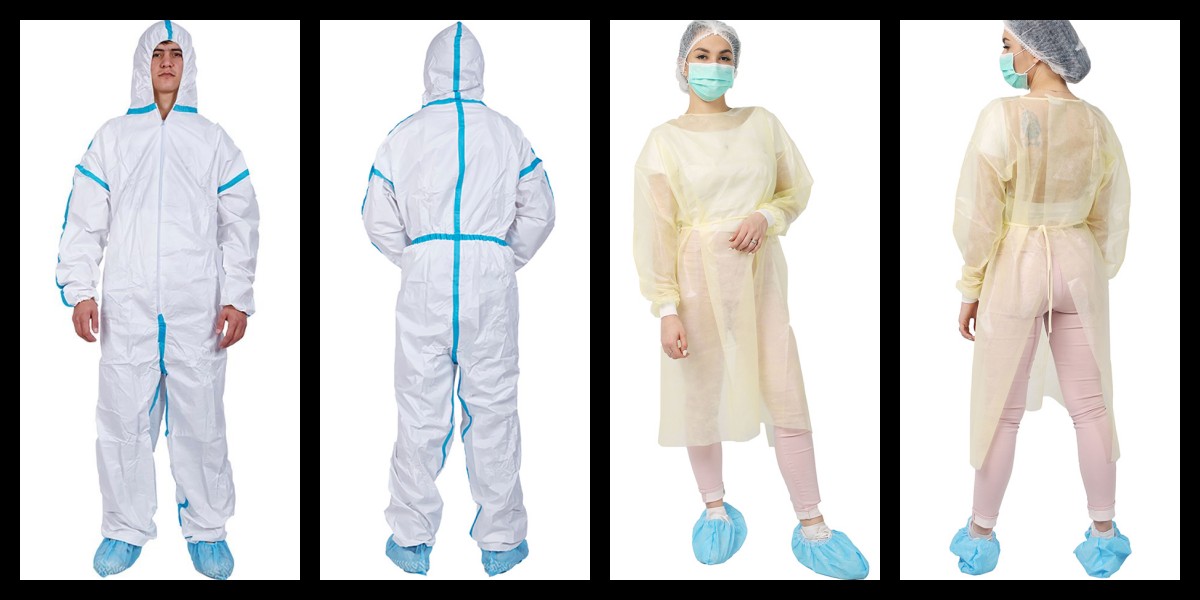
The core difference comes down to one thing: how much of your body is covered.
An isolation gown wraps around the front of your body and arms. It ties at the neck and waist. The back stays open. That design works well for routine patient care — droplet precautions, splash protection, standard contact situations. Clinicians can move fast and doff quickly.
A disposable coverall is a different category of garment. It seals the torso, arms, and legs into one enclosed suit. Most designs include an integrated hood. Some add boot covers. The back is not open. Nothing is open.
That gap — the back, the legs, the lower body — is where isolation gowns fall short in higher-risk situations.
Coverage, Materials, and Protection Level
The material difference follows the protection difference.
Isolation gowns use SMS nonwoven fabric or Polyethylene-coated material. They resist splashes and sprays well enough for most routine clinical settings. They are not built for full-body enclosure.
Disposable coveralls use microporous fabrics, Tyvek, or laminated composites. These materials are chosen for more complete liquid and airborne particle resistance. Contamination risk can spread beyond the front of the body. The material has to match that reality.
The Substitution Rule You Need to Know
A coverall is not a better isolation gown. It is a different product built for a different exposure scenario.
For routine droplet and contact precautions, an isolation gown is the right call. It’s lighter. More breathable. Faster to put on and take off. You’ll find it much easier to work in during long shifts.
But contamination risk doesn’t always stay at the front of the body. It can reach the legs, the back, or come from a high-risk pathogen — SARS, Ebola, MERS. At that point, an isolation gown’s open back is no longer enough. A full-body PPE coverall becomes the correct and necessary choice.
Comparison Table: Disposable Coverall vs Isolation Gown
Here’s a quick breakdown of where the two products diverge:
|
Comparison |
Isolation Gown |
Disposable Coverall |
|---|---|---|
|
Body Coverage |
Front body and arms; back usually open |
Full-body coverage including torso, arms, and legs |
|
Main Protection |
Splash, spray, and contact exposure |
Higher-risk liquid, particle, and contamination exposure |
|
Common Materials |
SMS nonwoven, PE-coated materials |
Microporous film laminate, Tyvek , laminated composites |
|
Typical Applications |
Hospitals, clinics, routine patient care |
Infectious disease control, laboratories, industrial protection, cleanrooms |
|
Donning & Doffing |
Faster and easier for frequent changes |
Requires more careful donning and doffing procedures |
|
Comfort |
More breathable for long shifts |
Higher heat load due to greater coverage |
|
Cost |
Lower cost for high-volume daily use |
Higher cost due to increased protection requirements |
|
Standards |
AAMI PB70 for medical isolation gowns |
EN 13034 , EN ISO 13982-1, ASTM F1670/F1671 depending on application |
Disposable Coverall vs Isolation Gown: Which One Should You Choose?
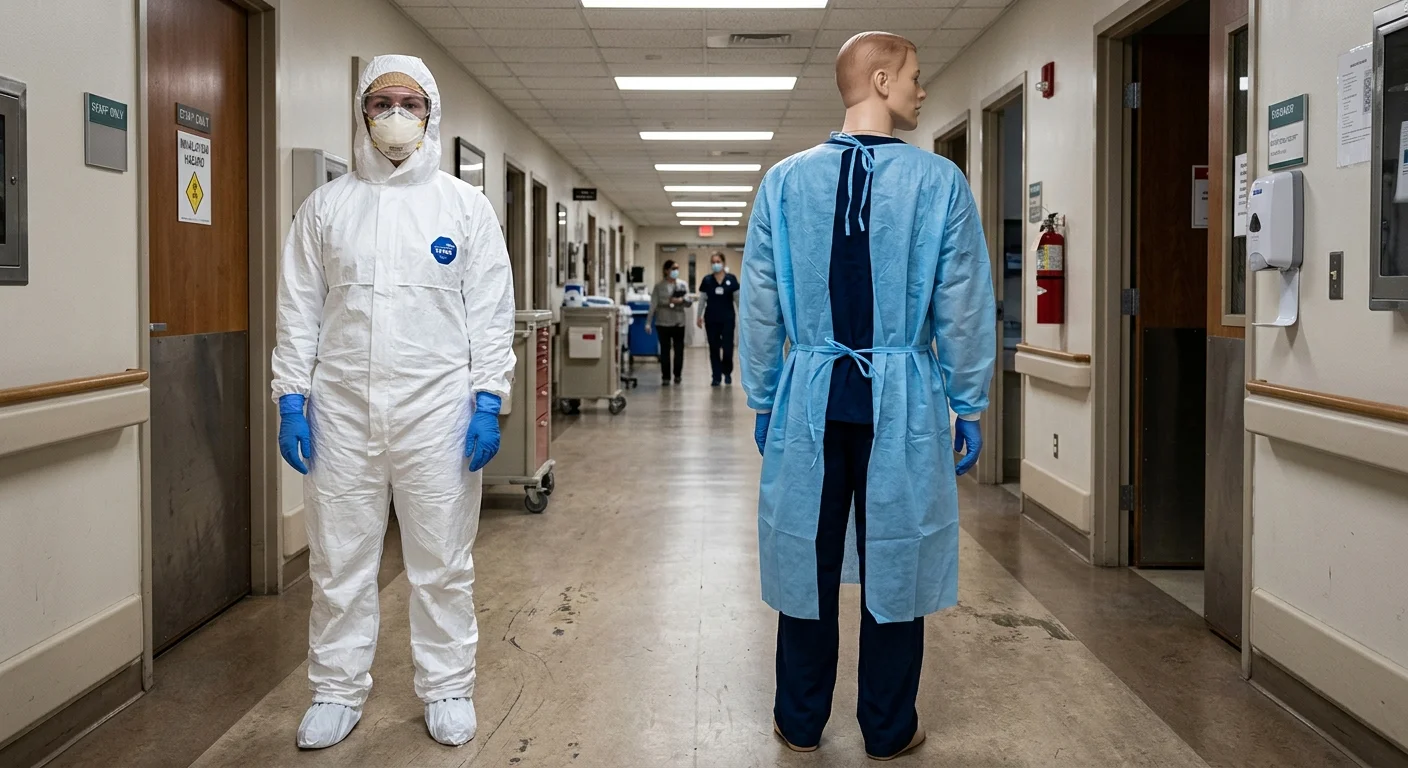
The wrong answer here doesn’t show up in an audit. It shows up in an infection report.
Picking between a disposable coverall and an isolation gown isn’t about price or preference. It’s about matching the garment’s protection level to the exposure in front of you. Get that match right, and your PPE does its job. Get it wrong, and the product gives people a false sense of security.
Here’s how to think through it.
Start With the Hazard, Not the Product
Before you pull up any spec sheet, define what you’re protecting against.
Low to moderate fluid exposure — splashes, sprays, routine contact risk — is where isolation gowns perform well. AAMI PB70 Level 1 through 3 covers most of these situations. Think standard contact precautions, bedside care, medication administration, and routine ward procedures. The gown’s front-body barrier handles all of it. You don’t need more coverage than the risk demands.
High fluid exposure is a different story. Heavy bleeding. Vomiting. Profuse diarrhea. Aerosol-generating procedures — intubation, bronchoscopy, emergency resuscitation. In these cases, contamination doesn’t stay at the front of the body. It spreads. A garment with an open back and no leg coverage falls short. That’s not a flaw in isolation gowns. It’s just the boundary of what they were built to handle.
The Clinical Decision, Step by Step
Use this framework before your next procurement decision:
Choose an isolation gown when: – Transmission risk is contact or droplet-based — MRSA, VRE, influenza, general COVID-19 ward care without high aerosol procedures – Fluid exposure is AAMI Level 2–3 at most — moderate splashes, no continuous spray – Staff need fast donning and doffing across high-frequency patient encounters – Front-of-body barrier is sufficient for the task
Choose a disposable coverall when: – You’re dealing with Category A or high-risk infectious diseases — Ebola , SARS, MERS, or any pathogen managed at that level – Aerosol-generating procedures are taking place near a high-risk infectious patient – Contamination will include heavy fluids, excreta, or spray reaching the legs, back, or lower body – Your facility follows ISO, GMP, or cleanroom protocols that require full personnel enclosure – The priority is maximum viral barrier and minimum HAI transmission risk — cost comes second
A Practical Checklist
All of the following true? An isolation gown is the right call:
– Fluid exposure: low to moderate
– Transmission mode: contact or droplet
– Task: short to moderate duration, frequent garment changes
– Coverage need: front-of-body protection
– Staff: mixed training levels, high-volume environment
Any single one of the following true? Reach for a disposable PPE coverall instead:
– Category A or equivalent infectious disease involvement
– Heavy fluid or spray exposure expected
– Aerosol-generating procedure in a high-risk patient setting
– Full-body enclosure required by facility or regulatory protocol
– Maximum barrier performance is non-negotiable
One More Consideration: Compliance vs. Comfort
Coveralls — Microporous and Tyvek constructions in particular — are less breathable than SMS isolation gowns. They raise heat load. They also take longer to put on and remove the right way. That’s not a reason to skip them when the situation calls for full coverage. But it does mean your staff needs solid training in full PPE gowning protocol — stepwise doffing without self-contamination is a real skill, not a quick briefing.
A well-worn isolation gown beats a coverall put on wrong, every time. The best protective garment is the one your staff will use correctly.
The bottom line is straightforward: isolation gowns for routine, broad-scope protection in standard clinical settings; disposable coveralls for high-risk, high-fluid, or infectious environments where full-body enclosure is the only responsible choice.
Disposable Coverall vs Isolation Gown: Common Questions Answered
These questions come up all the time — in procurement meetings, infection control reviews, and safety briefings. Here are the ones that matter most, with straight answers.
Q: Can a disposable coverall replace an isolation gown?
For routine patient care, no — and that’s not a downgrade. Isolation gowns are built for frequent, fast interactions. You put them on in seconds, take them off without help, and move through a ward without overheating. In that context, a coverall is the wrong tool.
Flip the scenario, though. Category A infectious disease. Heavy fluid exposure. Aerosol-generating procedures near a high-risk patient. Now an isolation gown’s open back is a real problem — not an acceptable one. A coverall isn’t optional at that point. It’s the only choice you can defend.
Q: Does a standard isolation gown protect against airborne particles?
No. Isolation gowns handle liquid splash and spray. They don’t seal around the wearer. Airborne particulates — biohazard aerosols, silica dust, chemical vapors — need a garment that closes off every exposure point. That means a microporous or Tyvek coverall. Look for an integrated hood, taped seams, and a storm flap closure.
Q: When does CDC guidance recommend coveralls over gowns?
For suspected or confirmed COVID-19 patients with no aerosol-generating procedures involved, a standard non- sterile isolation gown works. CDC lists coveralls as a valid alternative for transporting suspected COVID-19 patients. For confirmed Ebola cases — or unstable patients with active bleeding, vomiting, or diarrhea — guidance moves to impermeable gowns or coveralls. Standard SMS isolation gowns are not sufficient there.
Q: How do I know which protection level I need?
Run through three questions before you look at a spec sheet:
-
What’s the contamination type?
-
Low-to-moderate liquid only → AAMI Level 2–3 isolation gown
-
High-volume liquid plus pathogen risk → AAMI Level 4 equivalent impermeable gown or coverall
-
Particulate plus aerosol risk → microporous or Tyvek coverall with hood and boots
-
-
How much coverage do you need?
-
Front torso and arms → isolation gown
-
Full 360° enclosure including legs, head, and feet → coverall
-
-
How long is the task?
-
Short, high-frequency room entries → isolation gown for fast don/doff
-
Extended procedures, patient transport, decontamination work → coverall for full continuous coverage
-
One answer pointing toward full-body exposure is enough. Don’t scale the risk down just to justify the easier garment.
Conclusion
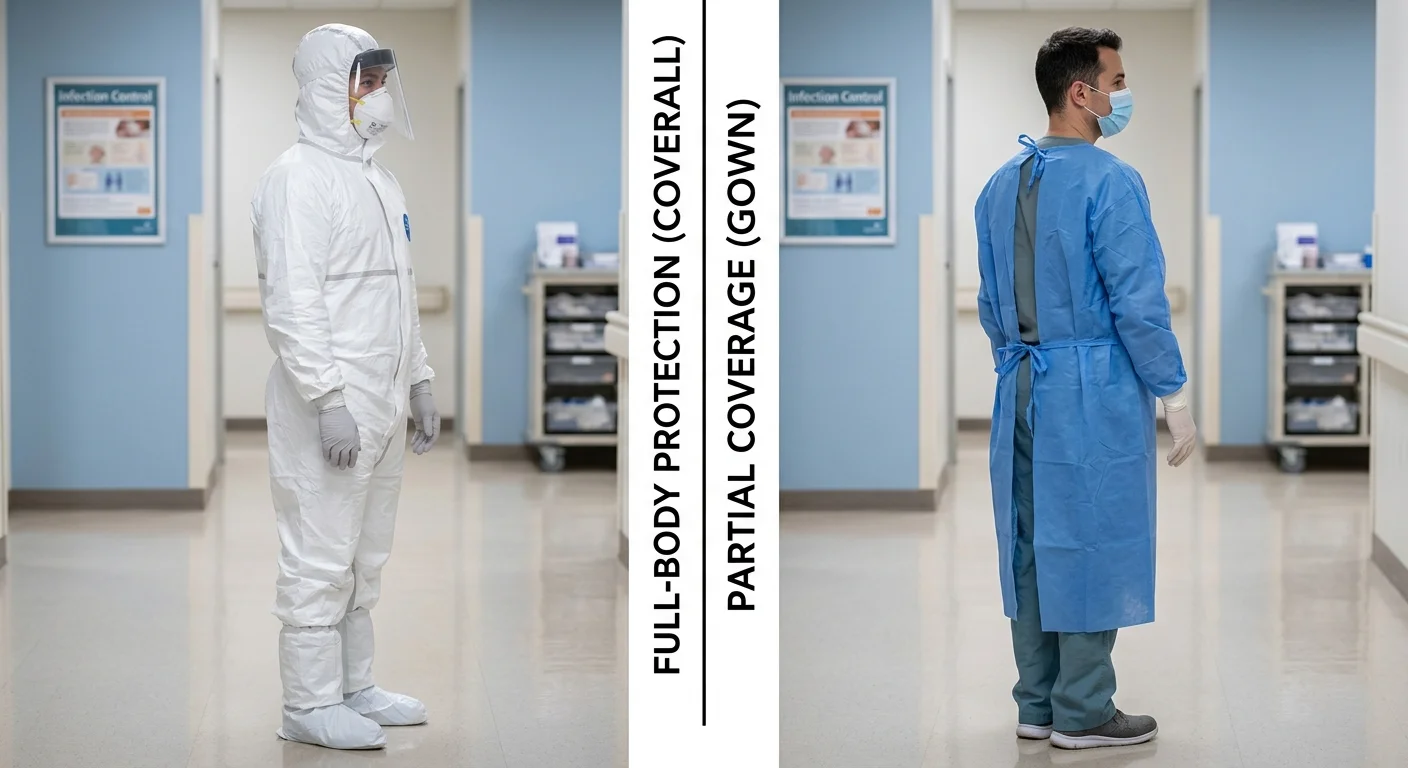
Disposable coveralls and isolation gowns serve different purposes.
Isolation gowns provide practical protection for routine environments where comfort, mobility, and frequent replacement are important.
Disposable coveralls provide broader coverage and stronger barrier performance for situations involving higher contamination risks or more demanding protection requirements.
The right choice is not about selecting the most protective garment. It is about selecting the garment that matches the actual hazard.
Morntrip provides disposable coveralls and protective clothing solutions for healthcare, laboratory, industrial, and cleanroom applications. Contact us for product specifications and sample requests.





