
Sourcing the right food processing coverall supplier is not only a workwear purchasing decision. For food factories, PPE distributors, uniform brands, and OEM buyers, the right garment can support hygiene control, reduce foreign body risks, improve audit readiness, and help workers follow food safety procedures more consistently.
Poland has several relevant workwear manufacturers, HACCP clothing suppliers, textile service providers, and OEM-capable garment partners. However, buyers should be careful with one important point: not every company in the Polish market is a direct manufacturer of food processing coveralls, and not every supplier offers OEM services.
This guide reviews 8 food processing coverall manufacturers and suppliers in Poland, including Poland-based workwear producers, HACCP workwear suppliers, and textile service providers. It also explains HACCP and DIN 10524 workwear considerations, reusable vs disposable coveralls, OEM services, sourcing documents, and how Poland suppliers compare with China PPE manufacturers for bulk and private label orders.
Note: This guide includes Poland-based workwear manufacturers, HACCP clothing suppliers, food industry workwear suppliers, rental-service providers, and OEM-capable garment partners. Not every company listed is a direct manufacturer of food processing coveralls.
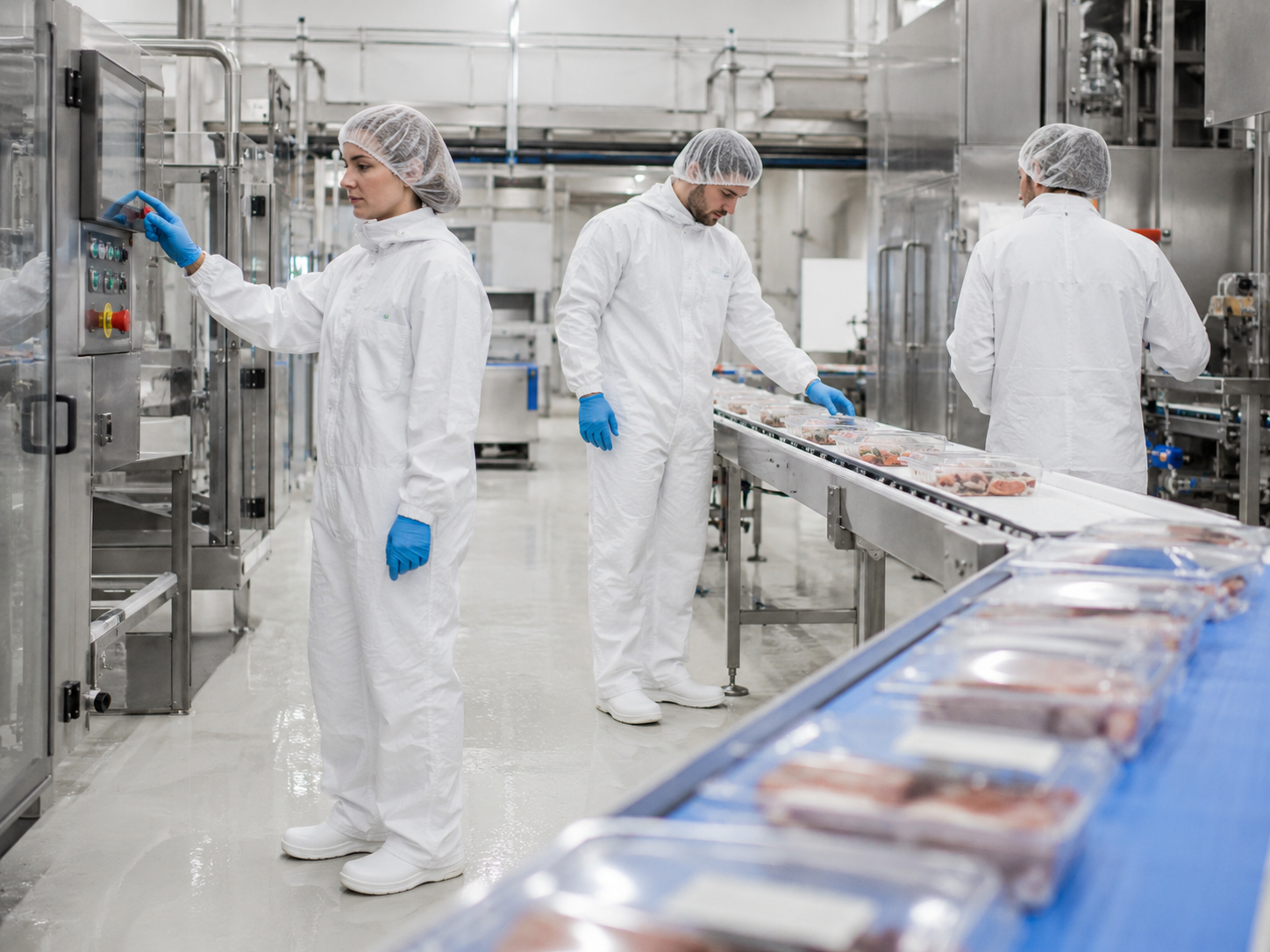
What Is a Food Processing Coverall?
A food processing coverall is a hygiene-focused workwear garment used in food production, food processing, packaging, cold storage, meat processing, dairy production, bakery, seafood, beverage production, catering, and HoReCa environments.
Unlike many industrial coveralls that mainly protect the worker from dirt, abrasion, or jobsite hazards, a food processing coverall is often selected to help protect the food product and production environment. Its main purpose is to reduce contamination risks from clothing, hair, fibers, skin particles, loose objects, external dirt, and foreign materials.
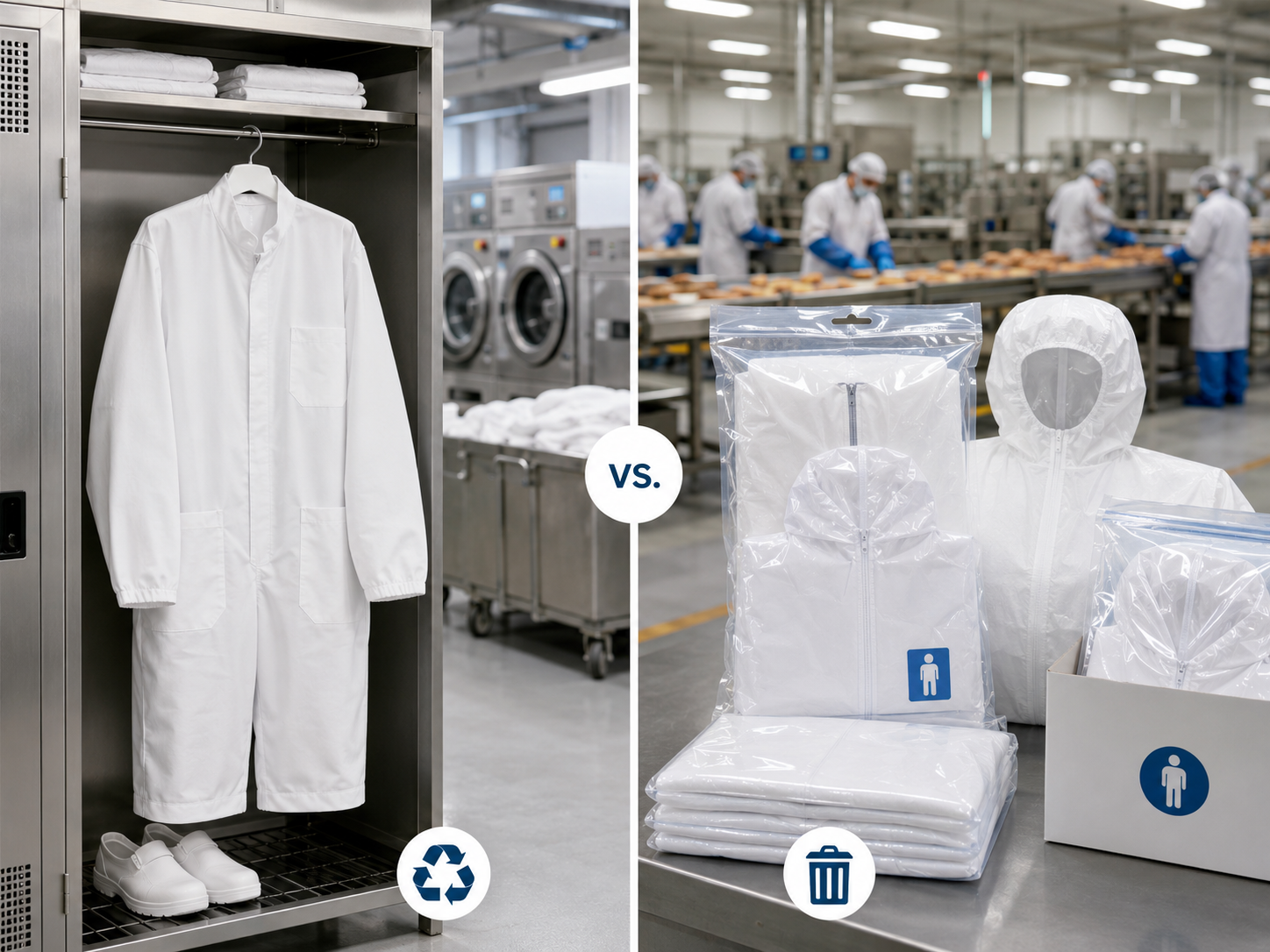
Food processing coveralls may be reusable, disposable, or part of a hybrid garment system. In many food factories, long-term employees wear reusable HACCP workwear, while visitors, temporary workers, contractors, sanitation teams, or high-contamination tasks may use disposable food processing coveralls.
Common food industry garment types include:
Reusable food processing coveralls
Disposable food processing coveralls
Food industry coats and jackets
Work trousers and bib pants
Aprons and sleeve covers
Caps, hoods, and hair coverings
Cold storage or wet-area protective clothing
The right choice depends on the food production area, hygiene risk level, laundering system, worker role, visitor policy, OEM requirements, and food safety management program.
Why Food Processing Coveralls Matter in Food Safety and HACCP Workwear
Food processing coveralls matter because clothing can become a contamination pathway. Workers may carry fibers, hair, dirt, skin particles, pens, tools, buttons, or loose pocket contents into production areas. In food manufacturing, even small foreign body risks can lead to product complaints, audit problems, recalls, and damaged customer trust.
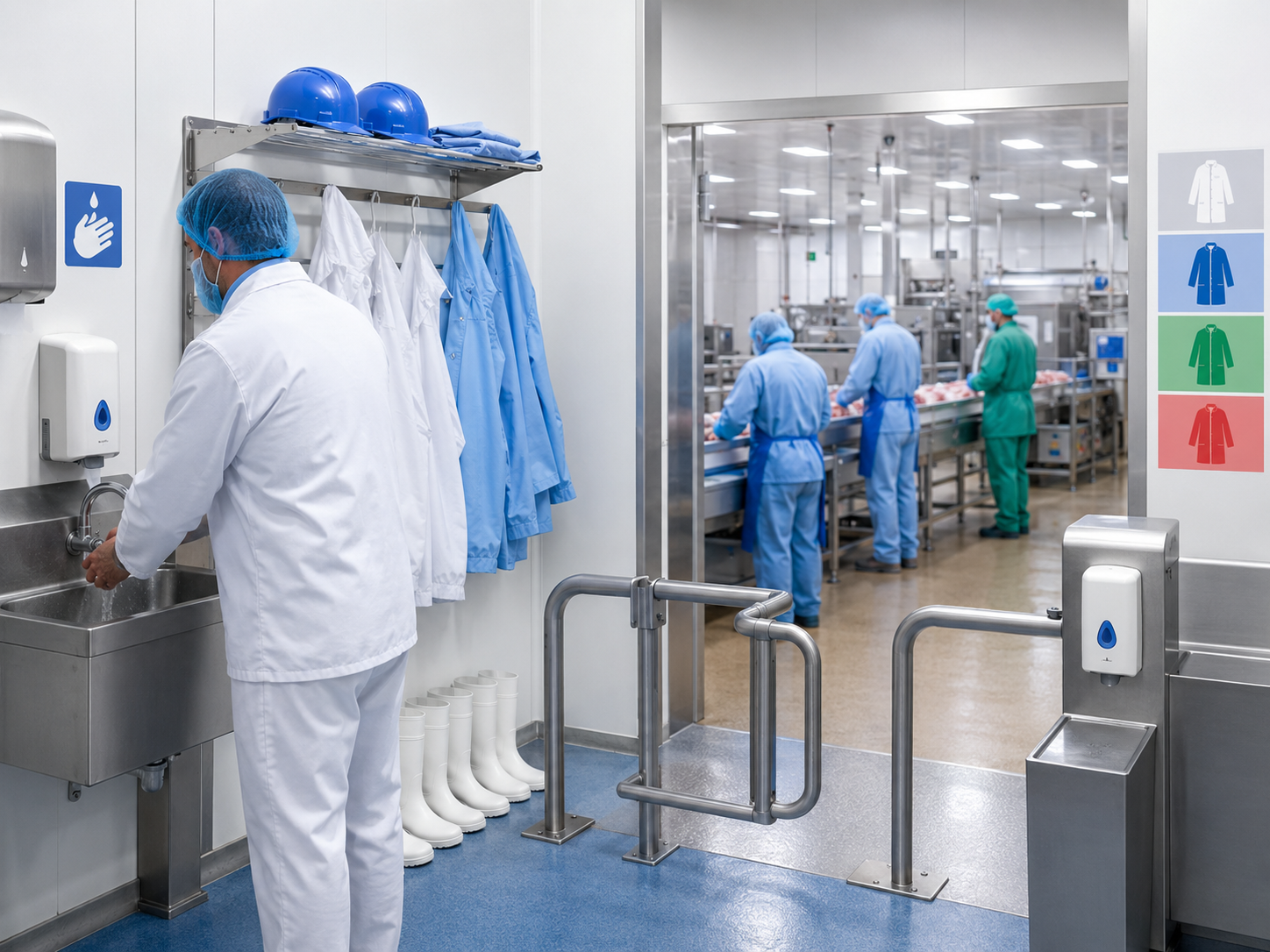
HACCP workwear is not just a uniform. It is part of a wider hygiene and contamination-control system. In many food factories, garments are managed together with hand hygiene, hair covering, footwear control, zoning, laundering, visitor control, and change-room procedures.
Food processing coveralls are especially important in:
Meat and poultry processing
Dairy production
Bakery and snack production
Seafood processing
Ready-to-eat food production
Frozen food and cold storage areas
Beverage production
Food packaging rooms
High-care and hygiene-controlled zones
For PPE distributors and OEM buyers, this means food processing coveralls should be evaluated not only by price, but also by garment design, fabric, laundering compatibility, size range, foreign body control, customization ability, and documentation.
Food Processing Coverall vs Regular Work Coverall
A regular work coverall may not be suitable for food production areas. Many industrial coveralls are designed to protect the worker from dirt, grease, abrasion, or general workplace hazards. Food processing coveralls are selected with a different priority: reducing contamination risks in the food production process.
Comparison Point | Food Processing Coverall | Regular Work Coverall |
|---|---|---|
Main Purpose | Food hygiene, contamination control, foreign body risk reduction | Worker protection, clothing protection, general workwear use |
Colour | Often white, light blue, or colour-coded by hygiene zone | Any colour depending on trade, brand, or jobsite |
Pockets | No external pockets or controlled internal pocket design may be preferred | External tool pockets and storage pockets are common |
Fasteners | Hidden press studs, covered closures, concealed zippers, reduced loose parts | Exposed buttons, zippers, snaps, or accessories may be common |
Fabric | Low-lint, washable, hygiene-focused, or disposable nonwoven materials | Durable cotton, polycotton, canvas, denim, or industrial fabrics |
Laundering | Often designed for hygienic laundering or controlled single use | May not support food factory laundering requirements |
Best Use | Food processing, packaging, meat, dairy, bakery, seafood, high-care areas | Construction, maintenance, workshop, warehouse, general industrial work |
Buyers should not rely only on generic terms such as “workwear,” “uniform,” or “protective coverall.” For food factories, the garment should match the food production area, hygiene program, washing process, and audit requirements.
Top 8 Food Processing Coverall Manufacturers and Suppliers in Poland
The following list is a practical sourcing reference for food factories, PPE distributors, uniform brands, and OEM buyers. It includes Poland-based workwear manufacturers, HACCP clothing suppliers, and textile service providers relevant to food processing coverall sourcing.
Company | Recommended Positioning | Buyer Verification Focus |
|---|---|---|
Polstar Holding | Polish PPE and workwear manufacturer with food industry clothing category | Food industry coverall models, HACCP information, fabric, washing instructions, OEM ability |
Vento Textile | Poland-based HACCP workwear manufacturer for food processing | Coverall or overall options, hidden fasteners, no-pocket design, MOQ, customization |
PW Krystian | Polish protective clothing and workwear manufacturer | Food industry range, HACCP suitability, OEM services, samples, datasheets |
LOGO | Polish workwear manufacturer with coverall customization options | Food processing suitability, fabric changes, colours, garment element customization |
FABOR Workwear | Poland-based workwear producer with local manufacturing capacity | Food industry workwear options, OEM capacity, fabric composition, laundering requirements |
4Workers | Polish food industry HACCP workwear supplier | Manufacturer status, coverall availability, HACCP workwear details, size range, bulk supply |
CWS Workwear Poland | HACCP-compliant workwear supplier and textile service provider | Poland service coverage, garment rental, laundering system, hygiene class support, customization limits |
Elis Polska | HACCP workwear rental and textile service provider for food industry buyers | Food industry garment options, laundering model, coverall availability, service terms, audit support |
Buyers may also review Bardusch, Lindström, Salesianer, Portwest, BP, Mascot, Fristads, Kentaur, and Clematis Polska as additional references, European HACCP workwear benchmarks, or OEM-related options. However, global brands and textile service providers should not be confused with Poland-based direct food processing coverall manufacturers.
1. Polstar Holding Food Processing Coverall and Workwear Supply
Polstar Holding is a strong candidate for food processing workwear sourcing in Poland. The company is relevant because it operates in PPE and workwear and has a food industry clothing category covering products such as jackets, trousers, bib pants, and overalls.
For buyers looking for food processing coveralls, Polstar may be useful as a Poland-based workwear manufacturer with food industry product experience. It may be especially relevant for PPE distributors, food factories, and B2B buyers who want local workwear production and a broader protective clothing portfolio.
Best for: Food industry workwear buyers, PPE distributors, and B2B customers looking for a Polish workwear manufacturer with food industry clothing options.
Buyers should verify: specific food processing coverall models, fabric composition, washing instructions, HACCP-related statements, size range, OEM capability, sample availability, and bulk order support.
2. Vento Textile HACCP Food Processing Coverall Manufacturing
Vento Textile is highly relevant to the food processing coverall topic because it focuses on workwear that meets HACCP-related food industry requirements. Its food industry workwear is suitable for areas such as dairy processing, meat processing, gastronomy, and food service environments.
Food processing buyers should pay attention to Vento Textile because its garment design logic includes features such as hidden pockets and hidden fasteners, which are important for reducing contamination and foreign body risks in food production.
Best for: Food processing companies and buyers looking for HACCP-style workwear with food safety-focused garment design.
Buyers should verify: coverall or overall availability, OEM design support, fabric options, no external pocket designs, hidden closure options, MOQ, colour choices, size range, and export support.
3. PW Krystian Food Processing Workwear and Protective Clothing
PW Krystian is a Polish manufacturer of protective clothing, workwear, corporate apparel, and PPE. It is relevant for food processing coverall buyers because it has experience in certified protective clothing and workwear manufacturing, and some product evidence indicates HACCP-related overall options.
Buyers should treat PW Krystian as a strong workwear manufacturer candidate and verify the exact food industry product range before placing OEM or bulk orders.
Best for: Buyers looking for a Polish protective clothing and workwear manufacturer with potential HACCP workwear relevance.
Buyers should verify: food industry garment range, HACCP workwear suitability, coverall model details, fabric, washability, OEM services, sample development, and private label options.
4. LOGO Workwear Manufacturer for Custom Food Processing Coveralls
LOGO is a Polish workwear and protective clothing manufacturer with coverall production and customization capability. Its value for food processing buyers is mainly in local manufacturing and the ability to adjust fabric, colour, and garment elements.
LOGO should not be described as a confirmed food processing coverall specialist unless buyers verify food industry product evidence. However, it may be a useful option for custom workwear or OEM coverall projects where garment design can be adapted to food processing requirements.
Best for: Buyers looking for Polish-made workwear, custom coverall development, and garment customization options.
Buyers should verify: food processing suitability, hidden fasteners, no-pocket design, light colours, laundering compatibility, OEM support, fabric options, and previous food industry references.
5. FABOR Workwear Food Industry Workwear Manufacturing Potential
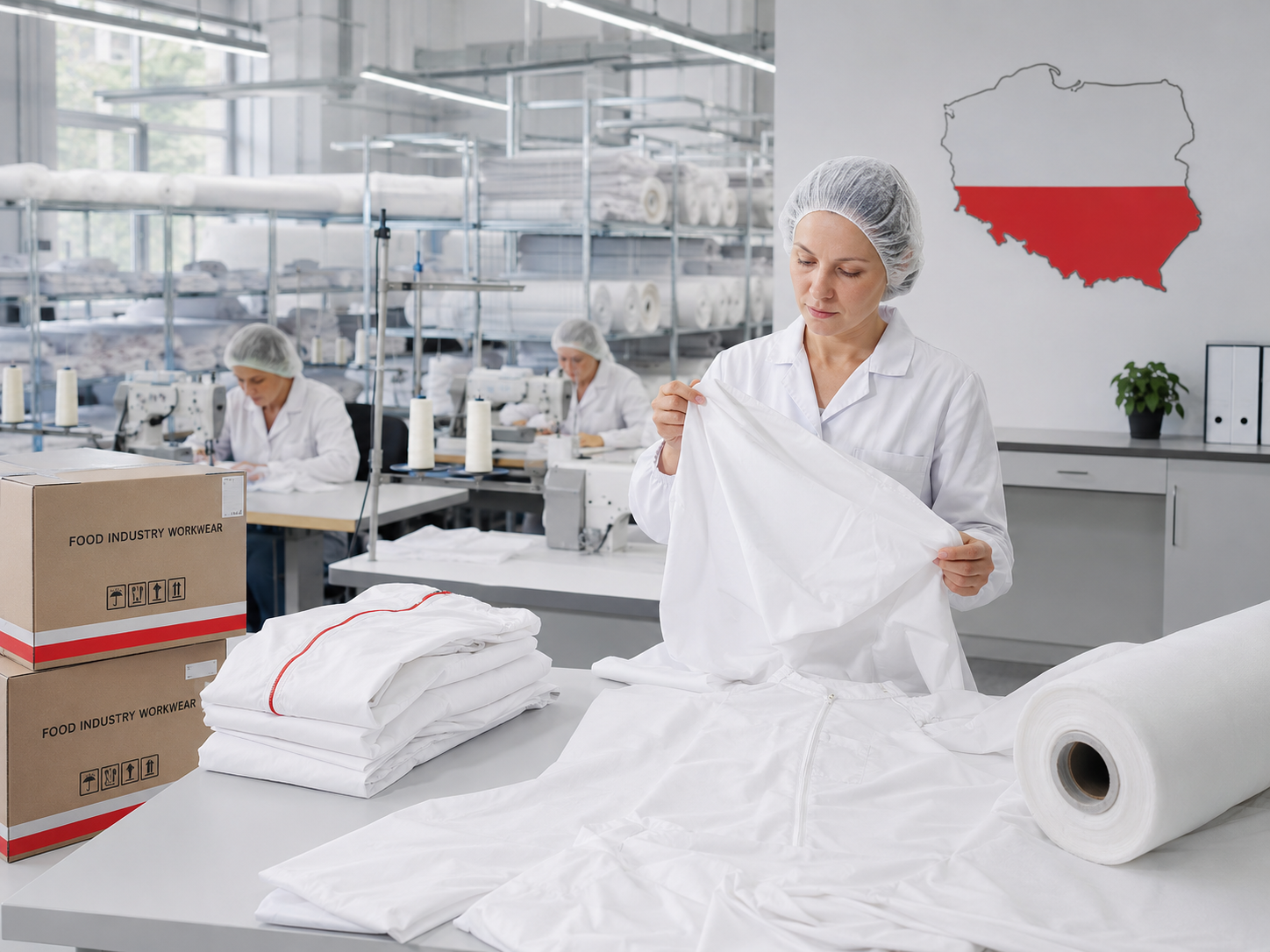
FABOR Workwear is a Poland-based workwear producer with local manufacturing capacity. It is relevant for buyers who want to explore Polish-made workwear and potential custom food industry garment programs.
FABOR may be more general workwear-oriented, so buyers should verify whether its product range includes food processing coveralls, HACCP-style workwear, or custom food industry uniforms before making sourcing decisions.
Best for: Buyers looking for local Polish workwear production and potential custom food industry garment development.
Buyers should verify: food processing coverall availability, HACCP design compatibility, fabric composition, washing instructions, OEM capacity, size range, and export support.
6. 4Workers Food Industry HACCP Workwear Supplier
4Workers is relevant as a Polish supplier of food industry HACCP workwear. Its food industry clothing range includes garments for food production environments, and it provides useful product-level details such as fabric composition, design features, and closures.
Because 4Workers may operate more as a supplier or channel than a direct manufacturer, buyers should verify company type and production source before positioning it as a manufacturer.
Best for: Food factories and PPE buyers looking for ready-to-buy HACCP food industry workwear in Poland.
Buyers should verify: coverall availability, manufacturer status, fabric composition, size range, HACCP suitability, bulk supply terms, and whether OEM or private label options are available.
7. CWS Workwear Poland HACCP Workwear Service
CWS Workwear Poland is relevant as a HACCP-compliant workwear supplier and textile service provider for the food and beverage industry. It is especially useful for food factories that need garment rental, industrial laundering, colour-coded hygiene concepts, and managed workwear service.
CWS should not be treated as a direct food processing coverall manufacturer. Its value is in workwear service, hygienic laundering, garment management, and food industry workwear programs.
Best for: Food factories looking for managed HACCP workwear, laundering services, rental models, hygiene zoning, and textile service support.
Buyers should verify: Poland service coverage, available garment types, coverall options, laundering process, hygiene class support, replacement policy, customization limits, and contract terms.
8. Elis Polska Food Processing Workwear Rental and Service
Elis Polska is relevant as a HACCP workwear rental and textile service provider for food industry buyers. It can support food factories that need hygienic clothing systems, industrial laundering, garment replacement, and service-based workwear management.
Elis is not best positioned as a direct OEM coverall manufacturer. It is more suitable for buyers who need managed workwear service for local food factory operations.
Best for: Food factories needing HACCP workwear rental, laundering, hygiene support, garment replacement, and audit-oriented workwear service.
Buyers should verify: food processing garment range, coverall availability, service coverage, laundering system, customization options, contract model, and whether the service fits their procurement needs.
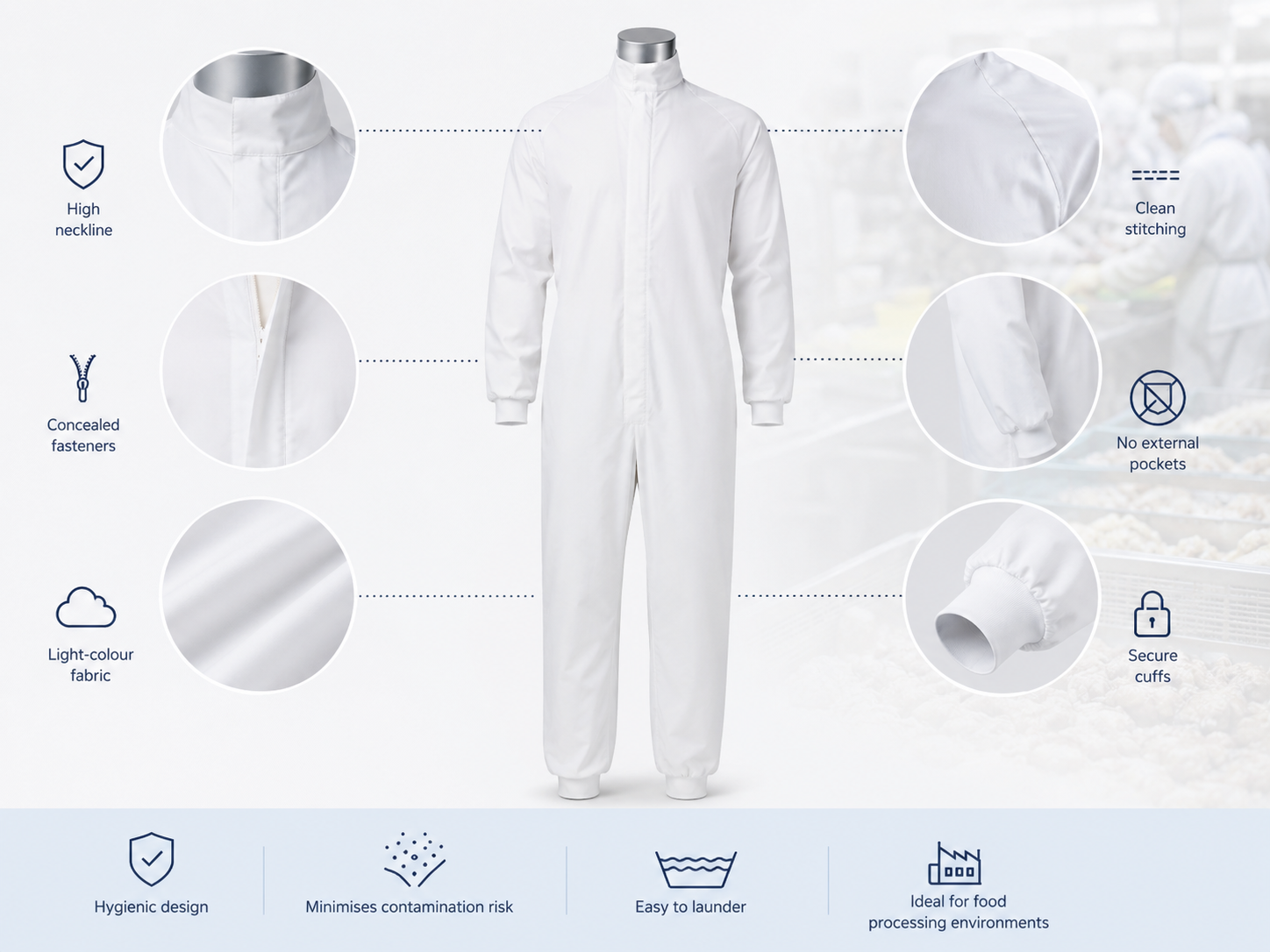
Key Design Features of Food Processing Coveralls for HACCP Workwear
Food processing coverall design should reduce contamination risks while remaining comfortable enough for workers to wear correctly. Small design details can affect hygiene, compliance, and worker behaviour.
Important design features include:
No external pockets: helps reduce the risk of pens, tools, paper, or loose objects falling into food products.
Hidden fasteners: concealed press studs or covered closures reduce exposed components.
Light colours: white or pale blue garments make dirt and contamination easier to see.
High neckline: improves coverage in hygiene-sensitive areas.
Long sleeves: help reduce skin and clothing exposure.
Elastic or secure cuffs: improve coverage around the wrist and glove interface.
Low-lint fabric: helps reduce fiber contamination risks.
Colour-coded trims: can help separate hygiene zones, allergen areas, raw zones, cooked zones, or visitor groups.
Metal-detectable components: may be considered where the food safety program requires detectable trims or closures.
For OEM projects, buyers should include these design details in the tech pack or RFQ instead of asking only for a general “food processing coverall.”
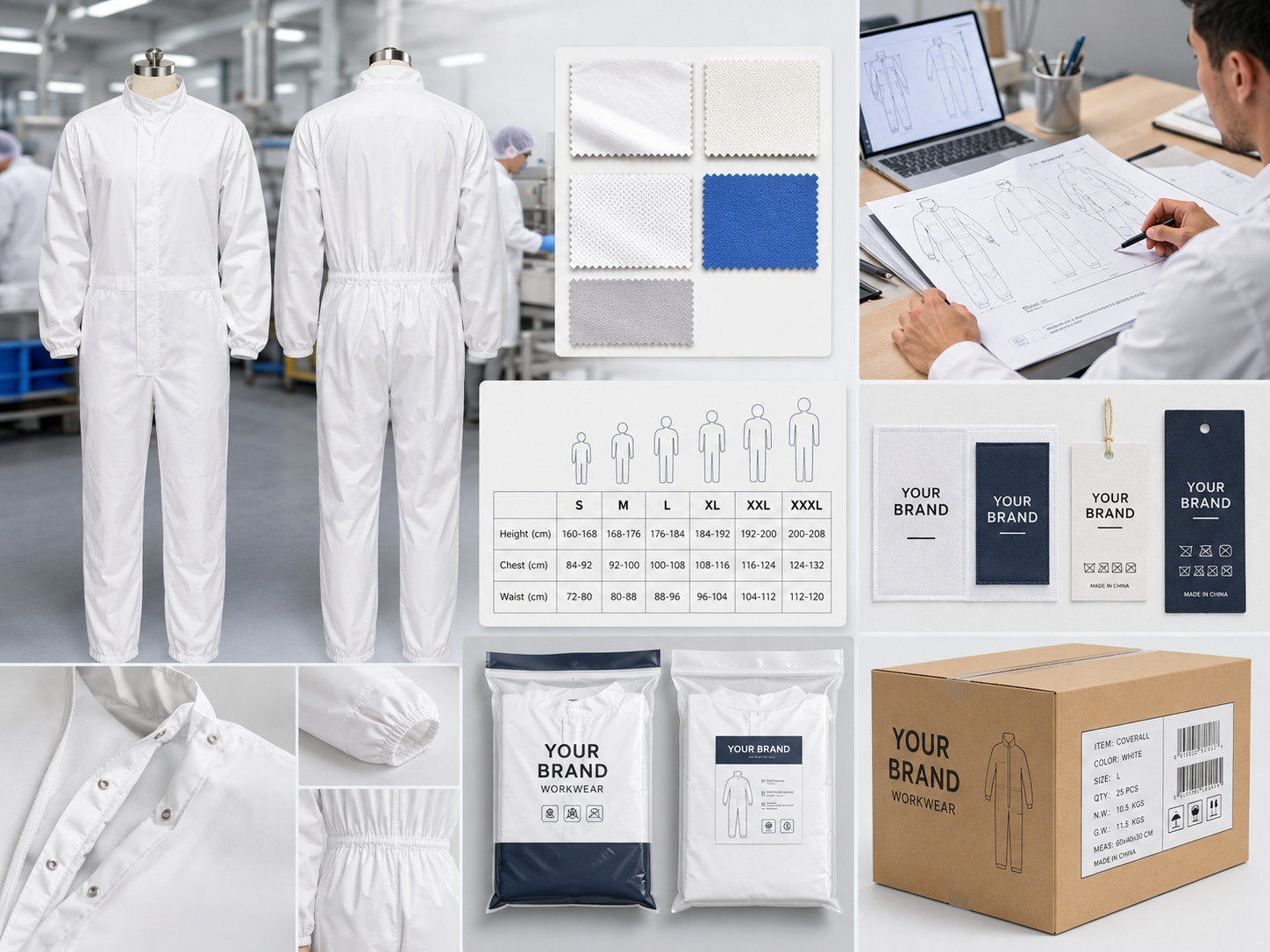
Materials Used for Food Processing Coveralls and HACCP Workwear
Material selection affects comfort, hygiene, washability, durability, linting, shrinkage, and total cost. Food processing coveralls may use reusable woven fabrics or disposable nonwoven materials depending on the application.
Material Type | Common Use | Buyer Notes |
|---|---|---|
Polyester/Cotton Blend | Reusable HACCP workwear, jackets, trousers, coveralls | Balance between durability, comfort, and laundering compatibility |
High-Polyester Fabric | Reusable food industry workwear | Often selected for low moisture absorption and industrial laundry performance |
PP Nonwoven | Disposable visitor coveralls, low-risk food areas | Economical, lightweight, suitable for short-term use depending on task |
SMS / SMMS Nonwoven | Disposable food processing coveralls and visitor garments | Better balance of breathability and barrier performance than basic PP |
PP + PE Laminate | Disposable coveralls for wet or contamination-sensitive tasks | May provide better light liquid resistance; breathability should be checked |
Microporous Film Laminate | Disposable protective coveralls for higher barrier needs | Useful where limited splash or fine particle barrier is required |
Buyers should verify fabric composition, washing instructions, shrinkage control, colour fastness, linting, comfort, and whether the material fits the food production area. For disposable coveralls, buyers should also confirm packaging, size range, and single-use instructions.
Reusable HACCP Workwear vs Disposable Food Processing Coveralls
Food processing coveralls can be reusable, disposable, or part of a hybrid system. The right choice depends on production workflow, hygiene risk level, laundering capacity, visitor policy, worker turnover, and cost structure.
Factor | Reusable HACCP Workwear | Disposable Food Processing Coveralls |
|---|---|---|
Best Use | Long-term employees, stable production lines, managed garment programs | Visitors, temporary workers, audits, sanitation tasks, contamination-sensitive work |
Laundering | Requires controlled washing, drying, storage, and replacement | No laundering required; discarded after use |
Cost Structure | Higher initial investment, lower cost over repeated use | Lower initial cost, ongoing restocking required |
Hygiene Control | Depends on laundering and garment management process | Useful for single-use hygiene control and temporary tasks |
Waste | Less garment waste but requires laundry logistics | More waste, but simple for temporary or high-contamination tasks |
OEM Potential | Strong for custom uniforms, labels, colour zones, long-term branding | Strong for private label disposable PPE, packaging, and bulk distributor supply |
Many food factories use a hybrid model: reusable HACCP workwear for core employees and disposable coveralls for visitors, contractors, sanitation teams, emergency stock, or short-term projects.
OEM Services for Food Processing Coveralls and Private Label HACCP Workwear
OEM services are an important reason why buyers compare Poland suppliers with overseas PPE manufacturers. For food processing coveralls, OEM is not just about adding a logo. Garment design, closures, pockets, labels, packaging, and colour zones may all affect food safety and audit readiness.
Common OEM services include:
Custom logo placement
Woven labels and printed neck labels
Private label packaging
Custom carton labels
Multilingual product labels
Custom size charts
Fabric selection
Colour-coded hygiene zone garments
No-pocket or hidden-pocket design
Hidden press studs or concealed zipper design
Elastic cuffs or secure wrist closures
Reusable or disposable material options
Sample development and fit approval
Wash test or wearer trial before bulk production
MOQ and lead time depend on garment type, fabric availability, branding method, sample approval, packaging requirements, and whether production is local or overseas. Buyers should prepare a detailed tech pack or RFQ before requesting OEM pricing.
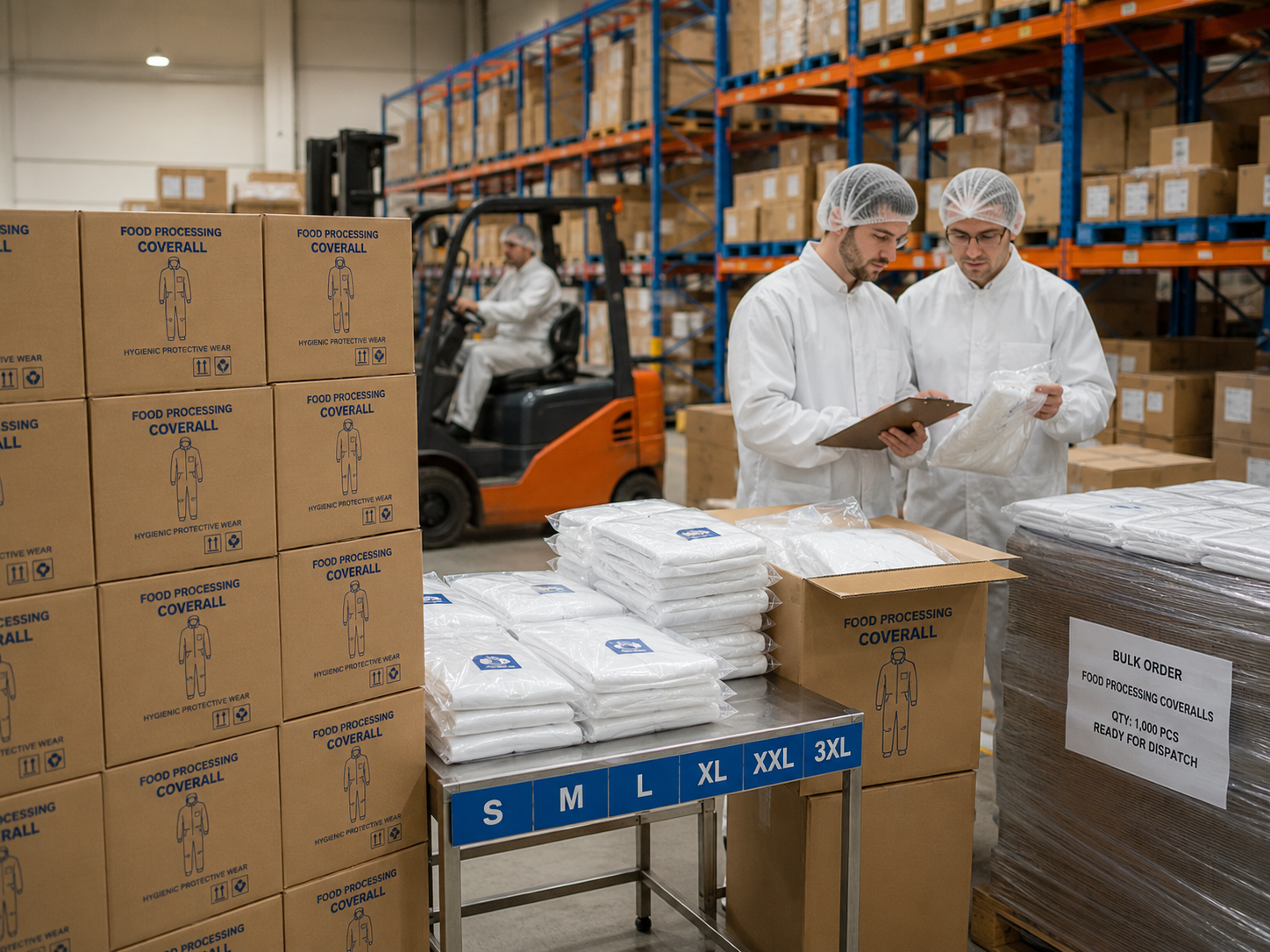
Bulk Order Checklist for Food Processing Coverall Buyers
Bulk food processing coverall orders require careful planning. A good supplier should not only quote a price, but also help buyers confirm the right garment type, fabric, size mix, packaging, documentation, and repeat order plan.
Before placing a bulk order, buyers should check:
Garment type: coverall, jacket, trousers, coat, apron, disposable suit, or full set
Reusable or disposable requirement
Food production area and hygiene risk level
Fabric composition and weight
Colour and colour-coding requirement
No-pocket or internal-pocket design
Hidden fastener or covered closure requirement
Size range and size mix
MOQ and production lead time
Sample approval process
Industrial laundering compatibility for reusable garments
Packaging and carton labeling
Private label or OEM artwork approval
Repeat order consistency
For food factories, it may also be necessary to separate garments by production zone, such as raw area, cooked area, allergen line, packaging room, cold storage, sanitation team, maintenance team, visitors, and high-care zones.
Documents to Request Before Buying Food Processing Coveralls
Documentation helps buyers verify supplier claims and reduce sourcing risk. This is especially important for PPE distributors, private label buyers, and food factories preparing for audits.
Important documents include:
Technical datasheet
Fabric composition
Size chart
Washing instructions
Product photos and garment design details
Packaging details
HACCP-related statement where applicable
DIN 10524-related statement where applicable
Industrial laundering compatibility information
OEKO-TEX certificate where available
ISO 9001 certificate where available
Sample approval record
OEM logo and label mockup
Private label packaging mockup
Bulk production confirmation
Buyers should verify documents for the exact garment model, fabric, colour, and design version. Generic claims such as “ HACCP,” “food safe,” or “for food industry” should be supported by product-level information.
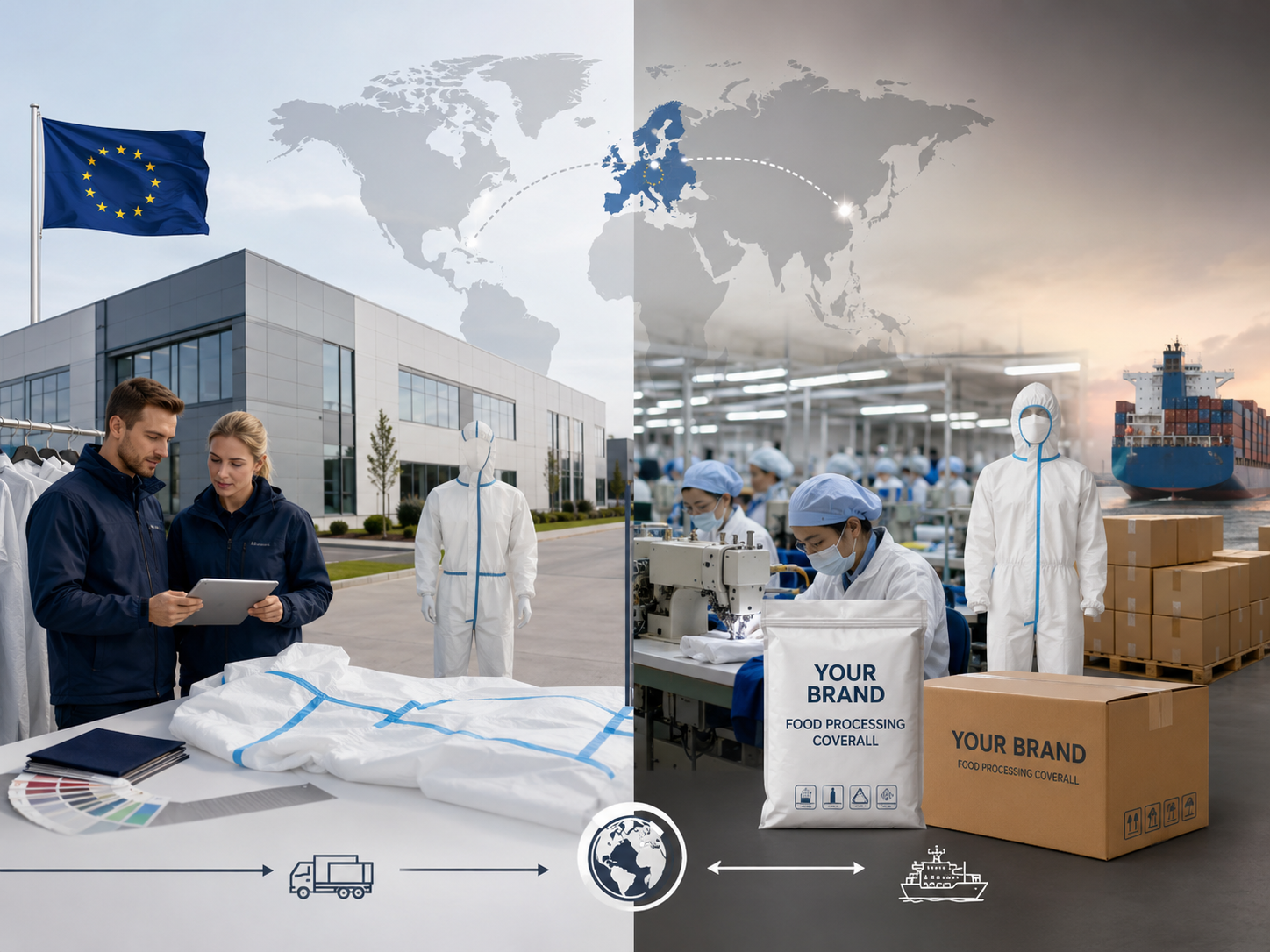
Poland Suppliers vs China PPE Manufacturers for Food Processing Coverall OEM Orders
Poland suppliers and China PPE manufacturers both have value, but they usually serve different sourcing needs.
Poland suppliers may be better for local EU service, small orders, food factory replenishment, HACCP rental programs, industrial laundering, and managed workwear service. They may also be useful for buyers who need local communication, quick adjustment, and service-based garment management.
China PPE manufacturers may be stronger for disposable food processing coveralls, OEM workwear projects, private label packaging, custom size charts, colour-coded garments, carton labels, and long-term bulk production. For PPE distributors and private label brands, direct manufacturer sourcing may offer more flexibility at larger volumes.
Factor | Poland Suppliers | China PPE Manufacturers |
|---|---|---|
Local Service | Strong for Poland and EU-based food factories | Requires international shipping and planning |
Small Orders | Often easier for local replenishment and rental services | MOQ may be higher depending on product and customization |
HACCP Rental / Laundry | Strong through local textile service providers | Usually not suitable for rental or laundry service |
OEM Customization | Available from selected manufacturers, but may cost more | Stronger for private label, packaging, colour, size, and material customization |
Disposable Coveralls | Available through suppliers or import channels | Stronger for large-volume disposable PPE production |
Lead Time | Faster for stocked local products or rental service | Longer for custom production and sea freight |
Best Fit | Local food factories, HACCP workwear service, urgent replenishment | PPE distributors, private label brands, OEM programs, bulk supply |
Buyers should not choose based only on country. A qualified Poland supplier is better for local workwear service and managed laundering. A qualified PPE manufacturer may be better for OEM food processing coveralls, disposable coveralls, private label packaging, and long-term distributor supply.
FAQ About Food Processing Coverall Manufacturers and Suppliers in Poland
What is a food processing coverall?
A food processing coverall is a hygiene-focused garment used in food production, processing, packaging, cold storage, meat, dairy, bakery, seafood, beverage, and HoReCa environments to help reduce contamination risks.
Is a food processing coverall the same as a disposable coverall?
No. Food processing coveralls may be reusable, disposable, or part of a hybrid system. Reusable HACCP workwear is common for long-term employees, while disposable coveralls are often used for visitors, temporary workers, sanitation tasks, or contamination-sensitive work.
What makes a coverall suitable for food processing?
Important features include low-lint fabric, light colours, no external pockets, hidden fasteners, secure closures, suitable laundering, comfort, and design that supports food hygiene and foreign body prevention.
Why are external pockets avoided in food processing workwear?
External pockets can hold pens, tools, paper, and other loose objects that may fall into food products. They can also collect dirt or contamination, especially in high-care areas.
What is HACCP-compliant workwear?
HACCP-compliant workwear generally refers to clothing designed and managed to support food safety programs, hygiene control, foreign body prevention, and cross-contamination reduction. Buyers should request product-level evidence instead of relying only on broad claims.
What is DIN 10524?
DIN 10524 is commonly used in Europe as a reference for food industry workwear design, function, fabric, use, and laundering. It helps buyers evaluate whether garments are suitable for different hygiene risk areas.
What materials are used for food processing coveralls?
Reusable food processing coveralls often use polyester/cotton or high-polyester fabrics. Disposable food processing coveralls may use PP nonwoven, SMS, SMMS, PP+PE laminate, or microporous film laminate.
What OEM services can buyers request?
OEM services may include custom logo, woven label, printed label, private label packaging, carton label, colour-coded hygiene zone garments, custom size charts, no-pocket design, hidden fasteners, fabric selection, and sample development.
Do Polish suppliers manufacture food processing coveralls directly?
Some Poland-based companies manufacture workwear, while others are suppliers, distributors, textile service providers, or rental companies. Buyers should confirm company type before placing OEM or bulk orders.
Should buyers choose Poland suppliers or China PPE manufacturers?
Poland suppliers may be better for local service, HACCP rental, laundering, and urgent replenishment. China PPE manufacturers may be better for OEM food processing coveralls, disposable coveralls, private label packaging, and long-term bulk production.
Conclusion: Choosing the Right Food Processing Coverall Supplier
Choosing the right food processing coverall supplier in Poland requires more than comparing prices. Buyers should evaluate company type, food industry relevance, garment design, HACCP or DIN 10524 alignment, fabric, laundering compatibility, OEM capability, documents, and repeat supply reliability.
The Top 8 companies in this guide can serve as a useful starting point. Polstar Holding, Vento Textile, PW Krystian, LOGO, and FABOR Workwear represent Poland-based workwear manufacturing options. 4Workers can be reviewed as a food industry HACCP workwear supplier, while CWS Workwear Poland and Elis Polska are more relevant as HACCP workwear service and textile rental providers.
For local food factories, Poland suppliers may be useful for rental service, industrial laundering, EU replenishment, and managed workwear programs. For PPE distributors, private label buyers, and long-term bulk programs, working directly with a PPE manufacturer may provide more flexibility in disposable food processing coveralls, custom labels, colour-coded hygiene apparel, private label packaging, and carton labeling.
As a professional PPE manufacturer, we can support food processing coverall OEM orders, disposable food coveralls, private label packaging, colour-coded hygiene zone apparel, custom size charts, carton labeling, and long-term bulk supply for distributors and food industry buyers. If you are comparing Poland suppliers with a PPE manufacturer for OEM food processing coverall orders, focus on samples, documents, garment design, fabric consistency, packaging, and repeat supply before making a final decision.





