Halyard has been a trusted name in surgical gowns for decades. But trusted doesn’t always mean right for your facility.
Think about who’s reading this. You might be a hospital procurement manager trying to justify a bulk order. Or a scrub nurse who’s sat through one too many long procedures, feeling wrapped in a trash bag. Maybe you’re an infection control specialist who’s started questioning whether your current surgical gowns hold up to AAMI standards. The answer isn’t always clear.
Here’s what most people miss:
Halyard’s product lineup is broader than it looks at first glance
The gap between protection levels matters more than the marketing lets on
Real-world performance tells a different story than any spec sheet
Here’s the honest breakdown.
Why Many Hospitals Still Choose Halyard Surgical Gowns?

Standardizing on a single surgical gown brand is never a casual decision. Yet procurement committees keep landing on Halyard.
There are specific, documented reasons for that.
Protection levels are clear. Halyard offers both AAMI Level 3 and Level 4 surgical gowns . Their AERO CHROME line uses distinct color coding, so OR staff can confirm the right protection level at a glance — before a procedure begins. That one design choice cuts out a common source of selection error in fast-moving surgical environments.
The compliance credentials are hard to dispute. These gowns meet: – AAMI PB70 – CPSC 16 CFR 1610 (flame resistance) – ISO 11810 (laser resistance) – ASTM D4966 (abrasion) – EN 13795 (microbial barrier)
That’s a full stack of certifications. It satisfies OSHA bloodborne pathogen standards and most hospital infection-prevention policy frameworks at the same time.
Lint reduction is a real infection-control argument. Halyard’s polypropylene nonwoven construction produces far less lint than traditional linen or spunbond fabrics. Their own research ties lint reduction to lower surgical site infection (SSI) risk — a direct link worth noting for any infection control team.
Then there’s the integrated system advantage. Halyard-funded data showed 100% sterility maintenance with their sterilization wrap. Standard instrument containers had an 87% failure rate by comparison. Infection prevention teams can bundle gowns, drapes, and wraps under one vendor’s documented barrier performance. That makes the value analysis much easier to close.
Halyard Gown Lines Explained Without the Confusing Product Names
Forget the trademark names — BASICS, EVOLUTION, ULTRA, AERO CHROME. Strip them all away, and Halyard’s gown catalog comes down to three collar colors. That’s the shortcut seasoned, OR coordinators rely on. Learn this first, and the rest falls into place.
Yellow collar = standard performance, no reinforcement
Low fluid. Short procedures. Think minor outpatient cases, simple plastics, or scope-assisted work with minimal splash. You get SMS fabric with no added barrier layers. That also means the lowest cost in the lineup. Case under 90 minutes? Blood loss light and predictable? Yellow is your call.
Green collar = fabric-reinforced, standard performance
Moderate fluid. Short to mid-length cases. The base SMS fabric stays, but extra SMS reinforcement patches cover the front panel and sleeves. Breathability holds up better here than with film-reinforced options. This is the workhorse tier — lap choles, C-sections, moderate orthopedics, general surgery with controlled irrigation. It handles the bulk of everyday OR volume without overbuilding.
Red collar = high-performance, high-fluid protection
Long cases. High blood loss. Exposure you can’t predict going in. Film-reinforced critical zones — or a construction that blocks fluid across the board — cover the front and sleeves. Two variants matter here:
Breathable back panel (AERO-type): You get the same red-collar barrier up front, but the back panel allows airflow. Best choice for high-fluid cases where heat stress on staff is a real clinical concern.
Full-barrier construction: Maximum protection across every zone. Heavier and less breathable. Use this for transplant, major trauma, and strict infection-control protocols.
One practical decision tree — two questions:
How much fluid, how long is the case? → Yellow / Green / Red
Is staff heat stress a factor in high-performance cases? → Breathable-back Red vs. full-barrier Red
Sleeve fit is the last variable worth noting. Raglan sleeves open up overhead reach — favored in ortho and cardiac. Set-in sleeves give a cleaner shoulder fit for standard and reinforced work.
Everything else on the label — fabric weight, reinforcement pattern, breathability — is just a branded variation on those same factors. Color plus reinforcement type. That’s what you need to make the right call.
Halyard ULTRA Gowns: Reliable for Everyday Surgery?
Most OR teams don’t need a fortress. They need a gown that works — day after day, case after case, through a full surgical schedule without complaint.
That’s where the Halyard ULTRA line earns its place.
ULTRA gowns cover the widest range of routine procedures: general surgery, standard orthopedics, routine GI, ENT, urology, and C-sections without anticipated major hemorrhage. These are cases where fluid exposure is real but predictable. The ULTRA SMS (spunbond-meltblown-spunbond) fabric creates a solid fluid barrier through the meltblown inner layer. It also breathes better than full-film impervious constructions. Staff notice the difference around hour three.
What “Reliable” Means in AAMI Terms?
The non-reinforced ULTRA gown (yellow neckband) meets AAMI PB70 Level 3 in critical zones A, B, and C. That covers the front chest to knees, sleeves from cuff to above the elbow, and the remaining front panel. This meets the barrier requirement for most invasive procedures on a standard OR schedule.
The back panel (Area D) is non-protective. That’s standard across the surgical gown industry. For everyday case volumes, it’s a fair trade-off.
The compliance credentials are solid:
– NFPA Class 1 flame resistance
–
ASTM D4966
abrasion resistance (low-lint construction)
– AORN guidance for fluid, flame, and lint performance
Built for the Details That Add Up
Two construction features matter more than they appear on a spec sheet:
Raglan sleeves extend the overhead range of motion. You get less seam strain during extended reach — ortho and laparoscopic teams feel the difference right away
Thumb loops on select models reduce sleeve ride-up at the glove-gown interface. This closes the gap where contamination most often enters
Look at SKU 95101 as a solid reference point — the ULTRA non-reinforced sterile gown with towel. It uses ULTRA SMS construction, hits AAMI Level 3 in zones A–C, and delivers fluid resistance, flame resistance, and low-lint performance. Single-use and sterile straight out of the pack. Facilities standardizing on one baseline option tend to make this their go-to for high-volume OR lists.
ULTRA Is Enough — Until It Isn’t
For most facilities, the inventory strategy is straightforward:
Yellow neckband (non-reinforced): Your default gown for low-to-moderate fluid cases
Green neckband (fabric-reinforced): Step up for moderate-to-higher fluid exposure. You get reinforcement panels at the chest and sleeves
Red neckband (film-reinforced): Use this for high fluid, longer cases — or move up to the AERO Series Level 4 for complex vascular, trauma, or transplant work
ULTRA isn’t the right answer for every case on your board. But for the cases that make up the bulk of your everyday surgical volume, it’s a defensible, well-documented choice — not just a convenient one.
Aero Blue vs Aero Chrome: Which One Feels Better in Long Procedures?
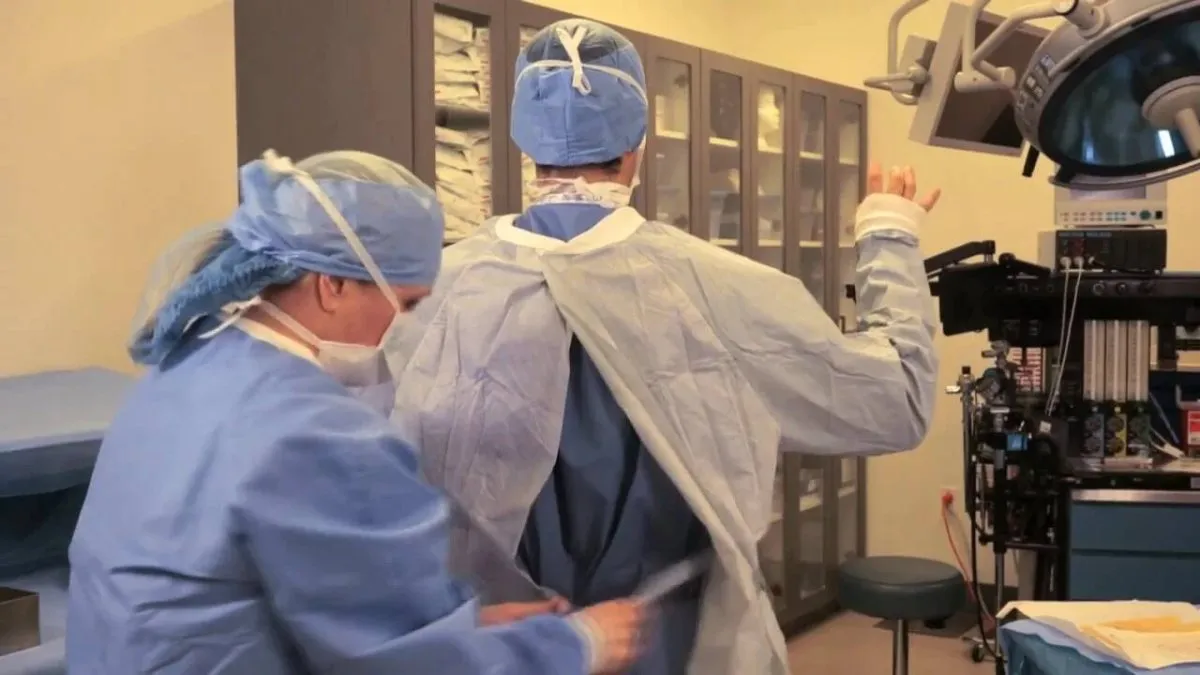
Four hours into a complex vascular case, comfort stops being a preference. It becomes a performance variable.
Both the Aero Blue and Aero Chrome carry AAMI Level 4 protection — the highest standard in Halyard’s surgical gown lineup. Same protection tier. Very different wearing experience. The real distinction is design philosophy: barrier-first vs. breathability-first.
Aero Chrome treats heat and fatigue as real clinical problems. Its lightweight fabric pairs a high-performance fluid and microbial barrier with a breathable back panel that pushes air through. The fitted V-neck closes the gap during forward leans — a small detail that makes a big difference across hours of bending over a surgical field. Knit cuffs and hook-and-loop closures at the neck and waist lock in fit without adding bulk. Staff reporting overheating, moisture buildup, or shoulder fatigue on long cases? Aero Chrome addresses all three.
Aero Blue goes a different direction. It puts coverage and barrier confidence ahead of airflow. The feel is more traditional — less ventilated, more substantial. High-fluid cases where splash protection is the top concern and reduced breathability is an acceptable trade-off? That’s where Aero Blue fits.
The Quick Decision Framework
Priority | Choose |
|---|---|
Long case + heat buildup risk | Aero Chrome |
Repeated forward lean movements | Aero Chrome |
Maximum fluid splash protection | Aero Blue |
More traditional, covered feel | Aero Blue |
For most 4+ hour procedures , Aero Chrome’s breathable back panel and lightweight build give it the edge. The barrier performance stays the same — no protection is lost. You just stop feeling like you’re wearing a heat trap through hour three.
Your OR team mentions fatigue on long lists? That feedback points straight at this decision. Aero Chrome is the practical fix.
Are Halyard Basics Gowns Good Enough for Low-Risk Tasks?
Short answer: yes — but there’s a hard boundary you need to understand before you order.
Halyard BASICS gowns are built for what the name implies. Low fluid. Short cases. The surgical field stays dry. Think minor skin excisions, cataract surgery, simple hernia repairs, routine ENT work, or endoscopy with minimal splash risk. In those contexts, BASICS isn’t a compromise — it’s the right call.
The non-reinforced BASICS surgical gown (white neckband) meets EN 13795-1:2019 Standard Performance — the correct regulatory tier for low-risk day surgery. The fabric uses SMS construction: lightweight, low-linting, and sterile straight out of the pack. Two towels are included. Your facility’s risk assessment doesn’t require AAMI Level 3–4 or EN High Performance for every procedure. BASICS covers all the boxes when it doesn’t.
There’s also a fabric-reinforced version (green neckband). It adds SMS reinforcement panels at the chest and sleeves. The standard-performance classification stays the same, but you get extra splash protection in the key zones. That’s useful for low-risk cases that may shift toward moderate fluid exposure.
Where BASICS Stops Working?
The boundary is clear, not vague:
Pulsatile bleeding or pressurized fluid spray → escalate now
Power tools, pulsed irrigation, or bone cutting → BASICS cannot hold
Prolonged exposure with large anticipated blood loss → AAMI Level 3–4 required
Major abdominal surgery, orthopedic joint replacement, trauma, cardiac — none of these belong in a BASICS gown. Halyard’s own clinical documentation is direct: procedures with moderate-to-high fluid exposure need higher protection levels.
Two questions drive the decision:
Is fluid exposure expected to be minimal and non-pressurized?
Does your internal policy specify Standard Performance (not High Performance) for this task?
Are both answers yes? BASICS isn’t just good enough. It’s the right gown for the job.
The Small Details That Matter in Real OR Use

Spec sheets don’t scrub in. Surgeons do.
After hours standing over a surgical field, the details on a product data page stop mattering. What matters is what’s built into the gown. Here’s what Halyard gets right — the small stuff that only shows up once a case is running.
Thumb loops. Most procurement checklists miss this one. On select Halyard models, thumb loops at the cuff hold the sleeve in place during active hand movement. The glove -gown interface is one of the most common contamination entry points in the OR. A sleeve that rides up even a centimeter creates exposure. The loop stops that from happening. Small fix. Real consequence.
Raglan sleeve construction. Set-in sleeves bind during overhead reach. Raglan sleeves don’t. The seam runs from underarm to collar instead of capping the shoulder. That opens up the full range of motion you need in orthopedic and laparoscopic work. After two or three hours of repetitive reaching, that difference is hard to ignore.
Color-coded neckbands. Yellow, green, red. You can see the protection level before the gown is even tied. In a fast-moving OR with cases running back to back, that visual check removes one more decision from an already packed environment. No label-reading. No second-guessing. The right gown is obvious.
Knit cuffs with a snug fit. On the AERO CHROME line, the knit cuff creates a clean, close seal at the wrist. It stays in place without cutting off circulation — something stiffer elastic designs fail at over long wear.
None of these features looks impressive in a catalog. But surgical teams notice them. And they notice fast when they’re gone.
What Surgical Teams Actually Like — and Complain About?
Real feedback from OR teams doesn’t come from surveys. It comes from shift handoffs, break room conversations, and the quiet frustration of someone who’s been wearing the same surgical gown style for six hours straight.
Here’s what surfaces when surgical teams weigh in on Halyard.
What Teams Praise?
The color-coding system gets genuine appreciation. It sounds trivial — until you’re running a back-to-back surgical list and someone grabs the wrong gown off the shelf. Yellow, green, red — the protection level is visible before the gown is even opened. Nurses and OR coordinators flag this as one of Halyard’s most underrated practical wins.
Comfort holds up longer than expected. With the Aero Chrome, surgical staff reports less heat buildup during procedures past the three-hour mark. That’s a real difference for teams doing complex vascular or prolonged orthopedic cases. It’s not a minor comfort preference. It’s a fatigue variable that affects concentration and performance.
The thumb loops and raglan sleeves earn quite a loyalty. These features don’t show up in purchasing conversations. They show up in feedback after a two-week trial. Scrub techs and surgeons start requesting the models that include them by name.
Where are the Complaints Cluster?
Sizing inconsistency between product lines is the top frustration. A surgeon who fits well in an ultra-large size may find the same labeled size runs noticeably small in the Aero Blue. For facilities running multiple gown types, that mismatch creates friction during fast turnaround between cases.
The heavier film-reinforced options trap heat. Teams in older ORs with poor ventilation feel this hard. The barrier performance is solid — but the breathability trade-off is real.
Packaging bulk adds up. High-volume facilities running dozens of cases a day find that the individual wrap format slows down setup. It’s a small friction point. Across a full surgical week, it compounds.
The honest read: Halyard scores well on fit details and protection clarity. The weak spots are sizing consistency across lines and heat management on full-barrier models. Both are worth testing in your trial evaluation before you commit to a facility-wide order.
Are Halyard Surgical Gowns Worth the Price?
The answer depends on what you’re comparing — and what you’re risking.
Halyard’s range starts at $2.50–$4.00 per gown for Basics disposables. It goes up to $9–$15 per gown for sterile, fabric-reinforced AAMI Level 4 options. Generic Chinese OEM alternatives at pallet volume can hit $2.50–$4.00 even for Level 3. So yes, Halyard costs more. The real question is whether that premium pays for itself.
For most acute-care OR settings, it does — but not for the reasons most procurement teams first mention.
The math that matters:
Halyard’s reinforced gowns can eliminate double-gowning in high-fluid cases. That cuts gown units per case by 1–2 pieces
Standardizing on AERO/ULTRA lines can cut your gown SKU count by 30–50%. For a typical 300-bed facility, that trims annual inventory holding costs by $5,000–$15,000
A single SSI costs $15,000–$40,000 to treat. A $3–$5 per-case barrier upgrade is hard to argue against at that scale
Where cheaper alternatives make sense: minor dermatology, low-fluid ambulatory cases under 60 minutes, and outpatient centers with minimal exposure risk. Halyard Basics or VALUESELECT fits those settings well — not the premium lines.
Here’s the straight bottom line. Halyard runs 10–40% more per unit. Yet preventing even one serious exposure event per 3,000–5,000 cases brings the total cost of ownership to neutral or lower than the budget option. That’s the number worth putting in front of your procurement committee.
Frequently Asked Questions About Halyard Surgical Gowns

Procurement teams and OR staff tend to ask the same questions. Here are the ones that come up most often — with straight answers.
Do Halyard surgical gowns contain latex?
No. Halyard does not use natural rubber latex in any of its surgical gowns. This covers the entire product line. So there’s no Type I latex allergy risk for sensitive staff or patients.
What are the cuffs made from?
100% polyester weave — not cotton. Polyester produces far less lint at the glove-gown interface. That means lower particulate contamination risk during procedures. Cotton simply can’t match that.
How much fluid protection does Aero Blue offer compared to other Level 3 gowns? Four times more fluid protection in critical zones than comparable AAMI Level 3 gowns. Cool Shield Core technology lets moisture vapor pass through — so heat escapes — but blocks liquid from getting in. You get better breathability and a stronger barrier, all within the same protection tier.
Can Halyard surgical gowns double as isolation gowns ? No. Surgical gowns and isolation gowns serve different purposes. They carry separate intended-use classifications. Surgical gowns belong in the OR — that’s what they’re built for. For medium-to-high contamination risk in general patient care, use a dedicated isolation gown rated AAMI Level 3 or 4. Don’t pull a surgical gown from the OR supply as a substitute.
What AAMI levels does Halyard cover?
Levels 1 through 4. AERO CHROME reaches Level 4 in critical zones — the highest fluid and microbial barrier rating under AAMI PB70. It also carries the highest laser ignition resistance rating. That’s worth noting for any OR running laser procedures.
How reliable is the barrier performance of MICROCOOL gowns?
The track record is strong. Since 2011, over 58 million MICROCOOL gowns have been sold. Zero documented personal injuries link back to barrier failure. The complaint rate for alleged strikethrough incidents sits below 1 in 1,000,000 gowns — that’s under 0.0001%. No medical journal or health organization report has recorded any infection tied to barrier failure.
How do you get the right size?
The gown needs to wrap all the way around the body and cover the back fully. Sleeves should reach the cuff without riding up during active movement. Too small — it restricts motion and risks sterile field contact. Too large — excess fabric can brush unsterile surfaces. Size up if you’re unsure. Then, verify the fit during a trial run before placing a facility order.
Where do you access detailed product specs and AAMI test data?
Two options. Log in to the HALYARD Customer Portal with a registered account. Or contact an Owens & Minor sales rep. Reps can pull IFUs, AAMI test summaries, and full performance documentation. Request those materials before any large procurement decision — they’re worth reviewing.
Conclusion
Halyard surgical gowns have a solid place in operating rooms. The protection levels are consistent. The product line covers everything from routine procedures to high-fluid-exposure surgeries. Procurement teams have a strong track record to back up their choice.
That said, no single brand fits every situation. Your OR runs long, demanding cases? The Aero Chrome’s comfort advantage becomes more important than any spec sheet can show. Is the budget the main concern? Halyard Basics holds up well — just know its limits before committing to a large order.
The smartest next step is simple:
Request sample units from both the ULTRA and Aero lines
Run them through your actual case mix
Let your surgical team share their feedback before placing any bulk order
At the end of the day, the best sterile surgical gown is the one your team trusts under pressure. That trust gets built in the OR — not on a product page.