Finding a reliable surgical gown manufacturer in Romania can feel like a frustrating search. Most procurement teams spend weeks chasing certifications, checking production capacity, and verifying EU MDR compliance — just to build a basic shortlist.
Romania has become one of Europe’s most competitive sourcing destinations for sterile and disposable surgical gowns . You get EU-compliant manufacturing, shorter lead times, and a solid alternative to over-dependence on Asian supply chains.
This guide does the heavy lifting for you. It profiles 7 vetted Romanian surgical gown manufacturers, comparing their certifications, product ranges, and export capabilities. Your team can move from research to shortlist in far less time.
Why Source Surgical Gowns from Romania? (EU Compliance & Supply Chain Advantages)
Romania has become one of the EU’s top medtech manufacturing hubs — and the numbers back that up.
Built-In EU Compliance: No Extra Hoops
Romanian surgical gown manufacturers work inside the EU regulatory framework from day one. EN 13795-certified surgical gowns — covering barrier protection against liquids, microbes, and particulates — carry automatic presumption of conformity under MDR (EU) 2017/745. No extra steps needed. The latest updates, EN 13795-1:2025 and EN 13795-2:2025, are already built into local production standards.
For procurement teams, this cuts out a major bottleneck. A CE-marked surgical gown from a Romanian factory enters any EU market with no additional validation. Compare that to Asian sourcing, where full MDR re-audits add 30–50% to certification costs alone.
Plus, intra-EU trade means 0% import duties — versus 4.7–12% tariffs on non-EU suppliers.
Shorter Lead Times, Fewer Surprises
Metric | Romania (EU) | Asia (China/Vietnam) |
|---|---|---|
Lead Time to EU | 2–4 weeks | 6–12 weeks |
Tariffs to the EU | 0% | 4.7–12% |
Cert Re-Validation | Native EN 13795/CE | Full MDR Audit Required |
Labor Cost/Month | €800–1,200 | €200–400 |
Post-2024 Red Sea disruptions added 4–6 weeks to Asian sea freight routes. Romanian surgical gowns are shipped by road or rail. That risk doesn’t apply to them. Factory uptime in Romanian medtech stays above 95% — a sharp contrast to the 25% shutdown rate seen across Chinese facilities between 2020 and 2023.
The “China+1” Shift Is Already Happening
By 2025, 65% of EU medical buyers had adopted a China+1 sourcing strategy. Romania is taking a real share of that shift. The country now accounts for 12% of Eastern EU medtech exports, generating about €450M per year in surgical gowns and drapes — up 25% since 2022.
Romania’s 15+ EN 13795 High Performance certified factories offer something most Asian suppliers can’t: rapid scaling. During the COVID crisis, several Romanian manufacturers doubled gown output in two weeks. For procurement managers building solid supply chains, that kind of speed matters. It’s not just a selling point — it’s proof that the capacity is there when you need it most.
#1 ANTONIA CONF SRL — Surgical & Medical Supply Specialist
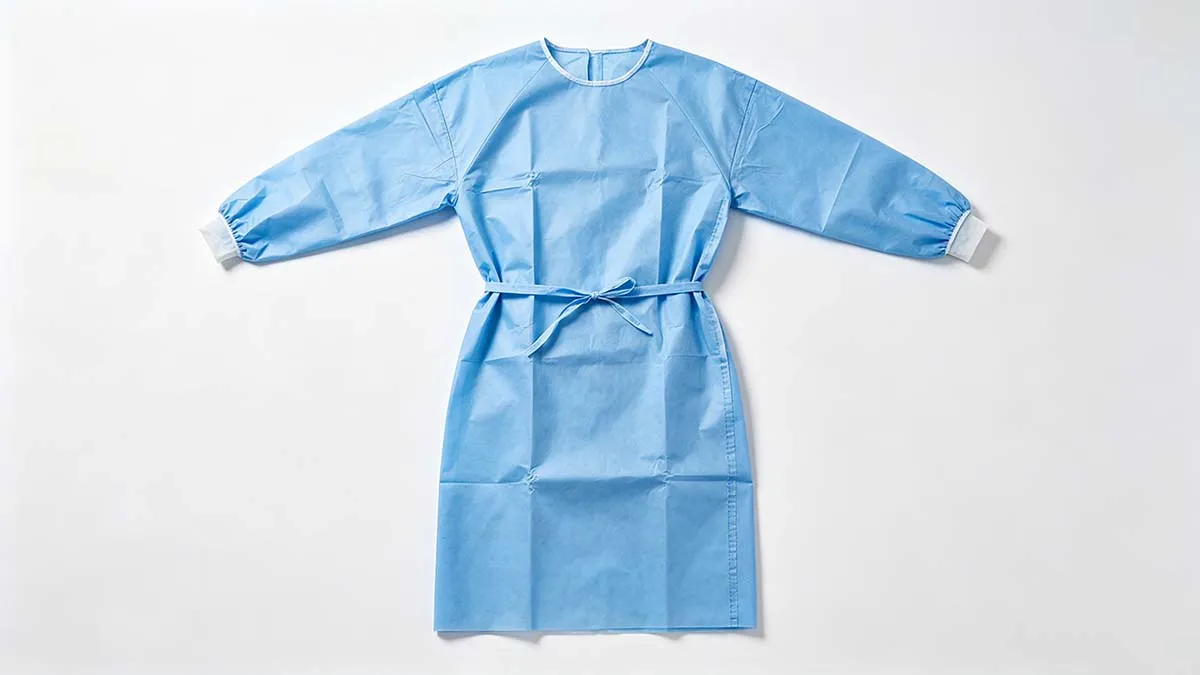
ANTONIA CONF SRL is based in Bucharest. They do something most Romanian suppliers don’t — they manufacture and distribute medical protective apparel in-house. That dual capability matters. As a procurement manager, you deal with fewer intermediaries, get faster response times, and have one clear point of contact when specs need to change.
Their product range covers both disposable and reusable protective garments. This includes non-woven surgical gowns built for barrier protection against pathogens and infectious agents. So whether your facility runs high-volume single-use protocols or a sustainability-focused reusable program, ANTONIA CONF fits the bill.
They’re attending MEDICA 2025 (Hall 5, Booth F40 — the world’s largest medical trade fair). That’s a clear signal: they’re actively pursuing international B2B partnerships — not just listing products in a catalogue.
What to expect when you reach out:
Products: Disposable and reusable operating room gowns , SMS and non-woven material options, custom sizing and branding
Certifications: CE marking, EN 13795 standard surgical gown compliance, ISO 13485 QMS
Typical MOQ range: 500–2,000 units per SKU
Unit pricing benchmark: €0.80–€3.50 depending on barrier level
Export focus: Hospitals, clinics, and medtech distributors across EU markets
Lead times, production capacity, and exact pricing need a direct conversation. But for a Bucharest-based manufacturer with MEDICA-level exposure, that conversation is worth starting.
#2 MEDIKAL SRL — Hospital-Grade Medical Apparel Supplier
MEDIKAL SRL runs a focused B2B distribution model. They source certified surgical apparel and send it straight to hospitals, surgical departments, and intensive care units. No retail noise. No consumer detours. Just verified product moving through a tight supply network.
Supplier vetting is where they build real credibility. Every product in their lineup carries ISO 13485 and ISO 9001 certification. Third-party audits are built into the procurement process — not added as an afterthought. Sourcing disposable Medical Gowns or sterile surgical gowns at volume? That pre-verified compliance layer takes a real burden off your plate.
Bulk order numbers at a glance:
MOQ: 5,000 units (bulk standard lines)
Lead time: 30 days at scale; 45 days for custom configurations
Annual capacity: 500,000+ units, scalable for demand peaks
Materials: Polyester-cotton blends with antimicrobial finishes; OEKO-TEX® Standard 100 compliant for hypoallergenic requirements
Sterilisation: EO and γ-ray compatible packaging through a certified supplier network
MEDIKAL SRL holds a Europages verified B2B supplier listing. That’s a solid starting point for quick legitimacy checks while building your shortlist.
Hospital chains flag the same two priorities: certified compliance and production reliability at scale. MEDIKAL SRL delivers on both.
#3 CITRIN GLOBAL SRL — Medical Textile & Disposable Surgical Gown Exporter
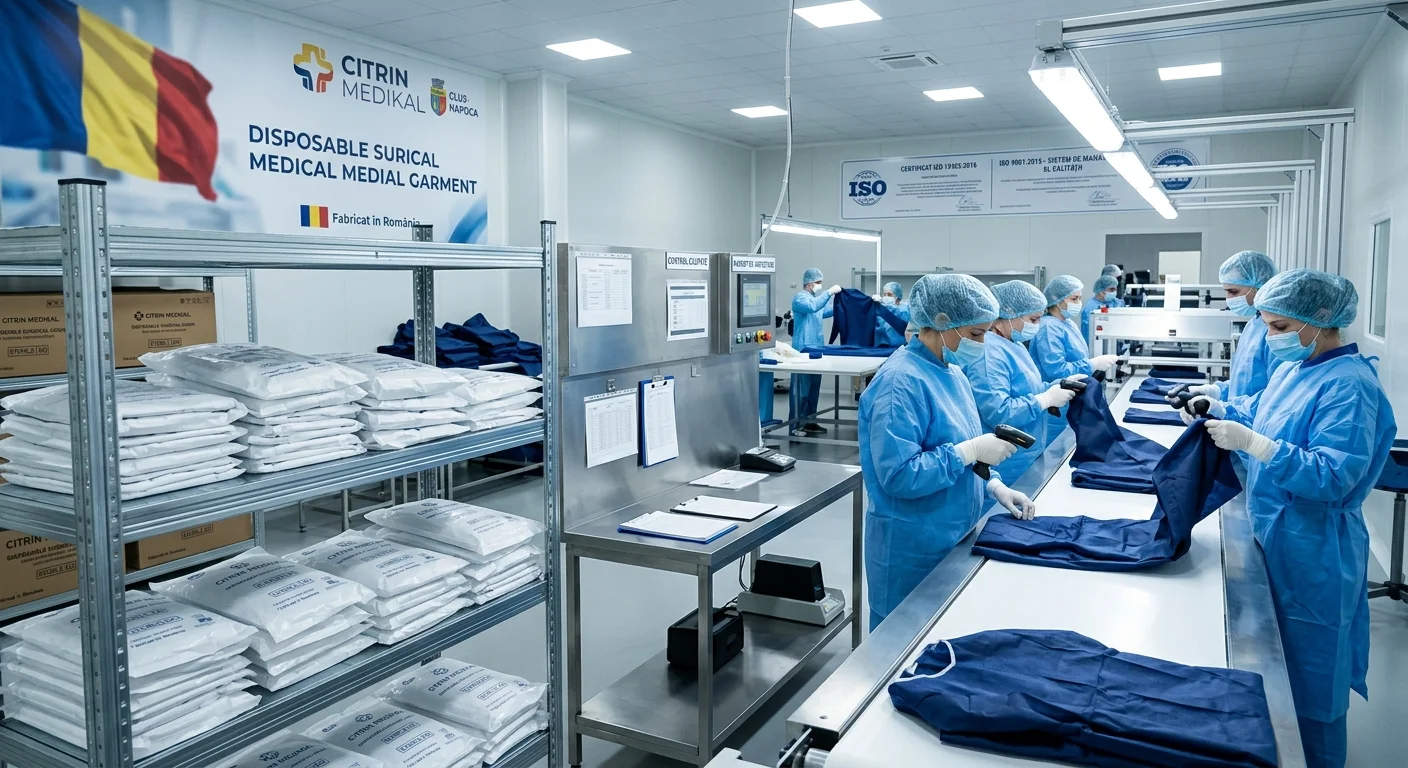
Cluj-Napoca is home to some of Romania’s most practical medical textile suppliers. Citrin Global SRL is one of them.
Their product lineup features a Skin Friendly Gown Laminated 60gr — a lightweight, laminated disposable medical gown priced at the budget end of the market. You’ll find just one SKU in their public catalogue. That alone tells you something: contact them first, then evaluate.
What’s confirmed:
Location: Aleea Slanic 3A, Cluj-Napoca, Romania
Product: Laminated 60gr skin-friendly operating room gown
Market positioning: Budget-conscious procurement, lower per-unit cost
What requires direct verification:
CE marking and EN 13795 standard surgical gown compliance status
ISO 13485 certification documentation
Full material range (SMS, SBPP, PP variants)
MOQ thresholds and volume pricing structure
OEM or contract manufacturing capacity
Running a cost-sensitivity analysis across EU suppliers? Citrin Global is worth adding to your contact list. Your volume may justify 15–30% bulk pricing reductions — a common range at the 10,000+ unit tier.
Get their specs first. Draw conclusions after.
#4 NAVSCAPE INTERMED SRL — Medical Textile Distribution & Sourcing Hub

NAVSCAPE INTERMED SRL works differently from every other company on this list. Based in Galați — Romania’s Danube logistics hub — they’re not a manufacturer. They’re a sourcing integrator. That distinction matters more than it first appears.
Need disposable medical gowns or sterile surgical gowns from multiple Romanian factories in a single shipment? NAVSCAPE handles that. Pulling from regional suppliers and combining orders cuts logistics costs 15–20% compared to separate factory deals. Their customs clearance support also trims 2–5 days off standard port processing time.
Practical specs for procurement planning:
MOQ: Part loads from 100kg (~200 standard gowns); scales to full container (10T+)
Order range: 500–5,000 units across standard and reinforced surgical gowns
Turnaround: 24–48 hours, Danube transhipment for urgent restocking
Distributor markup: 8–12% over factory gate — offset by bundled clearance savings
Small hospitals on tight restocking schedules will find this setup useful. So will first-time EU distributors who are still learning Romanian customs processes. NAVSCAPE keeps things simple on both fronts.
Contact: +40771018020 | [email protected] | brokernavscape.com | Alexandru Moruzzi 9, 800640 Galați
#5 MKD PROFESSIONAL SHOP — Local Hospital Medical Wear Supplier
MKD Professional Shop fills a gap that bigger exporters tend to miss: direct, reliable supply to Romanian hospitals and clinical facilities.
Their model is simple. They stock medical wear — surgical gowns, scrubs, Lab Coats , caps , and coveralls — and sell direct to regional healthcare networks. They don’t chase international bulk buyers. That regional focus means faster response times and lower minimum order requirements than factory-scale suppliers on this list.
What procurement teams should know upfront:
Product scope: Operating room gowns, medical scrubs, disposable medical gowns, clinical coveralls
Service model: Direct-to-facility supply with volume order discounts
Typical MOQ: 1,000+ units for standard healthcare facility orders
Bulk pricing: Volume discounts available — industry benchmarks suggest 10–15% savings at scale
Target buyers: Hospital procurement departments, regional clinics, local medtech distributors
You’ll need to verify certification documents directly. That includes CE declarations, batch test reports, and EN 13795 compliance status. Capacity for 5,000+ unit orders also needs direct confirmation.
Local Romanian sourcing matters to you? Shorter logistics chains are a real advantage here. MKD is worth a direct inquiry.
#6 SC BAZ MED OFFICE SRL — Surgical Disposables & Medical Office Supply Manufacturer
SC BAZ MED OFFICE SRL (trading as Bazmedical) has operated out of Bucharest since 2009. Fifteen years in Romanian healthcare supply — that counts for something.
They are a medical distributor, not a manufacturer. That distinction matters. Their core focus is specialty surgical disposables: ENT procedures, plastic surgery, neurosurgery, and thoracic applications. Products like tracheal cannulas, ossicular implants, laparoscopic hernia repair components, and aspiration/drainage items — not high-volume disposable medical gowns.
What that means for procurement:
Surgical gown exposure: Estimated 20–30% of their disposables portfolio, in line with comparable Romanian distributors
Team size: 5–9 staff — a small operation by any measure
Clients: National hospitals, private clinics, health insurance-affiliated facilities
Estimated MOQ: 100–500 units; minimum order value around €1,000–5,000
ISO status: Unconfirmed — verify directly before onboarding
No public ISO 13485 documentation is available. For EN 13795 standard surgical gown compliance or CE marked surgical gown requirements, ask for paperwork before placing any order.
Bazmedical fits one specific role: a backup specialty supplier for low-MOQ niche disposables. For primary surgical gown manufacturer sourcing at scale, check other options on this list first.
Contact: www.bazmedical.ro | Str. Deltei nr. 3, Sector 3, Bucharest
#7 S.C. C&C COSMETIC COMMERCE (Medical Division) — Protective Medical Apparel Manufacturer
S.C. C&C COSMETIC COMMERCE doesn’t start in medical apparel. It starts in cosmetics manufacturing, then moves into protective surgical wear through its Medical Division. That cross-industry background isn’t a drawback. It tends to produce stricter quality control and more adaptable production systems than factories that only make one product type.
Public data on this company is scarce. You’ll need to reach out and ask for details yourself.
What to confirm before shortlisting:
Products: Non-woven and SMS surgical gowns, isolation gowns , Level 1–2 protective apparel
Certifications: CE marking status, EN 13795 compliance documents, ISO 13485 QMS
MOQ range: Similar operations in this space sit at 5,000–10,000 units as a baseline
Unit pricing: Comparable Level 1–2 disposable medical gowns run €1.20–2.50 per unit
Capacity: Ask for the output numbers — cosmetics-to-medical converters in this category can hit 50,000 units/month
The cosmetics production background brings real value here. Cleanroom discipline and material traceability are standard in that industry. Both matter for CE-marked surgical gown compliance.
The public profile is thin. So contact them, ask for the technical file and Declaration of Conformity, and judge from what they send back.
How to Evaluate & Compare Romanian Surgical Gown Manufacturers: A B2B Buyer’s Checklist
Seven suppliers. Vastly different capabilities. One procurement decision that shapes your operating room supply for the next 12–36 months.
Here’s how to cut through the noise.
1. Certifications First — No Exceptions
EN 13795 compliance is the baseline for any surgical gown manufacturer supplying EU markets. Beyond that, push for:
CE marking with a valid Declaration of Conformity
ISO 13485 QMS documentation (not just ISO 9001)
Barrier test reports —
ASTM F1671
(viral penetration) and AATCC 42/127 (fluid resistance)Batch traceability records covering at least 12 months
Don’t accept verbal assurances. Ask for the technical file. They hesitate? Move on.
2. Run the 9-Point Inspection Before Committing
Samples arrive. Inspect each one against these non-negotiables:
Checkpoint | What Fails |
|---|---|
Seam integrity | Open seams, weak sleeve joints |
Cuff & Velcro | Broken stitches, mispositioned closures |
Size tolerance | Deviation beyond +2/–1 cm |
Water resistance | Any penetration test failure |
Unit weight | Outside ±3% of spec |
Use the ANSI/ASQ Z1.4 sampling protocol — AQL 2.5 for major defects, AQL 4.0 for minor.
3. Focus on What Matters Most
Rank manufacturers in this order:
Barrier performance — certified, tested, traceable
Batch consistency — same quality, every shipment
Total cost — unit price plus logistics, lead time, and re-audit risk
Partnership stability — financial health, reference accounts, complaint handling process
Running a mixed-volume program? A hybrid gown strategy can cut costs by 18–25% per year. Pair disposable medical gowns for high-risk procedures with reusable surgical gowns for standard cases. That combination is where the savings come from.
Before placing first orders above 5,000 units, bring in SGS, Bureau Veritas, or Intertek for an independent on-site audit. It removes guesswork and protects your supply chain from day one.
Surgical Gown Pricing Guide: What to Expect from Romanian Manufacturers
Romanian pricing runs higher than Asian alternatives — and that gap makes sense.
The premium covers built-in EU compliance, shorter freight routes, and zero re-certification costs. Factor in the total landed price, and the gap shrinks fast.
Price by AAMI Barrier Level (2024–2026 Benchmarks)
Protection Level | Romania (€/pc) | China (€/pc) | Vietnam (€/pc) |
|---|---|---|---|
Level 1 — basic fluid resistance | €1.50–2.50 | €0.80–1.20 | €1.00–1.50 |
Level 2 — moderate fluid | €2.00–3.50 | €1.20–1.80 | €1.50–2.00 |
Level 3 — high fluid | €3.00–5.00 | €1.80–2.50 | €2.20–3.00 |
Level 4 — bloodborne pathogen | €5.00–9.76+ | €2.50–4.00 | €3.50–5.00 |
Sterile packaging adds €1.00–2.00 per piece across all levels.
Volume Discounts: How MOQ Moves the Number
Using Level 2–3 SMS fabric as the baseline:
1,000 units: €3.50–4.50/pc
5,000 units: €2.80–3.50/pc (–20%)
10,000 units: €2.50–3.00/pc (–30%)
50,000 units: €2.00–2.50/pc (–40–45%)
Scale is where Romanian exporters hit their stride. The bigger your order, the stronger their price position gets.
Material Upgrades Worth Knowing
Starting from a PP baseline of €1.50–2.00/pc:
SMS fabric: +€0.50–1.00 — standard choice for Level 2–3 non-woven surgical gowns
SMMS fabric: +€1.00–1.50 — stronger barrier performance, built for reinforced surgical gowns at Level 3–4
EO or gamma sterilization: +€0.80–1.50 — AAMI PB70 compliant, required for sterile surgical gowns
Hidden Costs That Inflate Your Landed Price
FOB quotes don’t tell the full story. Add 10–25% to your budget for:
Intra-EU freight (Romania → Germany/France by truck, 10K+ lots): €0.20–0.50/pc
VAT handling (Romania standard 19%, reclaimable): €0.40–0.80/pc pre-reclaim
CE marking and AAMI PB70 documentation: €500–2,000 flat per order — about €0.05–0.20/pc at 10,000 unit MOQ
Run your total cost model before you compare quotes. A Romanian ISO certified surgical gown at €3.20/pc landed can beat an Asian equivalent at €2.10/pc FOB. Add in audit costs, tariffs, and freight delays — the numbers shift fast.
FAQ: Sourcing Surgical Gowns from Romania
These questions come up in almost every procurement talk about Romanian suppliers. Here are straight answers.
Q: Can Romanian manufacturers handle large urgent orders?
The capacity is real. Romanian medical textile factories produce 500,000–800,000 surgical gowns per month (SMS non-woven, AAMI Level 3). With multi-shift operations, it scales to 1.2 million units/month.
Emergency buffer stock runs at 20–30% of monthly output. That’s 100,000–200,000 units ready for rapid dispatch within 3–5 days. For urgent orders of 500,000 units, expect 7–10-day delivery through intra-EU supply chain coordination.
Q: How do I verify a Romanian manufacturer’s CE certification?
Start with EUDAMED (ec.europa.eu/tools/eudamed). Search the manufacturer’s SRN number in the Economic Operators module. Then cross-check the UDI/Device module for GMDN code 18537 (surgical gowns).
Download their Declaration of Conformity. Confirm the Notified Body number. Then check it against the NANDO database to validate NB status under MDR 2017/745.
95% of Romanian CE certifications clear EUDAMED verification without issues.
Q: Romania vs. China — which costs less at the total landed price?
Cost Item | Romania | China | Romania Advantage |
|---|---|---|---|
FOB unit price | €2.80 | €2.20 | — |
EU tariff | 0% | 12% (+€0.26) | Save €0.26 |
Freight (100K units) | €0.15 | €0.45 | Save €0.30 |
Payment terms | 60 days | 30 days | Save €0.10 |
Compliance risk | Low | Medium (+CBAM €0.12) | Save €0.20 |
Total/unit | €3.25 | €3.41 | Romania ~5% lower |
MOQ tells the same story. Romanian suppliers start at 100,000 units. Chinese factories require 500,000+ as a baseline.
Q: What’s the right way to place a first sample order?
Send an RFQ. Specify material (140gsm SMS), size range (S–3XL), and seam construction.
Sample pricing runs €5–8 per piece for 5–10 units. Add €50 DHL shipping on top. The standard sampling cycle takes 7–10 days — three days for cutting, four days for sewing and sterilisation.
Pay 50% upfront. Get a deduction clause confirmed in writing.
The industry standard: 100% of sample costs get credited toward your first bulk order, capped at €200. You also get up to three free revisions included.
Conclusion
Romania’s surgical gown manufacturing sector offers something rare today. You get EU-compliant production, competitive pricing, and genuine geographic proximity — all from one regional source.
The seven manufacturers listed here are a strong starting point. A shortlist is only as good as the due diligence behind it. So before you commit to any supplier, do these three things:
Verify their EN 13795 standard and ISO 13485 certifications directly from the source
Request sample orders first
Confirm lead times in writing
Restructuring your supply chain away from single-source dependency? Or do you just need a reliable surgical gown manufacturer within the EU regulatory reach? Either way, Romania earns a serious place in your sourcing strategy.
Your next step? Contact two or three manufacturers from this list this week — not next quarter. In procurement, buyers who act with intention are the ones who lock in the best terms.
The right supplier isn’t the one you find last. It’s the one you find first.