You’ve seen both SMS and SMMS fabric specs while sourcing nonwoven materials. The difference between the two can feel unclear — and that’s a common issue. These two polypropylene nonwoven structures look almost the same on the surface. Yet the gap in performance, cost, and application fit is large enough to change a product decision entirely.
One extra meltblown layer shifts the whole picture. It affects barrier strength, filtration efficiency, and how the material holds up in real conditions.
Buying materials and need a solid sourcing call? Weighing a material upgrade? Or just want to know what these fabric specs mean? This breakdown cuts through the confusion and gives you clear, straight answers.
SMS vs SMMS Fabric: Layer Structure Comparison
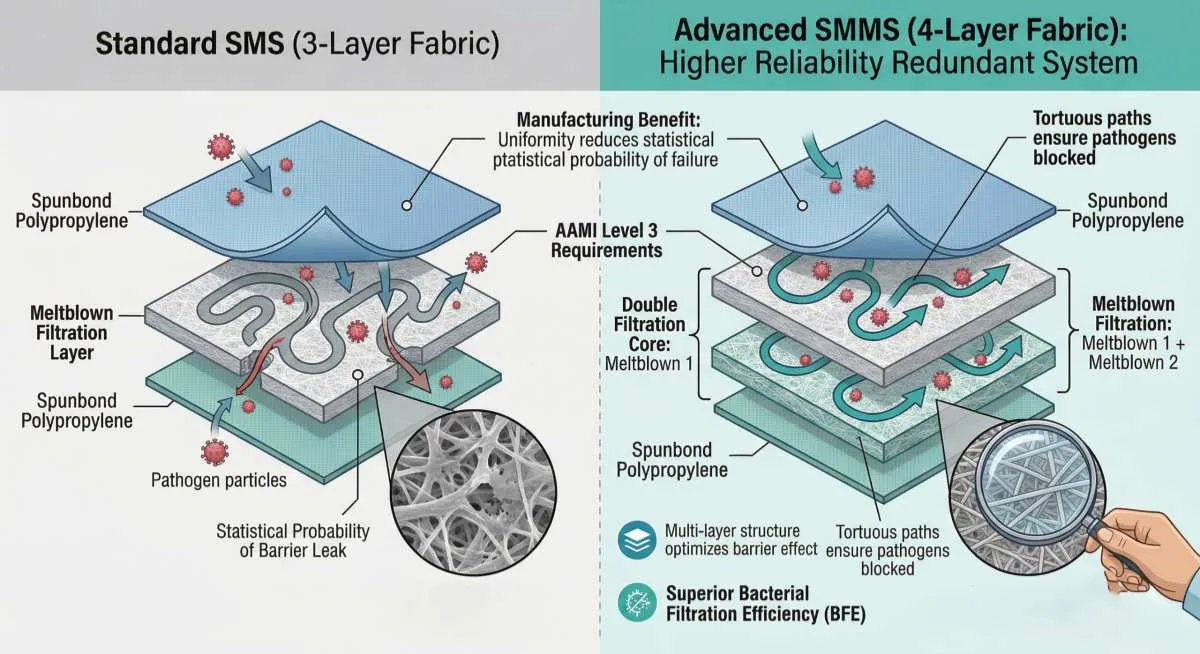
Strip both fabrics down to their core, and the difference comes down to a single layer.
SMS follows a three-layer sequence: Spunbond – Meltblown – Spunbond (S–M–S) . The two outer spunbond layers provide tensile strength and surface integrity. One meltblown layer sits in the middle, handling filtration.
SMMS adds one more meltblown layer: Spunbond – Meltblown – Meltblown – Spunbond (S–M–M–S) . Same outer shell. Two filtration layers instead of one.
SMS: [ S ] [ M ] [ S ] ← Single-core sandwich
SMMS: [ S ] [ M ] [ M ] [ S ] ← Dual-core sandwich
That extra M layer isn’t just redundancy — it creates a staged filtration system. The first meltblown layer catches larger droplets and particles. The second layer catches what slips through. Together, they deliver better filtration than a single thicker meltblown layer at the same GSM weight. Two thin layers working in sequence outperform one thick layer doing the job alone.
Here’s how the two structures compare:
|
Property |
SMS (S–M–S) |
SMMS (S–M–M–S) |
|---|---|---|
|
Total Layers |
3 |
4 |
|
Meltblown Layers |
1 |
2 |
|
Filtration Efficiency |
Moderate |
High |
|
Liquid Barrier |
Good |
Excellent |
|
Breathability |
High |
Moderate |
One caveat worth keeping in mind: more layers don’t mean better protection on their own. What drives barrier performance is the quality of the meltblown layers — fiber fineness, uniformity, pore structure, and bonding method. The dual-M design in SMMS works because of how those two layers interact with each other. Having two layers is not enough. How those layers are built and bonded is what makes the difference.
Performance: Protection, Filtration & Water Resistance
Let’s compare fabrics of the exact same weight. SMMS beats SMS in every safety test. One extra filter layer gives you a massive boost in real-world protection.
Liquid Protection
Think about fluid capacity before leaks happen. SMS works well for basic medical tasks and light fluid exposure. Heavy fluid situations like high-risk surgeries require SMMS. It handles much more fluid pressure. This fabric meets strict rules for advanced surgical gowns . It does this without failing under pressure.
Filtration: Blocking Germs
The double meltblown layer in SMMS adds more than just thickness. It builds a dense maze for particles. Tiny bacteria or viruses might slip past the first layer. The second layer sits right there to catch them. Standard SMS blocks about 95% of particles. SMMS pushes this trap rate over 99%. You get near N95-level safety as part of a complete protective suit.
Fewer Weak Spots
A high filtration average loses its value with a tiny thin spot in the fabric. SMMS brings a major advantage here. Its two inner layers back each other up. One layer might run thin in a specific spot during manufacturing. The second layer covers that exact gap. You see fewer defects. The people wearing the suits enjoy much more reliable protection.
Breathability vs. Protection
Adding more barriers often makes a fabric hot and stuffy. SMMS balances both needs well. It uses two thin, well-structured filters instead of a single thick one. This setup increases safety. At the same time, it keeps airflow moving. This smart design helps medical staff stay cool. They remain comfortable and focused during long shifts.
Softness & Comfort: Where SMS Has the Edge
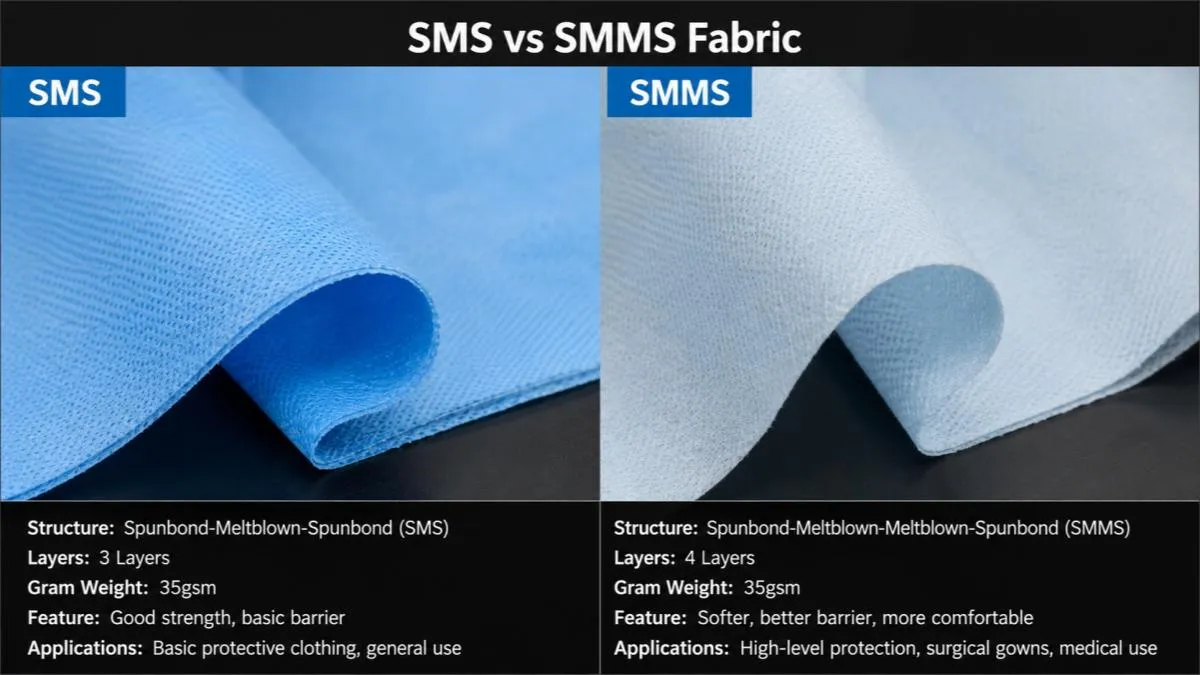
Protection isn’t the only thing a material has to do. It has to be wearable.
SMS earns its place here. SMMS has superior filtration — but that doesn’t make it the right choice for every application.
What does that mean at the skin level?
In controlled studies, medical staff wearing SMS surgical gowns report lower perceived heat and moisture buildup than those wearing Microporous alternatives. The pattern holds: microporous garments draw complaints of “stuffy and damp” after two to three hours of continuous wear.
SMS at 30–43 gsm runs cooler. Internal skin temperature runs 0.5–1.5°C lower than film-laminate designs. These results come from 4–8 hour wear tests at standard OR conditions — 22–26°C, 50–70% relative humidity.
That gap matters in real operating environments:
– It affects focus
– It affects compliance
– It affects whether staff wear the garment the right way for the full shift
Softness: Structure Drives the Feel
The softness advantage in SMS isn’t accidental — it’s structural.
The outer spunbond layers use coarser fibers (1.5–3.0 dtex). The middle meltblown layer uses ultra-fine fibers — 1–5 µm in diameter. That combination makes SMS feel softer than a single spunbond layer on its own. The meltblown core is more pliable. It adds suppleness to the layered structure that pure spunbond can’t match.
Finishing processes push this further. Medical-grade SMS uses point embossing and low-temperature thermal bonding. Both reduce surface stiffness without giving up strength. For hygiene products like diapers and feminine care items, additional skin-conditioning treatments bring the hand feel close to textile-grade softness — while keeping the structural integrity the product needs.
Microporous laminates are a different story. The film’s surface tends to feel stiff, slightly rough, and crinkly when the wearer moves. No finishing treatment makes up for a solid PE coating.
The SMMS Workaround
Filtration demands require SMMS, but comfort still matters? The answer is weight management.
A 25–35 gsm SMMS built as S(8)–M(7)–M(7)–S(8) holds BFE and liquid barrier ratings at EN 13795 / AAMI Level 3–4. At the same time, it keeps air permeability above 60–120 L/m²·s — well above microporous benchmarks.
Two thin, fine-fiber meltblown layers spread resistance more evenly than one thick layer. Pressure drop stays controlled. Filtration uniformity stays intact.
The bottom line: comfort, extended wear, and softness point to SMS as the default — for good reason. The breathability advantage is real and measurable. It comes straight from the structural simplicity of the single meltblown core.
Cost Comparison: SMS vs SMMS Fabric Price Difference
One extra meltblown layer costs money. That’s the short version. Here’s the longer one.
SMMS costs more than SMS at every production scale. Not because of markup — because of structure. Adding a second meltblown deposition head puts more equipment on the line. It increases polymer throughput, raises energy use per meter, and spreads higher capital costs across every roll that ships. None of that goes away at the negotiating table.
What’s Driving the Price Gap?
The cost difference isn’t random. It comes down to three specific factors:
-
Extra meltblown layer : Two M layers use more meltblown capacity than one. Equipment runs harder. Energy draw goes up.
-
Line complexity : SMMS production lines run at widths of 1.6 m, 2.4 m, and 3.2 m with speeds up to 350 m/min. They carry higher capital and maintenance costs than comparable SMS lines.
-
Output economics : Commercial SMMS lines produce 10–22 tons/day depending on scale. That’s heavy capital investment. Fixed costs per square meter stay high unless volume is large.
The Sourcing Decision in Plain Terms
SMS is the cost-efficient default. For disposable medical, hygiene, and general protective uses that don’t need maximum barrier performance, it gives you a solid price-to-performance ratio. You’re not paying for capability you won’t use.
SMMS earns its premium only when the spec calls for it — stronger liquid resistance, better antibacterial barrier, tighter uniformity across the web.
Requesting quotes? Don’t compare the roll price. Compare on:
-
Price per kg
-
Price per m²
-
Barrier requirement achieved at the target GSM
-
Yield loss and trim waste based on roll width
A wider roll (up to 320 cm for SMS, 3.2 m for SMMS lines) cuts slitting waste in high-volume operations. That saving can close some of the per-meter price gap between the two structures.
The rule is straightforward. Your product spec doesn’t need high liquid barrier performance? SMS keeps the total cost lower. It does? The SMMS premium is built into the structure — it’s the price of that second meltblown layer doing real filtration work.
SMS Nonwoven Fabric Applications: Where It’s Used
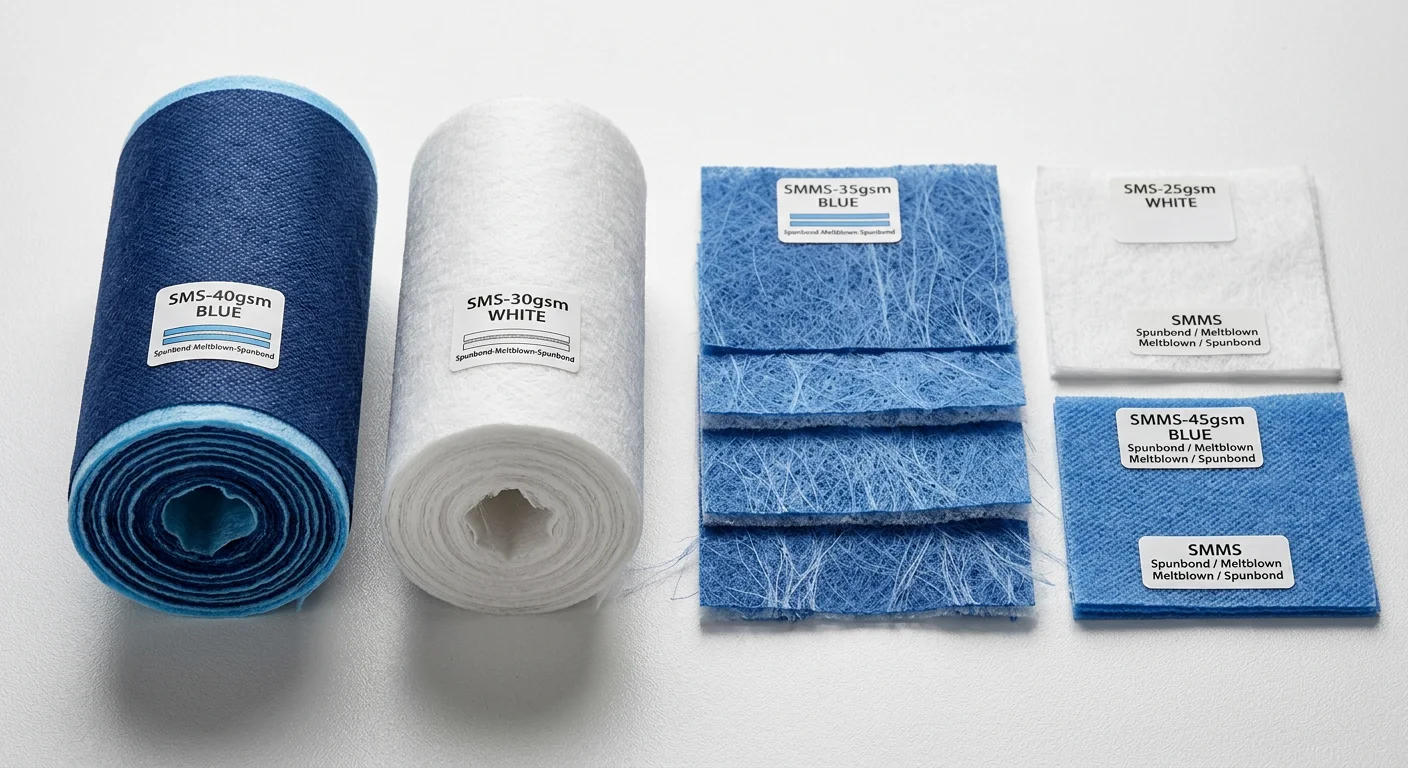
SMS fabric shows up everywhere — and most people don’t realize it.
The three-layer structure covers a wide range of industries. You get enough barrier protection for medical and hygiene use, enough breathability and softness for skin contact, and a low enough cost to work at a disposable-product scale.
Medical Use: Low to Mid-Level Protection
In clinical settings, SMS is the go-to material for AAMI Level 1–2 applications. Protection matters in these scenarios, but maximum barrier performance isn’t the primary spec.
-
Disposable isolation gowns and light surgical gowns : 25–40 gsm SMS handles general patient contact and limited splash exposure. Level 1 scenarios (ward rounds, outpatient visits) use 25–30 gsm. Level 2 scenarios (blood draws, suturing, ICU visits) step up to 30–40 gsm.
-
Surgical caps , shoe covers, and boot covers : Standard 25–40 gsm SMS. It blocks particles, costs less, and stays soft enough for extended wear.
-
Disposable bed sheets and surgical drapes : 25–40 gsm SMS with optional hydrophilic treatment for absorbent surface applications.
-
Medical masks and lab coats : The meltblown core delivers BFE ≥ 95%. Outer spunbond layers add moisture resistance and structural support.
Hygiene Products: The High-Volume Default
This is where SMS tonnage moves most. Thin-grade SMS — 10–25 gsm — leads the hygiene sector. It solves two competing problems at once: liquid barrier and breathability, at disposable-product unit economics.
-
Baby diaper backsheets : Pampers, Huggies, and comparable brands use SMS as the breathable, leak-resistant backsheet layer. Thin SMS replaces traditional PE film and cuts heat buildup. That’s a direct comfort upgrade at a comparable cost.
-
Sanitary napkin backing and leak guards : 10–20 gsm SMS replaces PE film in the backsheet and side-barrier components. It reduces heat buildup and improves wearability — a clear advantage for comfort-focused product lines.
-
Adult incontinence pads and care sheets : 10–25 gsm for breathable backsheet layers. For disposable care bed pads, 25–40 gsm is standard, often combined with fluff pulp for absorption.
The hygiene segment alone holds a large share of the global SMS market — estimated at ~$4.5 billion in 2023. Hygiene and medical applications together make up the majority of the total volume.
Industrial and Protective Uses
Heavier SMS grades — 25–55 gsm and above — cover industrial protective clothing , filtration, and durable surface covers.
-
Industrial workwear and protective coveralls : 25–50 gsm SMS is the standard spec for dust-controlled environments: electronics manufacturing, food processing, and light chemical facilities. Add anti-static or triple-barrier treatment (alcohol/blood/oil-repellent), and it handles most Level 1–2 industrial splash scenarios.
-
Filtration media : Heavy-grade SMS (>55 gsm) works as an industrial gas and liquid filtration material. Automotive oil mist filtration runs at 80–100 gsm. Industrial dust bags, HVAC pre-filters, and oil absorption applications all use high-GSM SMS for mechanical strength and capture capacity.
-
Disposable tablecloths, equipment covers, and agricultural sheeting : UV-treated SMS covers vehicles, furniture, and crop surfaces. It beats paper on tear resistance and beats woven covers on unit cost. That makes it a solid one-use material for hospitality, logistics, and outdoor applications.
-
Cleanroom apparel : Anti-static treated SMS is the top material choice for ESD-safe coveralls, lab coats, and shoe covers in semiconductor and precision manufacturing facilities.
The pattern across all these applications stays consistent. SMS earns its place where the spec calls for a breathable, lightweight, cost-efficient barrier — not maximum filtration. Past that threshold, the conversation shifts to SMMS.
SMMS Nonwoven Fabric Applications: Higher Protection Use Cases
SMS has its limits. SMMS picks up where SMS stops.
Those limits show up in specific places: operating rooms, high-exposure isolation wards, surgical drape systems, and any setting where one barrier failure carries serious consequences. SMMS was built for exactly these environments.
High-Risk Medical: AAMI Level 3–4 Territory
Surgical gowns, surgical drapes, and high-barrier isolation apparel are where SMMS demand is strongest. The dual meltblown layer isn’t just a spec upgrade. It’s what pushes a material past the AAMI Level 3 threshold — reliably, every time.
High-splash surgical settings are a good example. Think orthopedic procedures, trauma response, and open-cavity surgery. Blood and body fluid exposure isn’t a risk here. It’s a certainty. SMMS is built to handle it:
-
The outer spunbond layers take on mechanical stress.
-
The two meltblown layers block liquid and microbial penetration from reaching the wearer.
That’s the full system working together.
Level 4 scenarios go further — bloodborne pathogen exposure, infectious disease containment, and virus-present environments. For these, SSMMS (five-layer) structures are the answer. Each added meltblown layer creates a tighter fiber network. You get fewer penetration pathways and higher VFE ratings across the board.
Premium Hygiene Products
SMMS also serves high-performance hygiene products. Baby diapers, adult incontinence products, feminine care items — these all need strong leak protection and skin comfort at the same time. SMMS delivers both.
The weight range runs from 8–80 gsm. That covers a lot of ground:
-
Ultra-thin facing layers for soft, skin-contact applications
-
Heavier backsheet constructions where barrier demands are stricter
The four-layer structure cuts leak risk without the stiffness you get from film laminates. Add hydrophobic or anti-static finishing, and it fits right into premium infant and adult care lines. Zero margin for leakage — that’s the standard, and SMMS holds it.
Industrial Protective Clothing
SMMS also covers cleanroom coveralls , chemical-resistant workwear, and sterile-environment apparel. The dual meltblown core pushes particle and liquid barrier performance beyond what SMS can offer. At the same time, the garment stays lighter and more breathable than woven or laminate alternatives.
For facilities where contamination control is non-negotiable, that difference is real and practical. Staff wear protective clothing for full shifts. Weight and breathability directly affect how well they can do their jobs. SMMS gives you strong protection without the bulk. That’s the balance facilities actually need.
How to Choose Between SMS and SMMS: Decision Guide for Buyers
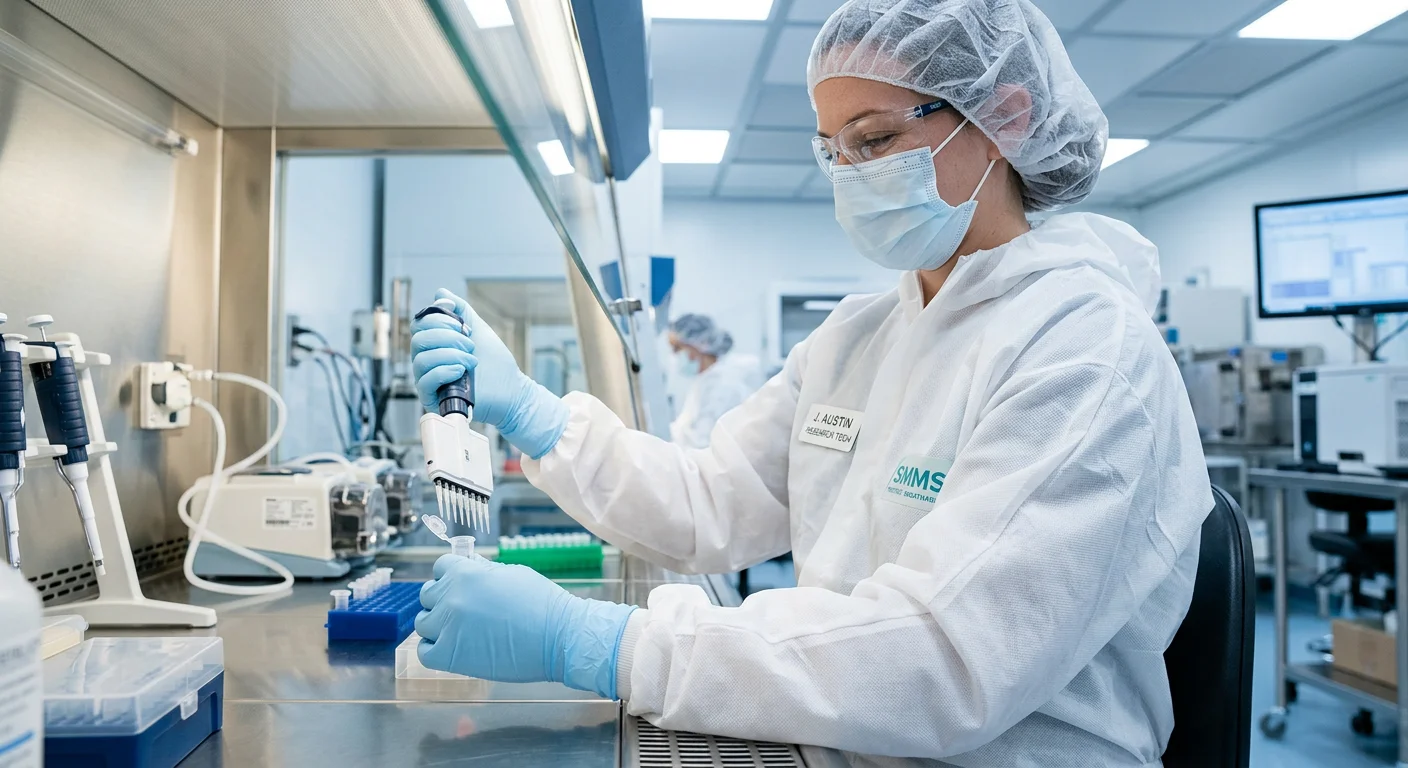
The wrong material choice doesn’t announce itself at the sourcing stage. It shows up later — in a failed certification test, a strike-through incident, or a product return from a hospital procurement team.
Three variables drive this decision. Get them right, and the choice becomes straightforward.
Variable 1: Protection Level Required
Match your material to the risk environment, not to the price sheet.
-
Low risk (outpatient visits, ward rounds, visitor access): AAMI Level 1–2 is the target. SMS at 15–30 gsm covers it. No reason to pay for dual meltblown performance you won’t use.
-
Moderate risk (emergency procedures, standard clinical operations, occasional splash exposure): Level 2, low-end Level 3. Budget allows? Go SMMS at 25–40 gsm . Is the budget tight? SMS at 25–35 gsm works — consider localized PE coating on critical zones.
-
High risk (operating rooms, ICUs, infectious disease wards, trauma response): Level 3–4, no compromise. Use SMMS or SMMMS at 35–60 gsm . The dual meltblown core does real structural work here. It’s not just ticking a spec box.
Variable 2: Wear Duration
Breathability becomes a bigger issue the longer a garment is worn. A material that feels fine at hour two can turn into a compliance problem by hour six.
-
Under 2 hours : Comfort and cost lead. SMS 15–30 gsm handles most non-surgical scenarios without trouble.
-
2–6 hours with fluid exposure risk : Move to SMMS 25–40 gsm. The barrier holds longer. The wear experience stays manageable.
-
6+ hours : You need both — barrier and breathability. Go with high-performance SMMS 30–45 gsm built with fine-fiber meltblown construction. Choosing SMS for extended wear? Don’t go below 30–40 gsm. Also, confirm the fabric has proper breathability finishing before committing.
Variable 3: Budget Allocation
SMMS runs 10–30% higher per square meter than SMS at equivalent GSM and width. That price gap is built into the production process — it reflects the extra deposition head, higher polymer throughput, and greater line complexity. No amount of negotiation closes it.
The practical approach: tier your material by role.
|
Staff Category |
Recommended Material |
Typical GSM |
|---|---|---|
|
Surgeons, ICU staff, high-risk ward |
SMMS / SMMMS |
35–60 gsm |
|
General clinical (nurses, technicians) |
SMMS |
25–40 gsm |
|
Administrative, logistics, visitors |
SMS |
15–25 gsm |
Spending the SMMS budget on visitor gowns is a waste. Putting SMS on an orthopedic surgeon is a risk. The right call is right-sizing — not defaulting to one material across the board.
The Short Version
Choose SMS for these conditions:
– Protection need is Level 1–2
– Wear time is under four hours
– Fluid exposure is minimal
– Cost efficiency is a priority
Choose SMMS for these conditions:
– The application demands Level 2–3 or higher
– Fluid splash is a real scenario
– Wear extends across a full clinical shift
– The end product must pass multi-point hydrostatic testing with consistent results
No protection level on the spec sheet? Ask for one. Sourcing nonwoven fabric without a target AAMI or EN 13795 rating is a direct path to a material mismatch. That problem shows up after production — not before.
Conclusion
SMS vs. SMMS — the difference is clear once you see what’s happening inside those thin, weightless layers.
Need everyday softness, breathability, and lower cost? SMS is your answer. Working in medical, surgical, or high-exposure environments? Meltblown layer filtration and barrier integrity are critical there. SMMS handles both — and it’s worth the premium price.
Most buyers get this wrong. They treat SMS and SMMS as the same thing. They’re not. Picking the wrong spunbond meltblown fabric hits more than just performance. It puts trust, compliance, and the people using your product at risk.
So before your next order, ask one simple question: what does this material need to do?
That answer points you to the right fabric — every time.
→ Explore our full range of nonwoven fabric solutions, or contact our team to get a sample matched to your exact specification.