Your first nonwoven fabric machine purchase can go wrong fast without the right knowledge. It’s an expensive lesson.
The market is packed with machine types — spunbond, meltblown, needle punch, and more. Each one targets different materials, output levels, and budgets. Pick the wrong fit, and you’re stuck with a machine that can’t keep up with your production. Or you’ve overspent on capacity you’ll never actually need.
This guide cuts through the noise. Are you a first-time buyer trying to get your bearings? Or a procurement manager comparing specs across suppliers? Either way, you’ll finish with a clear framework for making a smart, cost-effective decision — before you reach out to a single manufacturer.
What Is a Nonwoven Fabric Machine? (And Why the Definition Matters for Buyers)
The industry doesn’t tell you this upfront: “nonwoven fabric machine” covers two very different types of equipment. Mixing them up is one of the most costly mistakes a first-time buyer can make.
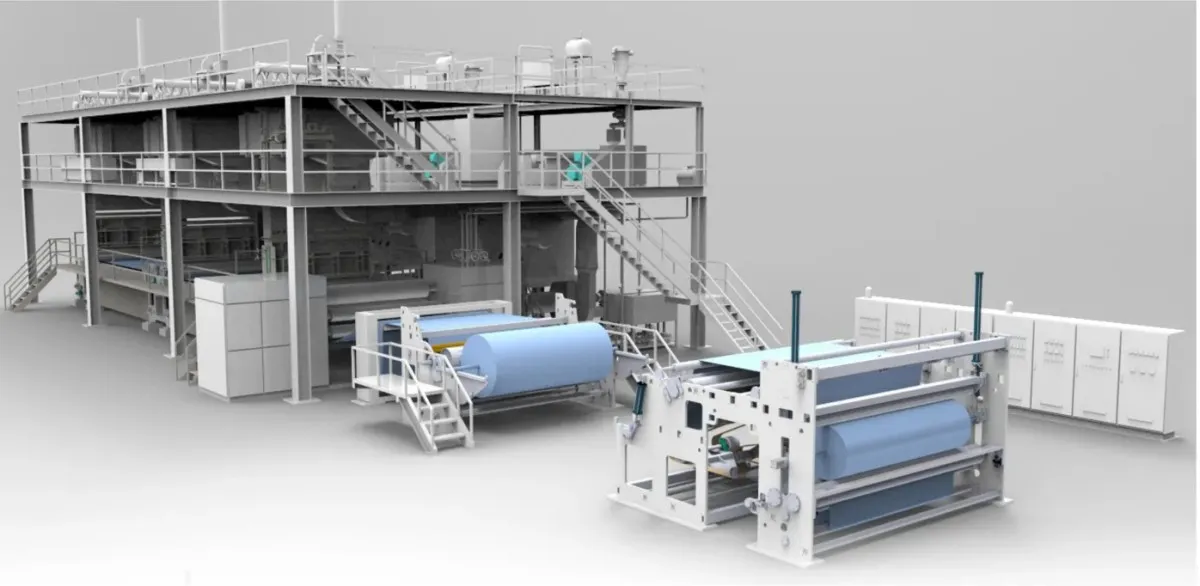
Production lines transform raw materials — PP pellets, polyester fibers — into large rolls of fabric. Think spunbond nonwoven machines, meltblown nonwoven machines, and needle punch nonwoven machines. Input: raw polymer. Output: fabric rolls.
Converting machines take those finished rolls and cut, fold, seal, and package them into end products — bags, wipes, masks .
The price gap between these two paths is massive:
-
A nonwoven production line (e.g., 3.2m spunbond) runs USD 2–8 million
-
A converting machine starts around USD 20,000–400,000
Get this wrong, and your entire investment plan falls apart before production even starts.
The 4 Main Types of Nonwoven Fabric Making Machines Explained
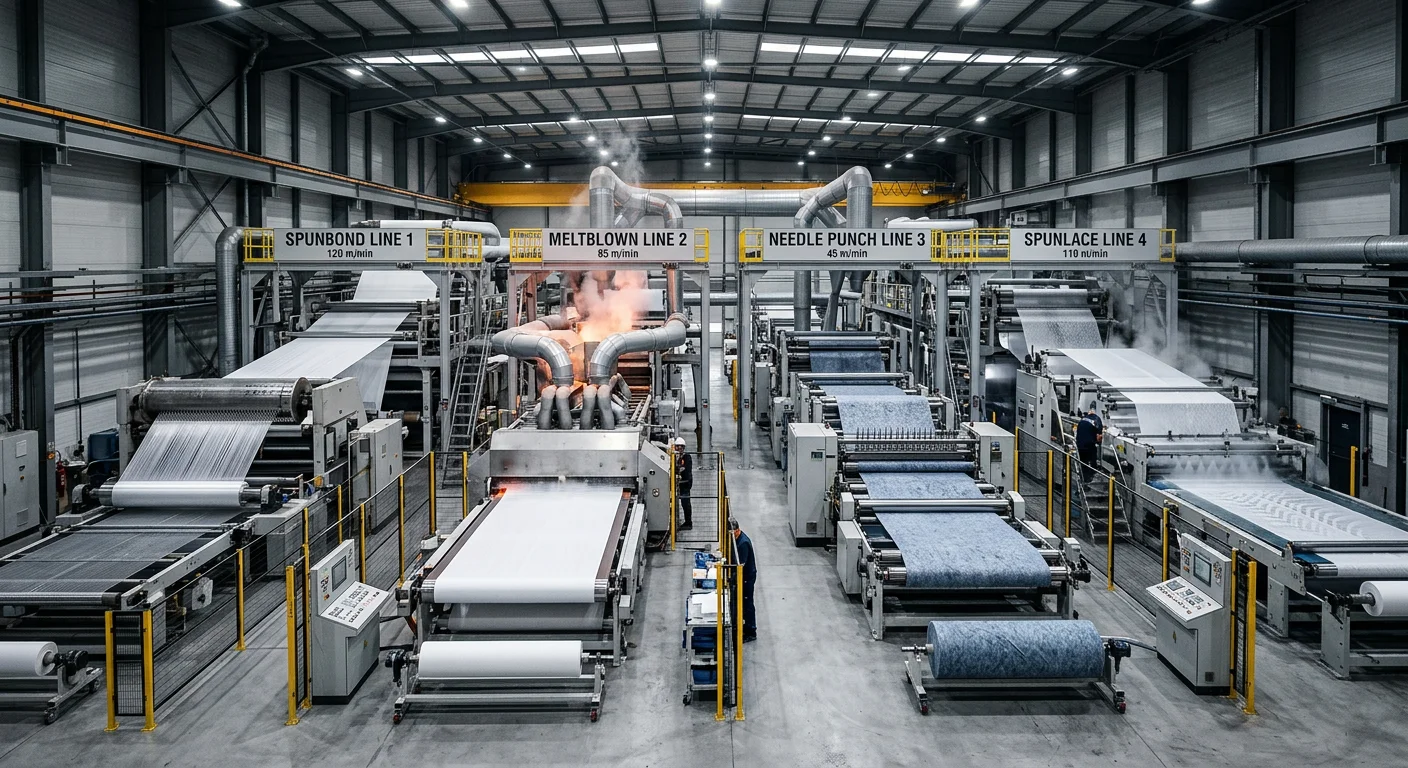
Four machines dominate this industry. Each one solves a different problem — and picking the wrong one doesn’t just cost you money. It costs you months.
Here’s how each one works, what it produces, and what you should expect to spend.
1. Spunbond Nonwoven Machine — The Workhorse
Think of spunbond like a pasta machine crossed with a fishing net. PP pellets melt into liquid polymer. The liquid gets pulled through tiny holes into long, continuous filaments. Those filaments land on a moving belt and bond into fabric using heat.
What it makes: Shopping bags (40–100 g/m²), agricultural covers, medical gowns , diaper backing layers — anything that needs high volume at low cost.
Investment range: – Small lab-scale line (1.6m): ~USD 300,000–600,000 – Standard industrial line (2.4–3.2m): ~USD 800,000–2,000,000 – Multi-layer SMS /SSMMS lines: USD 2,000,000–5,000,000+
This is the most common starting point for first-time buyers. The technology is mature. Spare parts are easy to source. And the learning curve is more manageable than with the other three machines on this list.
2. Meltblown Nonwoven Machine — The Filter Specialist
Same starting point as spunbond — melted PP — but a very different process from there. Ultra-high-speed hot air blasts the molten polymer through tiny nozzles. The result is fibers just 2–4 microns wide. That’s about 1/20th the diameter of a human hair.
You get a dense, cloud-like web with strong filtration performance. N95 masks, HVAC filters, and oil-absorption pads all use meltblown as their core functional layer.
Investment range:
– Standalone narrow line: USD 200,000–800,000
– Integrated into SMS composite lines: USD 2,000,000–5,000,000 total
One direct warning: this machine is not a good fit for zero-experience buyers operating alone. Die head precision and electrostatic charging control both need real technical depth. Plan for experienced staff or strong supplier support.
3. Needle Punch Nonwoven Machine — The Industrial Builder
No heat. No chemicals. Thousands of barbed steel needles punch up and down through loose fiber webs at hundreds of strokes per minute. This action tangles the fibers into dense, durable felt.
What it makes: Geotextiles (200–800 g/m²) for road and rail construction, carpet backing, automotive interior linings, and industrial filter bags. These are structural, heavy-duty materials — not soft consumer goods.
Investment range:
– Mid-range lines: USD 300,000–1,000,000
– High-end setups with thermal bonding or impregnation finishing: USD 1,000,000–3,000,000
Best fit: buyers who already have connections in construction, civil engineering, or automotive supply chains. Without an existing sales channel, this machine is a harder first step.
4. Spunlace (Hydroentanglement) Nonwoven Machine — The Premium Play
High-pressure water jets do the bonding here — no needles, no heat. The fabric comes out soft and textile-like. That’s why baby wipes, facial masks, and medical dressings use it.
Here’s how it works: fiber webs (usually viscose/polyester blends) pass under multiple rows of fine water jets at pressures up to 100+ bar. Water rebounds off the mesh below and tangles fibers from both sides at once.
Investment range:
– Basic line: USD 1,500,000–3,000,000
– High-speed wide-format lines (3.0–3.5m): USD 3,000,000–7,000,000
This is the highest entry barrier of the four. But personal care and medical consumable buyers pay stronger margins. The numbers can work — as long as you have stable, large orders confirmed before you start.
Quick Comparison: Which Machine Fits Your Situation?
|
Machine Type |
Typical Products |
Entry Difficulty (1–5) |
Estimated Investment (USD) |
Best For |
|---|---|---|---|---|
|
Spunbond |
Shopping bags, farm covers, medical gowns |
2–3 |
300K–5M+ |
First-time buyers, high-volume basic materials |
|
Meltblown |
Mask filters, air filtration, oil absorbents |
3–4 |
200K–800K (standalone) |
Filter companies, experienced operators |
|
Needle Punch |
Geotextiles, carpet, auto linings |
3 |
300K–3M |
Industrial/construction supply chains |
|
Spunlace |
Wet wipes, facial masks, and medical dressings |
4–5 |
1.5M–7M |
Premium consumer/medical markets with confirmed orders |
Fabric-Making Line vs. Converting Machine: Which One Do You Need?
Most people searching for a “nonwoven fabric machine” don’t realize they’re standing at a fork in the road. The two paths lead to very different businesses.
One question cuts through everything: Are you selling fabric rolls, or finished products?
Path A: Nonwoven Production Line (Sell the Fabric)
You buy PP pellets. Your spunbond nonwoven machine or needle punch nonwoven production line turns them into large fabric rolls. Then you sell those rolls by the ton to bag factories, garment makers, and disposable manufacturers.
The economics are straightforward — and tight:
– Gross margins run 10–20% on standard bulk fabric
– Your business lives and dies by volume, equipment uptime (target: 85–95% utilization), and raw material costs
– A 5–10% swing in PP pellet prices cuts straight into your margin
Capital commitment is heavy:
– Equipment alone: USD 500,000–1,500,000 for a basic 1.6–3.2m spunbond line
– Factory infrastructure, utilities, and warehousing: add another USD 200,000–500,000
– Total starting budget: USD 700,000–2,000,000
You’ll also need 3,000–5,000 m² of factory space. Ceiling heights must hit ≥6m. Electrical capacity often runs 300–800 kW. Add steam, cooling water, and environmental compliance systems on top of that.
The staffing demand is just as serious. One basic production line needs 20–50 people across operations, maintenance, quality control, and logistics. Every idle hour costs hundreds — sometimes over a thousand dollars — in lost output and fixed costs that keep running whether the line moves or not.
Path B: Converting Machine (Buy the Fabric, Sell the Product)
You buy finished fabric rolls from suppliers. Your converting machine cuts, folds, seals, and prints them into bags, wipes, or medical dressings. Then you sell finished goods to brands, retailers, and distributors.
The economic shift in your favor:
– Gross margins land at 20–40%, and customization pushes them higher
– Smaller orders, more SKUs, faster cash cycles
Capital requirements drop sharply:
– One mid-range automatic nonwoven bag machine: USD 15,000–40,000
– Add a simple printing unit and slitter: total startup package around USD 30,000–80,000
– Rent deposit plus initial fabric inventory: another USD 20,000–70,000
– Total: a small converting factory can open for USD 50,000–150,000
The space and power needs are much smaller, too. Standard industrial space at 150–400 m² works fine. The ceiling height of 3–4m is enough. Total electrical load sits at just 50–150 kW. One automatic bag machine runs on 10–25 kW and needs 1–2 operators per shift.
For first-time buyers with limited capital, converting is the lower-risk way in. New operators reach independent production within 2–4 weeks of training. The process follows clear SOPs — temperature, speed, and weld settings. No deep textile engineering background needed.
The Decision Framework
|
Factor |
Production Line (Fabric) |
Converting Machine |
|---|---|---|
|
Starting Capital |
USD 700K–2M+ |
USD 50K–150K |
|
Factory Space |
3,000–5,000 m² |
150–400 m² |
|
Team Size |
20–50 people |
6–12 people |
|
Gross Margin |
10–20% |
20–40% |
|
Learning Curve |
Steep |
Manageable |
|
Cash Flow |
Long cycle (30–90 day terms) |
Shorter, more flexible |
|
Best For |
Scaled industrial operations |
First-time buyers, small teams |
The rule is simple. Confirmed downstream buyers for large fabric volumes? A nonwoven production line makes sense. Still building your customer base and need flexibility? Start with converting equipment. Prove the market. Generate cash flow. Scale into fabric production once the numbers justify it.
7 Key Factors to Evaluate Before You Buy a Nonwoven Fabric Machine
Seven questions. That’s all that stands between a smart purchase and an expensive mistake sitting on your factory floor.
The nonwoven fabric machine market hit USD 1.57 billion in 2022 and is forecast to reach USD 3.47 billion by 2029 — growing at 12% per year. Suppliers know this. The pitch decks are polished. The brochure numbers look clean. Your job is to get past the brochure.
Here’s what to evaluate — for real.
1. Your Target Product Spec: GSM, Width, and Output Format
Talk to zero manufacturers first. Write down your finished product range in exact terms — GSM, roll width, bag dimensions, seam style, handle type, maximum and minimum thickness. All of it.
Then ask the supplier for sample output at your exact spec — not theirs. Most buyers miss this distinction. A machine that runs wide may still lose quality consistency at your specific GSM window. Request output tolerance data at your real target. Skip the mid-range showcase spec.
2. Capacity vs. Your Actual Daily Production Target
Nameplate capacity is a theoretical ceiling. It is not a promise.
Get three numbers from every supplier: output per hour, theoretical maximum, and stable operating rate at actual running speed. Then run your own math:
Daily output = hourly output × operating hours × uptime %
First-time buyers often miss two hidden variables: changeover time and startup waste. Both eat into real daily output — and the impact can be large. Ask for 8–24 hours of continuous-run data, including defect rates throughout. No data from a supplier? Treat that as a red flag.
3. Raw Material Compatibility: PP, PET, Viscose
A machine that runs PP well can still fail on PET or viscose blends. The reasons are clear — different temperature windows, different drying requirements, and different MFI (melt flow index) tolerances.
Ask whether your target feedstocks need changes to the screw, spinneret, web former, or bonding settings. Plan to run multiple raw materials? Run the highest-risk material first during factory acceptance testing. That’s where limits show up — before your money is locked in.
4. Automation Level vs. Your Labor Cost Reality
The purchase price is visible. The labor cost over five years is not, and it’s often larger.
Compare manual, semi-automatic, and fully automatic configurations across four variables: operators per shift, scrap rate, speed consistency, and changeover time. Build a simple model:
Annual labor cost = operators × shifts × daily wage × working days
A higher-automation nonwoven machine can pay back faster than a cheaper manual line — especially in markets where skilled labor is expensive or hard to keep. Ask the supplier for the minimum staffing per shift. Also, ask whether one operator can monitor multiple modules at the same time.
5. Power, Space, and Infrastructure
This is where unexpected costs show up after the PO is signed.
Get the full utility picture from the supplier in writing before you commit: voltage, frequency, total kW load, compressed air demand, cooling water flow, floor load rating, and ventilation requirements. Also, request a utility layout drawing and a civil foundation drawing — both before you sign anything.
The easy-to-miss risk here is utility peak load. A line may run, but it still needs an upgraded transformer, compressor, or chiller to do so. That upgrade can cost tens of thousands of dollars and add weeks of delay.
6. Quality Control: What Gets Measured Gets Managed
Speed tests are not quality tests. Many buyers watch the machine run fast and sign off. Then production starts. The real problems come out: edge irregularities, seal failures, and basis-weight drift across the fabric width.
Require measurable acceptance criteria in writing — cutting precision, heat-seal strength, bonding uniformity, and basis-weight consistency. Collect samples from three specific moments: startup, mid-run, and end-run. Quality often drifts after warm-up. A QC test that covers only the first twenty minutes has not tested the machine.
7. After-Sales Support: The Factor That Decides Total Cost
A low machine price turns into a high total cost fast. All it takes is a supplier who needs three weeks to ship a replacement part.
Before signing, confirm five things in the contract: spare-part response time, remote troubleshooting availability, onsite engineer terms, training days included, and full warranty scope. Then ask for the critical spare parts list. Find out whether those parts sit in local stock or only at the factory.
Repair timelines in this industry range from days to weeks. That gap, measured in production downtime, can cost more than the price difference between a budget supplier and a premium one.
The Buyer’s Evaluation Checklist (Print This Before Any Supplier Call)
|
# |
Evaluation Area |
What to Confirm |
|---|---|---|
|
1 |
Product Spec |
GSM, width, bag type, seam/handle, sample approved |
|
2 |
Capacity |
Hourly output, uptime rate, startup waste, changeover time |
|
3 |
Raw Material |
PP/PET/viscose compatibility, MFI tolerance, drying needs |
|
4 |
Automation |
Operators per shift, labor savings model, changeover staffing |
|
5 |
Infrastructure |
Voltage, kW, air, water, floor rating, layout drawings |
|
6 |
Quality |
Cutting accuracy, seal strength, width uniformity, and 8–24h stability data |
|
7 |
After-Sales |
Spare parts lead time, remote support hours, training days, and warranty scope |
Run every serious supplier through all seven. The ones that answer clearly and without hesitation are the ones worth your next conversation.
How Much Does a Nonwoven Fabric Machine Cost? (Full Budget Breakdown)
The number on the supplier’s quote sheet is real. It’s just not the whole story.
First-time buyers underestimate total investment by 40–80%. They see the machine price, wire the deposit, and then watch the actual costs pile up — freight, customs duties, installation engineers, factory upgrades, raw material inventory, trial-run waste. By the time the line runs stably, the real outlay looks nothing like the original plan.
Here’s what the full picture looks like.
The Machine Price Itself: A Range Worth Understanding
Prices shift by machine type, output width, and automation level. Here are real market benchmarks — not theoretical figures:
-
Small converting machine (bag-making, D-cut/T-shirt bags): USD 10,000–25,000 per unit. Add compressed air systems and accessories: another USD 3,000–8,000.
-
Mid-range spunbond production line (1.6–2.4m, S/SS): USD 335,000–840,000, depending on configuration. Chinese manufacturers quote USD 400,000–1,000,000 for this category.
-
Large-format SMS/SSS multi-beam lines (3.2m+, high-speed): USD 1,200,000–2,500,000 and up. European second-hand lines of equivalent spec trade between EUR 500,000 and 2,000,000.
Those are equipment-only numbers. The machine leaving the factory is just the starting point.
The Real Total Cost: 7 Budget Lines Buyers Forget
Using a mid-range 1.6–2.4m spunbond line at USD 500,000 as the baseline, here’s where the money goes:
1. Auxiliary Equipment (~USD 45,000–150,000)
The main machine doesn’t run alone. A multi-unit compressed air system costs USD 10,000–40,000. Cooling towers and chillers add another USD 15,000–50,000. Winding, trimming, and baling systems run USD 20,000–60,000.
2. Freight, Insurance, and Import Duties (~USD 40,000–80,000)
Ocean freight and insurance run 3–6% of equipment value. Import duties vary by destination. In markets like India, combined tariffs and GST can reach 20%+. On a USD 500,000 machine, this line alone can hit USD 80,000 before anyone touches a bolt.
3. Installation and Commissioning (~USD 10,000–40,000)
Overseas engineers charge USD 150–300 per person per day. A standard project uses 2–4 engineers over 30–45 days. That’s USD 10,000–40,000 for technical labor alone. Civil and electrical preparation work on your end comes on top of that.
4. Factory Infrastructure (~USD 50,000–500,000+)
A mid-range spunbond line needs 1,500–3,000 m² of floor space. Building new or doing major retrofits? Budget USD 150–400 per m². Using an existing facility still isn’t cheap. Foundation pits, ventilation upgrades, and power grid expansion can run USD 50,000–150,000. The electrical system alone is a big ticket — a mid-range line draws 400–800 kW, so transformer upgrades can cost USD 30,000–120,000.
5. Raw Material Inventory (~USD 150,000–400,000)
This is the line item that catches most buyers off guard. A 1.6m spunbond line producing 3,000–6,000 tons per year needs around 250–500 tons of PP pellets per month. At USD 1.20–1.50/kg, one month of safety stock runs USD 300,000–750,000. A conservative half-month buffer costs USD 150,000–400,000, and you must fund it before a single roll ships.
6. Staffing and Training (~USD 40,000–150,000)
A mid-range three-shift operation needs 45–90 people across operations, maintenance, and quality. Training periods run 1–3 months. At average Asian factory wages of USD 300–700/month, ramp-up payroll alone reaches USD 40,000–150,000 before the line produces anything sellable.
7. Trial-Run Waste and Scrap Buffer (~2–4% of equipment cost)
New lines don’t run clean from day one. In the first 3–6 months, defect rates of 5–10% are normal. On a 300-ton initial raw material run, 5% waste equals 15 tons — about USD 19,500 of PP pellets gone. Build a 2–4% scrap buffer on top of equipment cost before production starts.
Three Realistic Investment Scenarios
|
Scenario |
Setup |
All-In Budget |
|---|---|---|
|
Entry-level converting |
Bag machine + accessories, small workshop |
USD 40,000–100,000 |
|
Mid-scale spunbond line |
1.6–2.4m S/SS line, full infrastructure |
USD 900,000–1,800,000 |
|
Large-format SMS/SSS line |
3.2m+ multi-beam, medical/hygiene grade |
USD 2,500,000–5,000,000+ |
The gap between Scenario A and Scenario C isn’t just a price difference. It’s a different business model, a different customer base, and a completely different risk profile. Know which one you’re building before you request a single quote.
10 Questions You Must Ask the Nonwoven Fabric Machine Supplier Before Signing Any Contract
Suppliers are not your partners yet. They’re salespeople. The contract they hand you is written to protect them — not you.
Run through these questions before you sign anything. A good supplier answers them in writing, with numbers, no vagueness. One worth avoiding will hedge, delay, or fall back on brochure language.
1. What exact products can this machine produce?
Not categories. Products. “Nonwoven bags” means nothing. You want specifics: 80 gsm PP nonwoven, T-shirt cut, 300mm width, heat-sealed seam. Ask which certifications the output can meet — CE, ISO 13485, OEKO-TEX. For machines touching medical or food-contact applications, this question is required, not optional.
2. What GSM range and working width does it support — for real?
Get the full technical spec sheet: minimum GSM, maximum GSM, effective width, and adjustable pitch increment. A machine rated for 40–120 gsm that struggles below 60 gsm in practice is not a 40–120 gsm machine. A supplier who says “send us a sample first” has a gap in their product knowledge. That’s not diligence. That’s a warning sign.
3. What is the real output per hour — under your operating conditions, not theirs?
Ask for three numbers: rated speed, effective production hours per shift, and yield rate. “4,000 bags per hour,” based on 100% uptime and 0% changeover time, is fiction. What you need: output per hour at your target GSM and your bag size, with a 95–97% good-rate assumption built in.
4. What are the exact power, air, and facility requirements?
Get all of these in writing:
– Total installed power
– Average draw during production
– Voltage and phase
– Compressed air pressure and volume
– Floor footprint with operating clearance
Ask for the installation condition sheet and civil foundation drawing before you commit. Surprises after the PO is signed cost real money. Transformer upgrades alone can run USD 30,000–120,000.
5. How is training structured, and what does “complete” mean?
Ask for a written training outline. How many days? How many operators does it cover? Check whether it includes fault diagnosis, changeover procedure, and routine maintenance — or just “press start.” A supplier who defines completion as “the engineer left the building” is offering you nothing. Ask whether remote refresher sessions are available and what they cost.
6. What does the warranty cover, and what does it exclude?
Standard warranty language says 12 months. What it often excludes: wear parts, electrical components, damage from “operator error.” Get the exclusion list in writing. Also, ask for the consumables list with expected service life — cutting blades, belts, heating elements. Find out whether critical spares ship within 48 hours or take 15 days from the factory.
7. Can you run a trial with my raw material before I sign?
This question separates experienced buyers from the rest. A machine built around the supplier’s standard PP grade may behave differently on your MFI spec or fiber blend. Request a sample run — 2–5 kg per batch, 1–3 rounds. Ask for a written output report covering speed ceiling, defect types, and good-rate achieved. A supplier who won’t test your material before you commit is a structural risk. Treat it that way.
The right nonwoven fabric machine supplier answers all seven without hesitation and puts the key numbers in writing. A supplier who can’t — or won’t — do that is the problem. Not the contract.
Conclusion
Buying your first nonwoven fabric machine isn’t just a capital decision — it’s a strategic one. Get it right, and you’ve built the foundation of a scalable production business. Get it wrong, and you’re paying for that lesson for years.
The good news? Most beginners start blind. You don’t have to. You have a clear framework now — one that covers machine types, supplier evaluation, budget sizing, and the traps that sink first-time buyers before they produce their first roll.
So here’s your next move. Don’t wait until everything feels “perfect.” Start with your end product. Work backward to the machine. Then pick two or three nonwoven machine manufacturers. Ask the 10 questions in this guide. See what comes back and compare.
The market rewards people who move with clarity, not just speed.
Ready to take that next step? Request a quote or talk to our team — we’ll help you cut through the noise.