A single strand of hair. That’s all it takes — one overlooked detail on a busy production line — to trigger a customer complaint, a product recall, or a failed inspection that shuts your facility down for days.
Hair contamination in food processing isn’t a theoretical risk buried in a safety manual. It’s one of the most cited physical contaminants in food manufacturing. The FDA and ISO 22000 have spent decades writing rules because of it.
So why are disposable caps required? What do those regulations demand? And how do you make sure the headwear your team wears every shift is doing its job?
That’s what we’ll cover here — the science, the compliance requirements, and the practical decisions that matter on the floor.
The Real Risk: What Happens When Hair Enters Food
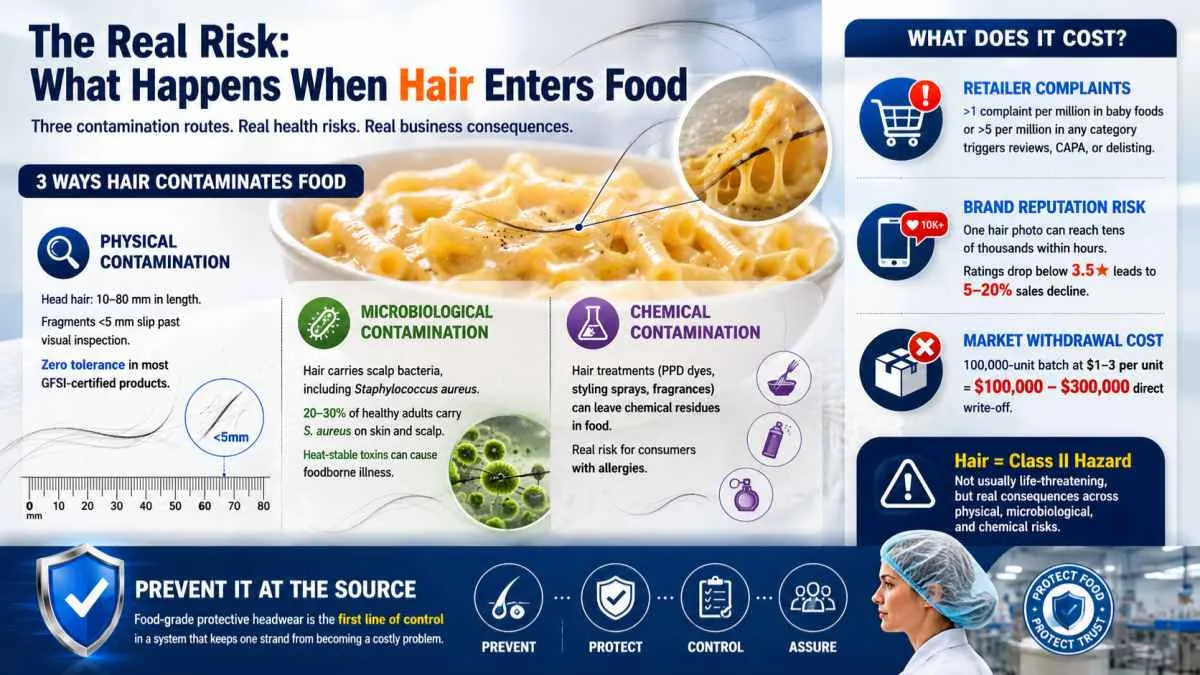
Most people assume the worst outcome of finding hair in food is a disgusted customer and a bad review. The actual risk runs deeper — and it moves in three separate directions.
Three Ways Hair Contaminates Food
Physical contamination is the obvious one. Head hair ranges from 10 to 80 mm in length. Fragments under 5 mm are the real problem — they slip past visual inspection without anyone noticing. In sticky or stringy foods — think cheese, dough, caramel — a single strand can bind into the product and reach a consumer’s plate. Most GFSI-certified manufacturers set zero tolerance for visible hair in finished products. One confirmed finding is enough to trigger a full lot investigation and a line hold.
Microbiological contamination is harder to see, but more serious. Human hair carries scalp bacteria, including Staphylococcus aureus — a pathogen that produces heat-stable toxins in protein-rich foods under temperature abuse. Around 20–30% of healthy adults carry S. aureus on their skin and scalp. Hair from an infected scalp acts as a direct transfer route to ready-to-eat food.
Chemical contamination gets left out of most training materials. It shouldn’t be. Hair treated with dyes containing para-phenylenediamine (PPD), styling sprays, or fragrance-based leave-in products can deposit chemical residues into food. For anyone with a contact allergy to PPD or fragrance compounds, that exposure is a real health concern — not a minor issue.
What Does It Cost?
The business consequences add up fast. Retailers track foreign body complaints per million units shipped. Go past 1 complaint per million in baby foods — or 5 per million across any category — and you face supplier performance reviews, corrective action demands, or delisting.
One hair photo on social media can pull tens of thousands of views within hours. Repeated hair-related one-star reviews push product ratings below 3.5/5. For some consumer brands, that drop ties directly to sales declines of 5–20%.
For market withdrawals, the numbers are blunt: a 100,000-unit batch at $1–3 per unit means a direct write-off of $100,000 to $300,000. That’s before labor, investigation costs, or destruction fees.
HACCP systems classify hair as a Class II hazard — not life-threatening in most cases, but carrying real consequences across physical, microbiological, and chemical risk dimensions. That three-part exposure is why food-grade protective headwear isn’t optional. It’s the first line of control in a system built to stop a single strand from turning into a very expensive problem.
Regulatory Requirements That Make Disposable Caps Non-Negotiable
Regulations here are unusually direct. Most food safety rules leave room for interpretation — hair restraints do not.
What the FDA Says?
21 CFR Part 110 is still the backbone of countless GMP manuals. Under it, food handlers must wear “in an effective manner, hair nets, headbands, caps, beard covers, or other effective hair restraints” wherever exposed product or food-contact surfaces exist. The FDA doesn’t suggest caps. It names them as an accepted control device.
“Effective manner” isn’t vague, either. In practice, auditors define it as:
-
100% scalp coverage — no loose edges, no stray strands visible at the forehead or nape
-
Facial hair coverage for any beard or stubble beyond 3 mm
-
Single-use disposable caps in any high-risk or RTE area where laundering validation isn’t on record
FSMA’s 21 CFR Part 117 raises the stakes further. Hair contamination that isn’t controlled can mark product adulterated under 21 U.S.C. 342(a)(4) — “prepared under insanitary conditions.” That label triggers a range of enforcement actions: Form 483 observations, Warning Letters, product recalls, and facility seizure. In serious cases, it leads to suspension of facility registration. That stops a plant from shipping food across state lines.
Third-Party Audit Schemes Raise the Bar Further
BRCGS Issue 9 grades hair restraint failures in three tiers. One operator with hair past the cap edge is a Minor. Multiple workers without restraints — or no defined policy at all — becomes a Major. Confirmed product contamination with no control in place? That’s a Critical. It can suspend your certificate outright.
SQF and FSSC 22000 follow the same logic. ISO/TS 22002-1, which supports FSSC certification, requires “suitable protective clothing , including head covering and facial hair covering where necessary.” Auditors expect a written PRP, documented issuance records, and proof that disposable or hygienically validated headwear is available and in use at all times.
Losing BRCGS, SQF, or FSSC certification over a personal hygiene failure is a real risk. Many major retailers write these certifications into supplier contracts. A downgrade or suspension cuts your access to those accounts — fast.
Why Disposable Caps Win Over Reusable?
Reusable caps aren’t forbidden. But they carry a compliance burden most facilities underestimate: laundering validation, segregation protocols, damage inspection, and replacement schedules. Nonwoven disposable caps cut through all of that. One cap per shift, issued at the gowning station, disposed of on exit. The control is documentable, uniform, and easy for auditors to verify.
For high-care and RTE zones, many retailer technical standards go further. They require single-use head coverings for all personnel, contractors, and visitors — no exceptions. In those environments, the disposable cap isn’t just the practical choice. It’s the only complaint.
What a Compliant Disposable Cap Must Cover (Functional Requirements)
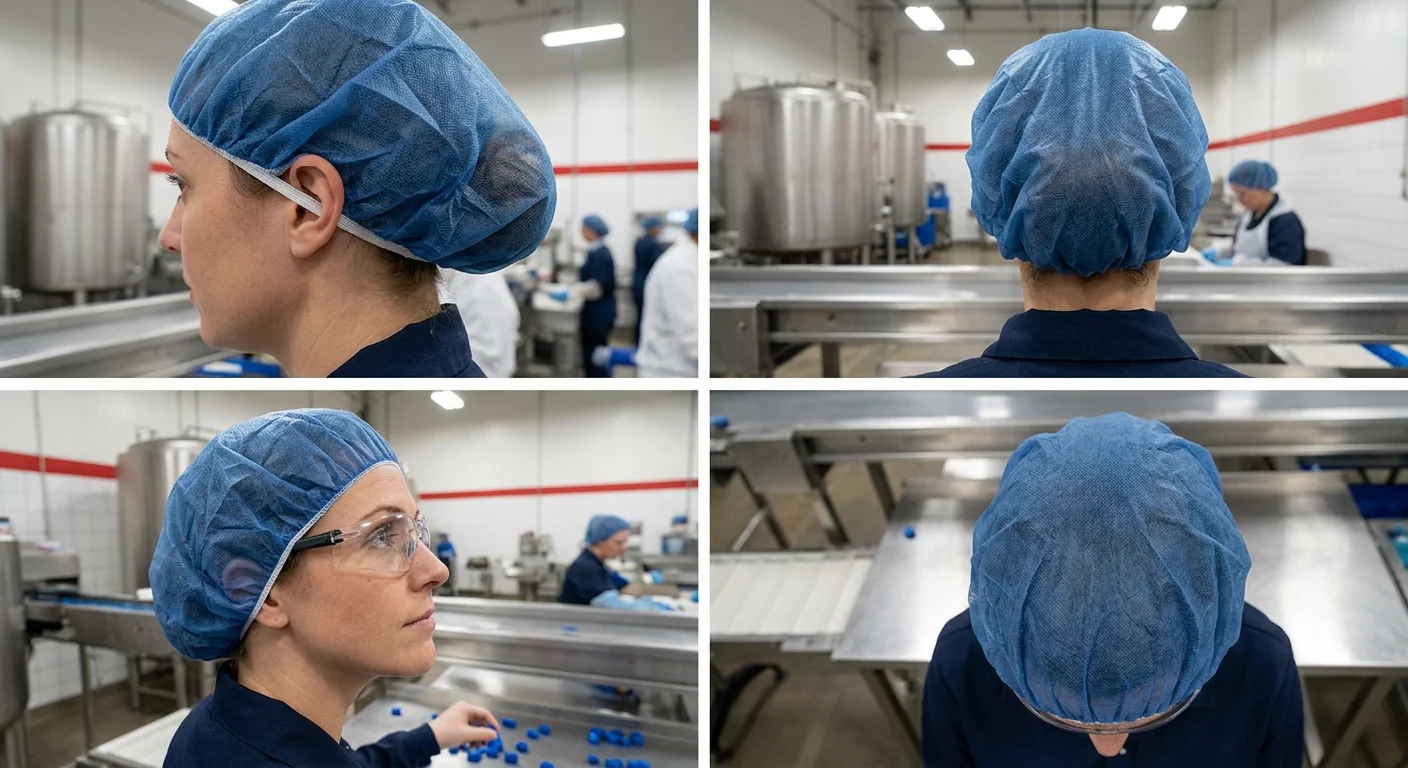
Here’s something that surprises a lot of plant managers the first time they read an audit finding: the violation wasn’t that their workers weren’t wearing caps . The caps were there. They just weren’t covering the right things.
Coverage is where most programs silently fall short. A disposable bouffant cap that sits too high on the forehead, rides up at the nape, or pinches at the temples isn’t a compliant cap — it’s a liability shaped like one. GMP and HACCP guidance is clear: no visible hair at the forehead, nape, temples, or around the ears when viewed from the front, back, or side. Not partially covered. Not mostly covered. Fully covered, with no gaps.
Scalp, Hairline, and Ears — All Three
The cap must enclose the scalp and hairline without gaps. That includes the obvious zones — crown, back of head — and the ones that get skipped: the hairline just above the ears, the sideburns, the nape where short hairs tend to escape. Auditors check from every angle. Hair visible anywhere along that perimeter counts as a nonconformance.
Ear coverage matters too. The elastic band should sit below the top of the ear, containing hair that grows behind and around the pinna. That strip of hair behind the ear? It’s one of the most common gaps in cap coverage — and one of the easiest to miss in a gowning station mirror.
Sizing Is a Compliance Issue, Not Just a Comfort One
Cap size is where the functional requirements get specific — and where facilities most often cut corners by ordering one-size-fits-most and calling it done.
-
Short hair (≤5 cm): A standard 21-inch bouffant cap handles this without tension gaps.
-
Medium-length hair: Use a 21–24 inch cap. Hair needs to be bunched or twisted first so the bulk doesn’t push the cap above the hairline.
-
Long hair, high-volume hair, braids, or natural texture: Use 24–28 inch caps built for cleanroom and food plant environments. Forcing high-volume hair into an undersized cap causes the elastic to pull back. The forehead hairline opens up. You’ve failed the coverage requirement before the shift even begins.
The Elastic Band Is Doing the Real Work
The elastic isn’t just there to keep the cap from falling off. It creates a continuous seal around the circumference — that’s what makes the cap compliant. That seal needs to hold through a full shift. Workers look up to check a conveyor, bend to lift a tray, and turn to pass product down the line. The seal must stay intact through all of it.
The numbers here are specific: flat elastic width of 3–5 mm for standard PP Bouffant caps, up to 8–10 mm for SMS-construction caps. Stretch ratio should reach 2–2.5× the relaxed circumference. That range accommodates different head sizes while keeping enough tension to stay in place.
So what happens when that seal fails — when caps ride up, gap at the forehead, or go loose around the ears? Two things. Hair escapes. And workers start adjusting their caps with their hands. Each hand-to-head contact moves scalp microflora to gloves , then to food-contact surfaces. A poor-fitting cap doesn’t just expose hair. It generates contamination events throughout the shift, one adjustment at a time.
Material, Breathability, and the Sweat Problem
PP nonwoven spunbond is the standard for most food plant environments — lightweight, breathable, and suitable for all-day wear in production zones. SMS (spunbond-Meltblown-spunbond) adds fluid resistance for areas with splash or droplet exposure, though at a slight cost to breathability.
In high-temperature zones — ovens, scalding lines, meat processing floors — breathability isn’t a comfort preference. It’s a functional requirement. A cap that traps heat causes workers to sweat through it. That sweat travels down through the hairline and forehead, and it becomes a contamination vector. A compliant cap in a hot zone must sit low enough on the forehead to block that path. It needs to overlap the frontal hairline and work alongside any sweatband worn beneath it. Both the hair and the sweat-management layer must stay above the product contact zone.
When the Cap Isn’t Enough: Beard and Facial Hair Coverage
Bouffant caps cover head hair and ears. They don’t restrain beards, goatees, or mustaches — and GMP doesn’t allow any workaround.
Facial hair longer than 3 mm (about two to three days’ growth) requires a dedicated beard snood. The snood must run from the lower lip, along the cheeks, under the chin, and up to the neck. Elastic secures it behind the ears or around the head. No facial hair should be exposed during normal speech or movement.
The beard snood and bouffant cap must overlap at the sideburn and cheek junction. That seam — where the ear meets the cheek, where temple hair meets beard — is where loose hairs and stubble escape. GFSI -aligned auditors under BRCGS, SQF, and IFS schemes check for that overlap. No overlap means no compliance.
Quick reference — what a compliant disposable cap must cover:
-
✅ 100% of scalp, crown, back of head, temples, and hairline (forehead and nape)
-
✅ Ears, with elastic seated below the top of the pinna
-
✅ Maintained seal through normal head movement — no gaps at forehead, ears, or nape
-
✅ Sufficient diameter for the wearer’s actual hair volume (up to 28 inches for high-volume hair)
-
✅ Breathable nonwoven material compatible with the zone’s temperature and splash conditions
-
✅ Beard snood paired whenever facial hair exceeds 3 mm, with overlap to the cap at the cheek/ear seam
High-Risk Food Processing Zones Where Caps Are Mandatory
Not every corner of a food facility carries the same contamination risk. A receiving dock and a ready-to-eat slicing room are two very different spaces. The rules that govern them should reflect that difference.
Cap requirements are strictest in high-risk and high-care zones. These are spaces where the product has already passed through a kill step. Packaging hasn’t been sealed yet. Any contaminant that lands on exposed food stays there. In these areas, disposable caps are mandatory PPE — not just a best practice.
The Four-Zone Model That Drives Cap Policy
Most hygienic zoning frameworks divide a facility into four tiers:
-
Zone 1: Direct food-contact surfaces
-
Zone 2: Near food-contact surfaces and open product areas
-
Zone 3: Same room as product, but no direct contact
-
Zone 4: Non-manufacturing or external support areas
Cap requirements are strictest at Zone 1 and Zone 2 interfaces. These are the spots where the product is exposed, the equipment is open, or post-lethality food moves between operations before final sealing. Zone 4 warehouse staff have more flexibility. Zone 2 workers handling chilled RTE product do not.
Where the Cap Rule Applies by Category?
Meat and poultry operations carry the greatest concern after the cook-chill steps. Once the lethality target is met, Listeria and Salmonella controls take over post-handling protocols. One contamination event in that window wipes out the kill step. There is no recovery from that.
Ready-to-eat foods — sliced deli items, packaged salads, cooked proteins — require caps in any open handling area. The consumer gets these products without another cooking step. There is no thermal backstop to catch a mistake.
Dairy tightens cap rules at open curd, slicing, and filling operations. Moisture-rich environments help microbes survive. Exposed product in those areas falls into high-care zoning — no exceptions.
Bakery and confectionery lines require mandatory coverage at cream filling, post-bake cooling, and decorated product packing. Any point where the finished product is exposed with no further kill step ahead of it needs a cap in place.
A Quick Field Test for Mandatory-Cap Zones
Not sure whether a space requires caps? Run through this checklist:
|
Question |
If Yes → |
|---|---|
|
Is the product exposed? |
Cap required |
|
Has the kill step already occurred? |
Cap required |
|
Is final packaging still ahead? |
Cap required |
|
Is this a chilled or frozen RTE product? |
Cap required |
|
Are personnel or contractors moving through? |
Cap required |
Most answers are yes? The zone is cap-mandatory under standard hygienic zoning controls. Your HACCP risk assessment should document the specific reason for each requirement.
How to Choose the Right Disposable Cap for Your Food Processing Operation?

The wrong cap doesn’t just fail a compliance check — it fails shift after shift, while you assume everything is fine. You won’t catch it until something goes wrong.
Three decisions determine the right cap: cap type, material, and fit for your specific zone. Nail all three, and everything else — procurement, documentation, audits — falls into place.
Cap Type: Match the Cap to the Hazard
Bouffant caps are the go-to choice for most food processing environments. They enclose the scalp, sides, back of the head, and hairline in one continuous structure. Most facilities have workers with mixed hair lengths and volumes. Bouffant caps handle that without asking anyone to adjust or secure anything themselves. Coverage stays consistent and audit-ready.
Hair nets handle basic containment in lower-risk areas. They’re lighter and more breathable than bouffant caps, but they leave more gaps. In high-care or RTE zones, those gaps are a real problem. Save hair nets for low-exposure areas where product contact isn’t happening.
Surgical or tie-back caps belong in medical and sterile environments. They’re the wrong tool for a food processing floor — full stop.
Material: PP for Most Zones, SMS When You Need More
Nonwoven polypropylene (PP) covers the majority of food plant needs. It’s lightweight, breathable enough for a full shift, and cost-effective at scale.
SMS (spunbond-meltblown-spunbond) is the better call for zones with splash, droplet exposure, or high moisture — dairy filling lines or wet protein processing, for example. You get fluid resistance. The trade-off is a small drop in breathability.
Color: Blue Is a Working Tool, Not an Aesthetic Choice
Blue caps dominate food environments for a practical reason. The color stands out against most food products and facility surfaces. A stray fragment of blue nonwoven is easy to spot. A white or beige cap fragment in a pale-colored product is not. That’s a detection-control decision — it has nothing to do with branding.
Procurement: Build the Math Before You Order
Disposable caps are single-use. Your consumption goes up with headcount and shift count. The planning formula is simple:
Daily cap demand = workers on the line × caps per shift (1) × number of shifts + buffer for visitors, contractors, and rejects
Most facilities low-ball that buffer. Visitors walk through high-care zones. Contractors show up without notice. Damaged caps get tossed before a shift even starts. Add at least 10–15% above your baseline headcount figure — that buffer fills up faster than you’d expect.
Before placing a bulk order, ask your supplier for documentation. You need the material specification, single-use designation, and any CE, ISO, or FDA certification that applies to your regulatory environment. A supplier who describes their product as “general use” — with no hygiene-control documentation to back it up — is a sourcing risk. That’s not a vendor you want between you and your next audit.
FAQ: Disposable Cap Compliance Questions Food Facilities Really Ask
These are the questions that come up after the training video ends. People feel safe enough to ask what they genuinely want to know.
Are disposable caps legally required, or just recommended?
No single law says “thou shalt wear a bouffant cap.” The law requires effective hair restraint. Your GMP program, customer specification, or audit standard then turns that requirement into a specific control. Once your food safety program names disposable caps as the approved method, they become mandatory. The difference between “required by regulation” and “required by your compliance program” stops mattering the moment an auditor walks into your gowning room.
Can workers wear their own hats from home?
The safest answer is no — unless your hygiene policy says otherwise in writing. Facility-issued caps are documentable, standardized, and traceable. A personal baseball cap is none of those things. Auditors under BRCGS and FSMA-aligned schemes expect controlled, documented headwear. Informal substitutions that vary from worker to worker won’t pass.
How often should a cap be replaced during a shift?
At a minimum, once per shift. Replace it right away if any of the following happen:
-
The cap tears, loosens, gets wet, or shows visible soiling
-
The worker uses a restroom or leaves the controlled area
-
The cap touches a non-food surface or contaminated material
A cap that can no longer be shown as clean and secure needs to go. Don’t adjust it. Don’t wear it until break.
Do disposable caps expire?
No printed expiry dates, but yes — treat them as controlled inventory with a real shelf life. Heat, moisture, UV exposure, and compression all break down elastic and seam integrity over time. Before pulling from stock, check that:
-
Packaging is intact and sealed
-
Elastic still stretches and snaps back with tension
-
No discoloration, brittleness, or odd odor
-
Lot traceability is readable
Reject anything that fails that list. A cap with weak elastic fails the one job it exists to do.
How is cap compliance documented for audits?
The standard is straightforward. One clean, facility-issued cap per entry or shift. Replace it after any contamination event or exit from a controlled zone. Back that up with supplier COAs, receiving inspection records, and a written SOP that lists the replacement triggers. Stock spare caps at every production entrance and change room — not just the main gowning station.
Conclusion
Hair in food isn’t a hypothetical risk. It’s a compliance failure waiting to happen — and a preventable one.
Every regulation covered here, from FDA 21 CFR Part 110 to HACCP critical control points, points to the same answer: a well-fitted, food-grade disposable cap, worn by every person on the production floor. Not sometimes. Not just in high-risk zones. Every shift, every time.
The good news? This is one of the simplest, most cost-effective protections a food facility can put in place. The right nonwoven disposable cap does more than satisfy an inspector. It protects your product, your customers, and your reputation.
Ready to find caps that fit your operation’s hygiene requirements? Explore Morntrip ‘s food-grade disposable cap line — built to meet the standards outlined in this article.
“Good enough” headwear has no place in food safety compliance. It never has.