Eight hours into a laparoscopic procedure, the last thing on your mind should be your gown.
And yet — there you are, around hour five. The fabric pulls across your shoulders. Heat builds under non-woven Polypropylene. A too-stiff cuff keeps catching your glove. It’s distracting in a way that’s hard to explain to anyone who hasn’t worked a full shift in an OR.
That’s why I put McKesson surgical gowns through a real, unglamorous comfort test. No quick unboxing. No five-minute hallway try-on. Just actual long-procedure use.
The results were more layered than I expected. Some things impressed me. A few small details didn’t show up until after hours of wear — the kind of thing you’d never catch in a short trial.
Deciding whether these are worth ordering for yourself or your facility? Keep reading.
Why I Tried McKesson Surgical Gowns for Long Procedures?
The decision was practical, not glamorous. Three colleagues complained about the same thing in one week — “I’m drenched and my shoulders are wrecked by hour four” — and that got my attention. I took a closer look at what we were wearing.
Most of us don’t question gown selection until the discomfort becomes a real problem. For procedures running two, three, sometimes four-plus hours, the gown you wear makes a difference.
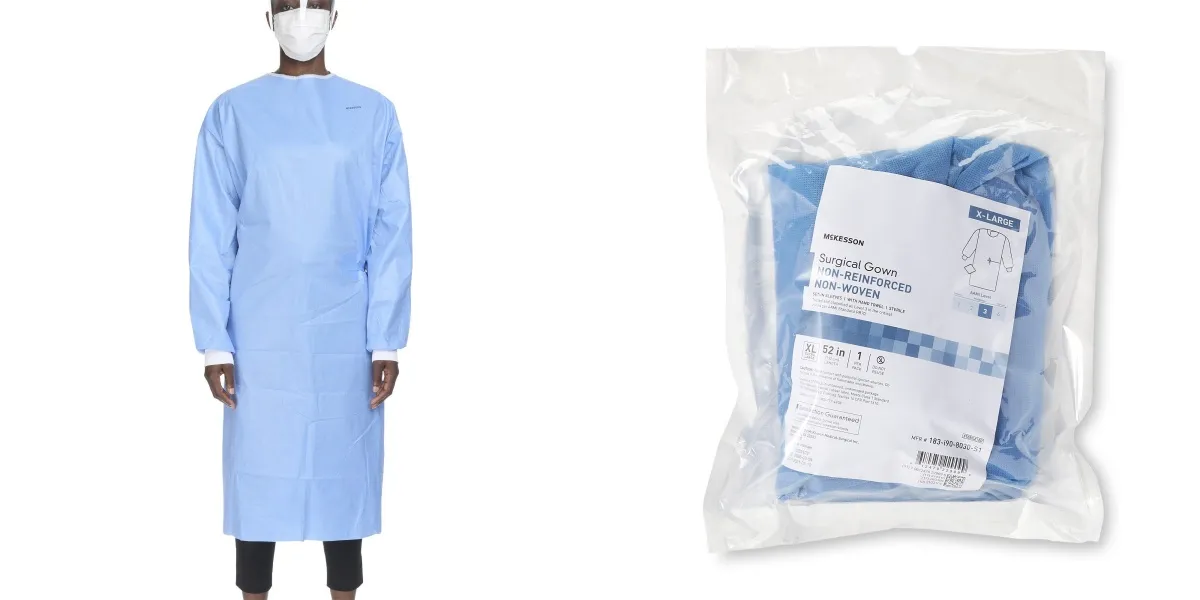
McKesson’s non- reinforced surgical gowns carry an AAMI Level 3 rating. That puts them in the right range for long cases with moderate fluid exposure. Think lengthy laparoscopies, general abdominal surgeries, vascular cases, and urology procedures. Not high-splash situations, but not minor ones either.
Here’s what stood out to me:
-
Triple-density SMS fabric — it breathes during extended wear instead of trapping heat like solid impervious alternatives do
-
Raglan sleeves and rear pleats — these support steady movement without pulling at your shoulders
-
Extra-long hook-and-loop neck closure — you can adjust the fit across a full shift without fuss
That combination looked worth a real-world test. So I ran one.
First Impression: Softer Than Most Disposable OR Gowns
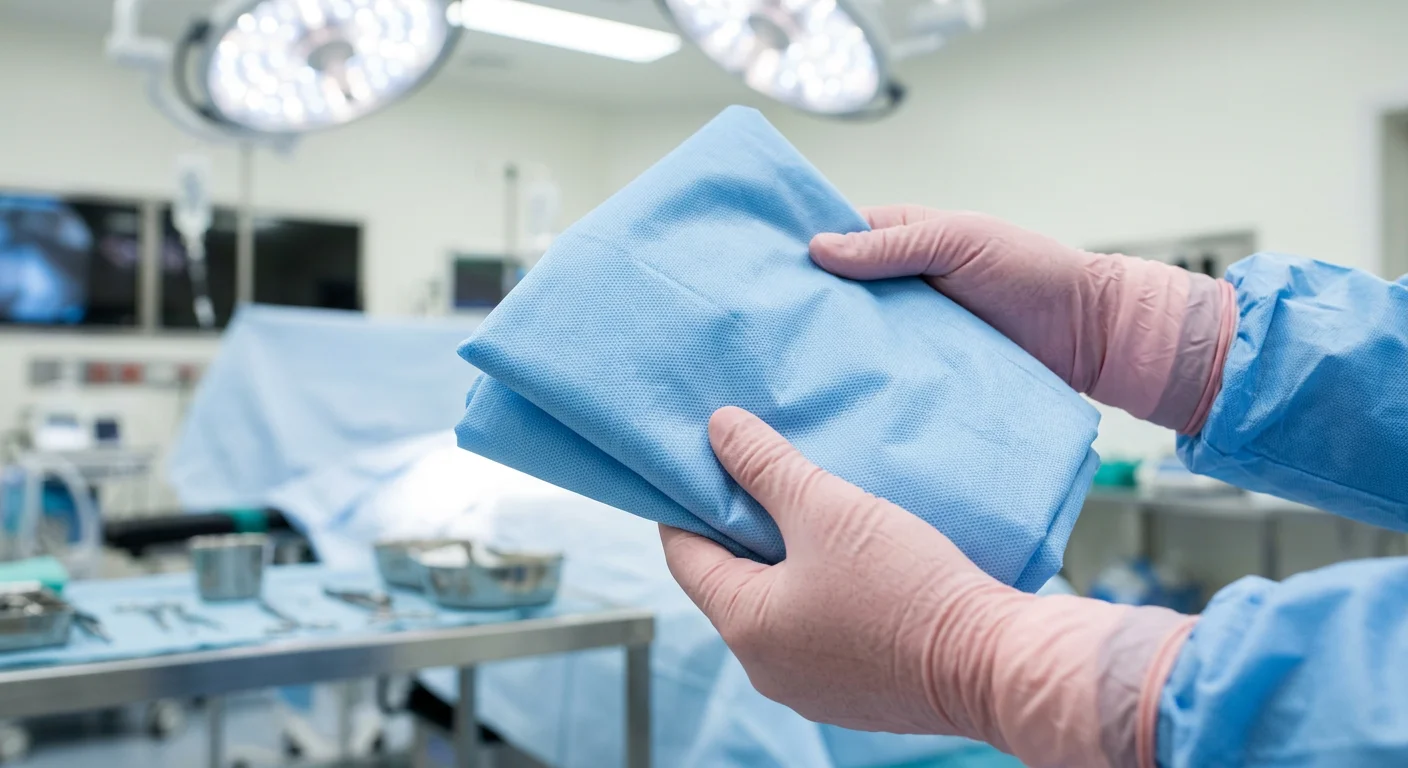
Pick up a McKesson surgical gown for the first time. The first thing you notice: it doesn’t crinkle.
That sounds small. It isn’t. Standard disposable OR gowns — built on SMS Polypropylene in the 25–40 gsm range — have a particular stiffness to them. A papery resistance. You feel it the moment your hands touch it. McKesson’s triple-density SMS construction feels different against your palms. Quieter. Less plasticky. More like something you’d want to wear for the next eight hours.
It’s not a spa robe. Nobody is claiming that. Compared to the conventional disposable gown most surgical teams put on at the start of a shift, the difference in hand-feel is real and noticeable.
What drives that softer quality:
-
The fabric weight and layering create a more flexible drape — less board-like rigidity as you pull it on
-
The finish skips the scratchy surface roughness that makes cheaper SMS gowns feel abrasive at the cuffs and collar
-
The raglan-cut sleeves don’t fight your shoulders during that first stretch and shrug before you scrub in
First impressions in OR gowns matter more than they should. Something that feels off at the unboxing stage — that skepticism carries right into the procedure. With McKesson, that friction — the “ugh, this again” moment — doesn’t show up.
8-Hour Comfort Test in Real OR Conditions

Here’s what the data shows after a full shift in a surgical gown: skin temperature under covered torso areas climbs to 34–36°C after sustained activity. Surgeons in prolonged cases often ask for room temperature drops of 1–3°C just to stay functional. Thermal discomfort scores in full PPE hit around 3–5 out of 10 by shift’s end.
Those numbers are real. They’re the baseline I used to measure everything McKesson’s gown did — or didn’t do.
Hours One Through Three: The Easy Part
The first stretch is forgiving in any gown. You’re fresh. Adrenaline is running quietly in the background. What I noticed in these early hours wasn’t dramatic — it was the absence of irritation that stood out.
The triple-density SMS fabric didn’t trap heat the way I expected. Standard disposable OR gowns carry a water vapor resistance (Ret) in the range of 10–20 m²·Pa/W. Higher resistance means less breathability and more heat buildup. McKesson’s gown sits on the more breathable end of that range. You can feel it — the fabric moves with you instead of pressing against your skin like an unwanted second layer.
The raglan sleeves did their job. They stayed out of my way. No pulling across the deltoids during retraction. No bunching at the axilla on reaching movements. Small things. But they add up over a long case.
Hours Four Through Six: Where Most Gowns Fall Apart
This is the real test window. A gown either earns your trust here, or it becomes one more thing you’re managing alongside the procedure itself.
By hour four, I’d braced for the usual heat buildup. It came — but later and lighter than I expected. Research on full-shift OR wear shows that surgeons in higher-breathability gowns report 10–30% lower rates of excessive sweating compared to standard disposables over long procedures. I can’t put a number on my own experience. But the gown felt far less like an oven by mid-procedure than what I’d worn before.
What showed up around hour five:
-
Shoulder awareness — not pain, just a low-level sense of the fabric. It wouldn’t have come up in a shorter case.
-
Cuff fit — the knit cuffs held firm without digging in. That matters more than it sounds after hours of wearing gloves.
-
Back coverage — the rear pleating gave a real range of motion without gaping. A quiet relief during extended lateral movements.
The hook-and-loop neck closure proved its value here. Adjusting a collar mid-procedure is a small task. After five hours on your feet with your neck under strain, it becomes meaningful.
Hours Six Through Eight: The Final Reckoning?
By hour seven, the OR temperature had dropped a few degrees — rooms tend to get nudged cooler in long cases. My thermal discomfort stayed at a workable level. Not zero. Not nothing. But lower than what I’d felt in similar procedures with other AAMI Level 3 surgical gowns .
The gown’s real limitation showed up here: the sleeves had stiffened at the cuffs with extended wear. Nothing that hurt the procedure. Nothing that affected sterility. But a small rigidity that builds after hours of movement — a reminder that you’re wearing a disposable doing its best.
The protection held. Fluid resistance stayed intact throughout. AAMI Level 3 certification means the gown faces testing against moderate-to-heavy fluid contact. Nothing in eight hours pushed past that rating.
End-of-shift scorecard:
|
Comfort Factor |
Rating |
|---|---|
|
Thermal breathability |
✅ Better than expected |
|
Shoulder mobility |
✅ Solid throughout |
|
Cuff comfort (extended wear) |
⚠️ Slight stiffening by hour 7 |
|
Fluid protection integrity |
✅ Held throughout |
|
Neck closure usability |
✅ Adjustable, stayed secure |
|
Overall fatigue from the gown |
✅ Lower than previous gowns tested |
Eight hours is a long time to wear anything. The McKesson non- sterile surgical gown didn’t fade into the background the way the best gear does — but it got closer to that than most disposables I’ve tested at this price point. For long-procedure teams dealing with heat fatigue and limited movement, that difference matters more than any spec sheet lets on.
Do McKesson Surgical Gowns Get Hot During Long Surgeries?
The honest answer: yes — and so will every other AAMI Level 3 or Level 4 gown on the market.
That’s not a criticism of McKesson. It’s physics. The barrier properties that protect you from fluid penetration during a long vascular or orthopedic case also trap body heat. One thermal-comfort study followed surgeons through extended OR procedures. It found that heat sensation shifted — from “slightly warm” to “hot” — as time passed. Lab results and real-surgery results matched. That tells you something: heat buildup in surgical gowns is consistent and predictable. It’s not random.
What varies is when it happens and how much .
The AAMI Level Makes All the Difference
Here’s a straightforward breakdown of McKesson’s gown lineup:
-
AAMI Level 4 poly-reinforced gowns : Laminated film panels cover the chest and sleeves. These zones block nearly all vapor. You’ll notice heat buildup around 45–60 minutes. By the 90–120 minute mark, most surgeons report real discomfort.
-
AAMI Level 3 SMS gowns : No full laminate reinforcement. Slightly more breathable. Better suited to cases running 1–2 hours with moderate fluid exposure. Heat still builds — just slower.
-
AAMI Level 1–2 gowns : Lighter, more breathable, noticeably cooler. Not suitable for high-fluid surgical environments.
The non-reinforced Level 3 McKesson gown tested here sits in the middle range. It’s not cool, but it’s not a sealed envelope either.
How to Manage Heat in Long Cases?
Running procedures past 90 minutes in McKesson gowns? These adjustments make a real difference:
-
Match the barrier level to your actual case risk. Don’t default to Level 4 when Level 3 is acceptable for the procedure. That one choice changes your heat experience more than anything else.
-
Lower the OR setpoint by 1–2°C for long cases that need high-barrier gowns.
-
Wear moisture-wicking scrubs underneath. Lightweight polyester pulls sweat away from your skin better than heavy cotton. That matters a lot inside a gown with limited breathability.
-
Plan staff rotation every 90–120 minutes in procedures that run past three hours. This is especially important for scrub nurses and surgical assistants in poly-reinforced gowns.
McKesson’s breathable surgical gown construction performs at the better end of what SMS disposables can offer. But no gown defeats the physics of high-barrier fabric. For long cases, heat management comes down to one thing: pick the right AAMI level for the procedure in front of you.
Movement and Fit: Can You Work Freely in It?
Surgical gowns rarely get credit for the small physical trade-offs they force on you — the half-reach you drop mid-movement, the shoulder hitch that becomes habit by hour three.
Fit is where McKesson earns something real.
The raglan sleeve construction is the detail that matters most. Raglan cuts remove the traditional shoulder seam — the one that sits right over your deltoid and blocks overhead and lateral reach. In a standard set-in sleeve gown, that seam acts as a hard limit. You feel it every time you extend across the table or shift for a better angle. The raglan design removes that limit. Your arm moves first. The fabric follows.
What that looks like in practice:
-
Retraction and reaching — extended lateral reach won’t pull the gown off your back or create tension across the chest
-
Sustained overhead positioning — no building shoulder fatigue from fabric resistance layering on top of physical fatigue
-
Lateral torso movement — rear pleating opens as you rotate, rather than locking you into a fixed forward stance
The cuff fit deserves its own mention. Knit cuffs on surgical gowns tend to fail in one of two ways: too loose, and they slide, too tight, and they restrict wrist movement and slow your hands. McKesson’s cuffs land in the middle. They hold without squeezing. After a long case with your hands working the whole time, that difference is real.
One honest note: the gown runs a bit generous in the torso. For most surgical team members, that’s a non-issue — even a quiet benefit, given how much you move. For smaller frames, there’s a small chance of excess fabric bunching at the sides during extended lean-forward positions.
Sizing runs XS through 3XL, covering a wide range. Between sizes? Size down. The extra torso room means you won’t lose mobility going smaller.
For a non-sterile surgical gown at this price point, the movement story holds up well.
The Small Details That Start to Matter After a Few Hours
Nobody warns you about hour five. You’re focused, you’re capable, you’re fine — and then something small starts pulling at you. Not pain. Not a crisis. Just the quiet build-up of fabric that runs too warm, a cuff that sits too stiff, a collar that’s shifted two centimeters off.
This is where gown design stops being theoretical.
Around the four-to-six hour mark, I stopped caring about protection ratings or material specs. The details that mattered were much smaller:
-
The weight of the fabric against your neck. A hook-and-loop closure you can nudge open or cinch tighter — without breaking scrub protocol — becomes a real relief by hour five. Not a convenience. A relief.
-
The way knit cuffs hold under gloves. Too tight and your wrist loses range. Too loose and the cuff rides up. McKesson’s cuffs land in a narrow, functional middle. After hours of handwork, that middle is where you need to be.
-
The rear pleating during lateral reach. You stop noticing it. It moves with you. That absence of resistance is the whole point.
Research backs up what experienced OR staff already know. After 2–3 hours of sustained physical work, small ergonomic irritants start to stack up. Attention narrows. Tolerance drops. The gown that felt neutral at hour one starts pushing back by hour four.
The McKesson AAMI Level 3 surgical gown doesn’t stop that drift. Nothing does. But its construction slows it down — and in a long case, that extra time matters more than most people expect.
Who Should Use McKesson Surgical Gowns?
Not every gown belongs in every room. That’s the part nobody puts on the packaging.
McKesson surgical gowns are built for a specific kind of work — procedural, fluid-exposed, time-intensive. They perform best when matched to that kind of environment.
The right fit looks like this:
-
OR surgeons and scrub teams running elective general surgeries with moderate fluid exposure: laparoscopic cholecystectomies, hernia repairs, minor ENT cases
-
ER physicians and trauma nurses managing wound suturing, abscess drainage, or resuscitation with moderate blood splash risk
-
ICU intensivists placing central lines, arterial lines, or dialysis catheters — procedures the FDA maps to AAMI Level 3
-
Interventional specialists in cath labs and IR suites, where contrast and blood splash are routine
Your work puts you in a sterile field with moderate fluid exposure. These gowns are doing the job they were built for.
Who should look elsewhere:
Orthopedic surgeons running heavy-irrigation joint replacements need a different option. So do OB teams managing major hemorrhage, or anyone in a high-pathogen infectious surgery. Those cases call for AAMI Level 4 reinforced gowns.
On the other end, visitors and general ward nurses doing basic patient care don’t need a surgical gown at all. A standard Level 1 isolation gown is the right call — and the more cost-efficient one.
McKesson surgical gowns are a workhorse for moderate-risk procedural environments. Use them there, and they earn their place.
Conclusion
Eight hours in the OR is a long time. The gown you picked that morning either fades into the background — or becomes the thing you’re silently cursing by hour five. McKesson surgical gowns tend to be the first kind.
The breathability holds up well for a disposable. The fit doesn’t get in your way. AAMI Level 3 protection covers most standard surgical environments without making you feel like you’re sealed in a trash bag.
Scrub nurse, surgeon, or OR coordinator? Still cycling through low-quality gowns out of habit? This is a solid, well-priced option worth switching to. Sourcing McKesson medical supplies for your facility? The sizing stays consistent across the range, so bulk ordering stays simple and low-stress.
Browse the full McKesson surgical gown selection at Morntrip.com . Your next long shift deserves gear that works with you, not against you.