You’ve seen the name Tyvek on coveralls, hazmat suits, and PPE catalogs so many times that it feels like a brand on its own. That’s where the confusion starts.
DuPont invented the material. But DuPont doesn’t sew your coveralls.
Think about what happens between those two facts. HDPE fiber rolls off a DuPont production line. Then it passes through a global network of garment makers, certifiers, and distributors before a sealed, CE-certified coverall lands in your warehouse. Most buyers never see that chain. Yet that chain decides whether your Protective clothing holds up in a chemical splash zone — or fails an audit.
This guide breaks down who manufactures Tyvek coveralls , how the OEM network runs, and what every serious B2B buyer needs to verify before placing a bulk order.
DuPont’s Role: Material Inventor, Not Just a Coverall Brand
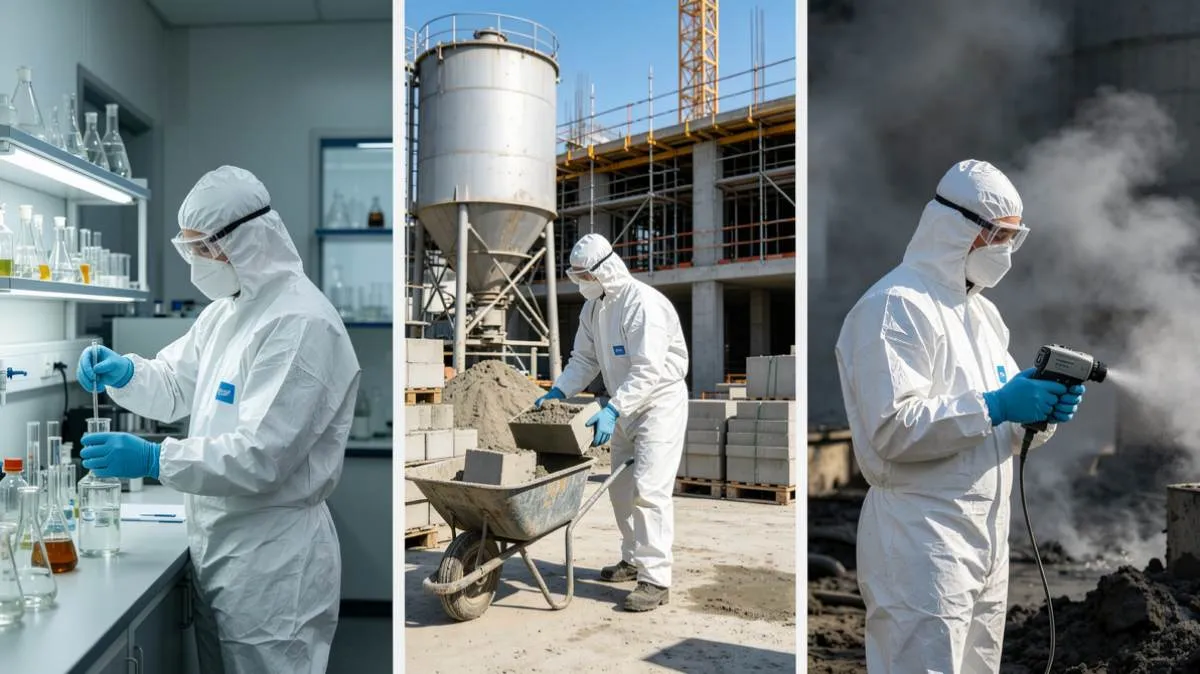
Tyvek has been around since 1955. DuPont researcher Jim White discovered the material that year. What followed was close to a decade of internal development before it ever reached a production line.
Here’s what that history means for your purchasing decisions today: DuPont is the sole legal producer of Tyvek base material. Full stop. No competing manufacturer makes it. No other factory can replicate it. The process is proprietary. It uses flash-spun technology — HDPE gets forced through high heat and pressure, then shot through a spinneret at a sharp pressure drop. The result is a continuous network of bonded filaments. DuPont patented the method. They own it outright.
What comes off that production line is a roll of nonwoven sheet, not a coverall . That distinction carries real weight in B2B sourcing.
Two Roles, One Company
DuPont plays two separate roles in the Tyvek supply chain at the same time:
-
Material producer — DuPont manufactures Tyvek roll goods at its flagship Spruance Plant in Richmond, Virginia. From there, the material goes to licensed converters across PPE, medical packaging, and construction sectors worldwide.
-
Branded PPE manufacturer — DuPont also produces its own finished protective apparel: the Tyvek 400, Tyvek 500, and Tyvek 600 coverall series. Each series targets different protection levels, seam constructions, and hazard classifications.
What Makes the Material Worth Protecting?
DuPont defends the Tyvek® trademark hard — and the material’s performance profile is exactly why:
-
Breathable but liquid-resistant — water vapor passes through; bulk liquid water does not
-
High particle barrier — blocks fine dusts, fibers, and particulates in cleanroom and industrial settings
-
Chemically inert — resists most organic and inorganic chemicals. That’s why it shows up in hazmat applications
-
Mechanically durable — tear resistance beats paper-based substrates by a wide margin
-
100% recyclable — HDPE polymer, the same material class as standard plastic bottles
The Trademark Line Every Buyer Must Understand
A coverall carrying the ” Tyvek ®” label must meet two conditions. First, it must be sewn from genuine DuPont Tyvek roll goods. Second, the factory must operate under a formal DuPont trademark and technical agreement.
Some factories buy authentic Tyvek material but work outside those agreements. They can still use the fabric — they just cannot sell the finished product under the Tyvek® name. DuPont enforces this. Calling an unlicensed garment a “Tyvek coverall” puts the seller at risk of trademark liability.
So before you approve any supplier, check one thing: does their Tyvek-branded PPE come with a valid DuPont licensing arrangement? Or are you looking at material-only sourcing with no brand authorization? That single question can save you a compliance headache down the line.
The Full Tyvek Coveralls Supply Chain: From HDPE Pellets to Your Warehouse
Six stages stand between a raw HDPE pellet and the sealed coverall in your storeroom. Most buyers only ever see the last one.
That gap is where sourcing mistakes happen.
Here’s how the chain runs:
1. HDPE resin → flash-spun Tyvek web DuPont starts with high-density polyethylene pellets. Under heat and pressure, those pellets get flash-spun into a continuous bonded filament web. That web is what gives Tyvek its barrier properties. This is the authorization gate. The protection isn’t added later — it’s built into the fabric right here. Generic HDPE nonwoven substitutes skip this step. They look similar. They don’t perform the same.
2. Roll goods → licensed converters
DuPont sells Tyvek roll goods to authorized converters only. A factory that can’t confirm its sources are genuine Tyvek web — not a substitute — is a factory you walk away from.
3. Cut and sew → garment assembly Most buyers underestimate how much work goes into this stage. Tyvek coveralls are not simply sewn garments. A capable OEM needs to handle automatic pattern cutting, hood integration, zipper installation, elastic cuff attachment, storm flap construction, and boot or boot-cover options — all based on the protection class required. Seam construction alone breaks into three types: stitched, taped, or heat-sealed. Each one affects whether the finished garment passes Type 5 or Type 6 certification.
4. Branding and packaging. Factories label, fold, and case-pack the finished garments — 25 units per case is standard for disposable coveralls. Folding orientation matters more than most buyers expect. A Tyvek coverall gets put on from a seated position, zipped front-to-back, storm flap taped shut, and used with a two-layer glove system. Pack-out that disrupts that sequence causes contamination control to break down at the user end.
5. QC → certification
These are two separate steps. Internal factory QC checks that each garment was built to spec. Third-party certification — CE Type 5/6, ASTM, ISO — checks that it meets the market standard. One does not replace the other.
6. Global distribution → your warehouse
Certificates must match the exact SKU, material lot, and protection class on the shipment. Lot traceability is not a nice-to-have. It’s what separates a clean audit from a recalled batch.
What to Verify Before You Sign a Purchase Order?
Ask every OEM supplier for:
-
Written confirmation of authorized Tyvek material sourcing
-
Cutting method documentation for high-volume runs
-
Seam construction specs per protection level
-
Hood, cuff, zipper, and boot configuration options
-
Case pack count and carton labeling standards
-
Third-party certificates tied to the exact SKU and material lot
-
Incoming, in-process, and final QC records
The supply chain is long. The verification list is short. Run through it every time.
Who Sews Tyvek Coveralls? OEM Manufacturers Explained
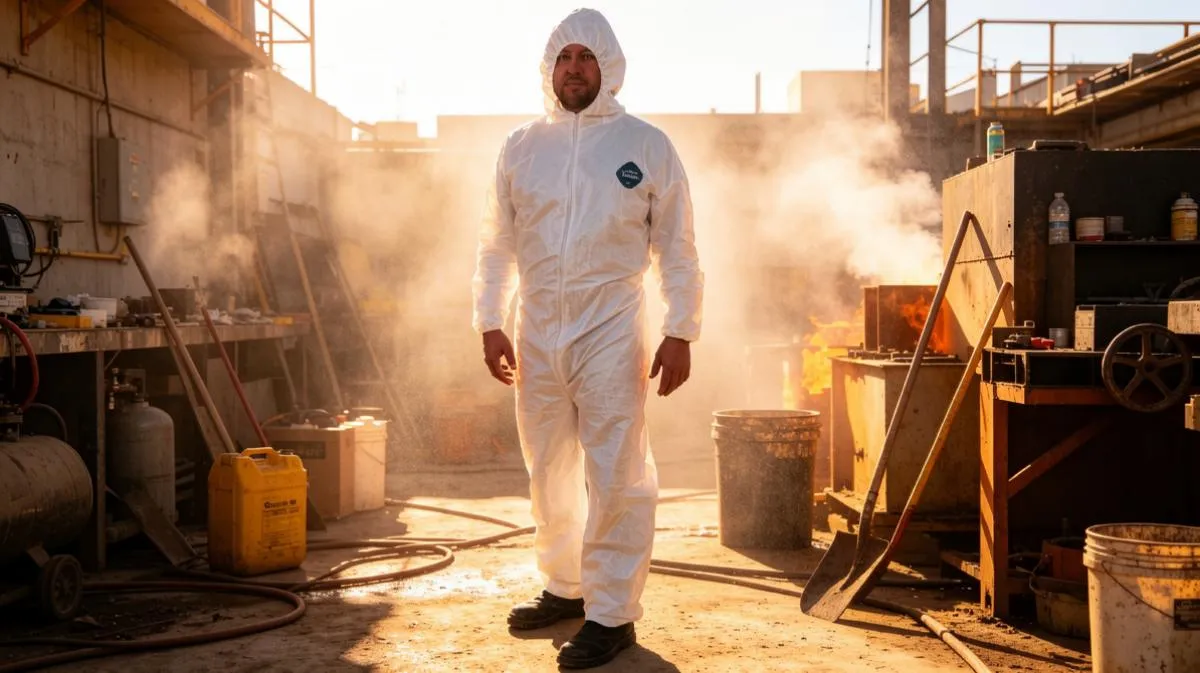
The label says DuPont. The factory is in Hubei.
Both statements can be true at the same time. Understanding why is one of the most useful things a PPE buyer can know.
DuPont’s product pages for the Tyvek 400 and Tyvek 500 Xpert list the garments as “manufactured by DuPont.” That language holds up in a legal and quality-control sense. DuPont owns the design, controls the specifications, and approves every production run. But the physical cutting, sewing, and seam-taping? A global network of contract garment factories handles that work. Many of them operate out of China, Vietnam, and other low-cost manufacturing regions — all under DuPont QA oversight.
This is standard OEM logic. Shifting assembly to specialized contract factories cuts CMT (cut-make-trim) costs by 30–60% compared to in-house US or European sewing operations. A pandemic surge can push global demand for disposable coveralls into the tens of millions of pieces per month. No single in-house facility scales that fast. The OEM network does.
Two Categories of OEM Production
Tyvek garment manufacturing splits into two clear lanes:
Lane 1: DuPont-authorized garment OEMs
These factories buy genuine Tyvek roll goods from DuPont or through authorized distribution channels. They run under formal material supply and branding agreements. The finished garments can carry the Tyvek® name. Interior neck labels show the Tyvek logo, a product code, and batch traceability information that links each garment back to a specific DuPont material lot. Zipper pulls and garment panels carry printed Tyvek branding.
Lane 2: Private-label OEMs
These factories also buy genuine Tyvek fabric — but outside the full DuPont branding agreement. Their finished products reference “made with DuPont Tyvek” on packaging. The garments use authentic material. The Tyvek® trademark, though, does not appear on the product itself. This lane supplies a large share of hospital procurement, industrial tenders, and regional distributor catalogs worldwide.
What does a Qualified Tyvek OEM need?
Not every garment factory can sew a compliant Tyvek coverall. The qualification bar is specific.
Material sourcing and traceability. The factory must document a direct chain from DuPont-supplied roll goods to every finished garment lot. Counterfeit coveralls swap out genuine Tyvek for microporous film. The difference shows up on incoming roll inspection — grammage, surface texture, and the characteristic Tyvek filament structure are all measurable. A capable OEM runs those checks before a single panel gets cut.
Seam construction capability
Seam type is not a cosmetic choice. It determines whether a finished garment passes CE Type 5 or Type 6 classification — or fails both. Compliant Tyvek garment OEMs run:
-
Serged seams for basic protection classes
-
Bound seams for improved particle resistance
-
Hot-air taped seams for liquid barrier performance (12–25 mm tape width, peel strength targets aligned with EN 14325)
Hot-air taping machines and ultrasonic sealing equipment are major capital investments. Factories without them cannot produce Type 5/6 certified garments — full stop.
Pattern control and fit specification
DuPont’s counterfeit detection guidance flags one specific tell: fake Tyvek 500 Xpert coveralls often show two-piece hood construction, while authentic models use a one-piece hood cut. Authorized OEMs work from DuPont-approved pattern files. Size dimensional tolerances across S–3XL ranges are controlled, not estimated.
Certification infrastructure. For EU markets, production must run under Regulation (EU) 2016/425, with a notified body Module C2 or D QA system covering ongoing production surveillance. Relevant EN standards include EN 13982 (Type 5), EN 13034 (Type 6), EN 1073-2, and EN 1149, depending on the model. ISO 9001 is the baseline requirement. Serious OEMs also carry ISO 13485 for medical-adjacent applications and ISO 14001 for environmental compliance.
China’s Position in Global Tyvek Garment Production
The numbers are clear. During the COVID-19 pandemic, China supplied well over 50% of global disposable coverall imports by volume. That dominance didn’t appear overnight. Chinese nonwoven PPE manufacturers had already spent a decade building cutting lines, taping equipment, and certification infrastructure suited for large-scale disposable coverall production.
Current FOB price benchmarks show the market structure:
|
Garment Type |
FOB Price (20,000+ MOQ) |
|---|---|
|
Standard microporous Type 5/6 coverall |
USD $1.20–$2.00 per piece |
|
Tyvek-fabric coverall (certified) |
USD $3.00–$6.00 per piece |
The gap between those two figures comes down to fabric cost. Labor cost is comparable. So if you see Tyvek priced at Microporous levels, be skeptical. You are likely not getting genuine Tyvek fabric.
A mid-scale Chinese OEM in the Hubei nonwoven manufacturing cluster — the same region that includes manufacturers like Morntrip — runs 200–500 workers, multiple automatic cutting lines, and 100+ sewing and taping stations. Output at that scale reaches hundreds of thousands of coveralls per month. Export share exceeds 80% for many of these factories, with goods flowing to the EU, the US, Japan, and Middle Eastern markets. Annual shipment volumes of 5–20 million garments are routine for established exporters at this tier.
The OEM/ODM service structure at this level covers both ends of the market:
-
OEM manufacturing of DuPont-spec models under CMT-plus-QA compliance frameworks
-
ODM development for custom specifications — alternative pocket placement, colored seam taping, specialized hood or boot configurations, customer logo printing on Tyvek panels
Trial run minimums start at 1,000–3,000 pieces. Mass production orders in the 50,000–500,000+ piece range run on 30–45 day lead times. Tyvek roll availability is the main variable that shifts that window.
How to Identify Who Sewed Your Coveralls?
Got a shipment and want to trace the garment back to its real manufacturer? Four sources give you the answer:
-
Interior label — EU PPE regulations require the manufacturer’s name and address on the garment, not just the brand owner’s. That address is often a Chinese OEM even when the brand name on the outside is European.
-
CE certificate and notified body number — The technical file behind the CE mark lists the manufacturing entity. Pull the certificate and read it. “CE 0123” or any similar marking traces back to a specific notified body, and through them to the production audit records.
-
Customs and tender documents — Government procurement records and import filings name the supplier of origin. Researchers and buyers use these documents to map branded Tyvek coveralls back to the factories that produced them.
-
DuPont material authorization documentation — Any OEM with proper sourcing can show purchase records or a formal authorization letter confirming their Tyvek roll goods supply. A factory that hedges on this request? That hesitation tells you something.
The OEM layer is not a weakness in the Tyvek supply chain. It’s a structural feature — one that enables global scale, competitive pricing, and regional flexibility. The risk isn’t that OEMs exist. The risk is buying from one that hasn’t been verified.
How to Verify You’re Getting Genuine DuPont Tyvek Coveralls?
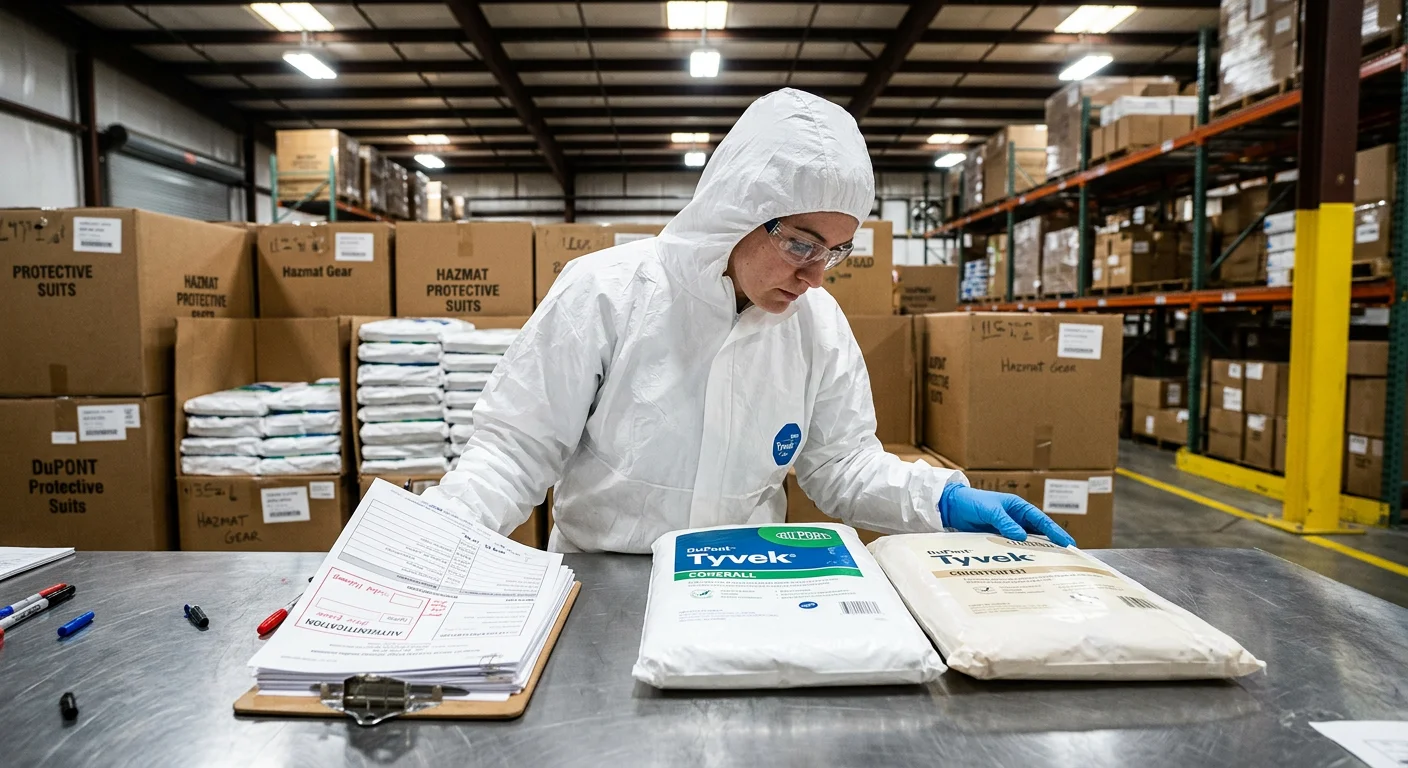
Counterfeits don’t announce themselves. They arrive in convincing packaging, carry specs that sound right, and get stacked in your warehouse next to the real thing. By the time a garment fails in a chemical splash zone, the invoice is already filed.
Four points tell the story. Check all of them — not just one.
The Four Things That Must Match
1. The trademark must appear as registered
Look for DuPont™ Tyvek® — with both marks — on the garment itself, the packaging, and the instruction sheet. A genuine Tyvek 500 Xpert shows the Tyvek® name on the zipper pull and carries an interior branding label. Neither is decorative. Both are verification points.
2. The material description must say flash-spun HDPE
Genuine Tyvek is a single-layer, flash-spun high-density polyethylene nonwoven. That’s it. Check the TDS or datasheet. See PP, SMS, or microporous film (MPF) listed? That’s not Tyvek — no matter what the product name says. DuPont’s own counterfeit comparisons found fake garments built with MPF construction, sold under Tyvek-adjacent branding.
3. The packaging format must match DuPont’s current design
DuPont updated its packaging in 2017. Known fakes still circulate in the pre-2013 layout. Here’s what to check: genuine bags use two short single-sided adhesive strips running lengthwise. Fakes often use a double-sided strip spanning the full bag width. The seal pattern doesn’t match. Stop right there.
4. The inside neck label must be present
Every genuine DuPont Tyvek garment has an interior neck label. It shows the applicable norms, lot number, and manufacturing date. No label means no traceability. No traceability means no audit defense. Some documented fakes shipped with this label missing altogether.
Red Flags Worth Stopping For
-
“Tyvek style” or “Tyvek-type” wording anywhere on the item or packaging — genuine product uses the registered mark, not approximations
-
Material spec reading PP+PE, SMS, or microporous film instead of flash-spun HDPE
-
Packaging that looks dated, with mismatched seal patterns or no printed instructions
-
Price well below the $3.00–$6.00 FOB range typical for certified Tyvek coveralls, plus a seller who can’t produce CE certificates or test data
-
CE documentation that references a different model number, size variant, or protection class than what’s on the actual garment
The Pre-Purchase Verification Workflow
Run this before signing any purchase order:
-
Confirm the exact model code matches across the offer, invoice, garment marking, and certificate — any mismatch is a stop signal
-
Request the TDS and verify the fabric is described as flash-spun HDPE Tyvek, not a substitute
-
Pull the CE certificate and match the certificate model number to the physical product, including size and variant
-
Inspect packaging format against DuPont’s current design standard — check seal style, adhesive strip placement, and printed instructions
-
Check the neck label for lot number, manufacture date, and applicable norms — treat a missing label as a major warning
-
Compare zipper and hood construction to genuine reference images — fake Tyvek 500 Xpert units have turned up with two-piece hood construction, while the genuine model uses a one-piece cut
The safest procurement path is an official DuPont authorized distributor. DuPont’s SafeSPEC tool lets you validate the product line, cross-reference hazard compatibility, and pull permeation data before you commit. Ask any distributor for their authorization proof. Then check their name against DuPont’s regional channel listing to confirm.
The checklist is short. The consequences of skipping it are not.
Conclusion

The Tyvek name on a coverall label tells half the story. DuPont engineers the material — the flash-spun HDPE fabric that makes genuine Tyvek Coveralls worth trusting in a chemical plant or hazmat job. But the finished garment comes out of certified OEM factories across the world. Different manufacturers sew, test, and brand these garments. Some meet strict standards. Others don’t.
That gap matters a lot for a bulk order.
So here are the questions worth asking:
-
Who holds the DuPont fabric license?
-
What certifications cover the finished garment?
-
Where does quality control happen in the supply chain?
At Morntrip, we build ISO-certified, CE Type 5/6 compliant Tyvek coveralls . Our supply chain is fully transparent. We source verified DuPont fabric and provide final inspection documentation at every step.
Ready to source smarter? Contact our team for samples, MOQ details, and a quote for your industry.