
A splash hits your sleeve during a chemical transfer, and suddenly you’re wondering if that disposable lab coat is actually protecting you or just making you feel protected. It’s a fair question—one too many buyers only ask after the fact. Not all disposable lab coat material is the same. Some fabrics shrug off liquids like a duck’s back; others soak through faster than a paper towel. The difference comes down to what’s happening at the fiber level—PP, SMS, or PE-coated—and whether “fluid resistant” means what you think it does. Before you stock up on the wrong PPE lab coat for your lab, clinic, or spray booth, understand the difference between “water-resistant” and “waterproof,” and match the right protection to the job.
Are Disposable Lab Coats Waterproof? Here’s the Straight Answer
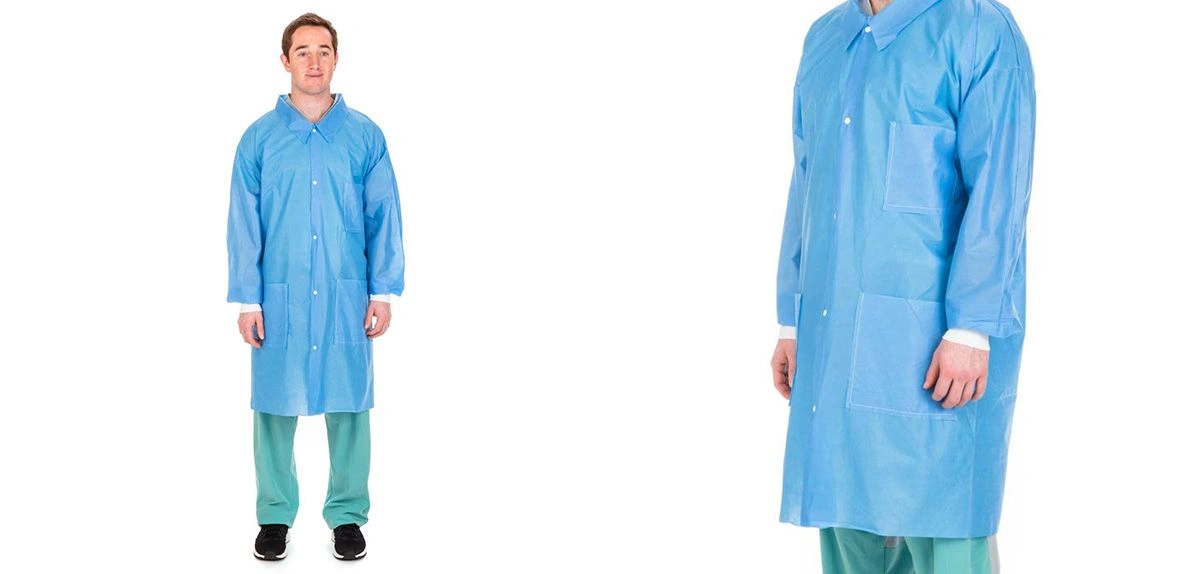
Most disposable lab coats aren’t waterproof. They’re fluid-resistant, and the gap between those two words matters more than most buyers realize.
A standard SMS lab coat or polypropylene lab coat blocks light splashes, dust, and biological particles. It’s not built to survive a soaking. VWR’s SMS data backs this up: their fabric shows H₂O resistance of just 16.7 grams, with a water vapor transmission rate of 965 g/m²/24h. Liquid gets through eventually. This is routine contamination control, not chemical bath protection.
3M describes its disposable lab coat material the same way – “basic barrier against light liquid splashes.” Even Tyvek, known for tougher performance, is marketed as repelling “water-based liquids and aerosols,” not blocking them entirely.
Truly waterproof lab coats exist, but they’re the exception. Look for PE-coated, PP+PE laminated, or microporous film construction. These are the products explicitly labeled “waterproof barrier protection” or “liquid-resistant, highest level of protection.” Everything else is splash protection.
Disposable Lab Coat Material Breakdown
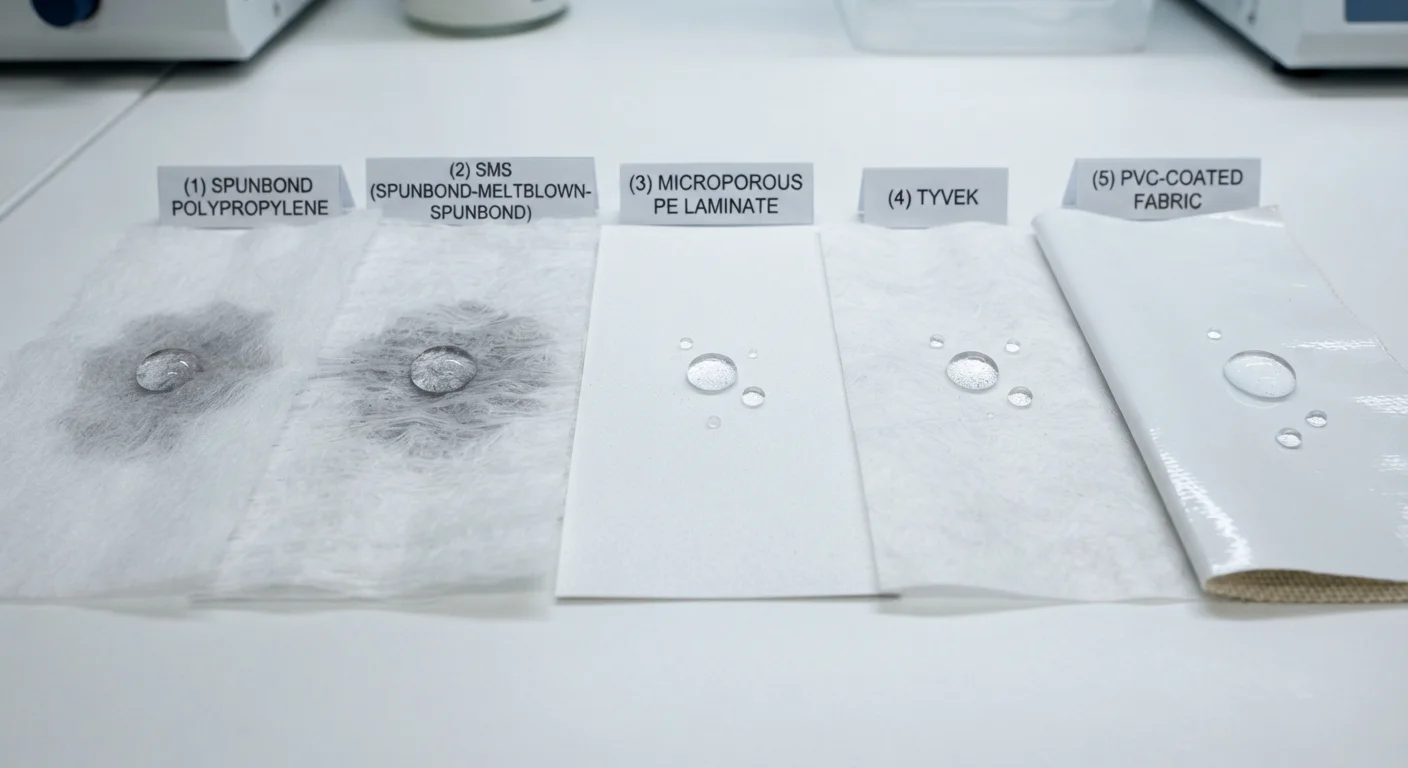
Five materials dominate disposable protective clothing . Each handles liquid differently, and the gap between them is bigger than most spec sheets show.
Polypropylene lab coat (PP nonwoven): This is your entry-level barrier. Spunbond PP, typically 25–40 g/m², single layer. It stops dust. It doesn’t stop liquid. Most PP lab coats can’t hit the 17 cm H₂O hydrostatic pressure threshold required by medical standards like GB 19082-2009. What they do deliver is airflow. Breathability regularly exceeds 2500 g/m²/day. Good for dry, low-splash work. Wrong choice for anything wet.
SMS lab coat (Spunbond-Meltblown-Spunbond): The meltblown middle layer changes everything. It’s the actual barrier. The two spunbond layers just protect it. Under AAMI PB70 testing, a well-made SMS coat hits Level 2 or 3. That’s 20 to over 50 cm H₂O of hydrostatic resistance, with liquid penetration under 1.0 g in impact tests. Blood-penetration trials show SMS blocking significantly more fluid than plain spunbond PP. This is the material for moderate splash zones: general chemistry labs, bodily fluid exposure, standard clinical work.
Microporous PE-coated / laminated film: Now we’re talking real waterproofing. A PP base layer laminated with a microporous PE film creates a true liquid barrier while still letting vapor escape. PTFE-style triple-laminate versions can reach hydrostatic pressures around 50 kPa, roughly 5000 cm H₂O. That’s an entirely different tier from SMS. Breathability holds steady too, often 1000–1800 g/m²/day. This is your go-to for heavy splash, continuous wet work, or chemical handling.
Tyvek: High-density polyethylene fibers, nonwoven structure. DuPont markets it around Level C protection with vapor transmission near 1500 g/m²/day. It breathes better than microporous film but trades off some hydrostatic performance. The balance makes it popular for long shifts in cleanrooms and pharma settings where comfort matters as much as barrier strength.
PVC/PU-coated fabric: The heavyweight option. Full coating means near-total liquid resistance, often exceeding 50 kPa hydrostatic pressure. Built for strong acids, aggressive solvents, BSL-3/4 perimeter work. PU-coated versions breathe reasonably well (3000–5000 g/m²/day). Pure PVC does not.
|
Material |
Hydrostatic Resistance |
Breathability |
Best For |
|---|---|---|---|
|
PP Nonwoven |
<17 cm H₂O |
≥2500 g/m²/day |
Dust, dry environments |
|
SMS |
20–50+ cm H₂O |
500–2000 g/m²/day |
Moderate splash, bodily fluids |
|
Microporous/PE Film |
Up to 5000 cm H₂O |
1000–1800 g/m²/day |
Heavy splash, wet work |
|
Tyvek |
Level C rated |
~1500 g/m²/day |
Long shifts, cleanrooms |
|
PVC/PU Coated |
50+ kPa |
3000–5000 g/m²/day |
Strong acids, BSL-3/4 |
Match the fiber to the fluid. Guessing wrong isn’t a materials problem. It’s a safety one.
Fluid Resistant vs Waterproof: A Guide to Telling These Key Terms Apart
Two words. One massive gap in protection. “Fluid resistant” and “waterproof” get used interchangeably on product pages, but they describe entirely different physics.
Fluid resistant means short exposure, low pressure, brief contact. Think venipuncture splashes — under 50 mL, contact time under a minute — or a cracked centrifuge tube spraying reagent across a bench. The fabric holds up under a quick hit, not a soaking. Waterproof means sustained pressure, continuous exposure, no penetration over time. That’s a pressure washer at 100–200 bar, or a chemical spill sitting on fabric for 30 minutes or more.
The two tests that tell you which one you’re getting:
AATCC 42 (Water Impact Test). A fixed volume of water hits the fabric surface; absorbent paper behind it gets weighed for pickup. Lower grams mean better splash resistance.
-
0–1 g: high-performance waterproof-level barrier
-
1–5 g: standard fluid-resistant disposable coat performance
-
Above 5 g: inadequate for bodily fluid exposure
Hydrostatic Head. Water column height in millimeters measures the point where fabric starts leaking under sustained pressure.
-
0–1000 mm: water-resistant, fine for general lab and clinical splash
-
1000+ mm: crosses into true waterproof territory
-
1500–5000 mm: industrial-grade — pressure washing, spray booths, continuous chemical exposure
A liquid repellent lab coat rated at 200–800 mm hydrostatic head with AATCC 42 results under 5 g is built for routine bodily fluid and light reagent splash, not for standing water or high-pressure spray. If your job involves sustained soaking, industrial paint, or aggressive chemical handling, you need hydrostatic ratings at 1500 mm or higher, paired with near-zero AATCC 42 absorption.
Don’t trust marketing language alone. Ask for both numbers.
Selection Guide by Scenario
Skip the spec sheet for a second. The fastest way to pick the right disposable lab coat is to ask what’s actually going to hit the fabric. Dust? A splash? A soaking? Once you know that, the material choice writes itself.
Dry labs and routine research work don’t need much. If your day involves handling samples, running assays, or general benchwork with only occasional light splashes, a polypropylene or basic SMS lab coat covers you. This is the everyday nonwoven lab coat , comfortable and breathable, built for incidental contact and dust control. Upgrading to heavier protection here adds cost without adding value.
Clinical settings and biological fluid exposure change the equation. Blood draws, specimen handling, and patient contact demand a fluid-resistant disposable coat with documented barrier performance. Look specifically for SMS, microporous film, or Tyvek construction. Check the barrier data, not just whether the packaging says “PPE lab coat.”
Chemical handling, industrial spray booths, and cleaning operations need waterproof performance, not resistance. PE-coated or PVC disposable protective clothing handles sustained rinsing, spray exposure, and repeated liquid contact. Standard single-use lab coat materials weren’t designed for continuous wet exposure. Using them here is a false economy.
High-hazard chemical exposure is a different category. No disposable lab coat is engineered for concentrated acids, strong solvents, or prolonged contact with hazardous chemicals. At this level, step up to certified chemical protective suits matched to the specific hazard class. A standard lab coat here creates a real safety gap.
Quick Decision Path
-
Dry work, occasional splash → PP or SMS
-
Bodily fluid or biological contact → SMS, microporous film, or Tyvek
-
Chemical spray, rinsing, industrial cleaning → PE-coated or PVC
-
High-concentration chemical exposure → Certified chemical protective suit
Match the scenario first. The material follows naturally.
Key Inspection Points for Purchasing Disposable Lab Coats (Practical Buying Checklist)
Spec sheets lie by omission more than they lie outright. Here’s what to actually check before you sign a purchase order.
Read the seams, not just the fabric. Stitched seams are the weak point on any fluid resistant disposable coat. Liquid finds the needle holes before it finds a way through the fabric itself. If you’re buying for chemical or heavy biological exposure, ask specifically for “sealed seams” or “taped seams” in the spec sheet. Standard stitching is fine for dry work. It’s a liability for anything wet.
Check the certification. “Waterproof” on packaging means nothing without a number behind it. For medical-grade PPE lab coats, ask whether the product references GB 19082 or equivalent standards covering synthetic blood penetration and microbial barrier testing. For chemical work, check for EN 13034 /EN 14605 compliance. Labels showing “Type 6” indicate low-level splash protection, which covers most general lab solvent handling. Anything less specific than that is a red flag.
Match breakthrough time to your chemical. A vendor claiming solvent resistance without listing breakthrough time is guessing. For low-to-moderate risk organic solvents, look for a minimum 30-minute breakthrough time. For strong acids or alkalis, that number needs to hit 60 minutes or more, paired with heavier microporous film construction (55–65 g/m² range).
Never plan to rewash single-use lab coats. Rewashing them is a false economy. Washing degrades nonwoven fiber structure, increases shedding, and tanks barrier performance. Build “single-use only, no laundering” directly into your procurement contract language.
Order quantities depend on risk level. Low-risk dust/splash environments run roughly one coat per person per shift. Moderate biological or solvent exposure pushes that to two. High-risk acid or concentrated solvent work needs three, factoring in a 15–20% loss buffer for damage and contamination swaps.
Bulk & Wholesale Considerations for Disposable Lab Coats
Once you move from a few coats to a few thousand, the procurement math changes. Cost, fit, and protection level all shift when you buy in bulk.
MOQ reality check. Most mid-size PPE factories set MOQs at 500–1000 units per style, capped at 3–5 mixed sizes. Specialized exporters like Morntrip go lower, with free samples plus 100–200 unit trial orders before you commit to full production (typically starting at 1000 units, scaling to 5000–10,000 for full-container loads). Add custom logos or unique cuff designs, and the minimum hits 1000–2000 units to offset tooling costs.
Size and cuff specs to lock down. Cover S–5XL, but stock smart: M/L/XL typically account for 70–80% of lab populations, so a 3:4:3 ratio covers most teams. For fluid work, specify knit elastic cuffs (5–8cm stretch, 16–20cm circumference) to block backflow. Build in a ±1.5cm tolerance per size and put it in writing.
Weight-to-protection mapping . Match grammage to hazard level:
|
Risk Level |
Material |
Weight |
|---|---|---|
|
Low (dust/teaching) |
PP |
20–30 g/m² |
|
Moderate (splash) |
PP+PE or SMS |
35–45 g/m² |
|
High (bio/pressure spray) |
Coated laminate |
45–60 g/m² |
Certification checklist before you sign. Ask for ISO 9001, CE, FDA registration, and PB70 Level equivalency reports. Request tensile strength data (≥15–20N) and batch-level test reports — not just marketing claims.
Vet the supplier. Confirm daily output ≥500 units, on-time delivery ≥95%, sampling turnaround under 3 days, and defect rate under 2–5%. Morntrip fits this profile: full material customization, multi-certification, and export experience with EN14126/Type 5-6 standards. It’s worth requesting a quote against your exact spec sheet.
Conclusion
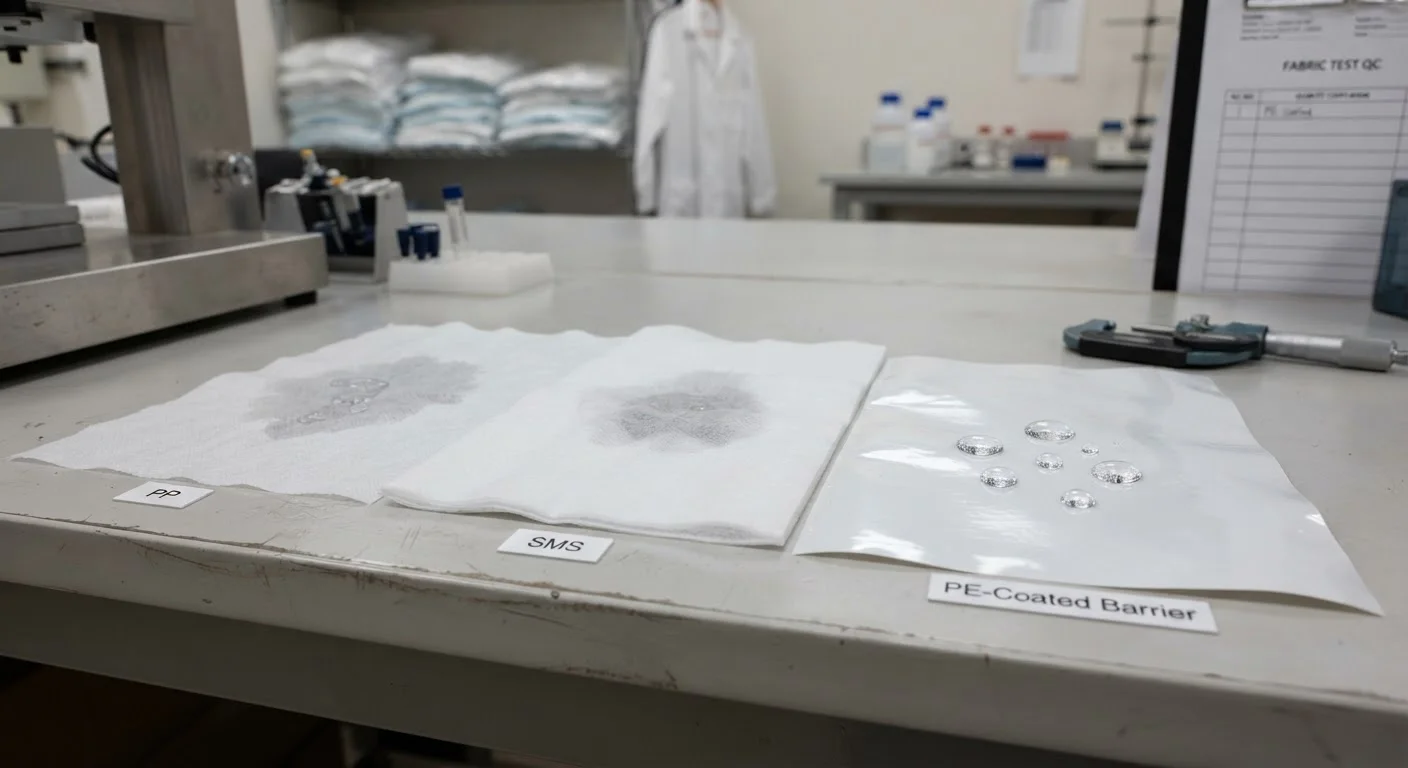
Not every disposable lab coat is created equal, and “protective” doesn’t always mean “waterproof.” A standard polypropylene lab coat handles dust and light splashes just fine. But if you’re staring down chemical spills or bodily fluids, you need an SMS lab coat or PE-coated barrier fabric built for genuine fluid-resistant performance.
Match the material to the mission. Know your risk level, check the ANSI/AAMI PB70 rating, and stop assuming “disposable” means your safety is disposable too.
Browse Morntrip’s certified disposable protective clothing lineup and find a fluid barrier that fits your workspace, not just your budget.





