Every time your lab restocks disposable lab coats , someone on your procurement team quietly wonders: are we just burning cash? You’re not wrong to ask. That flimsy Polypropylene coat protects for one shift, then it’s landfill. Meanwhile, reusable lab coats sit at a higher upfront cost but promise savings, sustainability points, and better protection over hundreds of wears.
It depends on your lab, your budget, and your risk exposure. We break down the real differences among fabric composition, chemical resistance, laundering demands, and per-wear cost so you can stop guessing and start comparing apples to apples. Whether you’re running a teaching lab or a Level 3 pharma facility, you’ll walk away knowing exactly which coat belongs on your shelves.
Disposable Vs Reusable Lab Coats Comparison Table
Comparison point | Disposable Lab Coats | Reusable Lab Coats |
|---|---|---|
Typical materials | SMS, polypropylene, microporous film, Tyvek/nonwoven blends | Cotton, polyester/cotton blends, barrier fabrics, FR-treated, Nomex/chemical-splash variants |
Primary use cases | Visitors, contractors, short tasks, PCR contamination control, high-risk isolation | Routine staff use, clinical chemistry, hematology, blood bank, dedicated personnel |
Protection profile | Low linting; splash resistance varies by grade | Consistent, durable protection depending on treatment/class |
Reuse model | Single-use / limited-use | Multiple wash cycles; requires a laundry plan |
Price per unit | SMS: $2–$5; high-barrier: $4–$8; bulk as low as $0.15 | Standard cotton ~$31.40; barrier polyester ~$30.06; Nomex/chemical-splash $68.38–$345.80 |
Ongoing cost | No laundering, but repeat purchases add up | $1–$3 per wash cycle |
Per-wear economics | ~$3–$6 per wear | ~$2–$3 per wear (50–80 cycles) |
Sustainability | Immediate waste, often biohazard disposal | Lower waste per wear; longer garment life |
Comfort | Lightweight, lower breathability | Cotton/polycotton typically more breathable for long shifts |
Replacement cadence | Every use or task entry | Every 50–100 wash cycles (barrier garments sooner) |
Best-fit buyer | Unpredictable volume, visitor-heavy, short projects | Stable staffing, predictable laundering infrastructure |
Neither option is automatically safer or more protective. The correct lab coat should first meet the protection requirements of the task. Cost, laundering, and convenience should be considered after the required level of protection has been identified.
Disposable Vs. Reusable Lab Coats: What’s the Difference?
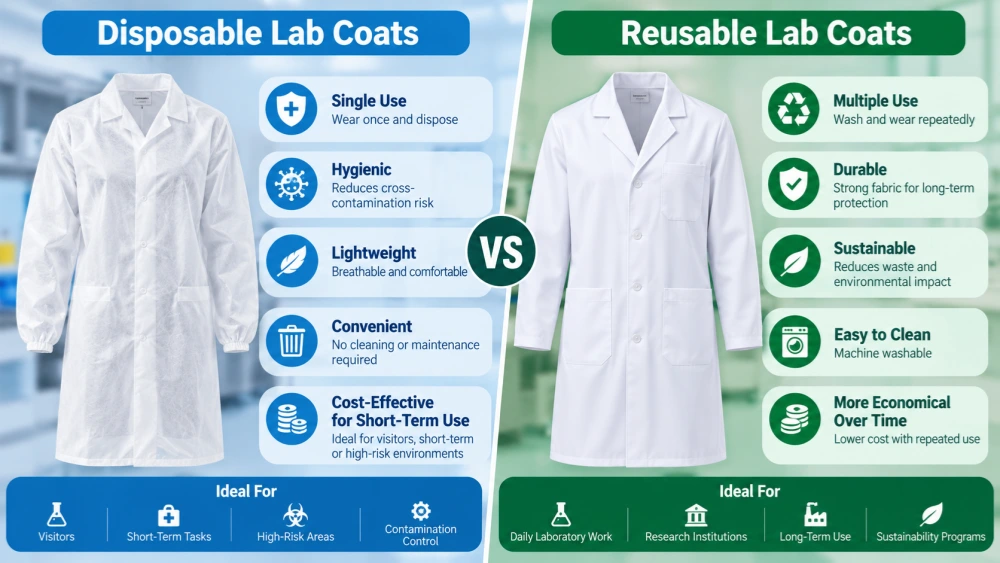
The biggest difference is not simply whether you throw the coat away or wash it.
Disposable and reusable lab coats differ in their materials, contamination-control process, durability, maintenance, long-term cost, and waste generation.
Materials And Construction
Disposable lab coats are commonly made from lightweight nonwoven materials.
Polypropylene (PP) is widely used for basic disposable lab coats. It is lightweight and economical, making it suitable for general hygiene, visitors, and low-risk applications.
SMS (Spunbond-Meltblown-Spunbond) uses multiple layers of polypropylene. The layered structure can provide better barrier performance than basic single-layer nonwoven material while remaining relatively lightweight.
Microporous film materials add a film layer that can improve resistance to liquid penetration while still allowing some moisture vapor to escape.
Other specialized disposable garments may use materials such as Tyvek or similar protective fabrics.
Reusable lab coats are different. They are commonly made from cotton, polyester/cotton blends, polyester, or specialized protective fabrics.
These materials are designed to withstand repeated wear and laundering. Some reusable garments may also include additional features for specific workplace hazards.
The material name alone, however, does not tell you how protective a lab coat is. Buyers should also check garment construction, coverage, closures, seams, and relevant test data.
Protection And Contamination Control
Disposable lab coats simplify contamination control because the garment can be removed and discarded after its intended use.
This can be useful when workers move between controlled areas, when visitors need temporary protective clothing, or when a facility wants to reduce the movement of contaminated garments.
Reusable coats require a different system.
After use, they need to be collected, transported, cleaned, inspected, and returned to service according to the facility’s procedures. Potentially contaminated reusable PPE should not simply be taken home and washed with normal household clothing.
However, disposable does not automatically mean more protective .
A lightweight disposable PP lab coat may provide less barrier protection than a reusable garment designed and tested for a specific hazard. Likewise, a reusable cotton coat should not be assumed to provide adequate protection against every chemical or liquid exposure.
Always match the garment to the actual hazard and intended use.
Comfort And Durability
Comfort becomes important when employees wear lab coats for several hours each day.
Disposable coats are usually lightweight, but comfort varies greatly by material. Some low-cost nonwoven coats can feel warm during long periods of use, especially when the material has limited breathability.
Reusable cotton and polyester/cotton lab coats are often comfortable for routine daily wear. They may also provide a more structured fit and stronger pockets, seams, and closures.
Durability is another major difference.
Disposable coats are designed for single or limited use. They are not normally intended to go through repeated industrial laundering.
Reusable lab coats are specifically designed to survive repeated wear and cleaning. Their actual service life depends on the fabric, construction, laundering process, frequency of use, and exposure conditions.
Inspect reusable coats regularly. Damaged closures, holes, worn fabric, or reduced protective performance may indicate that a coat needs replacement.
Laundering And Maintenance
Disposable lab coats eliminate most laundry management.
After use, the garment is removed and handled according to the facility’s waste and contamination procedures.
Reusable coats require an organized laundry system.
Facilities need to consider:
How used coats are collected
How contaminated garments are separated
Who performs the laundering
What washing process is required
How coats are inspected after cleaning
When damaged or worn garments are replaced
For laboratories handling biological, chemical, or other hazardous materials, employees should follow the facility’s safety procedures for contaminated protective clothing.
Home laundering may be inappropriate for contaminated PPE. Professional or onsite laundering programs allow facilities to maintain better control over collection, cleaning, inspection, and redistribution.
This hidden operational cost should be included when comparing disposable and reusable lab coats.
Cost Per Use
Looking only at the purchase price can give buyers the wrong answer.
A disposable lab coat usually costs less to purchase because you are buying a lightweight garment designed for short-term use. But every discarded coat has to be replaced.
Reusable lab coats require a higher initial investment but spread that cost across multiple uses.
A simple way to compare them is:
Disposable annual cost = Price per coat × Coats used per day × Operating days
For reusable coats:
Reusable annual cost = Initial garment cost + Laundering cost + Replacement cost
For example, a facility with stable staffing and an existing professional laundry system may achieve a lower cost per use with reusable coats.
A visitor-heavy facility may reach a different conclusion. Buying reusable coats for occasional visitors and then collecting, laundering, storing, and redistributing them may cost more than using disposable coats.
That is why procurement teams should calculate total cost per use , not simply compare unit prices.
Environmental Impact
Disposable lab coats create waste after each use. Facilities with hundreds or thousands of garment changes per month can generate a significant volume of waste.
Reusable coats spread the environmental impact of manufacturing across multiple uses, but they also require water, energy, detergent, transportation, and laundry equipment.
This means the environmental comparison is not as simple as:
Reusable = sustainable
Disposable = unsustainable
The result depends on how many times a reusable coat is actually used, how it is laundered, transportation requirements, and how disposable garments are handled after use.
For procurement teams, the most useful metric is often environmental impact per use rather than per garment.
When To Use Disposable Vs Reusable Lab Coats
Risk level makes this decision for you before budget ever gets a vote. Here’s the practical breakdown.
Reach For Disposable Lab Coats When…
Grab disposable coats for visitors and maintenance workers walking through your facility for a single task. Same goes for anyone entering a high-risk zone, doing molecular biology or PCR work, or handling anything with known or suspected biological contamination. Hazardous chemicals, bodily fluids, infectious pathogens — these are disposable-coat territory, full stop.
The disposable lab coat material (Tyvek or polypropylene) exists for this job: contamination control and short-term protection. You wear it, you get exposed to something you do not want to carry out of the room, and you toss it. No decontamination protocol needed. No laundry ticket to track. Done.
Reach For Reusable Lab Coats When…
Reusable lab coats belong on dedicated staff working in stable, low-to-moderate-risk environments — the kind where a professional laundry program already exists, and the coat rarely sees anything worse than a coffee spill. Medical lab coats worn daily by bench technicians, routine clinical work, teaching labs with predictable exposure levels — these are where reusable PPE lab coat programs make sense.
The catch: this only works if the coat stays free of obvious contamination. A reusable coat that is still wet with a hazardous substance, or one carrying a strong chemical odor, does not go in the laundry bin. It gets discarded. The same rule applies to anything exposed to volatile carcinogens, teratogens, materials with an LD50 under 50 mg/kg, strong corrosives, or chemicals capable of permeating nitrile gloves . When in doubt, that chemical-resistant lab coat you were counting on for another 40 wash cycles becomes a one-time-use item.
The Decontamination Step Nobody Skips
If there is any known or suspected biological exposure, decontaminate before laundering — no exceptions. Some institutional protocols require disinfection or autoclaving first, and spore contamination requires autoclaving. Most SOPs prohibit home-laundering reusable lab coats entirely. Laundering through a professional or onsite service is the standard. Household laundry streams and shared machines are off the table.
Some universities have already built this into policy — routing reusable coats through dedicated laundry services while reserving disposables for visitors or whenever a risk assessment flags them as the safer call. That is the model worth copying: match the coat to the actual exposure risk, not to whichever option is sitting closest to the door.
FAQ About Disposable And Reusable Lab Coats
Procurement teams ask the same handful of questions before they commit budget. Here are straight answers, backed by the numbers that matter.
What Material Is Cheapest For Disposable Lab Coats?
PP nonwoven and SMS sit at the bottom of the price ladder, and by a wide margin. At scale, quotes for PP nonwoven cluster in the $0.14–$0.60 per piece range. One supplier lists PE material running 40–65 grams per piece, with polypropylene nonwoven weighing in at 20–120 g/m² depending on the barrier level you need. Heavier gsm means better splash resistance, but it also nudges the price up. If your lab is buying thousands of coats a month for visitor gowning, PP nonwoven is where the savings live.
What MOQ Is Normal For Disposable Lab Coats?
Most factories won’t quote their best pricing below 5,000–10,000 pieces. Some push the floor even lower, offering their sharpest per-unit rates only at 20,000 pieces. On the smaller end, market listings show MOQs starting around 1,000 pieces, but you’ll pay a premium for that flexibility. For context, retail/case packaging benchmarks show about 30 pieces per case at $1.67–$1.87 each through U.S. online distribution. That’s useful if you’re buying small batches without going through a manufacturer.
What Certifications Matter?
This depends on what you’re protecting against.
Infection control → look for EN 14126
Electrostatic risk (cleanrooms, electronics work) → EN 1149-5
Flash fire exposure → NFPA 2112
Arc-flash environments → ASTM F1506 paired with NFPA 70E or CSA Z462
Blood and body fluid penetration → ASTM F1670/F1671
Controlled environment / cleanroom compliance → ISO class-specific certification (more on this below)
Chemical protective clothing standards → EN ISO 13034 and EN ISO 14325
Sterile barrier assurance → look for garments manufactured under ISO 9001:2015 quality systems
If a supplier can’t point you to the specific standard behind their “protective” claim, treat that as a red flag.
What Cleanroom Classifications Should I Be Checking?
Lab coats get sold against ISO Class 3 through Class 8 environments, and the naming conventions still overlap with older “Class” terminology you’ll see in older spec sheets:
ISO Designation | Legacy Class Name |
|---|---|
ISO 3–4 | Class 1–10 |
ISO 5 | Class 100 |
ISO 6 | Class 1,000 |
ISO 7 | Class 10,000 |
For sterile, single-use garments used in the tightest environments, some manufacturers go further, offering coats gamma-sterilized to SAL 10⁻⁶ under ISO 11137-1, complete with full traceability and certificates of sterility. That level of documentation matters if you’re running pharma-grade cleanroom operations, less so if you’re gowning teaching-lab students.
What’s The Main Benchmark For Reusable Lab Coats?
Cotton and cotton/polyester blends dominate this category, built for repeated laundering rather than single use. Retail Cotton lab coats span an enormous price range, anywhere from about $24.86 up to $339.50, depending on brand, cut, fabric weight, and any added chemical-splash or flame-resistant treatment. The lower end gets you a standard clinical coat. The upper end includes certified protective features like NFPA 2112 flame resistance or ASTM F1506 arc-flash compliance.
The trade-off is that you pay more upfront, but the cost per wear drops after about 50 wash cycles.
Do Disposable And Reusable Coats Ever Share The Same Chemical Protection Rating?
No, and the labeling reflects that. Disposable, limited-use coats sold in Europe often carry CE Category III, Type PB (6)-B classification combined with EN 14126, a rating built for partial-body protection against infectious agents during short exposure windows, not for a fabric expected to survive fifty wash-and-wear cycles. Reusable coats built for the same chemical-splash environments need their own durability testing across repeated laundering, which is a different certification conversation. If a reusable coat manufacturer can’t show you wash-cycle-specific test data, ask for it before you commit to a bulk order.
Conclusion
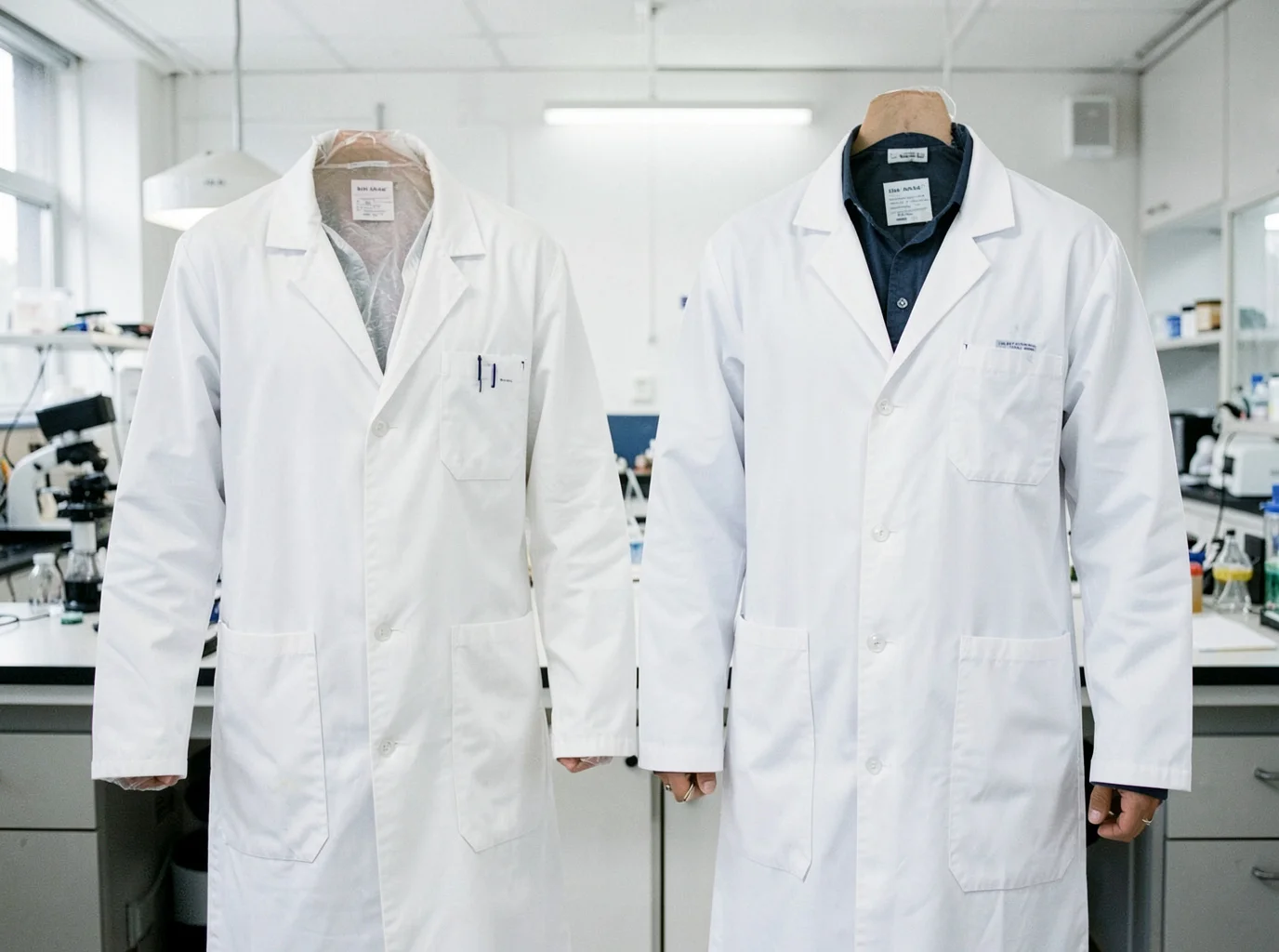
Choosing between disposable and reusable lab coats means matching protection, budget, and sustainability goals to your lab’s real-world demands. Disposable coats win on convenience and contamination control for short, high-risk tasks. But when you tally the numbers over months (not days), reusable lab coats consistently deliver lower cost-per-wear, better chemical resistance, and a far smaller environmental footprint, especially when laundering protocols are dialed in correctly.
If you’re managing procurement for a pharma facility, diagnostic lab, or teaching institution, audit your current usage patterns before your next bulk order. Partnering with an experienced reusable lab coat manufacturer like Morntrip pays off. We help labs build coat programs that fit their workflow, budget, and compliance needs.
Reach out to our team for a tailored recommendation.