
Grab any two white coats hanging in a hospital supply closet, and chances are they’ll look nearly identical at first glance. But hand one to a nurse walking into an isolation room and the other to a lab tech running routine bloodwork, and you’ll quickly see why mixing them up is a genuine safety gap. The difference between isolation gowns and lab coats is about fluid resistance, coverage, and how much protection your work demands. Whether you’re stocking a hospital supply room, outfitting a lab, or trying to understand what’s hanging in the break room, this guide shows where these protective garments overlap, where they differ, and how to choose the right one before it matters most.
Isolation Gown Vs Lab Coat: Key Differences
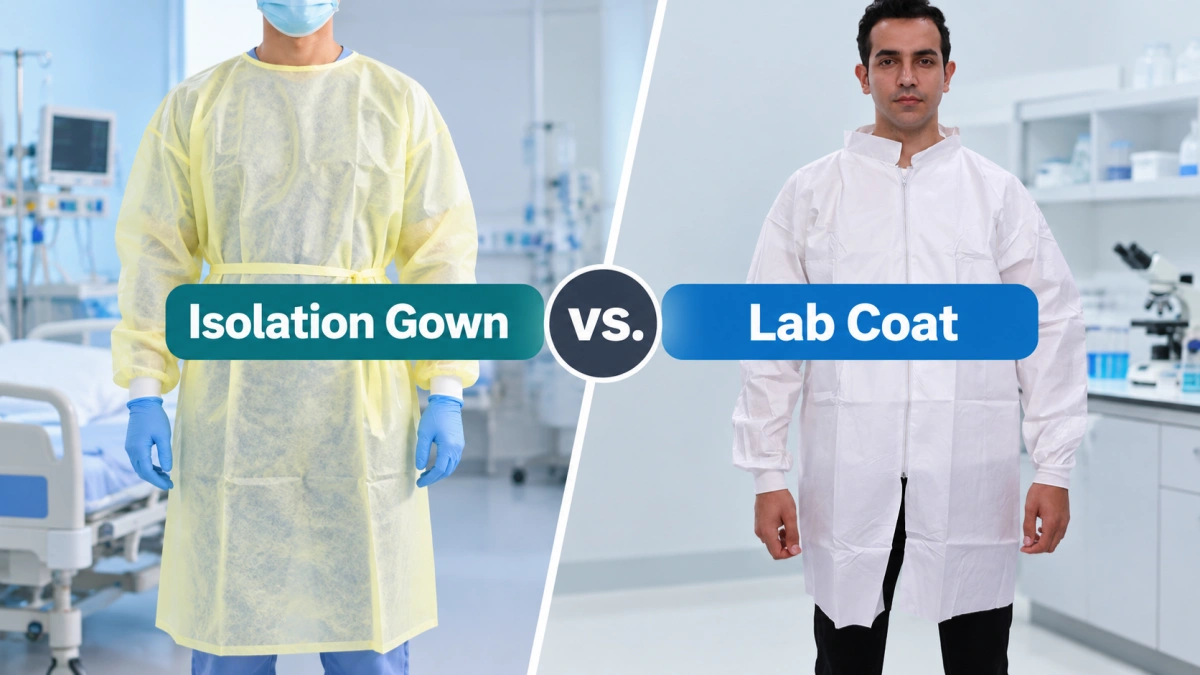
Isolation gowns and lab coats aren’t held to the same standard. Isolation gowns fall under ANSI/AAMI PB70, a liquid-barrier classification system that sets minimum barrier performance, labeling, and test methods for healthcare protective apparel. Lab coats are not tested or rated this way.
PB70 breaks fluid protection into four levels:
-
Level 1 – lowest barrier, minimal fluid exposure risk
-
Level 2 – light fluid exposure
-
Level 3 – moderate fluid exposure, higher pressure fluids
-
Level 4 – highest barrier, includes pathogen-resistant testing
Levels 1–3 use spray impact penetration and hydrostatic head testing. Level 4 sits in its own category above that. This is the spec buyers should reference when comparing disposable isolation gown products.
Isolation gowns cover the torso and arms and are open at the back, built for quick don/doff during patient care. Lab coats close in the front, made for all-day wear at the bench.
Most isolation gowns used in patient care are non-sterile. Sterile versions appear in surgical or invasive-procedure settings. Lab coats aren’t treated as sterile apparel at all.
Disposable isolation gowns use PP or SMS nonwoven fabric, chosen for fluid resistance rather than comfort alone.
The FDA recognizes ANSI/AAMI PB70:2022 as a consensus standard, and CDC’s NIOSH list includes ASTM F3352-2023 for healthcare isolation gowns. This places them in a different regulatory category than standard lab coats.
How Do Isolation Gowns and Lab Coats Differ in Design and Coverage?
The way these two garments are cut tells you almost everything about what they’re meant to do. Isolation gowns are built like a wrap, not a coat. They’re designed for full coverage across the torso and arms, and many close in the back rather than the front, either with an open-back style or a full-back design that overlaps the panels and secures with side ties. That overlapping back panel isn’t a small design quirk. It seals off gaps so fluids can’t sneak through during patient care.
Lab coats take the opposite approach. They’re cut more like actual clothing, closed in the front, often fastened with simple snaps, and shaped for comfort and mobility rather than barrier sealing. You can move freely in a lab coat because it’s not trying to wrap around and protect your entire backside. It’s protecting your front and sides while you work at a bench.
Cuffs and fit reveal the same story. Isolation gowns often use knit cuffs paired with tie closures at the neck and waist, creating a snug seal at pressure points. Lab coats may also have knit cuffs, but the emphasis shifts toward workwear comfort rather than a true barrier seal.
Material weight backs this up, too. A Level 1 isolation gown might use 25–35 gsm Polypropylene, while a Level 4 gown steps up to 70 gsm PE-laminated SMS fabric, heavy-duty medical protective clothing built for high fluid and viral exposure. Lab coats, by contrast, stay lightweight, since they’re meant for basic care and general handling rather than serious fluid resistance.
The takeaway is simple: if your work demands real coverage and cross contamination prevention, an isolation gown is the right call. If you just need lighter laboratory safety attire for everyday tasks, a lab coat gets the job done.
How Does Fluid Resistance Differ Between Isolation Gowns and Lab Coats?
Numbers tell the real story. A Level 1 isolation gown lets up to 4.5 grams of water through under AATCC 42 impact testing. That sounds like a lot until you realize it’s the minimal protection tier, meant for basic care with almost no splash risk. Move to Level 2, and the threshold drops to ≤1.0 gram, with a hydrostatic pressure requirement of ≥20 cm under AATCC 127. Level 3 keeps the same 1.0-gram ceiling but raises the pressure bar to ≥50 cm, built for procedures with heavier fluid volume.
Level 4 lives in a different world. It’s the only tier labeled fluid-impermeable. It has to hold up against synthetic blood and viral penetration under pressure, tested through ASTM F1670 and F1671. This is protective clothing for long, fluid-intense procedures where bloodborne pathogen exposure is a real concern.
Lab coats aren’t built around that framework. There’s no barrier level on the label because there’s no liquid-barrier standard they’re tested against. Pull up a Kimtech lab coat spec sheet and you’ll find fabric metrics like ASTM D737 and ASTM D6701 — tests for breathability and general fabric durability, not fluid resistance.
For splash or soak risk on the job, pick an isolation gown matched to the right barrier level. Routine lab work with minor incidental contact? A lab coat is fine. Light fluid exposure calls for a Level 2 gown , larger-volume exposure a Level 3 gown. High-risk, fluid-intense, or bloodborne pathogen scenarios demand a Level 4 gown, no substitutes.
That gap is the difference between a garment engineered against blood and viral penetration and one that’s comfortable to wear at a bench all day.
When Should You Choose an Isolation Gown or a Lab Coat?
Dry work gets a lab coat. Wet or splashy work gets an isolation gown. That one rule clears up most of the confusion on a hospital floor or in a production facility.
Lab coats work in low-risk, controlled areas – QC labs, support labs, any space where you move between rooms. You are not expecting blood or body fluids to touch your clothing. The lab coat provides comfort and identification.
Use isolation gowns when you expect contact with blood, body fluids, secretions, or splashes. CDC guidance under Standard Precautions says to wear a gown only if contact with clothing is expected. If that risk exists, reach for the gown.
Matching the Level to the Task
Once you have decided a gown is necessary, the AAMI level tells you how much protection to add. Level 1 covers minimal fluid exposure, basic care, and low-risk tasks. Level 2 handles low-to-moderate splash risk and more than routine care. Level 3 is for moderate-to-high exposure – blood draws, suturing, ICU procedures, pathology work.
In pharmaceutical and production settings, the same logic applies. Use a lab coat in controlled support areas. Put on a gown in moderate-risk production zones. If the product is open to the environment, bump up one protection level.
Run through a quick checklist. If fluid splash or spray is possible, choose a gown. For dry work focused on cleanliness, a lab coat works fine. If contamination risk is limited to your front side, a gown fits better than a coverall . In higher fluid-risk clinical or production zones, size up to a higher AAMI level gown.
Disposable vs. Reusable Options: What Changes in Daily Use?
Money and logistics settle this debate before infection control gets much say. A disposable isolation gown removes washing from your routine but adds continuous purchasing and waste handling. A reusable lab coat flips that trade-off. You stop repurchasing, but now you manage collection, sorting, washing, drying, storage, and return logistics every single day.
The cost math backs this up. One benchmark calculation shows a reusable garment costing $25 upfront, plus $0.15 for cleaning and $0.05 for consumables per use, landing at $0.45 per use by the 100th wear. The disposable equivalent runs $0.50 per use. Reusables become the smarter buy once the purchase cost spreads across enough cycles and cleaning stays cheap. That is the break-even math procurement teams should run before signing a bulk order.
For healthcare worker protective wear, high-turnover, high-contamination environments favor disposables. You skip the recontamination risk that comes with laundering. Low-risk lab settings, where garments see light daily wear, tilt toward reusable lab coats. Your washing infrastructure and turnover rate should decide which column you fall into.
What Should Buyers Check Before Ordering?

Picking the right barrier level is half the job. The other half is making sure your supplier delivers what the spec sheet promises.
Start by confirming the business is real. Check that the business license, registered address, and payee name all match. Then find out if you’re dealing with a factory or a trader. Ask for a machine list and production capacity that matches your volume.
Before placing a bulk order, check:
-
Certifications: ISO 9001, BSCI , and product-specific lab reports for your isolation gown or reusable lab coat line
-
Samples: a physical sample matching final specs, not a stock lookalike
-
Written specs: materials, dimensions, tolerances, and packaging, signed off in advance
-
MOQ and pricing: locked in writing so terms don’t shift after deposit
-
Lead time: typically 15–20 working days for many packaging orders
-
Payment terms: 30% deposit / 70% before shipment is standard; 100% upfront is a red flag
-
Factory audits: recent reports, ideally within 12–18 months, or a live video walkthrough
Vague answers to technical questions about fabric or fluid resistance testing are a warning sign. A supplier who knows their materials will happily talk through them.
Frequently Asked Questions About Isolation Gowns and Lab Coats

Procurement teams tend to ask the same handful of questions before they commit to an order. Here are the ones that come up most.
Can a lab coat protect against bloodborne pathogens?
Not reliably. NIH guidance points to ASTM F1670 (synthetic blood) and ASTM F1671 (viral penetration) when someone needs bloodborne-pathogen protection. Standard lab coats aren’t tested against either standard. If that’s your exposure risk, you need a Level 4 isolation gown, not laboratory safety attire.
Is Level 4 really the only level tested for viruses?
Yes. Under ASTM guidance, Level 4 is the sole tier evaluated for viral penetration resistance using ASTM F1671. It’s held to a strict bar too: no penetration at 2 psi (13.8 kPa) for both synthetic blood and viral testing. Levels 1 through 3 never face that test. They’re measured on water resistance instead.
What fabric shows up most in higher-protection gowns?
Sourcing sheets for critical-zone protection call for SMS fabric or microporous breathable material. Film-reinforced gowns are expected to pass ASTM F1670 in high-exposure areas like the chest and forearms, where contact risk runs highest during procedures.
What should I ask for on a spec sheet?
Four things, every time:
-
The AAMI PB70 level printed on the label
-
Confirmation of whether it’s an isolation gown or lab coat, and whether it’s rated for splash protection or bloodborne-pathogen barrier protection
-
Test reports for AATCC 42, AATCC 127, ASTM F1670, and ASTM F1671, whichever apply to that level
-
Evidence of critical-zone reinforcement and seam strength testing for higher-risk garments
Do lab coats have their own performance specs?
They do, just a different set. Manufacturers test tensile strength (ASTM D5034, D1682), tear resistance (ASTM D5587 or D1424), seam strength (ASTM D751), and breathability (ASTM F1868, D6701, D737-75). None of these measure fluid barrier performance, which is exactly why lab coats stay out of the PB70 conversation entirely.
Conclusion
Choosing between an isolation gown and a lab coat comes down to matching the right protective clothing to the right risk level. An isolation gown, especially a fluid-resistant gown rated Level 2 or 3, is your go-to when there’s real exposure to blood, fluids, or contamination. A reusable lab coat, on the other hand, earns its place in low-risk lab settings where basic coverage is enough.
Get this distinction wrong, and you’re not just breaking a dress code—you’re opening the door to cross-contamination and unnecessary risk. That’s the real value here: clarity that protects both your team and your compliance record.
If you’re currently comparing suppliers or stocking up for your facility, don’t guess. Reach out to Morntrip ‘s team for tailored recommendations on isolation gowns and PPE personal protective equipment that actually fit your workflow—your staff (and your budget) will thank you.





