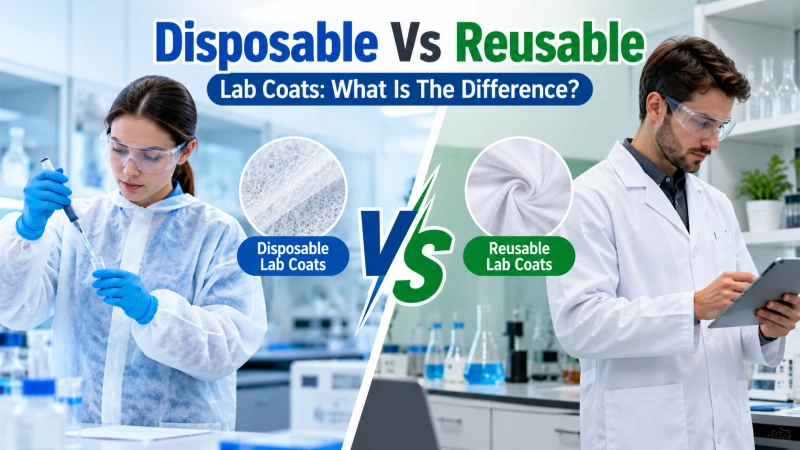
Flip through a lab equipment catalog or check a hospital supply closet, and you’ll find garments labeled as either a ” lab coat ” or a “lab jacket.” It looks like marketing fluff, but the difference matters. The length of the hem, the weight of the fabric, and the way the cuffs close around your wrists determine whether you are shielded from chemical splashes or wearing a glorified white button-up. Whether you’re a nurse choosing daily wear, a chemistry student outfitting for the lab, or a procurement manager ordering protective gear for an entire department, getting this right saves money, hassle, and a trip to the ER.
Lab Coat Vs. Lab Jacket: Key Differences at a Glance
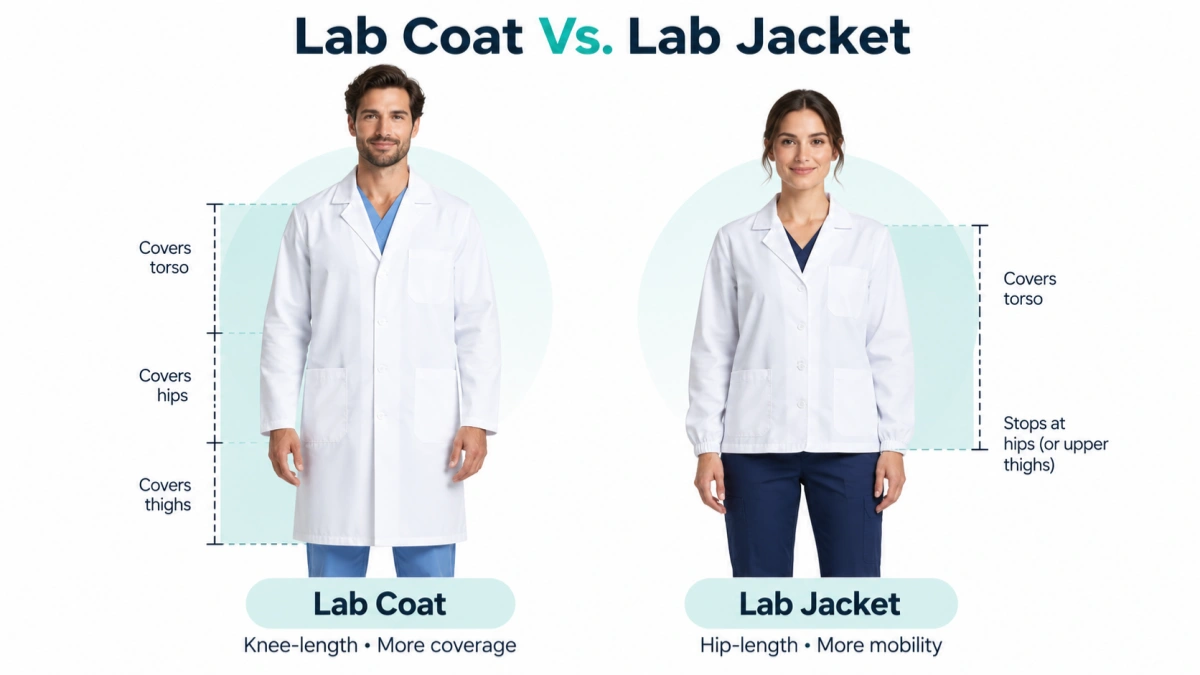
Strip away the branding, and the practical distinction between a lab coat and a lab jacket is how much body coverage it provides.
Length is the defining factor. A standard laboratory coat runs knee-length or longer, with most reusable versions measuring around 97 to 107 cm (38.25 to 42 inches). That fabric covers your torso, hips, and thighs, which is why hospitals and chemistry labs default to full coats when splash exposure is a serious risk. A lab jacket stops at the hip or upper thigh. McMaster draws this line cleanly, separating knee-length lab coats from jackets that cover only the top of the hips.
Coverage changes how the garment performs. The longer hem on a lab coat protects better against spills, dirt, and abrasion, but it puts more fabric around your legs when you walk, sit, or climb a step stool. A lab jacket’s shorter cut trades some of that coverage for mobility, which helps when you bend over equipment or move between workstations all day.
Supplier naming is not standardized. TDS sells a product called the “Maxi-Gard protective lab coat ” that stops at the hip. Fisher Scientific generally follows the knee-length coat and shorter jacket convention, but other vendors do not. If you are sourcing in bulk, do not rely on the product name alone. Ask for the finished garment length or the exact hem position.
Material and closures are not reliable differentiators. Both coats and jackets come in cotton blends, polyester, Polypropylene, and SMS fabric. Cuffs range from knit to open to elastic, and both styles use buttons and snaps interchangeably. What one supplier builds in SMS with a snap front, another builds in cotton-poly with buttons. None of those details tell you whether you are holding a coat or a jacket.
The smarter sourcing approach separates two independent variables: garment style (coat versus jacket, based on measured coverage) and use cycle (disposable versus reusable). A lab coat can be single-use or reusable, and so can a lab jacket. Treating these as a single decision leads to purchasing mistakes—especially for procurement teams ordering protective clothing at scale.
Why Are Some Short Lab Coats Called Lab Jackets?
The naming comes down to inconsistent branding rather than any formal technical standard. Browse through any medical supply catalog, and you will find hip-length garments sold as Lab Jackets, Short Lab Coats, or Medical Jackets, all describing the same cut.
Graham Medical Products lists the LabMates Lab Jacket as a hip-length garment made from SMS nonwoven fabric, featuring a snap front, knit collar and cuffs, and three pockets. It comes in white or blue across sizes Small through X-Large. The FitMe Lab Jacket shares that same hip-length cut, but uses three-ply SMS fabric, two waist pockets, and a chest pocket. Unlike most disposables, it is washable and can be autoclaved up to five times.
The ISOL8 Healthcare Unisex Medical Coat uses the word “jacket” in its product description despite being sold as a short-sleeve warming garment. It is made from 40 gsm, 100% Polypropylene SMS, with plastic snaps and soft knit cuffs. Short sleeves leave the forearms exposed, which matters in surgical and acute-care settings. It also carries CE marking and MDR 2017/745 Class I medical device certification, details that tell you far more than the product title.
Fisher Scientific bypasses the distinction by grouping “Lab Coats and Jackets” into one combined catalog category. In practice, the industry rarely treats these names as separate tiers of protection. Common materials across the board, such as polyethylene, cotton, and polyester blends, serve the same goal of reducing contamination and splash exposure whether the tag says coat or jacket.
Medical suppliers tend to favor “jacket,” while lab apparel vendors often use “short lab coat” for the same item. The sales channel determines the terminology on the page, regardless of garment engineering.
When comparing options, treat the name as marketing language. The hem length, fabric weight, and certification data show what you are buying.
Does a Longer Lab Coat Provide Better Protection?
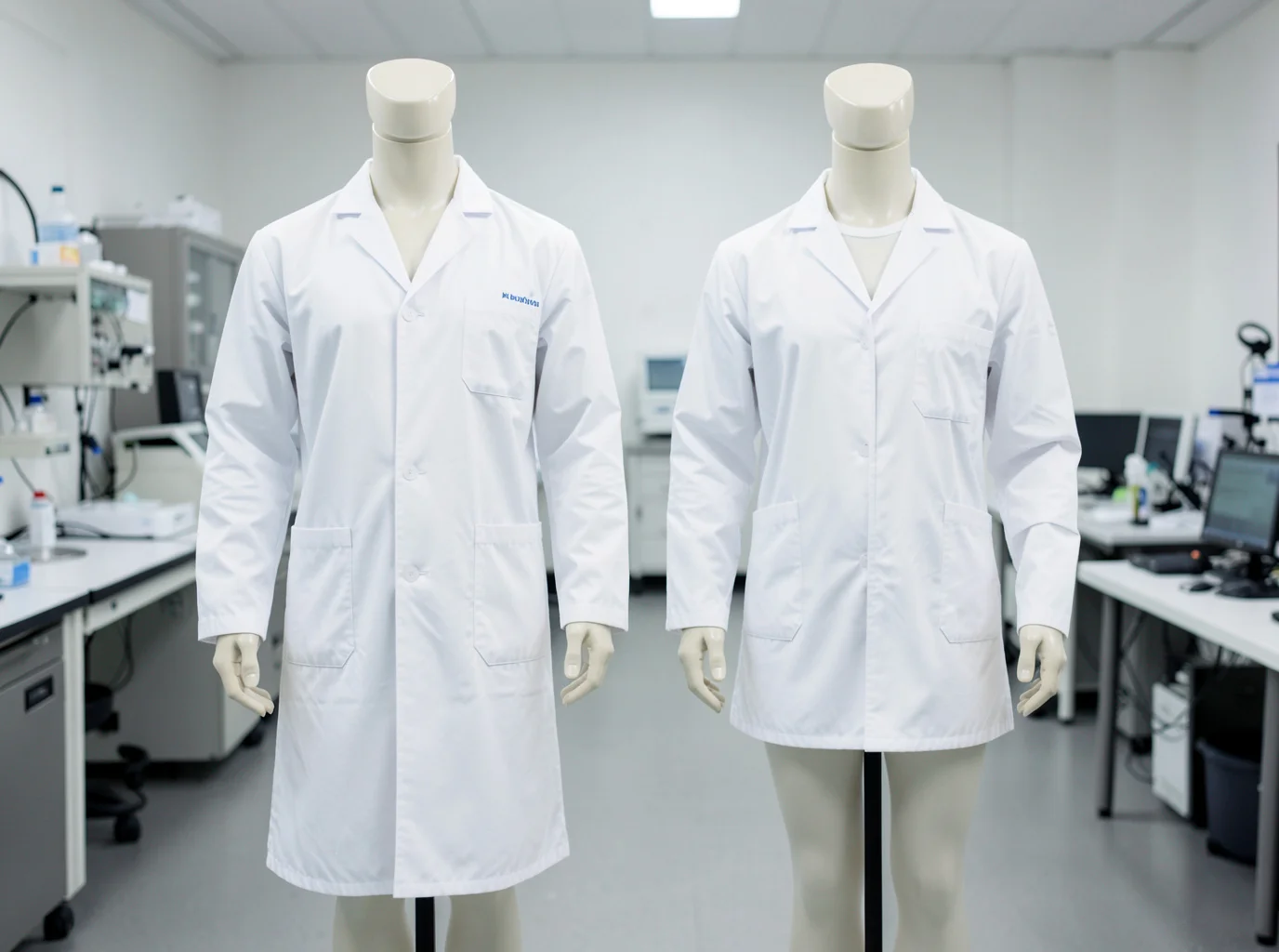
A longer lab coat covers more surface area, but coverage does not equal barrier performance. Most lab safety guidelines call for a coat that reaches at least to the knee. The practical requirement is that it covers your torso, arms, and upper thighs while you move, whether you bend, reach, or sit down.
More fabric doesn’t mean better protection.
-
A longer hem reduces exposure around the shins, knees, and upper legs during spills or drips.
-
Real protection depends on fabric weight, coating, seam construction, cuff design, closure type, and garment integrity. NIH guidelines flag seams and front-or-back opening styles as key checkpoints. Length alone tells you nothing.
-
A standard white cotton lab coat, regardless of length, is built for light splashes and general contamination. It will not block chemicals, infectious materials, or flammable liquids.
An open front undercuts coverage, no matter the length.
Your lab coat should fasten securely with snaps or buttons, leaving no gaps across the chest or abdomen. Cuffs must reach your wrists and overlap your gloves . A long coat with an open front, a partial zipper, or widely spaced buttons lets liquid pass straight through to your clothes. A shorter coat that closes properly protects better than an unbuttoned knee-length one.
Side slits and back vents create blind spots.
Vented or split hems make walking and sitting easier, but they expose your legs. Inspect the garment while standing, stepping, and bending over, rather than on a hanger. For chemical splash risks, choose a cut that remains closed over your torso and thighs as you move. If you need extra coverage, add a chemical-resistant apron instead of relying on a longer hem.
Sitting down can erase the benefit of a longer hem.
Sitting causes the hem to ride up and bunch across the thighs, which often pulls the front open. A catalog photo of a standing model reveals very little about how the coat performs at a bench. Request images showing the model from consistent angles in multiple working positions: standing closed, seated, bending, and reaching overhead. Check the knees, thighs, waist, and cuffs in every photo. Exposed skin or street clothing indicates a gap in protection.
Match the garment to the actual hazard, not just the length.
-
Liquid or chemical exposure: Look for ASTM F903 (chemical liquid penetration) or AATCC 42 (water impact penetration) test data. A “chemical resistant” label without test numbers is not proof.
-
Bloodborne pathogens: Confirm ASTM F1670 or ASTM F1671 testing. Extra fabric covers more skin, but it cannot substitute for barrier testing.
-
Flame or heat hazards: Standard lab coat fabrics do not offer flame resistance. For flammable liquid work, confirm NFPA 2112/2113 or ASTM F1506 compliance.
-
Cleanroom work: Cleanroom coats control static and minimize particle shedding. They are not built for chemical or heat defense, which manufacturers often note on spec sheets.
When sourcing, prioritize closure design, fit, and verified test standards. A well-fitted coat with task-specific certifications protects better than an untested long coat with an open front or split seams. For specific chemical or biological hazards, a shorter certified coat will outperform an untested knee-length model every time.
Should You Choose a Lab Coat or a Lab Jacket for Your Work?
Forget job titles. Choosing between a lab coat and a lab jacket based on roles like “chemist wears a coat, visitor wears a jacket” leads to safety gaps. OSHA guidance ignores titles. It requires identifying the chemicals, quantities, and operating conditions first, then matching protective clothing to chemical, fire, reactivity, biological, and radiation hazards. Base your choice on that risk assessment.
Choose a lab coat when:
– You need torso, hip-to-thigh, arm, and personal-clothing coverage
– Small chemical splashes, biological material, or unsealed radioactive material are part of your routine
– Your institution mandates lab coats for BL-2 or higher work
Choose a lab jacket when:
– Upper-body and arm protection is the priority
– You spend time seated, moving around equipment, or bending down
– Shorter-hem mobility matters more than lower-body coverage
Certain fit details matter whichever style you choose. Look for a high collar, a full front closure, a trim fit that avoids bagging, and cuffs that sit snug at the wrist. Knit or elastic cuffs reduce contact contamination at the wrist line. For tasks with real contamination risks, pick a snap front or quick-release closure so you can shed the garment fast in an emergency instead of fumbling with buttons.
When working with pyrophoric materials, air-sensitive chemicals, or clear fire hazards, wear an institution-approved flame-resistant garment. A standard cotton lab coat provides no protection against fire, regardless of hem length.
Match the Scenario to the Garment
|
Work Scenario |
Pick This |
Why |
Switch If |
|---|---|---|---|
|
Standing at a fume hood |
Lab coat |
Full front closure, thigh coverage, and snug cuffs block small splashes |
Stepping and turning near rotating equipment with low lower-body risk |
|
Seated microscope/instrument work |
Lab jacket |
Short hem avoids bunching and chair-wheel snags |
Open chemicals or dripping samples are present (use a longer coat) |
|
Frequent bending for low samples |
Lab jacket or short coat |
No dragging hem, elastic cuffs, closed front |
Drip or splash hazards require thigh coverage |
|
Moving between rooms with samples |
Lab coat |
Full torso coverage, tailored fit, closed front |
Low-risk zones call for quick removal |
|
In and out of cleanrooms/cold storage |
Lab jacket |
Easier on/off, fewer snags on doors and equipment |
Biological, chemical, or radioactive contamination requires more coverage |
Some hazards exceed what either garment can handle. Working with large volumes of corrosive or toxic chemicals requires chemical-resistant aprons, sleeves, or full-body suits matched to chemical compatibility data. Floor-level fire hazards require flame-resistant pants or coveralls , as an FR coat leaves legs exposed. High-splash biological work calls for garments tested to ASTM F1670 or F1671 per NIH guidance. Radiation, laser, and cryogenic hazards require specialized gear worn over your coat or jacket.
When ordering disposables through Morntrip , check the fabric weight (gsm), closure type, cuff style, hem length, and pack count in advance. Order based on chest and sleeve measurements rather than height alone; loose sleeves catch on equipment, while tight fits pull closures open.
How to Compare Lab Coat and Lab Jacket Samples Before Ordering?
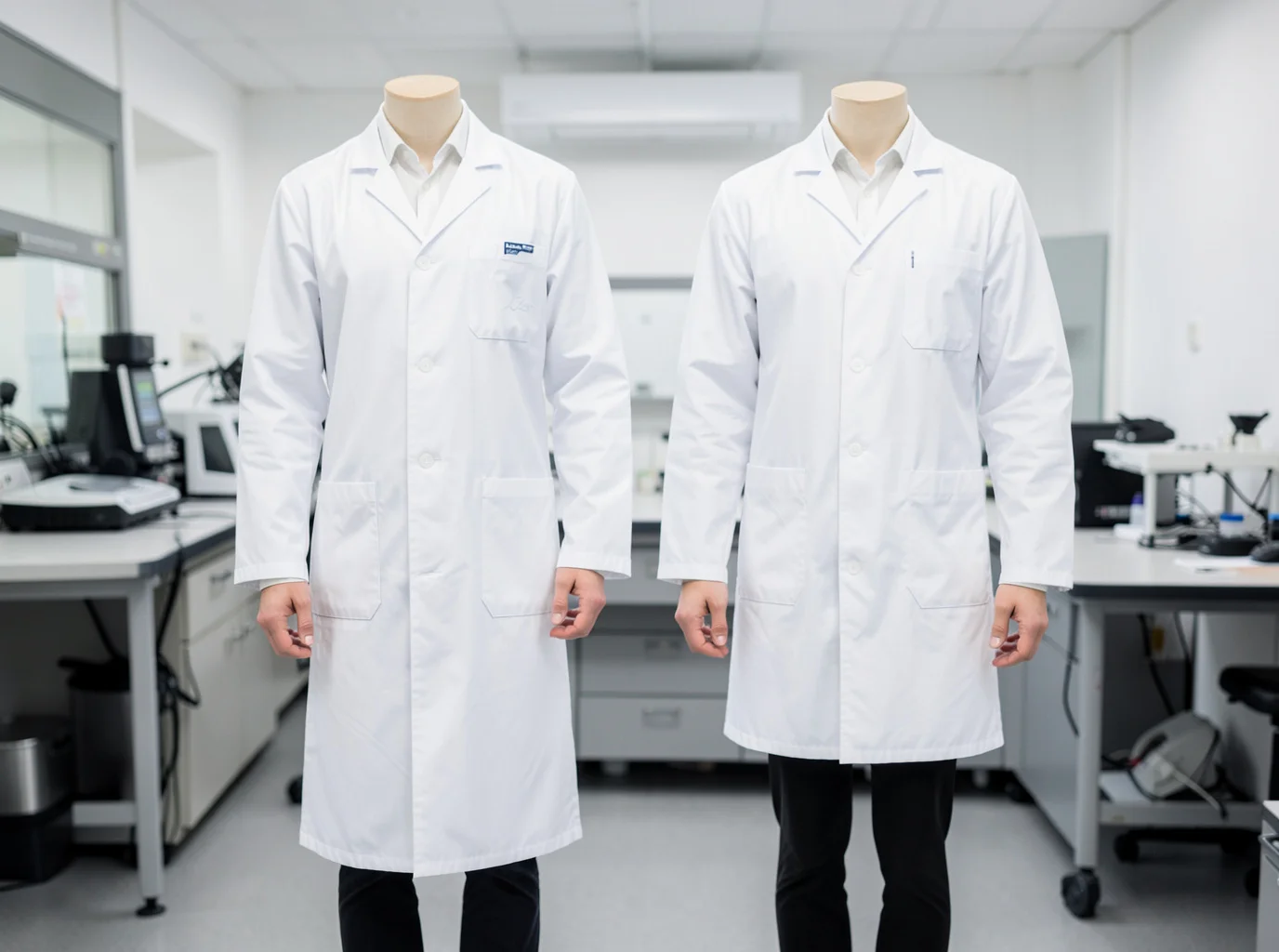
Side-by-side comparisons fall apart when you think you are only testing hem length, but other variables have shifted along with it. Before deciding between a coat and a jacket, lock down every other detail first.
Match the samples before you compare anything else. Pull a long coat and a short jacket with identical fabric composition, weight, color, closure, pockets, cuffs, and seam construction. Record the fiber content, fabric weight, stretch percentage, finish, and wash method for each. If you skip this, differences in fabric stiffness or closure design will skew how you judge garment length.
Run a controlled wearer trial. Put the same person in both garments, wearing identical base layers and PPE in the same size. Test six movements at a minimum: standing, sitting on a lab stool, walking, bending forward, reaching across a bench, and raising both arms. Check seated posture and see how easily gloved hands can get into the pockets.
Photograph every movement the same way. Keep the camera height, distance, lighting, and angles (front, side, and rear) identical for both samples. Take photos while standing, seated, in a 30° forward bend, with arms extended, and with arms raised. Compare hem rise, wrist coverage, shoulder restriction, front gaping, and pocket access while seated or wearing gloves.
Set a coverage target and score against it. The garment should cover the torso, arms, and upper legs, sleeves should overlap gloves, and the front closure should close cleanly without pulling.
|
Checkpoint |
Sample A: Long Coat |
Sample B: Short Jacket |
|---|---|---|
|
Standing: torso covered |
Pass / Fail |
Pass / Fail |
|
Bending: hem rise (cm) |
___ |
___ |
|
Arms raised: restriction (0–3) |
___ |
___ |
|
Front closure gaping (0–3) |
___ |
___ |
|
Pocket access with gloves |
Pass / Fail |
Pass / Fail |
|
Wearer preference (1–5) |
___ |
___ |
Measure, don’t trust labels. Require finished measurements for chest, length, shoulder, sleeve, and sweep, checking at least eight points with the measuring method and tolerances clearly noted. Use ±1 cm chest, ±2 cm length, and ±1 cm sleeve as starting benchmarks. Add an 8–10 cm chest allowance for movement, since a deep breath and a forward reach can add 6–8 cm.
Verify compliance for the actual use case. Cleanroom garments require Helmke Drum particle data, typically under 50 particles/ft³ at ≥0.5 µm. For fluid or biohazard handling, insist on ASTM F1670/F1671 or EN 14126 test reports rather than general protective claims.
Lock the approved sample into the purchase order. Specify whether you are buying a long lab coat or a short lab jacket, attach the final measurements and reference photos, and include an acceptance clause for post-wash tolerances. Bulk orders through Morntrip should reference this signed sample rather than a product name alone.
Conclusion
The choice between a lab coat and a lab jacket comes down to how much coverage your work demands. Full-length lab coats protect anyone handling chemicals, bodily fluids, or anything that could splash past the waist. Lab jackets suit lighter-duty settings where mobility and comfort matter more than maximum coverage. Each style is built for different risks.
If you are outfitting a team, request fabric swatches and sample garments before placing a bulk order. Check the seam construction, closure style, and fabric weight against your lab conditions. Morntrip offers both styles in medical-grade fabrics ready for custom sizing. Order a sample set today.