Pick up a hotel shower cap, and you know right away something’s wrong. It barely fits. It fogs up fast. Then it goes straight into the trash after one use.
A well-made reusable shower cap is a different story. It’s a tool you’ll reach for again and again.
The problem? The market is full of both types. “Just pick one” doesn’t help — not when you’re protecting a blowout, packing for a hotel stay, or cutting down on single-use plastic waste.
This guide breaks down what separates a reliable waterproof shower cap from a throwaway one. We cover materials, durability, cost, and real-world use cases. So you can skip the guesswork and buy the right one the first time.
What Makes a Shower Cap Work?
Most shower caps fail at the same three things: waterproofing, fit, and hair protection. Not one or two. All three.
That’s why cheap caps leave your hairline damp. Why does the elastic dig in after ten minutes? Why does your blowout still collapse even though you wore one?
Here’s what separates a functional shower cap from a waste of money:
Waterproofing isn’t just about material — it’s about structure. A dual-layer cap uses a polyester outer shell plus a PEVA waterproof lining. That combination builds a real barrier against moisture. Single-layer plastic? It holds off light spray for maybe five minutes. Then water gets through.
Fit depends on the elastic band doing real work. A 360° seal along your hairline keeps water out. Too loose, and water seeps in at the edges. Too tight, and you’re pulling it off within 15 minutes. That’s a real problem during deep-conditioning treatments.
Hair protection is the factor most people skip over until it’s too late. A well-fitted cap traps gentle warmth around your hair. That warmth helps a hair mask absorb better — up to 20–30% more than leaving your hair exposed.
The most common shower cap complaints — “my hair got wet anyway,” “it gave me a headache,” “too stuffy for a hair mask” — all trace back to these three points. Waterproofing fails. Fit is off. Heat distribution gets ignored.
Know what to look for. Then buy with that in mind.
Reusable Shower Caps: Materials, Performance & Who They’re For
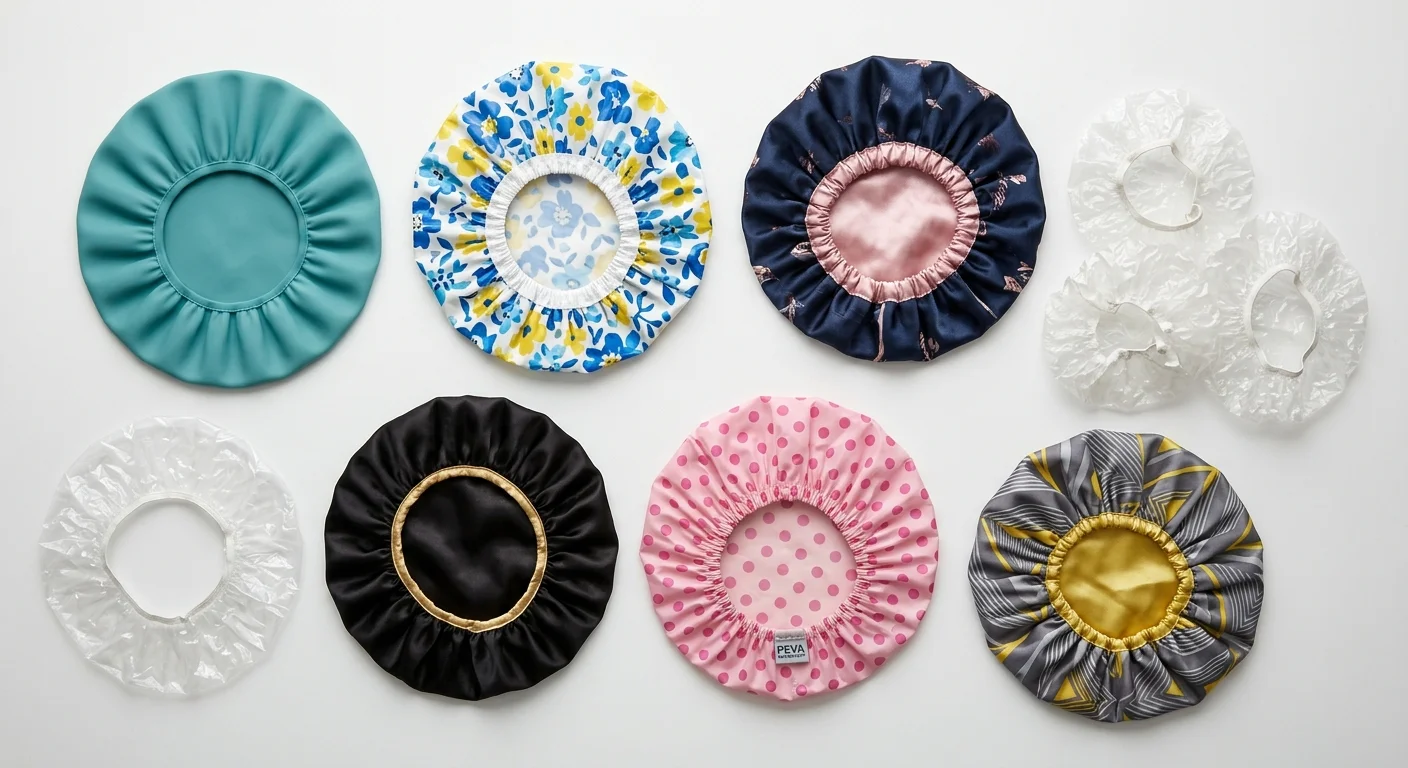
The material inside your shower cap matters more than the brand name on it.
Reusable shower caps span a wide range — from flimsy EVA film to reinforced nylon with TPU lining. Knowing the difference tells you what you’re paying for.
The Material Stack: What Each Layer Does
Most quality reusable shower caps are built in layers. Each layer has a job.
The outer shell handles waterproofing. Here’s how the main options compare:
PEVA / EVA — Soft, flexible, chlorine-free. The most common waterproof layer is in mid-range reusable caps. A well-made PEVA cap holds up through daily showers for 6–12 months without noticeable leakage. The weak point: elastic edges. That’s where water breaks through first as the material wears down.
Nylon (laminated) — Tougher than film-based materials. A PU- or TPU-coated nylon shell handles repeated stretching far better. That matters if you have thick, voluminous hair that pulls the cap wide each time. Good laminated caps last users close to 3 years.
TPU film — The premium option. Waterproof ratings on quality TPU reach ≥ 10,000 mmH₂O — far beyond anything a shower produces. No halogens, no odor, and it folds thousands of times without cracking. The tradeoff: higher cost and more demanding construction — heat-sealed seams, bonded layers.
Silicone — Forms a near-complete seal, similar to a swim cap. Lifespan runs 3–5+ years. The downside is real: poor breathability, uncomfortable heat buildup, and a poor fit on larger head sizes or dense curls.
The inner lining determines how your hair feels after.
A satin lining cuts friction against your hair shaft by a wide margin. Satin-lined caps reduce hair breakage by 40–50% compared to standard plastic interiors — the same principle behind satin pillowcases in curly hair communities. Protecting a blowout or keeping curl definition? This isn’t a luxury feature. It’s the reason your style survives the shower.
A microfiber lining works on a different principle — it absorbs residual moisture vapor instead of repelling it. Better for wet-hair wrapping. Less effective than satin for preserving dry styles.
Disposable Shower Caps: Convenience Above All
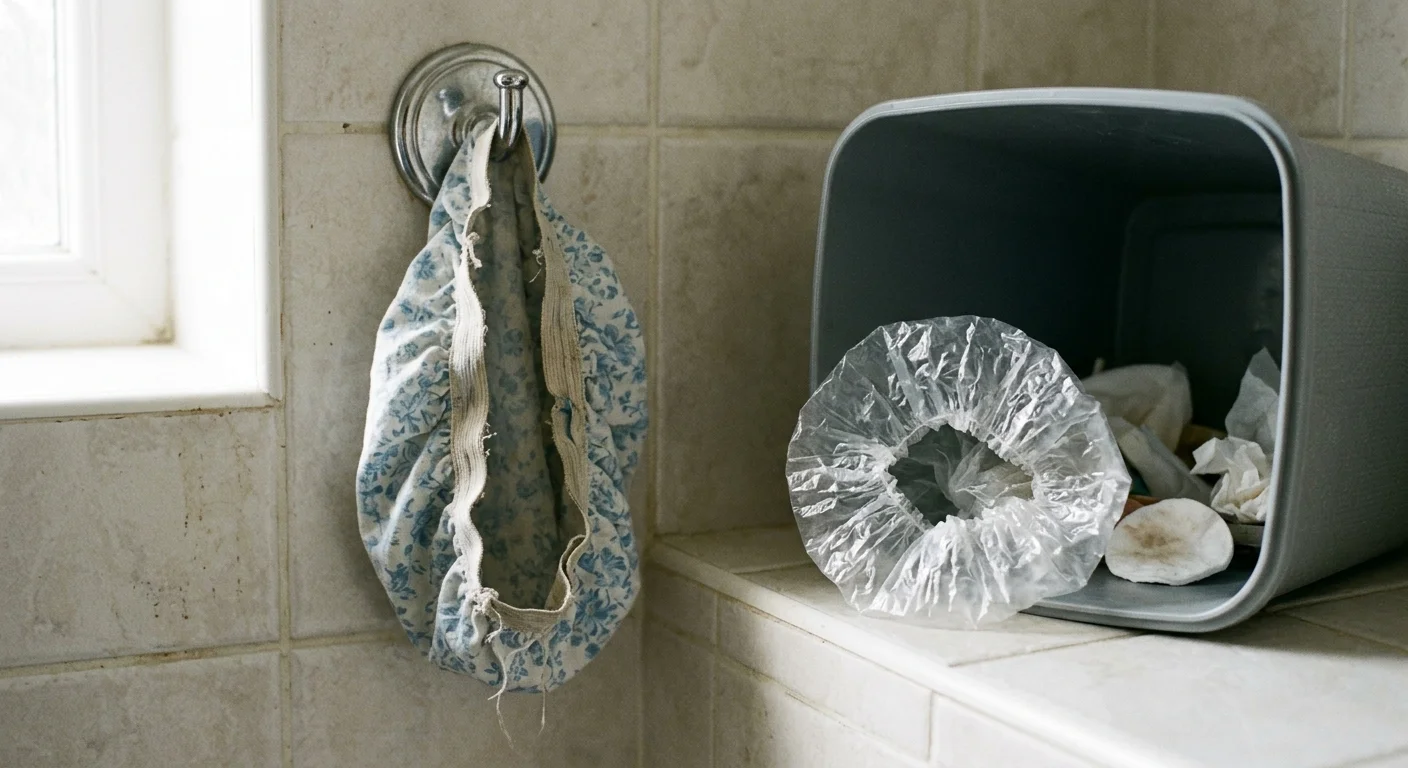
Thin, cheap, and gone after one use — that’s the whole point.
Disposable shower caps solve a specific problem: zero friction. No rinsing, no drying, no storing. You use it, you trash it, you move on. For hotels, hair salons, and anyone who just needs a cap right now, that logic makes complete sense.
But “convenient” doesn’t always mean “reliable.” There’s a real gap between a cap that holds up and one that leaks halfway through your conditioner.
What Disposable Caps Are Made Of?
Most disposable shower caps use PE film, 0.015–0.02 mm thick. That’s thinner than a grocery bag. At this thickness, the cap handles a short shower without issue. A standard 10–15 minute rinse? Fine. Go longer, add steam, or stretch the elastic too wide, and micro-stress cracks start to form. They show up in the thinnest spots — along the elastic band seam and gathered edges. That’s where water gets in.
Thicker PE (0.025–0.03 mm) performs noticeably better. Less tearing, better elasticity, and a more secure seal around the hairline. Salons tend to stock this heavier spec. It costs about 20–40% more per unit, but it’s worth it for clients sitting under a dye application for 30–45 minutes.
A quick material breakdown:
Standard PE (0.015–0.02 mm) — Hotel giveaway tier. Lightweight, folds almost flat (about 1–2 g per cap). Good for splash protection. Not built for steam or long wear.
Thicker PE (0.025–0.03 mm) — Salon and spa standard. Handles heat and chemical exposure better. The elastic band holds its shape more reliably.
Nonwoven + PE laminate — Adds breathability. Cuts down on condensation inside the cap. The PE layer still needs to be at least 0.02 mm to hold up against chemical agents like dye or perming solution.
Where Disposable Caps Clearly Win?
Hotels. The math is simple. A 150-count box of PE caps runs $5–8 wholesale — about $0.03–0.05 per cap. For a 100-room hotel at 80% occupancy, that’s $80–125 per month total. No laundering, no storage rotation, no cross-contamination risk. That’s why disposables are the default in just about every hotel bathroom worldwide.
Travel packing. A single disposable cap folds down to a 3–4 cm disc and weighs under 2 g. Fifty caps total around 50–100 g. A quality reusable cap alone weighs 30–60 g. Every gram matters in a carry-on. Disposables win on space and weight, no contest.
Salons and temporary use. One cap per client. No hygiene questions, no reuse decisions.
The Real Cost Calculation
Disposable caps look cheap — and for low-frequency use, they are. At $0.06 per cap, someone using one three times a week spends about $9.40 per year. That’s a solid deal.
Use one every day, and the numbers shift fast. At 365 uses per year, the same per-cap cost adds up to $21.90 per year — more than many durable reusable caps that last two years or longer.
The break-even point sits at once or twice per week. Use less: disposables win on cost. Use more: a reusable cap pays for itself within a year.
Head-to-Head Comparison: Reusable Vs Disposable Shower Caps
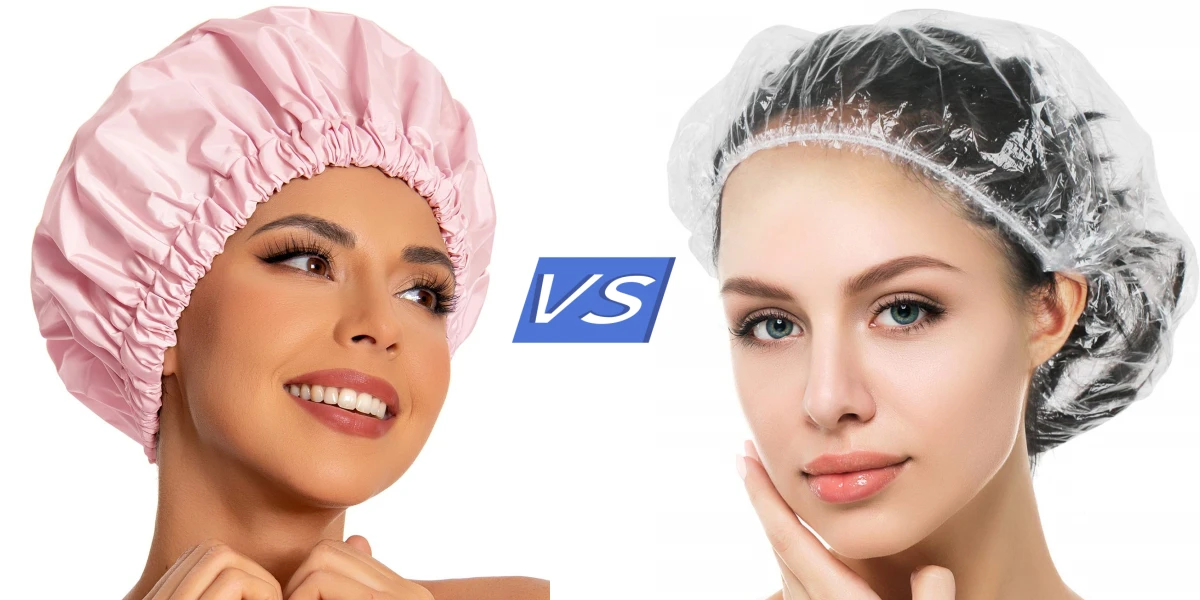
Seven dimensions. One clear winner in most of them. Here’s the breakdown you need.
Dimension | Disposable | Reusable | Winner |
|---|---|---|---|
Waterproofing | Thin PE film, prone to micro-tears | Dual-layer PEVA/polyester, consistent seal | ✅ Reusable |
Lifespan | 1–5 uses | 200–300+ uses (6–12 months) | ✅ Reusable |
Cost per use | $0.006–0.03 (low-frequency) | Drops to ~$0.006 at 200+ uses | Depends on frequency |
Comfort & fit | Single elastic band, one-size issues | Wide band, inner lining, better seal | ✅ Reusable |
Hair protection | Inconsistent — pinhole leaks ruin styles | Stable waterproofing + softer interior | ✅ Reusable |
Hygiene management | Zero maintenance, no cross-contamination | Requires regular cleaning | ✅ Disposable (high-turnover settings) |
Environmental impact | ~730 g plastic waste/person/year | ~30–60 g/year | ✅ Reusable |
1. Waterproofing
Budget hotel shower caps run at less than 0.02 mm thick. Stretch one over a full head of hair, and micro-stress cracks form along the gathered edges and elastic seam. That’s right where water gets in. That’s not a design quirk. That’s physics.
Dual-layer reusable caps use a polyester outer shell bonded to a PEVA waterproof lining. The structure holds under steam, sustained heat, and repeated stretching. The result: far fewer leaks compared to standard PE film.
Exception: For dye applications and chemical treatments, a disposable cap is the better choice — not for waterproofing, but for hygiene. You don’t want color or perm solution sitting inside a cap you’ll use tomorrow.
2. Lifespan
Reddit users are blunt about thin disposable caps: “Four to five showers, max.” Hotel caps are designed to be thrown out the same day. That’s the whole model.
A quality reusable cap — polyester plus PEVA dual-layer construction — handles daily use for 6–12 months. That’s 200–300 uses from a single cap.
The lifespan gap between the two isn’t close. Reusable caps last 40 to 100 times longer than disposable ones.
Exception: High-intensity chemical applications — bleach, heavy dye, keratin treatments — can contaminate a reusable cap beyond practical cleaning. For those sessions, one-and-done makes sense.
3. Cost Per Use
The math on disposables looks good on the surface. At $0.006–0.03 per cap, the daily cost feels small.
Run the numbers over a full year, and the picture shifts.
At $0.10 per cap, daily use adds up to $36.50 per year. A mid-range reusable cap at $20 covers the same 365 showers — and often another full year after that.
The break-even point: Your per-cap cost hits $0.07 or more, and you’re using one every day. A reusable cap pays for itself within 3–6 months. Everything after that is money back in your pocket.
For low-frequency use — a few times a year, mostly travel — disposables stay the cheaper option. There’s no point buying a reusable cap you’ll use four times.
4. Comfort and Fit
Most disposable caps use a single heat-fused elastic joint. It holds once. Sometimes twice. The band is narrow, the tension is uneven, and the size range is “medium and hope for the best.”
Reusable caps are built to a different standard. A wide elastic band — at minimum 0.8 cm, preferably wider — spreads pressure evenly around the hairline. An inner lining of polyester or fabric sits against your hair instead of bare plastic. The result: a cap you can wear through a full deep-conditioning treatment without a headache.
Exception: Industrial and medical settings sometimes source disposables in precisely sized batches. In those environments, getting the right fit can be easier with disposables than with the limited size range most reusable retail caps offer.
5. Hair Protection
A disposable cap that leaks — even a little — defeats the entire purpose. Pinhole failures along the elastic let moisture in at the roots. Your blowout collapses. Your curl pattern flattens. The whole reason you put the cap on gets wiped out.
Reusable caps with a fabric or polyester interior create less friction against the hair shaft. Less friction means fewer breakage points, less static, and a better chance your style survives intact.
Exception: Sealing in a treatment — a dye, a deep conditioner you don’t want dripping — shifts the cap’s job from keeping water out to keeping product in . Either type works for that. But a reusable cap you’re not willing to stain with color? That’s where the disposable makes more sense.
6. Hygiene
This one doesn’t go to the reusable cap by default.
Disposable caps are built for one use only — no cleaning cycle, no contamination risk, no shared-use questions. For hotels, salons, clinics, and any high-turnover setting, that’s not just convenient. It’s the right call from a hygiene standpoint.
Reusable caps need maintenance. Hand-wash them regularly. Air-dry after every use. Check for mold or residue buildup. Keep up with that routine, and the risk stays low. Skip it, and bacteria and scalp buildup accumulate fast.
The practical line:
– Shared or professional environments → disposables
– Personal use, single household → A well-maintained reusable cap works fine
7. Environmental Impact
The numbers here are stark.
One person using a disposable cap every day generates 730 grams of plastic waste per year — about 365 caps at ~2 g each. That’s close to three-quarters of a kilogram of single-use plastic, every year, from one person’s shower routine.
A reusable cap? One or two caps per year, weighing around 30 g total. Annual plastic waste drops to 30–60 grams — a reduction of more than 90%.
Exception: Reaching for a shower cap only a handful of times a year — packing for one hotel stay, the occasional bad-weather day — the environmental math on disposables looks much less dramatic. The real problem is daily high-volume use, not the occasional grab-and-go.
Which Shower Cap Should You Choose? A Scenario-Based Decision Guide
The right shower cap isn’t a universal answer. It’s a match between your habits, your hair, and how you live.
Run through these four questions. Your answer locks in your best option.
Step 1: How Often Do You Use One?
Frequency is the single biggest factor in cost-per-use math.
Once a week or less — Disposables make sense. You’re not generating enough use to justify a quality reusable cap.
2–4 times a week — A mid-range reusable cap (around $10–15) pays for itself within a few months. It outperforms disposables on every practical measure.
5+ times a week — Invest in a high-quality reusable with a satin or polyester lining. At this frequency, you’ll see the difference in both cost and hair condition.
Step 2: What Does Your Hair Need?
This is where most people under-invest.
Got curly, color-treated, or dry hair? Or do you use your cap for hair masks and deep conditioning? A smooth interior lining isn’t optional. A satin-lined cap cuts friction against the hair shaft by 40–50% compared to bare plastic. That’s the difference between a curl pattern that survives the shower and one that doesn’t.
Curly and long-haired users should also check the cap’s diameter. Standard caps run 25–28 cm. Got significant volume or length? Go for XL sizing — at least 35–40 cm — with a high dome. A cap that presses down on your curls defeats the purpose.
General hair with no specific treatment needs? A standard reusable with a basic polyester lining covers you fine.
Step 3: Does Sustainability Factor Into Your Decisions?
The numbers are worth knowing.
One person using a disposable cap three times per week creates 156 caps and over 0.5 kg of plastic waste per year. A single reusable cap used over that same period produces around 30 grams of total waste.
The real environmental shift comes with regular, high-frequency use. Reaching for a cap most days? Switch to a reusable PEVA or PUL option and commit to using it for at least a year. That cuts your plastic output by over 90%.
For occasional use, the environmental gap is smaller. Bringing a handful of disposables on a 5-day trip isn’t the problem. Throwing one away every single day is.
Step 4: What’s Your Budget?
Budget | Best Fit | What You Get |
|---|---|---|
Under $5 | Basic disposable pack (20–50 count) or entry reusable | Fine for low-frequency use, minimal hair protection |
$6–15 | Quality reusable, machine-washable | Good seal, comfortable band, 1–2 year lifespan |
$16–30+ | Satin-lined, XL, or branded reusable | Built for curly/long hair, high-frequency daily use |
The Scenario That Works for Most People: Use Both
One reusable cap handles your home routine. A small pack of disposables covers travel.
Here’s what two years looks like for someone who showers without washing hair three times a week, plus three short trips per year:
All disposable : ~342 caps, $20.52 over two years
Hybrid approach : One $12 reusable cap at home + 30 disposables for travel = $13.80 over two years — plus 312 fewer single-use caps in the trash
The reusable cap carries the everyday load. Keep the disposables in your travel bag. They’re there for hotel stays, backup situations, or any session with dye or chemical treatments you’d rather not soak into a cap you’ll use again tomorrow.
Quick Match by Profile
Daily hair-protection routine → Dual-layer reusable (PEVA outer + satin lining), diameter 30–35 cm, XL if needed. Budget $12–20. Expect 1–3 years of use.
Curly or natural hair → Satin or silk interior, high-dome design, ≥35 cm diameter. Some caps are reversible — waterproof side out for showers, satin side out for mask treatments.
Frequent traveler → Pack 5–10 disposables as backup. Travel a lot? A compact foldable reusable (under 10×10 cm packed) earns its place fast.
Hotel or clinic purchasing → Disposables are the standard operational choice. For premium rooms or spa areas, quality reusable caps at around $10 per unit lift the guest experience without adding much cost.
Eco-focused consumer → Reusable PEVA or PUL , no PVC, target lifespan minimum one year. At $15 with weekly use across two years, that works out to about $0.12 per use and 300+ fewer disposable caps discarded.
Conclusion
Here’s the honest truth: no shower cap is “better” for everyone. There’s only the right one for your hair, your routine, and your values.
Shower daily? Have long hair? Want to cut down on plastic waste? A quality reusable shower cap — silicone, EVA, or double-layered fabric — pays for itself within weeks. It protects your hair better, too. Packing light for a weekend trip or stocking a guest bathroom? A reliable disposable hotel shower cap does the job well.
The real mistake isn’t choosing one over the other. It’s grabbing the cheapest option without thinking, then wondering why your hair gets wet anyway.
Now you know what to look for. Go find the one that fits your life.
👉 Browse Morntrip’s shower cap collection — reusable and disposable options, built for people who think about this stuff.