
Surgical caps help maintain hygiene control in operating rooms by containing hair and reducing particle contamination. However, choosing a compliant surgical cap is not as simple as looking for a “medical grade” label.
Unlike surgical masks or gowns, surgical caps do not have one universal standard that defines every performance requirement. Buyers need to evaluate multiple factors, including regulatory requirements, material quality, testing documentation, and supplier capabilities.
This guide explains the key standards and requirements that healthcare buyers should understand when selecting surgical caps and evaluating manufacturers.
Are Surgical Caps Regulated as Medical Devices?

Surgical caps are generally considered low-risk medical products, but their regulatory requirements vary depending on the market where they are sold.
In the United States, surgical caps are regulated by the FDA as Class I medical devices under the surgical apparel category. This classification means they are subject to general controls, such as proper labeling, establishment registration, and device listing requirements.
However, FDA classification alone does not confirm that a surgical cap provides a specific level of barrier protection. Unlike surgical masks or protective gowns , surgical caps do not have a dedicated FDA performance standard that defines requirements such as bacterial filtration or fluid resistance.
For international markets, requirements may differ:
-
The European market typically evaluates surgical caps under medical device regulations and applicable surgical clothing standards.
-
China requires manufacturers to comply with NMPA requirements and applicable national or industry standards.
-
Many healthcare buyers also expect manufacturers to follow ISO 13485 quality management practices.
For procurement teams, the key point is that regulatory registration confirms product compliance with market requirements, but performance testing is still needed to verify product quality.
What Standards and Requirements Apply to Surgical Caps?
Because there is no single universal surgical cap standard, buyers usually evaluate products through a combination of regulatory requirements, surgical clothing standards, and performance testing.
FDA Requirements for Surgical Caps
In the United States, surgical caps fall under FDA Class I medical device regulations.
Manufacturers are generally responsible for:
-
Proper product labeling
-
Manufacturing controls
-
Device listing and establishment registration where required
-
Maintaining product safety and quality records
However, buyers should understand that FDA registration does not mean a surgical cap has passed specific barrier tests.
A supplier claiming that a surgical cap is “FDA approved” may be using inaccurate wording. Most Class I surgical caps are not individually “approved” by the FDA in the same way that higher-risk medical devices may require premarket review.
When purchasing from overseas manufacturers, buyers should focus on actual product documentation, test reports, and quality systems rather than relying only on regulatory claims.
EN 13795 for Surgical Clothing Performance
EN 13795 is one of the most important references for evaluating surgical clothing performance in Europe and many international markets.
Although it is primarily designed for surgical gowns, drapes, and clothing systems, its performance concepts are often applied when evaluating surgical headwear.
Important areas covered by EN 13795 include:
Microbial Cleanliness
Surgical clothing should limit microbial contamination and prevent products from becoming a source of microorganisms near the sterile field.
For surgical caps, this relates to:
-
Clean manufacturing conditions
-
Proper material selection
-
Reduced contamination risk
Particulate Cleanliness
Healthcare environments require materials with low particle and lint release.
A surgical cap that sheds excessive fibers may increase contamination risks during procedures, especially in controlled operating environments.
Barrier Performance
Surgical clothing standards also consider resistance against liquid penetration.
For surgical caps, fluid barrier requirements depend on the procedure risk level and facility expectations rather than a universal classification.
AAMI PB70 as a Fluid Barrier Reference
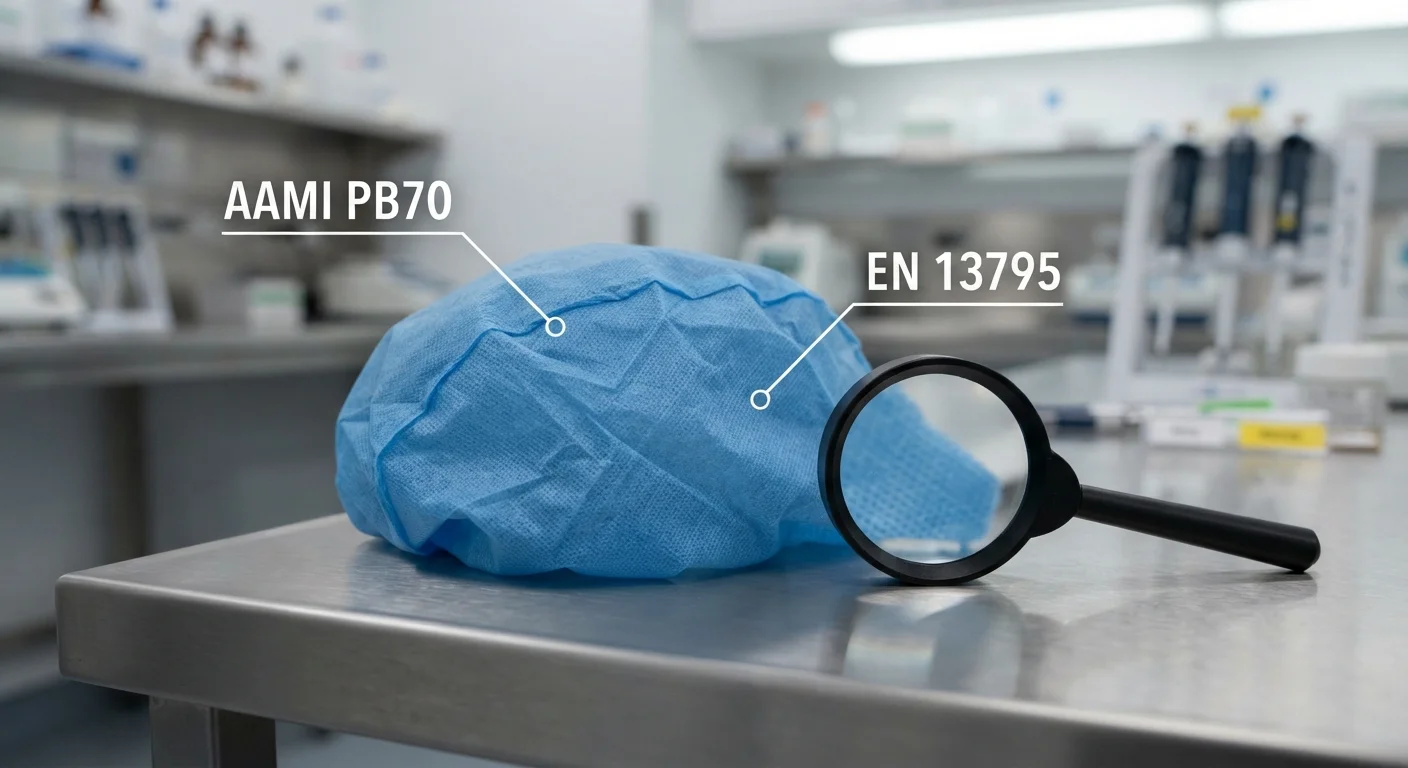
AAMI PB70 is a well-known standard for liquid barrier performance of surgical gowns and protective drapes.
It is not specifically designed for surgical caps, but some buyers reference its barrier concepts when evaluating headwear materials used in higher-risk environments.
The standard evaluates resistance to liquid penetration through different performance levels based on tests such as:
-
Impact penetration testing
-
Hydrostatic pressure testing
When surgical caps are used in procedures where fluid splash may occur, buyers may request material testing data related to liquid resistance.
However, a higher barrier level is not always necessary for every healthcare application. The appropriate requirement depends on the intended use environment.
ISO 13485 Quality Management for Surgical Cap Manufacturers
For hospitals and distributors, supplier quality control is often just as important as product specifications.
ISO 13485 is the internationally recognized quality management system for medical device manufacturers.
A surgical cap manufacturer following ISO 13485 typically has systems for:
-
Document control
-
Production consistency
-
Supplier management
-
Risk management
-
Product traceability
-
Corrective and preventive actions
While certification alone does not guarantee a perfect product, it shows that the manufacturer operates under a structured medical device quality system.
For large healthcare buyers, ISO 13485 certification is often an important supplier qualification requirement.
Key Performance Requirements of Surgical Caps

Standards provide a framework for evaluation, but the actual performance of a surgical cap depends on its design, materials, and manufacturing quality.
A reliable surgical cap should provide effective hair containment, low particle release, acceptable comfort, and consistent performance throughout its intended use.
Hair Coverage and Secure Fit
The primary function of a surgical cap is to keep hair contained and reduce the possibility of contamination in controlled environments.
A well-designed cap should remain securely positioned during normal movement without creating excessive pressure on the wearer. The elastic or tie system, fabric dimensions, and overall construction all influence how well the cap performs during extended use.
Inconsistent sizing is a common issue in disposable medical products . Even when the material quality is acceptable, poor dimensional control can affect comfort and coverage. For this reason, buyers should confirm product dimensions and evaluate samples before placing large-volume orders.
Low Lint and Particle Control
Particle control is one of the most important considerations for surgical headwear.
Disposable surgical caps are commonly manufactured from nonwoven materials such as polypropylene or SMS because these materials provide a good balance between protection, weight, and comfort.
The structure of the fabric affects how much lint and particles are released during use. Materials with poor quality control may shed fibers that could be undesirable in controlled healthcare environments.
When evaluating surgical caps, procurement teams should pay attention not only to the material name but also to the manufacturer’s production consistency and available performance information.
Fluid Resistance and Barrier Protection
Although surgical caps are not usually the primary protective barrier against fluids, some healthcare environments may require additional resistance against accidental splashes.
The level of protection needed depends on the application. A routine clinical environment may prioritize comfort and contamination control, while higher-risk procedures may require stronger material performance.
It is important to understand that thicker fabric does not automatically mean better protection. Effective barrier performance depends on the complete material structure, manufacturing process, and testing results.
Breathability and Comfort
Healthcare workers may wear surgical caps for several hours, making comfort an important factor in product acceptance.
A cap that traps excessive heat or causes discomfort may affect user compliance. Materials need to balance protection with breathability, especially in operating rooms where procedures can last for extended periods.
Factors such as fabric structure, softness, elasticity, and moisture management all influence wearing comfort.
For hospitals purchasing large quantities, selecting products that healthcare workers are willing to wear consistently is just as important as meeting technical requirements.
Sterility and Biocompatibility
Surgical caps are available in both sterile and non-sterile versions depending on the intended application.
For sterile products, buyers should verify the manufacturer’s sterilization process, packaging integrity, and batch documentation. Proper control of sterilization processes helps ensure that products maintain their intended quality until use.
Because surgical caps are worn directly against the skin and hair, material safety is also an important consideration. Manufacturers should be able to provide information about material composition and suitability for healthcare use.
How to Evaluate a Surgical Cap Supplier?
Choosing the right surgical cap manufacturer requires more than comparing unit prices. A reliable supplier should be able to demonstrate consistent quality, transparent documentation, and manufacturing capability.
Before placing an order, buyers should evaluate:
1. Manufacturing Qualifications
Check whether the supplier has:
-
Medical device quality management systems
-
Relevant market registrations or filings
-
Experience producing healthcare products
A manufacturer experienced in disposable medical products is generally better prepared to manage material control, production processes, and documentation requirements.
2. Product Specifications
Technical specifications should be clearly defined before purchasing.
Important details include:
-
Material type (PP, SMS, or other nonwoven materials)
-
Fabric weight
-
Product dimensions
-
Packaging method
-
Sterile or non-sterile status
These specifications should be included in purchase agreements to ensure consistency between samples and mass production.
3. Testing Documentation
Professional suppliers should be able to provide supporting test information.
Depending on the market and product type, buyers may request:
-
Material specifications
-
Biocompatibility information
-
Sterilization records
-
Lint or particle testing
-
Physical performance testing
-
Quality inspection reports
A supplier that cannot provide basic documentation may create unnecessary compliance risks.
4. Production Traceability
Traceability is especially important for healthcare products.
A reliable surgical cap supplier should maintain records related to:
-
Production batches
-
Manufacturing dates
-
Raw material sources
-
Quality inspections
This helps buyers manage recalls, quality investigations, and inventory control when necessary.
Documents Buyers Should Request Before Purchase
Before placing an order, healthcare buyers should review documentation that supports both product compliance and manufacturing capability.
The exact documents required depend on the target market and application, but professional suppliers should generally be able to provide information about their quality system, product specifications, and testing results.
Product documentation should clearly describe the surgical cap, including the material composition, available sizes, packaging details, and whether the product is sterile or non-sterile.
Testing documentation is also important because product claims should be supported by evidence. Depending on the product type and market requirements, buyers may request information related to material safety, physical performance, cleanliness, or sterilization processes.
For sterile surgical caps , additional records related to sterilization validation, packaging integrity, and batch traceability may be necessary.
A strong supplier should also maintain production records that allow products to be traced back to specific manufacturing batches. This is particularly important for healthcare products because it helps manage quality investigations and ensures better control throughout the supply chain.
FAQ: Surgical Cap Standards and Compliance
Are all surgical caps required to be sterile?
No. Surgical caps are available in both sterile and non-sterile versions.
The appropriate option depends on the intended application and the requirements of the healthcare facility. Many operating environments use non-sterile surgical caps as part of standard surgical attire, while sterile versions may be selected for specific procedures or purchasing requirements.
The key consideration is not simply whether a cap is sterile, but whether the product meets the cleanliness, quality, and usage expectations of the intended environment.
Is a higher GSM surgical cap always better?
No. Fabric weight is only one factor that affects surgical cap performance.
A higher GSM material may provide a thicker feel and potentially improve durability, but it can also reduce breathability if the fabric structure is not properly designed.
A good surgical cap needs a balance between material strength, particle control, comfort, and breathability. The best choice depends on the application rather than fabric weight alone.
What material is commonly used for surgical caps?
Most disposable surgical caps are made from polypropylene nonwoven materials because they provide lightweight protection and good manufacturing consistency.
Common materials include spunbond polypropylene and SMS nonwoven fabrics. SMS is often selected for applications requiring a better balance between softness, strength, and particle control.
However, material type alone does not determine product quality. Manufacturing processes and quality control also play an important role in final performance.
Can surgical caps comply with standards without a specific certification?
Yes. Surgical cap compliance is usually determined by a combination of factors rather than one universal certification.
Because there is no single global standard covering every aspect of surgical cap performance, buyers typically evaluate regulatory requirements, applicable performance expectations, manufacturing quality systems, and supporting documentation together.
A supplier that understands these requirements and can provide clear evidence of product quality is usually better positioned to meet professional procurement needs.
What documents should buyers request from a surgical cap supplier?
Buyers should request documents that help verify both the product and the manufacturer.
These may include product specifications, material information, applicable test reports, quality management documentation, and sterilization records for sterile products.
The purpose of reviewing these documents is not simply to collect paperwork, but to confirm that the supplier has consistent manufacturing processes and can deliver the same quality level over repeated orders.
Conclusion
Choosing the right surgical cap requires more than checking certifications or product claims. Buyers should consider applicable regulations, material performance, product quality, and supplier documentation together.
A reliable surgical cap manufacturer should provide consistent products, clear specifications, and supporting documents to help healthcare facilities maintain compliance and quality standards.
By evaluating suppliers based on both product performance and manufacturing capability, buyers can make more informed purchasing decisions and reduce quality risks.





