Finding a reliable isolation gown manufacturer in Japan is harder than it should be. For most procurement teams, it turns into a full supply chain headache. Japan’s medical protective apparel sector ranks among the most rigorous in the world. It’s built on decades of manufacturing discipline, AAMI PB70 compliance culture, and material innovation that outpaces many Western competitors.
The problem? Information is scattered. Company names don’t translate well into English. And the gap between a Tier-1 surgical gown manufacturer and a mid-tier distributor isn’t obvious from a website alone.
This guide cuts through that noise. Below, you’ll find the 2026 ranking of Japan’s top 10 isolation gown manufacturers . Each one has been reviewed across certifications, production capacity, customization capabilities, and real-world fit for global B2B buyers.
Why Japan’s Isolation Gown Manufacturers Stand Out in Global PPE Supply Chains?
Japan’s PPE sector doesn’t compete on price. It plays a different game.
Chinese and Southeast Asian manufacturers lead on volume. Japanese isolation gown manufacturers take a different position — built on material performance, consistent quality, and supply reliability that procurement teams in ICUs and surgical suites depend on.
The numbers back this up. Japan’s medical PPE market hit an estimated ¥120–150 billion ($8–10B USD) in 2023. In high-specification surgical and sterile protective apparel, Japanese manufacturers hold an estimated 8–12% share of global supply — a surprisingly large slice for a country of this size.
What drives that? Three things:
-
Material engineering. Japanese SMS isolation gown constructions reach hydrostatic resistance of 100–300 cmH₂O — that’s up to 200% better than standard Chinese disposables. Moisture vapor transmission rates hit 3,000–10,000 g/m²·24h. This cuts heat stress across full 8–12 hour shifts.
-
AAMI PB70 compliance culture. Leading hospital gown manufacturers in Japan hold ISO 13485 certification and track full lot-level traceability down to fiber batch numbers. Defect rates run at 0.1–0.5% — well below the global industry average of 1–2%.
-
Supply chain resilience. Japanese PPE protective clothing suppliers keep 1–3 months of safety stock on hand. They also run dual-base production across domestic and Southeast Asian facilities. This setup makes supply disruption far less likely than relying on a single-origin source.
Global procurement is shifting. Buyers are moving away from “lowest unit cost” toward total risk-adjusted cost — factoring in emergency procurement premiums and stockout exposure. That shift favors Japan.
How We Ranked These Japanese Isolation Gown Manufacturers?
Not every list deserves your trust. This one was built to earn it.
We evaluated each isolation gown manufacturer in this ranking across five weighted dimensions — no gut instinct, no paid placement, no brand favoritism.
|
Dimension |
Weight |
|---|---|
|
International Certification Coverage |
30% |
|
Production Capacity |
20% |
|
Customer Reputation & Compliance Record |
20% |
|
Export Market Reach |
15% |
|
OEM/ODM Capability |
15% |
Certifications carried the most weight — and for good reason. A manufacturer holding FDA registration, CE MDR approval, ISO 13485:2016, and verified AAMI PB70 Level 3 or Level 4 compliance carries a very different risk profile than one with a single regional certificate. That gap matters. We cross-checked every credential against source databases: PMDA, FDA Device Listing, and accredited bodies, including TÜV SÜD, SGS, and BSI.
Scores sometimes landed within three points of each other. In those cases, certification tier and repeat-buyer rate broke the tie.
Manufacturers with MHLW manufacturing licenses, zero major recalls in the past five years, and repeat purchase rates above 70% scored highest on compliance. Those with unresolved quality incidents — even minor ones — received lower scores.
#1 Hogy Medical Co., Ltd. — Japan’s Largest Medical Textile Manufacturer
64 years of non-stop manufacturing does something to a company. It sharpens it.
Hogy Medical Co., Ltd. (ホギメディカル株式会社) was founded in 1961 in Tokyo’s Minato-ku district. Today, it sits at the top of Japan’s medical textile market. It’s listed on the Tokyo Stock Exchange Prime Market (ticker: 3593). Revenue runs at US$246 million a year. The company employs 1,441 people across production, sterilization, and direct sales.
This is not a distributor. This is not a trading company with a factory tucked outside the city. Hogy manufactures.
Production Infrastructure
Three core facilities carry the weight:
-
Miho Plant No. 2 (Ibaraki Prefecture) — primary production line for medical nonwoven products and surgical packs
-
Tsukuba Plant — nonwoven medical textiles and sterilization pouches
-
Edosaki Sterilization Center — steam and ethylene oxide post-processing
All four sites — including headquarters — hold ISO 13485:2016 certification. That covers the full chain. From raw fiber to sterile final pack, quality accountability runs end to end.
Core Products for Global Procurement Teams
Hogy builds its isolation gown and surgical gown lineup on SMS and SMMS nonwoven constructions:
|
Product Category |
Material Structure |
AAMI PB70 Equivalent |
|---|---|---|
|
Ward isolation gowns |
SMS ~25–30 gsm |
Level 1–2 |
|
Standard surgical gowns |
SMS/SMMS ~35–45 gsm |
Level 3 |
|
Reinforced high-risk gowns |
SMMS + film-laminated critical zones |
Level 4 |
The Level 4-equivalent configurations pass synthetic blood penetration ( ASTM F1670 ) and viral penetration testing (ASTM F1671). Those are the standards that matter most in high-exposure surgical environments.
Their flagship product, the REVICE Customized Surgical Kit, pulls 30–50 individual disposable items into one pre-configured pack. Efficiency gains are real: 30–50% less OR preparation time. Run eight procedures a day, and those savings stack up fast.
Hogy’s sterilization pouches (Mekkin Bags) hold a 70–90% usage rate across Japan’s major acute-care hospitals. That’s not just strong market share — that’s category dominance.
Best Fit For
Hogy Medical is the right call if you are looking for high-acuity surgical environments. You need verified ISO 13485 traceability at the lot level. And you want a manufacturer that sells to healthcare facilities — no middlemen, no three-layer distribution chain.
They are not the cheapest option on this list. They were never trying to be.
#2 Kawamoto Corporation — Specialist in Non-Woven Medical Protective Apparel
93 years in Osaka teach a company what hospitals need.
Kawamoto Corporation (川本産業株式会社) has been based in Chuo-ku, Osaka, supplying medical and care facilities since 1931. Their focus stays tight: medical, nursing, and hygiene consumables — nothing else. You’ll find isolation gowns , surgical gowns, protective coveralls, and the full range of non-woven medical protective apparel that clinical environments go through every day.
Their non-woven product line covers AAMI PB70 Level 1–3 configurations:
-
Basic isolation gowns — PP spunbond, ~25 g/m², for general ward and outpatient use
-
SMS surgical gowns — 35–40 g/m², with reinforced chest and forearm zones reaching 45–50 g/m² or PE-laminated for high-fluid surgical environments
-
PE-coated protective coveralls — total ~35–50 g/m², ultrasonic-sealed seams, optional hood and boot covers
International buyers can start OEM/ODM orders at 5,000 pieces on standard isolation gowns. Delivery runs 6–10 weeks to port. Export volume flows mainly through East Asia and Southeast Asia. Smaller quantities reach European and North American distributors.
Best fit for: hospital procurement teams sourcing Japan-standard disposable protective apparel at professional-grade specs — without paying the premium that Japan’s largest surgical pack manufacturers charge.
#3 Medicom Japan (AMG Inc.) — Global Brand with Japan-Based Distribution & Manufacturing
Medicom didn’t start in Japan. It built toward Japan.
1988 — that’s when the Medicom Group launched in Canada. Since then, it has spent decades building one of the most spread-out infection-control supply chains on the planet. Japan connects to that network through A.R. Medicom Inc. (Japan) Ltd., a Kobe-based sales and regulatory office at the 9F Yomiuri Kobe Building, Chuo-ku.
The structure is intentional. Medicom produces bulk SafeWear isolation gowns — PP and SMS builds covering AAMI PB70 Level 1 through Level 3 — at its Asia facilities in Shanghai and Malaysia. From there, the gowns get imported, relabeled, and distributed with Japan-specific QA and MHLW-compliant paperwork. Local manufacturing stays below 15% of total volume. The Kobe office takes on everything else:
-
National hospital sales
-
PMDA regulatory affairs
-
Key account management with university hospital groups
For global procurement teams, the certifications stay with the product. Medicom holds FDA 510(k) clearance and CE MDR compliance. You also get verified AAMI PB70 test reports from accredited labs. That makes Medicom a practical, low-hassle pick for multi-country tenders — especially those that need documented Level 2–3 performance across several markets at once.
Best fit for: Large hospital groups and regional APAC procurement HQs. If you need a single vendor that covers both Japan-compliant SKUs and certified PPE under one accountability structure, Medicom fits that role well.
#4 Koken Ltd. — Japan’s Industrial & Medical Respiratory and Gown Solutions Provider
Koken Ltd. built its reputation on one core idea: you work somewhere toxic, you walk out breathing.
That industrial-first focus shapes how this Tokyo-based manufacturer builds protective apparel. KOKEN LTD. (光研株式会社) is a full-scale industrial PPE supplier. Respiratory protection is the core product. Body protection is the natural next step. Their chemical protective suits cover organic solvents and hazardous particulate environments. You get EN Type 4/5/6-equivalent performance — barrier specs that sit well above standard disposable isolation gowns .
Japan’s pandemic procurement surge put that difference to the test. Hospital infection-control teams buying for negative-pressure wards and decontamination operations chose industrial chemical protective apparel for a clear reason. It outperformed typical medical-grade options in high-risk settings. Standard gowns weren’t built for those conditions. These suits were.
Best fit for: Procurement teams sourcing high-barrier protective apparel for:
-
Chemical exposure environments
-
Decontamination workflows
-
Elevated biosafety settings
Standard AAMI PB70 Level 2 gowns don’t cover enough in these scenarios. Koken’s industrial-grade suits do.
#5 Marusan Industry Co., Ltd. — High-Volume Disposable Isolation Gown Factory
Ehime Prefecture rarely comes up in global PPE discussions. That’s a mistake.
Marusan Industry Co., Ltd. (丸三産業株式会社) runs multiple nonwoven production facilities across Ehime — Ozu, Ikazaki, and Seiyo. That makes it one of Japan’s most concentrated regional manufacturing hubs for cotton-based and nonwoven medical textiles. Their strength lies in two areas: cotton processing and PP nonwoven fabrication. For disposable isolation gown production, that dual capability carries real weight.
What They Make?
Marusan builds isolation gowns on SMS/SMMS Polypropylene nonwoven constructions at 25–40 g/m². These cover AAMI PB70 Level 1–3 performance ranges. Standard configurations come in M/L/LL sizing with a back-open design, dual tie closures, and knitted rib cuffs. Those cuffs sit flat over nitrile gloves and stay in place mid-procedure — no rolling back, no repositioning.
Level 3–4 export configurations add thumb loops. You can also request optional PE-film lamination at critical zones.
Volume & Pricing
Marusan runs ≥2–3 convertible nonwoven lines. That puts estimated annual disposable isolation gown output at 20–40 million pieces.
Here’s where it gets practical for procurement teams:
-
Marusan controls its own upstream nonwoven production. No middlemen, no sourcing gaps.
-
Pricing runs 5–10% below comparable Japanese-made gowns — ¥120–160/piece on orders above 500,000 units per year.
-
Standard domestic lead time: 7–14 days
-
Custom OEM orders: 30–45 days
Best fit for: B2B distributors and hospital procurement teams that need high-volume, Japan-manufactured non-woven isolation gowns — with competitive unit pricing and clear, verifiable domestic production records.
#6 Toray Industries Medical Division — Advanced Material Innovation for Isolation Gowns
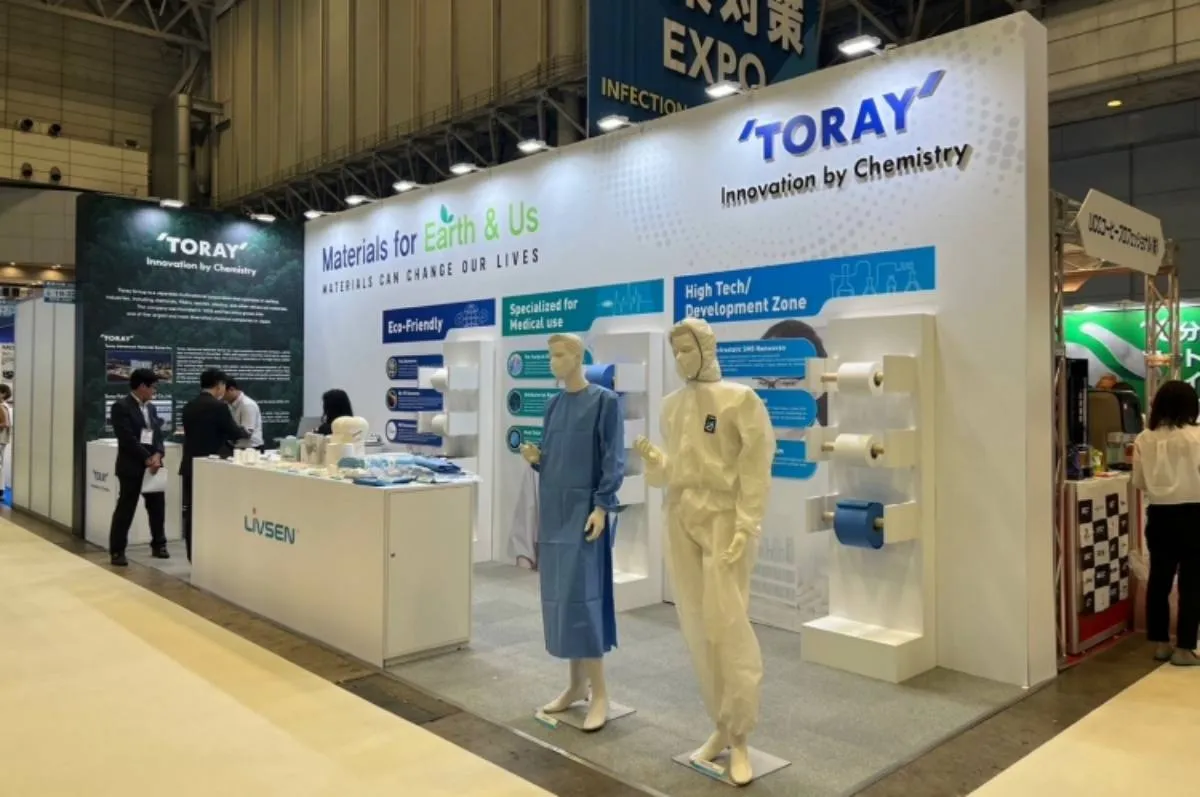
Toray Industries doesn’t make isolation gowns. It makes the materials that make isolation gowns worth buying.
That difference is important. Toray is one of Japan’s largest advanced materials companies. Its dedicated medical division supplies engineered fabrics, barrier films, and multilayer composite structures to medical apparel manufacturers around the world. Think of it as the upstream supplier behind finished-gown brands — the one that decides how well those gowns perform in the field.
Their core medical materials cover three main categories:
-
Multilayer barrier laminates
-
Engineered film composites
-
High-performance nonwoven-compatible substrates
All of them are built to meet AAMI PB70 Level 2 through Level 4 performance requirements.
For procurement teams sourcing reusable isolation gowns, Toray-backed fabric systems hold up through 50–100 industrial launderings at 60–75°C. Shrinkage stays at ≤5% — a level of stability that matters when gowns go through repeated hospital wash cycles.
Best fit for: OEM medical apparel brands and ESG-focused hospital systems that need engineered barrier fabrics with verified ISO 14001 and OEKO-TEX Standard 100 credentials. These are buyers who care what’s inside the gown — not just what’s printed on the label.
#7 Azearth Corporation — Custom OEM Isolation Gown Manufacturer for Export Markets
Azearth Corporation fills a clear niche in Japan’s PPE market: custom OEM isolation gowns made for export. Not domestic hospital networks. Not bulk commodity orders. Export — with all the compliance demands that come with it.
Their gown range covers AAMI PB70 Level 1 through Level 4. That means everything from light procedural gowns to high-fluid-resistance versions for infectious-disease and emergency use. Level 4 gowns meet the full barrier standard. You get synthetic blood penetration resistance, viral penetration testing, and sealed critical-zone seams.
For OEM buyers, the practical specs look like this:
-
Sample lead time: 5–15 days
-
MOQ: 1,000–5,000 pieces per style
-
Mass production lead time: 15–45 days post-approval
-
Customization options: SMS/PP/PE-coated fabrics, knit cuffs, thumb loops, private-label packaging
Export paperwork is handled, too. Azearth provides English spec sheets, HS code guidance, and FOB/CIF Incoterms support, so if you’re running multi-country tenders, that saves real time and reduces back-and-forth.
Best fit for: Distributors and trading companies entering the U.S., EU, or Southeast Asian hospital supply channels. You need a Japan-based OEM partner with confirmed barrier-level compliance and order minimums that flex to your volume.
#8 Haruyama Healthcare — Hospital Gown & Isolation Gown Specialist Since 1960s
Sixty-plus years of supplying Japanese hospitals leave a mark. You see it in the details — how cuffs sit over gloves, where the ties land, which fabric weights hold up to ward laundry cycles instead of just passing lab tests.
Haruyama Healthcare entered medical textiles in the 1960s. They built their name on two categories most manufacturers treat as afterthoughts: hospital patient gowns and reusable isolation gowns. That tight focus is the whole point.
Their reusable gown line uses 65/35 polyester-cotton blends at 110–150 g/m² — built for real hospital laundry conditions. Here’s what you get from the specs:
-
Wash durability: Holds through 50–100 cycles at 80–90°C
-
Shrinkage control: Stays at ≤3–5% after 10 industrial washes
-
Tear strength: Clears ≥20–25 N in both directions
Performance meets AAMI PB70 Level 1–2 equivalent. That’s the right spec for general ward and examination room use. Comfort and wash durability take priority here — not maximum barrier protection.
Best fit for: Japan-based hospital procurement teams and domestic distributors sourcing durable reusable isolation gowns and patient apparel. Export capability is limited. International certifications like FDA 510(k) or CE MDR are not a focus for them. This is a domestic specialist — and it runs that way on purpose.
#9 Fujian Nanliang (Japan Partner) / Cross-Border Japan-Certified Isolation Gown Suppliers
Most “Japan isolation gown manufacturers” don’t make their products in Japan. That’s not a criticism — it’s just how the industry works.
Here’s the structure:
-
A Japanese entity (the 製造販売業者) holds the PMDA registration, owns the brand, and manages QMS documentation.
-
A Chinese or Southeast Asian factory handles production. Fujian is the main hub.
-
The factory runs SMS/SMMS cutting, ultrasonic seaming, lamination, and packaging.
-
The box ships FOB Xiamen or Fuzhou. It reaches Yokohama in 3–5 days. It then enters the Japanese hospital supply chain under a Japanese company name.
>70% of Japan’s isolation gown volume comes from Asian OEM production, based on industry estimates. Mid-sized prefectural hospital procurement teams know this and accept it. The tender document says “PMDA-registered product” — not “manufactured in Japan.”
Why This Model Exists — And Why It Works?
The cost math is simple. Japan-produced AAMI PB70 Level 2–3 isolation gowns cost $1.20–1.80/unit. Fujian OEM versions with full Japanese QMS documentation come in at $0.30–0.70/unit. That’s a 40–70% cost reduction. You still get the compliance paperwork that Japanese hospital buyers need.
For buyers outside Japan — in the Middle East, Southeast Asia, and Latin America — “Japan-certified / Japan QMS-audited” adds real pricing power. You can charge 10–30% above standard Chinese-made PPE. Plus, the price still sits 30–60% below a pure Japanese-manufactured product.
Best fit for: Budget-sensitive hospital procurement teams and emerging-market distributors who need documented Japanese certification without paying full Japan-manufactured prices.
#10 Showa Gloves / Showa Group — PPE Conglomerate with Isolation Gown Product Extensions
Showa Group built its reputation on its own hands. Over 1,800 glove SKUs. $1.8 billion in annual revenue. 6,500 employees across manufacturing sites in Japan, Malaysia, Vietnam, and beyond. This is a serious industrial operation — and it’s becoming more relevant to isolation gown procurement every year.
Here’s why this entry makes the list: Showa claims to be the only company that controls the full design and manufacture of its protective gloves — from raw compound formulation through coating, forming, and final packaging. That level of vertical integration doesn’t stay in one product lane. It spreads. The same nonwoven supply chain, cleanroom discipline, and medical certification setup that supports disposable examination gloves connects straight to SMS/PP isolation gown and disposable coverall production.
Their hospital and laboratory client base creates a natural cross-sell opportunity. A procurement team already buying Showa nitrile exam gloves can add AAMI PB70 Level 1–2 isolation gowns to the same order — no separate vendor relationship needed. One framework agreement. One distribution center. Combined volume thresholds that can open up 3–8% multi-category discounts for accounts spending $500K+.
-
No need to juggle multiple suppliers
-
Gloves and isolation gowns ship under one vendor structure
-
Global distribution covers Europe, North America, and the Asia-Pacific
Best fit for: Industrial and healthcare buyers who want consolidated PPE sourcing — gloves plus protective apparel, all under one roof.
FAQ: Sourcing Isolation Gowns from Japanese Manufacturers
Procurement teams ask the same questions every cycle. Here are the answers that move decisions forward.
Q: What should I verify before placing an order with a Japanese isolation gown manufacturer?
Seven things. Run through all of them before you commit to an RFQ:
-
Product type — surgical isolation gown or non-surgical? These are two separate products. Each follows a different regulatory path.
-
AAMI protection level — Level 1 through Level 4. Level 4 gives you the highest barrier. Match the level to your procedure’s fluid exposure risk — not the lowest price tier.
-
Material composition — request GSM, fabric structure (SMS, SMMS, PE-laminated), and fluid-barrier test data linked to the specific SKU. Get the documentation, not just a verbal claim.
-
ISO 13485 certificate — any manufacturer selling gowns as medical-device quality must hold this. No exceptions.
-
Monthly output and surge capacity — ask for the numbers. Compare their stated capacity against your demand spikes, not just your baseline usage.
-
Disposable vs. reusable lifecycle cost — disposable gowns can look cheaper per unit. Add waste-disposal and incineration costs to the math before you decide.
-
Batch documentation — lot-level records are required for hospital procurement compliance. Consistent records are not optional.
Q: Do Japanese companies manufacture isolation gown materials inside Japan?
Yes. Mitsui Chemicals (TSE: 4183) disclosed in 2020 that it was supplying nonwoven raw materials for isolation gowns under an emergency arrangement. That is direct proof of Japan’s upstream material capability in medical PPE. So, a Japanese factory that can’t supply finished gowns isn’t a dead end. You can source Japanese nonwovens and pair them with cut-and-sew assembly elsewhere. That still counts as a valid Japan-origin strategy.
Q: What belongs in an RFQ to a Japanese isolation gown supplier?
Keep it specific. Vague RFQs return vague quotes.
-
AAMI level per SKU
-
Fabric composition and nonwoven GSM
-
Sterile vs. non-sterile designation
-
Reusable vs. disposable
-
MOQ and annual volume tiers
-
Lead time — standard and expedited
-
Certifications: ISO 13485, AAMI PB70 test reports
-
Packaging configuration and case-pack specs
-
Carton cube and weight (critical for freight cost modeling)
-
Incoterms and export documentation capability
Q: How do I avoid over- or under-ordering?
Tie your order quantity to five variables: procedure count, average procedure duration, expected fluid exposure level, clinician role, and reuse policy. Don’t skip this step. Hospitals that end up in one of two bad spots — stockpiling excess disposables or scrambling through emergency procurement windows. Both cost far more than running the numbers upfront.
Q: When should I reject a Japanese supplier outright?
Ask them four things: the exact AAMI protection level, surgical or non-surgical, disposable or reusable, and whether lot-level batch documentation is available. A supplier who can’t answer all four clearly — stop the conversation. These are basic competencies. Any supplier operating in Japan’s PPE market should handle these questions without hesitation.
Conclusion
Japan’s isolation gown manufacturing sector isn’t just reliable — it sets the standard. Take Hogy Medical’s large-scale production precision. Then look at Azearth’s flexible OEM options built for export. These manufacturers share something rare in global PPE sourcing: AAMI PB70 compliance, strict quality control, and decades of medical textile experience — all under one flag.
Procurement officers, distributors, and B2B buyers — you’ve spent enough time weighing options. The research is done. What separates a strong sourcing partnership from an expensive mistake isn’t finding information. It’s knowing the right questions to ask once you’re at the table.
Your next move:
-
Shortlist two or three suppliers from this guide
-
Request full documentation on certifications and MOQ terms
-
Place a sample order before committing to volume
Don’t wait for a supply disruption to force a decision. The best isolation gown manufacturer for your operation is the one you vet today.