Choosing the wrong surgical gown isn’t just a budget mistake. It’s an infection control risk — one that affects the OR, your staff, and your patients directly.
Medline surgical gowns land on a lot of hospital procurement shortlists. The reasons are solid: strong market presence, a wide product range, and compliance credentials that hold up to real scrutiny.
But “popular” and “right for your facility” are two different things.
So here’s what this review does: it breaks down AAMI level 3 versus level 4 protection, clarifies sterile versus non-sterile needs. You get more than a spec sheet — you get a clear answer.
Why So Many Hospitals Choose Medline Surgical Gowns?
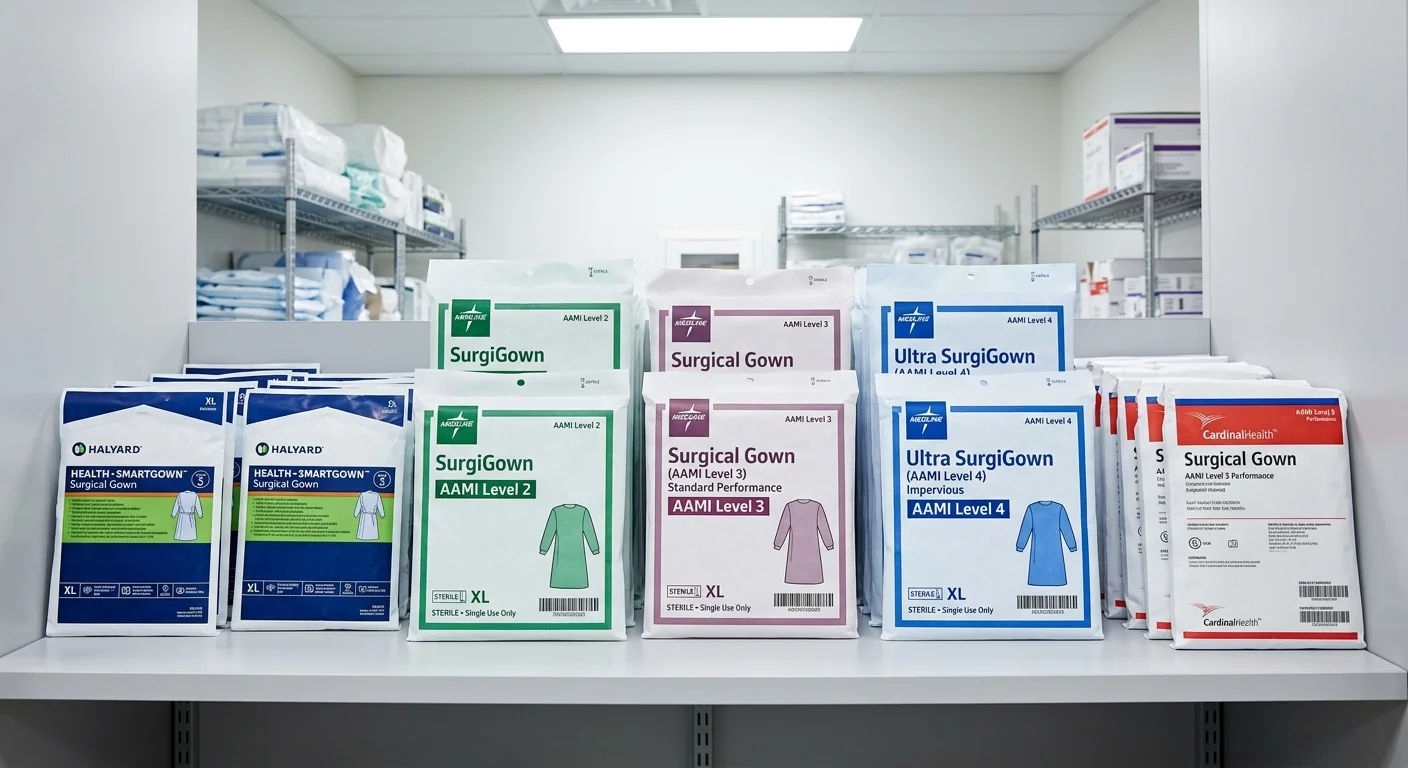
Medline didn’t reach the top of the surgical gown market by chance. It got there by fixing real procurement problems that hospital supply chain teams face every day.
The biggest reason hospitals keep coming back? Vendor consolidation. One supplier covering gowns, drapes, PPE, and surgical infection-prevention products under a single contract — that cuts procurement complexity fast. Medline’s 2024 acquisition of Ecolab’s global surgical solutions business made that one-stop-shop promise far more credible for large IDNs and health systems.
But convenience alone doesn’t win OR supply contracts. Clinical performance does.
Here’s what makes Medline’s design stand out at the product level:
-
SMS fabric with poly-reinforced chest and sleeves — fluid barrier protection placed right where exposure risk is highest
-
Heat-sealed sleeve seams — block liquid strike-through at one of the most overlooked contamination pathways
-
Anti-slip sleeve coating near the knit cuff — engineered to stop gloves from rolling down during long procedures, targeting a known glove–gown interface risk
-
Wider chest and sleeve cut — gives surgeons a better range of motion without losing protection, which matters during hour four of a complex case
Procurement teams also respond well to Medline’s tiered portfolio structure. You get options across all AAMI protection levels. Facilities can match gown cost to actual case risk — Level 1/2 for low-fluid procedures, Level 3 for standard general surgery, Level 4 or reinforced for orthopedics, trauma, and OB. At high-volume GPO contract pricing, mid-range AAMI Level 3 gowns land between $1.20–$2.00 per unit. Reinforced Level 4 options run $2–$4 — numbers that hold up against comparable Halyard and Cardinal Health SKUs.
On top of that, Medline brings strong distribution reliability. Hospitals weighed that factor heavily after COVID-era supply shocks exposed vendor gaps. You also get documented FDA Class II compliance and growing support for greener OR initiatives. Put it all together, and the procurement case is hard to push back on.
What Medline Surgical Gowns Feel Like in Real Use?

Spec sheets don’t scrub in. People do.
The people wearing these gowns through four-hour orthopedic cases or back-to-back general surgery days have opinions no product brochure will ever capture. Here’s what Medline surgical gowns feel like in practice — broken down by product line, wearing scenario, and the honest detail that helps you make a smarter procurement call.
The Blockade Poly-Cotton Gown: Think Light Scrub, Not Paper Crinkle
The Medline 2-Ply Blockade uses a polyester-cotton blend — 55/45 or 65/35 poly/cotton. That ratio matters more than it sounds. The fabric drapes and breathes closer to a lightweight scrub top than to the stiff, papery feel of standard disposable gowns .
The dimensions back up that roomy, low-restriction feel: 48″ length, 62″ sweep at the hem, 14.5″ sleeves. Patients report feeling covered — not just barely covered. The overlapping back panels and dual-tie closure (neck and mid-back) give a wrap-robe feeling. That’s a big step up from the exposed, open-back anxiety you get with single-use alternatives.
Weight sits around 120–160 gsm — solid without feeling heavy, and close to silent during movement. No rustling. No crinkling. Just a soft cloth against the skin.
The Aurora Poly-Reinforced Gown: Protected, Breathable, and Cooler Than You’d Expect
The Aurora Poly-Reinforced Surgical Gown works on different principles. The main body uses lightweight SMS fabric — 30–40 gsm — with a noticeable but not unpleasant rustle as arms move. The reinforced chest and forearm panels are where things get interesting.
High hydrostatic head fabrics feel denser and a bit smoother than basic SMS. Fluid beads up and runs off — staff describes it as “slick,” almost water-repellent to the touch. Those reinforced zones also produce a crisper, “surgical drape” sound during arm movement. Oddly, that sound tends to reinforce the sense of protection in the wearer’s mind.
The raglan sleeve cut is worth calling out specifically. Overhead reach, cross-body movement, and forward lean — all feel far less restricted compared to set-in sleeve designs. Surgeons report no tugging at the neck while leaning into a deep field, as long as sizing is right (L or XL for most adults).
Moisture vapor transmission rates of ~800–1,500 g/m²/24h in AAMI Level 3–4 fabrics translate to this in real terms: it feels like a thin athletic windbreaker, not a plastic raincoat. For procedures under two hours, most staff report mild warmth at reinforced zones — tolerable, non-clammy, and far less oppressive than older fully-coated gowns.
Past two to three hours under OR lights, heat does build up — mostly at the lower back and chest. Still, Aurora-type breathable designs draw far fewer complaints about overheating and “plastic cling” than legacy impervious gowns do.
Matching Feel to Function
|
Scenario |
Best Fit |
Why It Works |
|---|---|---|
|
Patient comfort, modesty, and short exams |
Blockade poly-cotton |
Soft, robe-like, low-noise, breathable |
|
Standard to high-risk surgical procedures |
Aurora poly-reinforced |
Cool SMS body + protective, fluid-repellent panels |
|
Heat-sensitive staff, longer cases |
Lighter Aurora variants |
Less reinforcement stiffness, maximum breathability |
The bottom line: Medline’s real-use feel is not uniform across its product line — and that’s a strength. The Blockade and Aurora serve different sensory and protection needs. Knowing which one goes into which room is the difference between a gown your staff tolerates and one they trust.
Where Medline Surgical Gowns Perform Well — And Where They Don’t

The data on Medline surgical gowns tells two stories at once. Both of them are true.
A peer-reviewed study tested three leading U.S. surgical gown systems — Halyard 7G, Medline 8G, and Cardinal Health 9G. The focus was on glove–gown interface leakage under a standardized test. Medline landed in the middle: mean leakage of 8.47 g across all glove configurations. That’s behind Cardinal 9G (7.25 g) but ahead of Halyard 7G (8.72 g). The difference was significant (F = 8.34, p < 0.001). Not alarming — but not best-in-class either.
The sharper finding shows up in single-glove configurations. Remove double-gloving from the equation, and Medline 8G’s mean leakage rises to 11.22 g — the highest of the three gowns tested (Cardinal 9G: 9.33 g; Halyard 7G: 10.13 g). That’s a real gap. It has a direct practical implication: Medline gowns rely more on double-gloving to reach competitive barrier performance at the cuff.
Switch to double synthetic gloves , and the numbers shift fast. Leakage drops to 2.76 g — one of the lowest values recorded across all configurations tested. The gown itself isn’t the weak point. The glove-gown pairing is.
Researchers made this clear: gown and glove must work as a system. Medline’s knit cuff adds comfort and helps gloves grip better. But it can trap fluid at the glove–cuff transition zone. This happens when the overlap is too short or the wrong glove type is used. That’s the trade-off built into the 8G design.
Where Medline Holds Its Ground?
On regulatory compliance, Medline is solid. The Medline Level 4 Surgical Gown with Breathable Sleeves holds FDA 510(k) clearance (K242844). It meets ANSI/AAMI PB70:2022 Level 4 — the top U.S. liquid barrier rating. That means it resists synthetic blood and viral penetration under ASTM F1670/F1671 test protocols. Reaching Level 4 while keeping breathable sleeves is a real engineering achievement. Most Level 4 products give up one to get the other. For European markets, Medline also meets EN 13795-1 standards covering liquid penetration, microbial penetration, and material strength. The full line is latex-free — a practical detail for facilities tracking staff allergy risks.
Where It Falls Short?
The interface leakage data gives procurement teams a straight answer to their toughest question. Under real single-glove OR conditions, Medline 8G is the weakest performer among the three major U.S. brands tested. For facilities that haven’t yet made double-gloving standard across all high-fluid procedures, that gap isn’t just a number — it’s an operational risk.
What to Do About It?
You don’t need to switch vendors. Fix the protocol instead:
-
Default to double synthetic gloves for all Level 3–4 Medline gown applications. This pulls measured leakage down to the 2–3 g range and closes the gap with Cardinal 9G.
-
Enforce ≥7–10 cm glove–gown overlap at the knit cuff. This matters most when arms are flexed in deep surgical fields.
-
Add adhesive strips or glove-strap systems in high-splash specialties — orthopedics, OB/GYN, trauma — where cuff exposure risk runs highest.
-
Track sleeve contamination rates by gown brand in your QA data. If cuff strikes keep showing up, adjust glove type before you renegotiate your gown contract.
Medline’s Level 4 compliance is real. Its comfort advantage is real. Its interface vulnerability under single-glove use is also real. The facilities that get the most out of these gowns don’t treat the gown as a standalone product. They manage the glove-gown system as one unit.
What Hospitals Should Check Before Ordering Medline Surgical Gowns?
A purchase order for surgical gowns looks simple on paper. It rarely is.
There’s a big difference between “we ordered Medline surgical gowns” and “we ordered the right Medline surgical gowns for each clinical area.” That gap is where infection control failures hide. Before your supply chain team signs off, here’s the checklist that closes it.
Confirm FDA Classification — Not Just the Brand Name
Medline’s surgical gown portfolio covers four separate regulatory categories: surgical gowns, surgical isolation gowns , non-surgical isolation gowns, and procedural gowns. Each one has different FDA requirements and approved use cases.
For OR use, you need a Class II medical device with 510(k) clearance — product codes FYA or FYC. Ask Medline for the specific 510(k) number on every SKU you’re considering. Then check it in the FDA database yourself. A gown’s label must state “surgical gown” and confirm sterile packaging. No label, no OR use — no matter how it’s marketed.
Match AAMI Level to Actual Procedure Risk
Every Medline surgical gown SKU should have a tested AAMI PB70 barrier level printed on the package. That level must match the fluid exposure reality of the procedure — not just the department name.
Use this as a working benchmark:
-
Level 4 : Major orthopedics, open abdominal, cardiothoracic, trauma resuscitation
-
Level 3–4 : C-section, vascular, urology with moderate splash
-
Level 2–3 : ICU routine care, med-surg floors
-
Level 1 : Visitors, very low-acuity tasks
Map every clinical area to its minimum required level before placing the order. Aligning gown level to procedure risk has cut HAIs by 15% in facilities that moved high-risk areas to Level 3–4 and dropped over-specced gowns in low-risk zones. That one step makes a real difference.
Demand the Test Data, Not Just the Claims
A stated AAMI level means nothing without documented test results to back it up. For each gown line, ask for actual lab reports that confirm:
-
ASTM F1671 — viral penetration resistance (required for Level 4)
-
ASTM F1670 — synthetic blood penetration (Levels 2–4)
-
AATCC 127 / AAMI PB70 — hydrostatic pressure
-
AATCC 42 — impact penetration
Also, confirm the testing lab holds ISO 17025 accreditation. Medline citing “high barrier performance” without referencing specific ASTM standards is a red flag. Drop that SKU from your formulary. Vague compliance language is not compliance.
Verify Sterility Standards and Shelf-Life Documentation
Any gown used in surgical procedures must meet a Sterility Assurance Level of 10⁻⁶. That’s a hard requirement. Ask Medline three direct questions:
-
What sterilization method do you use — EtO, gamma, e-beam, or steam?
-
What validated SAL standard applies (e.g., ISO 11135 for EtO)?
-
What shelf-life studies confirm sterility holds through the stated expiry date?
Check expiry dates on both the shipper boxes and individual unit packs. Expired sterile gowns aren’t just waste. The FDA allows their use for staff training where barrier protection isn’t needed. Build that into your policy before go-live.
Run a Pilot Before the Bulk PO
Paper specs won’t tell you a gown splits at the shoulder during doffing or traps heat two hours into a complex case. Test 50–100 units per SKU in real procedures first. Collect feedback on three specific metrics:
-
Tear/defect rate — anything above 2% during donning and doffing triggers rejection
-
Heat stress onset — average procedure time before staff report discomfort
-
Closure reliability — tie systems versus hook-and-loop under actual OR conditions
No bulk order moves forward without that data.
Build a Tiered Formulary — and a Supply Redundancy Plan
After clinical validation, build your Medline surgical gown formulary around your real case mix — not convenience. A solid evidence-based target: 15–25% Level 4, 30–40% Level 3, the rest at Level 1–2 — adjusted to your facility’s surgical volume.
Also, build supply protection into the contract. Get Medline’s standard lead times, monthly maximum allocations during surge periods, and confirmation of multi-plant manufacturing capacity. For Level 4 surgical gowns, dual-source from day one. Facilities that skipped this step paid for it during the COVID-era supply shocks.
The hospitals that get the most from Medline’s product line treat procurement as a system — not a transaction. This checklist is where that system starts.
Conclusion
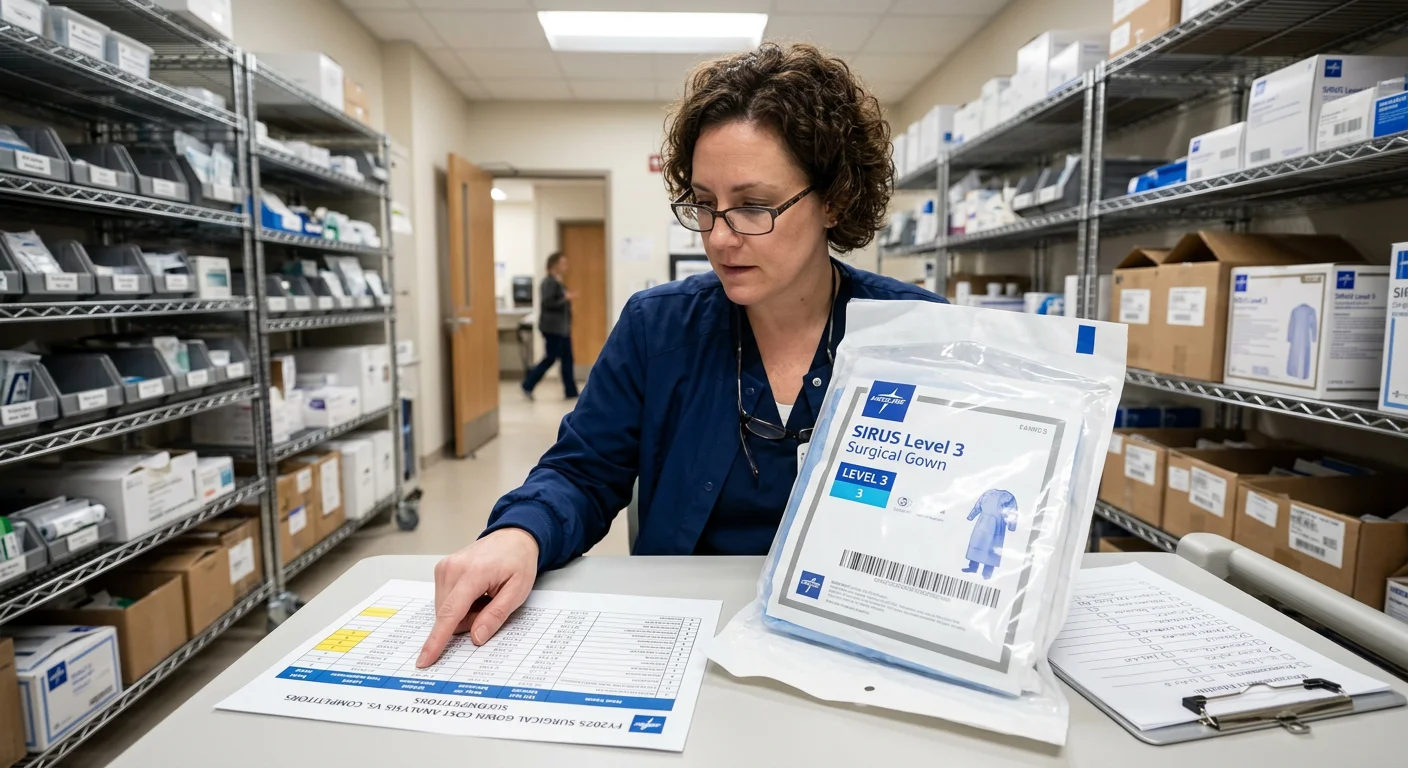
Medline surgical gowns check every major box — protection levels, real-world comfort, compliance credentials, and cost. They’re not the flashiest option out there. But for hospitals that need reliable AAMI level 3 and level 4 surgical gown coverage across high volumes without second-guessing quality, Medline gives you a dependable baseline that holds up well.
The honest takeaway: fit your gown to your procedure, not your budget alone. A reinforced surgical gown in a high-fluid vascular case isn’t a luxury — it’s a line of defense. Getting that wrong costs far more than any per-unit price difference between brands.
Ready to move forward? Here’s what to do:
-
Request samples for your specific procedure mix
-
Loop in your infection control team at the start — not after decisions are made
-
Compare total cost across your full usage volume, not just the catalog price
The right gown protects your patients. The right decision protects everyone else.