Wrong GSM for your surgical gown fabric? That’s not just a budget problem — it puts patients and surgical teams at real risk.
Most procurement specs still treat SMS nonwoven as one material category. They list 30gsm and 50gsm as if they’re the same thing. They’re not.
The weight difference isn’t just a number on a datasheet. It separates basic barrier protection from true fluid resistance under high-pressure surgical conditions.
This guide breaks down how 30gsm, 40gsm, and 50gsm SMS nonwoven perform across the metrics that matter most:
-
Hydrophobicity
-
Breathability
-
Tensile strength
-
Compliance with AAMI PB70 and EN 13795
Use this to match the right material to the right clinical environment — with no guesswork.
30gsm SMS Nonwoven: Performance Profile & Best-Fit Use Cases
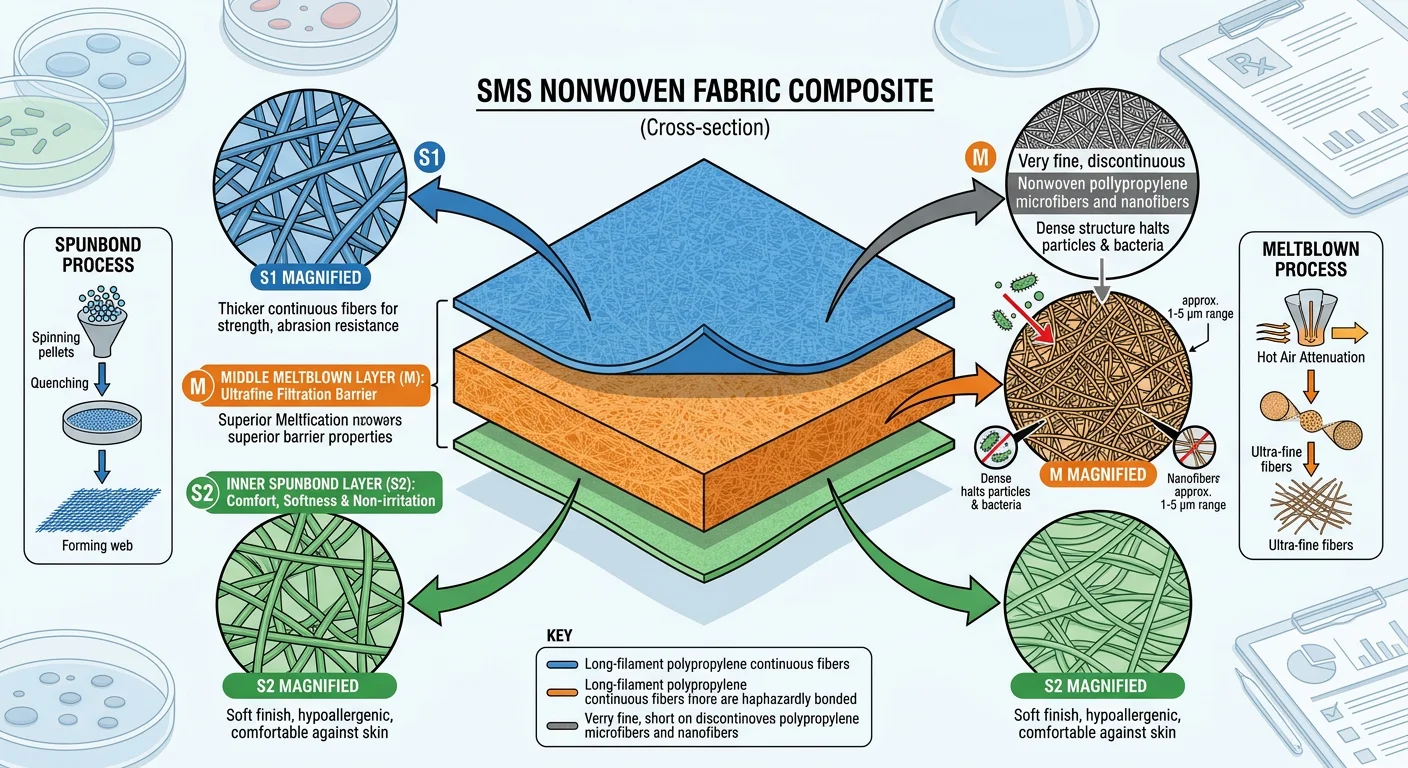
At 30gsm, you’re at the lightest end of the SMS range that still meets clinical standards. That’s exactly where its value sits.
This isn’t a compromise material. It’s a focused tool built for specific environments. Knowing where it works — and where it doesn’t — separates smart procurement from expensive specification mistakes.
What the Numbers Tell You?
30gsm SMS nonwoven fabric is structured as SMS or SSMMS and is 100% polypropylene. It delivers one core trade-off: maximum breathability without sacrificing basic barrier compliance.
Here’s what that looks like in real testing data:
|
Performance Metric |
30gsm SMS (Medical Grade, 3-Anti-Finish) |
|---|---|
|
Hydrostatic Pressure |
800–1,500 mmH₂O |
|
Impact Penetration (AATCC 42) |
≤1.0–2.0 g (vs. Level 1 limit of 4.5 g) |
|
Air Permeability |
150–300 L/(m²·s) |
|
Tensile Strength (MD) |
40–70 N |
|
Tensile Strength (CD) |
20–40 N |
|
AAMI PB70 Compliance |
Level 1 standard: select SSMMS formulations that reach Level 2 |
The breathability number matters more than most procurement teams expect. At 150–300 L/(m²·s), 30gsm SMS is far more comfortable to wear than 40–45gsm alternatives. Those heavier options drop to 80–150 L/(m²·s). For clinical staff in isolation gowns during long, low-risk shifts, that gap is noticeable by hour three.
Impact penetration performance also holds up well. A well-finished 30 gsm three-anti SMS hits ≤1.0–2.0 g on AATCC 42. That’s well below the 4.5 g ceiling AAMI Level 1 requires. This isn’t borderline compliance. It’s built-in headroom that helps maintain consistency across production batches.
Where 30gsm SMS Belongs — and Where It Doesn’t
Matched use cases:
-
Visitor isolation gowns — Short wear time (1–3 hours), low fluid exposure, high comfort priority. 30gsm meets Level 1 liquid barrier requirements. Per-unit cost stays low enough for high-volume disposable use.
-
General ward and outpatient isolation gowns (AAMI Level 1–2) — Fever clinics, IV placement, wound dressing changes, routine patient contact. Fluid splash risk exists, but volume stays low. The barrier margin is solid. Plus, the breathability becomes a real clinical advantage during long shifts.
-
Basic procedure support — Routine dental checks (no high-volume irrigation), standard venipuncture, post-operative ward care. Exposure to body fluids is occasional and low in volume.
Where 30gsm SMS falls short:
-
Urology — high-volume irrigation procedures : Sustained fluid saturation breaks down barrier performance. Level 3–4 materials or PE-laminated SMS are the right call here.
-
Orthopedic surgery (joint replacement, open fractures) : High-pressure irrigation plus heavy blood volume goes beyond what 30gsm can resist. You need a minimum of 40–50gsm SMS — often with lamination reinforcement — for correct specification.
-
Cardiothoracic, hepatobiliary, and major oncological resections : High blood loss, long procedure durations, sustained gown saturation. These environments require Level 3–4 rated materials, regardless of fabric weight.
The core rule: 30gsm SMS is built for low-duration, low-volume fluid exposure . Any procedure with sustained irrigation, heavy bleeding, or high-pressure fluid contact pushes this material past its design limits.
Cost Position
At bulk pricing (1×40HQ volumes, FOB China or Southeast Asia), medical-grade 30gsm SMS with three-ant finish runs $1.50–2.50 USD/kg. That makes it the most cost-efficient nonwoven option across the AAMI-compliant range. For high-turnover visitor gowns and routine isolation use, that cost structure is hard to beat.
40gsm SMS Nonwoven: The Mainstream Choice for Standard Surgical Gowns
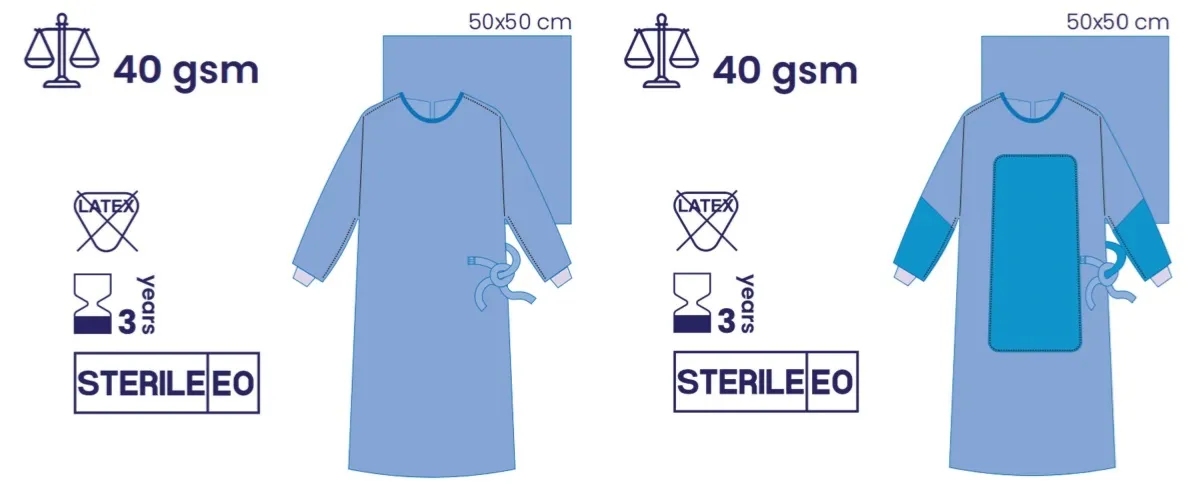
Here’s a fact supply chain managers don’t often discuss: most surgical gowns in general operating rooms worldwide fall into one weight band — 35 to 45 gsm SMS nonwoven . Not 30gsm. Not 50gsm. That middle ground exists for a clear reason.
40gsm isn’t a compromise. It’s an engineering decision.
The Performance Numbers That Explain Its Dominance
At 40gsm, the spunbond meltblown fabric structure hits a key crossover point. You get the highest barrier improvement per extra gram of polymer added. And breathability hasn’t yet become a problem for clinical use.
Here’s what that looks like in real terms:
|
Performance Metric |
40gsm SMS (Medical Grade) |
|---|---|
|
Hydrostatic Head |
30–40 cm H₂O |
|
Bacterial Filtration Efficiency (BFE) |
≥98% |
|
Air Permeability |
~70–80% of 30gsm equivalent |
|
AAMI PB70 Compliance |
Level 2–3 capable |
|
EN 13795 Classification |
Standard performance gown |
The hydrostatic head jump from 30gsm to 40gsm is significant. You get a 30–70% higher barrier with just a ~33% increase in polymer weight. That’s a strong barrier upgrade per unit of material cost. BFE also moves from the ≥95% range into ≥98% territory. That threshold is what separates basic isolation from genuine surgical-grade protection.
Breathability holds up well, too. At 70–80% of 30gsm’s air permeability, 40gsm polypropylene nonwoven fabric stays comfortable across multi-hour procedures. Compare that to 50gsm variants, which drop to 50–60% of 30gsm breathability. Researchers have flagged that gap as a real comfort issue in clinical settings.
Where 40gsm SMS Fits Best?
Manufacturers and procurement catalogs agree on this. 35–43gsm SMS/SMMS is positioned as standard surgical gown weight — not reinforced, not high-risk. That classification covers:
-
General surgery — short to moderate duration, moderate fluid exposure
-
Gynecological and abdominal procedures — standard fluid contact without sustained high-pressure irrigation
-
Laparoscopic procedures — limited external fluid contact, with breathability as a priority during extended wear
-
Standard OR environments requiring AAMI PB70 Level 2–3 compliance
For AAMI Level 2, a 35–40gsm SMS with hydrophobic, antistatic, and alcohol-repellent finishes meets the core test requirements: AATCC 42 impact penetration ≤4.5 g and AATCC 127 hydrostatic pressure ≥20 cm H₂O. Step up to 40–45gsm SMMMS, and Level 3 compliance becomes achievable for moderate fluid exposure scenarios under EN 13795 high-performance zone requirements.
The Cost-Performance Logic Behind the “Mainstream” Label
40gsm’s procurement advantage isn’t just about price per kilogram. It’s about inventory logic .
Set 40gsm as a hospital standard, and your procurement team can cover most general surgical procedures with a single SKU. High-risk surgeries move up to 50gsm or reinforced alternatives. Everything else runs on one standardized gown spec. That cuts SKU complexity, simplifies stock management, and lowers per-procedure material costs — without dropping barrier compliance where it matters.
At bulk FOB pricing, medical-grade 40gsm SMS runs $2.00–3.20 USD/kg. Yes, that’s above 30gsm in price. But the barrier improvement you get is far larger than that cost difference suggests. For any facility running moderate-risk procedures at volume, the numbers make a strong case on their own.
50gsm SMS Nonwoven: High-Barrier Protection for High-Risk Surgical Environments
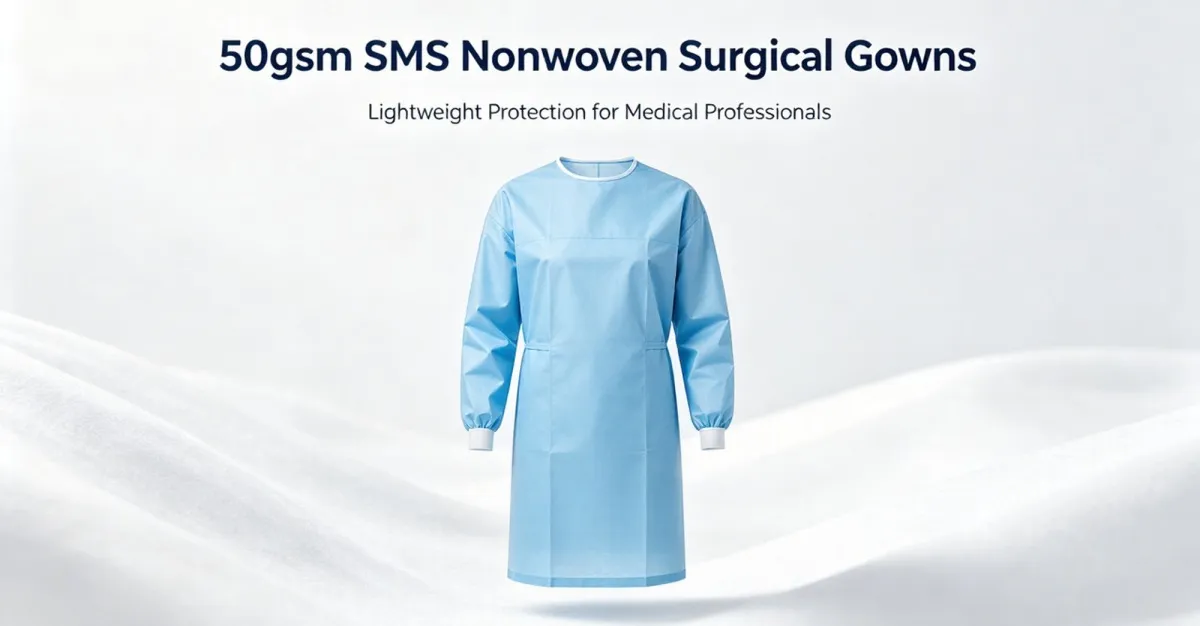
Four hours into a coronary bypass — chest cavity open, irrigation fluid building up, gown fabric under constant mechanical stress — the cost difference between 50gsm and 40gsm stops mattering. What matters is whether the barrier holds.
50gsm SMS nonwoven is built for that environment. High fluid volume. Long procedure. Zero tolerance for barrier failure. That’s the spec.
The Performance Gap Between 40gsm and 50gsm
The jump from 40gsm to 50gsm isn’t linear — it’s strategic.
|
Performance Metric |
50gsm SMS (Medical Grade) |
|---|---|
|
Hydrostatic Pressure |
80–95 cm H₂O (20–35% above 40gsm) |
|
Tear Strength (MD) |
10–13 N |
|
Tear Strength (CD) |
8–10 N |
|
Abrasion Resistance |
~20–40% more cycles vs. 40gsm |
|
AAMI PB70 Compliance |
Level 3–4 capable |
|
EN 13795 Classification |
High-performance surgical gown |
Three numbers matter most here.
Hydrostatic pressure: 80–95 cm H₂O. This is the working range for 50gsm surgical gown fabric weight against sustained fluid exposure — orthopedic irrigation, cardiovascular field flooding, trauma hemorrhage. It clears the AAMI Level 3 threshold of ≥50 cm H₂O by a solid margin. It also puts the fabric within range of Level 4’s blood and viral penetration resistance requirements under ASTM F1670/F1671 testing.
Tear strength: 10–13 N longitudinal. EN 13795 high-performance critical zones require ≥10 N. At 40gsm, hitting that target requires reinforcement panels. At 50gsm, it stays stable across the full fabric body — no localized engineering needed.
Abrasion resistance: 20–40% more cycles . Joint replacement surgeries run 3–6 hours. The chest and cuff zones take continuous contact stress throughout. That wear adds up. 50gsm’s denser spunbond meltblown spunbond fabric structure has a thicker meltblown layer — about 20–25% thicker than 40gsm. That shrinks the effective pore size and resists the slow micro-penetration that breaks down lighter fabrics in long procedures.
Where 50gsm SMS Belongs?
Three clinical environments drive most of the 50gsm demand:
Cardiovascular surgery (3–6+ hours, 1,000–5,000 mL irrigation volume). Blood and fluid contact runs long at the chest, cuff, and forearm zones. You need steady hydrostatic resistance across the full procedure. Full-body 50gsm fabric works best here — or at minimum, coverage across the critical anterior zones.
Orthopedic surgery (hip/knee replacement, spinal procedures). High-pressure pulsatile irrigation delivers 3–10 L per procedure. That creates direct-impact fluid stress. The front torso, outer arms, and thigh zones need fabric that holds up under that mechanical load. Reinforced surgical gown designs often use 40gsm body fabric paired with 50–60gsm SMS/SMMS critical zone panels. That brings average fabric weight to around 44–46gsm while delivering near-full-50gsm barrier performance at the zones that matter.
Trauma surgery and complex oncological resections (≥4–6 hours). High contamination risk. Unpredictable hemorrhage. Long wear time. Standard 35–40gsm fabric starts showing fatigue-related penetration at high-stress points under those conditions. 50gsm cuts out that failure mode entirely.
Full-Body 50gsm vs. Zonal Reinforcement: The Cost Logic
This is where procurement decisions get practical.
A full-body 50gsm surgical gown uses 150–200 g of fabric per unit (3–4 m² × 50gsm). Compare that to full-body 40gsm, and you’re adding 30–40 g per gown. That translates to 20–30% higher material cost.
The zonal alternative uses 40gsm body fabric across 70–80% of the surface area. Then, 50–60gsm nonwoven fabric barrier protection panels cover the critical anterior zones. The result is a composite average weight of around 44–46gsm. Cost premium drops to 10–15%. Critical-zone barrier performance matches or comes close to full-body 50gsm output.
Procurement recommendation by risk tier:
-
Highest-risk procedures (liver transplant, major vascular surgery with high viral load exposure): Full-body 50gsm, or 60gsm front/sleeves + 40–45gsm back panel.
-
High fluid exposure standard cases (orthopedic, cardiac long procedures): 40gsm body + 50gsm reinforced chest/cuff/anterior thigh zones.
-
Extended moderate-risk procedures (tumor resection, limited irrigation): High-finish 40gsm with targeted 50gsm local panels — controls cost without dropping EN 13795 compliance.
AAMI PB70 and EN 13795: What 50gsm Needs to Certify
AAMI Level 3 requires hydrostatic pressure ≥50 cm H₂O and controlled impact penetration under AATCC 42. Well-engineered 50 gsm medical-grade nonwoven fabric clears both with room to spare.
Level 4 is where things get serious. ASTM F1670 (synthetic blood penetration) and ASTM F1671 (viral penetration using Phi-X174 bacteriophage) are the tests that decide it. Fabric weight alone doesn’t get you there — meltblown uniformity, hydrophobic finish chemistry, and seam construction all play a role. But 50gsm’s denser fiber packing builds the baseline pore structure that makes Level 4 certification reachable without exotic coating systems.
For EN 13795 high-performance classification, the headline requirements are critical zone tear strength ≥10 N and liquid barrier resistance across key anatomical areas. 50gsm meets both without variation. That’s why it’s become the standard material spec for reinforced single-use surgical gowns across European hospital procurement systems.
Bottom line: sustained high-volume fluid exposure, extended procedure duration, elevated infection transmission risk — any one of those conditions makes 50gsm SMS fabric hydrophobic properties combined with correct meltblown layer density the minimum defensible choice. Not a premium. A baseline.
Side-by-Side Comparison: 30gsm vs 40gsm vs 50gsm SMS — Key Performance Metrics
The numbers below don’t lie — but they need context.
GSM values mean nothing on their own. What matters is how they shift performance across six key dimensions. Here’s the full picture, laid out for procurement decisions.
The Master Comparison Table
|
Performance Metric |
30gsm SMS |
40gsm SMS |
50gsm SMS |
|---|---|---|---|
|
AATCC 42 Impact Penetration |
1.5–3.0 g |
0.5–1.5 g |
0–0.5 g |
|
AATCC 127 Hydrostatic Head |
25–35 cm H₂O |
40–60 cm H₂O |
70–120 cm H₂O |
|
BFE (ASTM F2101) |
≥95–98% |
97–99% |
≥99% |
|
Tensile Strength MD |
25–35 N |
35–50 N |
45–65 N |
|
Abrasion Resistance (Martindale) |
2,000–4,000 cycles |
4,000–8,000 cycles |
8,000–12,000 cycles |
|
Air Permeability (ASTM D737) |
250–400 L/m²·s |
150–250 L/m²·s |
80–150 L/m²·s |
|
AAMI PB70 Level |
Level 1–2 |
Level 2–3 |
Level 3–4 |
|
EN 13795 Classification |
Standard Performance |
Standard–High Performance |
High Performance (Critical Zone) |
|
Relative Material Cost ($/m²) |
1.00× |
1.25–1.35× |
1.55–1.75× |
Three Patterns Every Procurement Team Should Know
Liquid barrier jumps sharply with weight. Each 10 gsm increase pushes hydrostatic head up by 20–40 cm H₂O under the same processing conditions. Going from 30gsm to 50gsm can triple fluid resistance at the upper end. That’s not a small gap — it’s the difference between AAMI Level 2 and Level 4 territory.
BFE improvement levels off fast. All three weights deliver solid bacterial filtration. The step from 30gsm (≥95%) to 40gsm (97–99%) is a real gain. From 40gsm to 50gsm, the improvement is small. BFE is your primary concern? Meltblown layer density and electrostatic treatment drive filtration far more than GSM does.
Breathability falls hard as weight rises. This is the trade-off that catches facilities off guard. Going from 30gsm to 50gsm cuts air permeability by 60–70%. For surgical teams wearing gowns through 4–6 hour procedures, that’s a real heat stress factor — not just a comfort preference.
The Cost Reality
Material cost tracks weight in a close to straight line. But finished gown pricing stretches those differences further. Using 30gsm fabric as your cost baseline:
-
40gsm adds 8–15% to the finished gown FOB price
-
50gsm adds a further 10–18% on top of that
For high-volume procurement, those percentages add up fast. For high-risk surgical environments, the cost gap becomes a secondary concern — barrier failure carries a far higher price.
One critical correction : GSM alone does not set the AAMI or EN 13795 certification level. Seam construction, hydrophobic finish chemistry, and meltblown uniformity all play a role. There are documented cases where 35–40gsm SMMS fabric reaches Level 4 , while a badly engineered 50gsm SMS tops out at Level 2 . Verify via test reports — not spec sheets.
How to Choose the Right GSM for Your Surgical Gown: A Scenario-Based Decision Guide
Three procurement ranges. That’s all you need to remember.
Low-risk procedures: 35–40gsm. Mid-risk: 45–50gsm. High-risk or high-fluid: 50–60gsm. Everything else is detail — important detail, but detail all the same.
Here’s how that breaks down by clinical environment:
Surgical Scenarios
Low-risk, low-fluid exposure — outpatient minor surgery, wound debridement, superficial lipoma excision, routine thyroid or breast surface procedures.
35–40gsm SMS covers the spec. The priority here is lightweight, breathable, low-lint fabric. Your supplier stocks mid-range only? 40gsm is a safe floor.
Mid-risk, standard fluid contact — inguinal hernia repair, laparoscopic cholecystectomy, routine gynecological procedures, arthroscopy, standard urology.
Move to 45–50gsm SMS or SMMS . Industry data places most surgical gown fabric in the 45–55 g/m² band. 50gsm sits in the mid-to-high range — strong enough as a barrier, but not so heavy it wears down the surgical team.
High-risk, heavy splash, extended duration — C-sections, open abdominal surgery, joint replacement, trauma, any procedure with sustained blood or body fluid exposure.
Go with 50–60gsm , or a reinforced critical-zone design. Standards documentation backs this up: higher-performance products built from the same base materials as standard ones can reach greater fluid resistance through weight increase alone or targeted critical-zone treatment .
Non-Surgical Environments
ICU isolation and general infection control? 35–40gsm — breathability matters more than surgical-grade barrier here.
Fever clinics, infectious disease wards, emergency observation? 40–50gsm. The deciding factors are seam strength and viral penetration resistance.
Budget Is Tight
Full-body 50gsm isn’t always the right call.
A 40gsm body + localized PE laminate reinforcement on the chest, forearms, and high-contact zones gives you near-equivalent critical-zone barrier performance. The material cost drops 10–15% compared to full-body 50gsm.
Sourcing this design? Ask three specific questions upfront:
-
What percentage of surface area is reinforced?
-
Is the composite bonded at seams or panel-laminated only?
-
What is the hydrostatic pressure target for the reinforced zones?
A supplier who can’t put all three answers in writing is a specification risk — before the gown even ships.
Sourcing SMS Nonwoven for Surgical Gowns: What to Ask Your Supplier
Supplier qualification is where procurement decisions hold up — or fall apart.
The right GSM means nothing if the fabric behind it doesn’t match the spec sheet. Here’s what to verify before a purchase order goes out.
Supplier Credentials: Three Documents That Matter
-
ISO 13485 — Request the certificate number, issuing body, and expiry date. Check that the scope covers medical nonwoven or surgical gown materials. General textile certifications don’t count.
-
CE / FDA registration — Ask for documents tied to the specific product SKU. A blanket company claim isn’t enough.
-
SGS or Intertek test reports — Full reports, not summaries. You need the sample ID, test standard, date, and numerical pass/fail results. Use these to cross-check hydrostatic pressure and tensile strength figures against what the supplier is telling you.
Technical Specs to Lock Down in Writing
-
Layer structure : plain SMS (3-layer) or SMMS/SMMMS? A 45gsm SMMMS reaches Level 3 protection. A 45gsm plain SMS may not. The structure matters as much as the weight.
-
GSM tolerance : confirm production lot deviation. Also, ask whether the PPE supplier can run non-standard weights — 35gsm and 45gsm are the two most relevant ranges for surgical gown applications.
-
PP grade : Virgin polypropylene is the standard for surgical gowns. Recycled content brings barrier variation and cleanliness risks. Don’t accept it.
-
Surface treatment : hydrophobic for liquid repellency. Hydrophilic treatment suits situations where moisture management and wearer comfort take priority.
Performance Data to Request Before Sampling
|
Data Point |
What to Ask |
|---|---|
|
Hydrostatic pressure |
Exact value + test standard used |
|
Tensile strength |
MD and CD values, units, test method |
|
Air permeability |
Required for gowns worn 3+ hours |
Get this data before you request samples. It tells you whether sampling is worth your time.
Commercial Terms Worth Asking Upfront
-
MOQ : ask by color, width, and GSM as separate line items. Standard and custom grades often carry different minimums. Know each one before you negotiate.
-
Lead time : stock goods ship faster. Custom GSM or surface treatment runs take longer. Ask for pilot production timelines too — not just the bulk lead time.
-
Trial order : Request a pilot lot before any bulk commitment. Test it against your target AAMI PB70 or EN 13795 performance level. Don’t test it against the supplier’s own spec sheet.
-
Consistency controls : ask for lot-to-lot COA records, PP traceability documentation, and in-process QC checkpoints. The meltblown layer drives barrier performance. Batch inconsistency in that layer is the most common cause of field failures in SMS surgical gowns .
A supplier who hesitates on any of these — the documentation, the pilot lot, the lot traceability — is giving you an answer. The risk doesn’t disappear after the container ships.
Conclusion

Picking between 30gsm, 40gsm, and 50gsm SMS nonwoven fabric isn’t a minor spec choice. It’s a patient safety decision hiding inside procurement language.
The surgical gown fabric weight you choose shapes whether the material holds up under fluid pressure, long surgical hours, and real procedural stress. Get it wrong, and no cost-saving covers the exposure risk.
Here’s the quick breakdown:
-
30gsm — low-risk, short procedures
-
40gsm — standard surgical environments
-
50gsm — high-fluid situations where penetration is not acceptable
So what do you do with this? Take it into your next sourcing conversation. Check AAMI PB70 classification levels against your specific use cases. Ask for test data — not product claims, actual test data.
Any serious medical-grade nonwoven fabric supplier hands you that documentation on the spot. No delays, no excuses.
Can’t get it? Keep looking.