
Walk into any pharmacy — or browse online — and you’ll see acronyms everywhere: BFE, PFE, VFE. They’re printed big on packaging, as if you already know what they mean. Most people don’t. Mask manufacturers are counting on that.
Mask filtration ratings aren’t just technical trivia. They’re the difference between real protection and false confidence. Each rating measures something different. Each one filters something specific. And each one matters more in certain situations than others.
By the end of this guide, you’ll know which rating to look for. You’ll understand why the others still matter. And you’ll have what you need to make a smarter buying decision next time.
BFE vs PFE vs VFE: What Is the Difference?
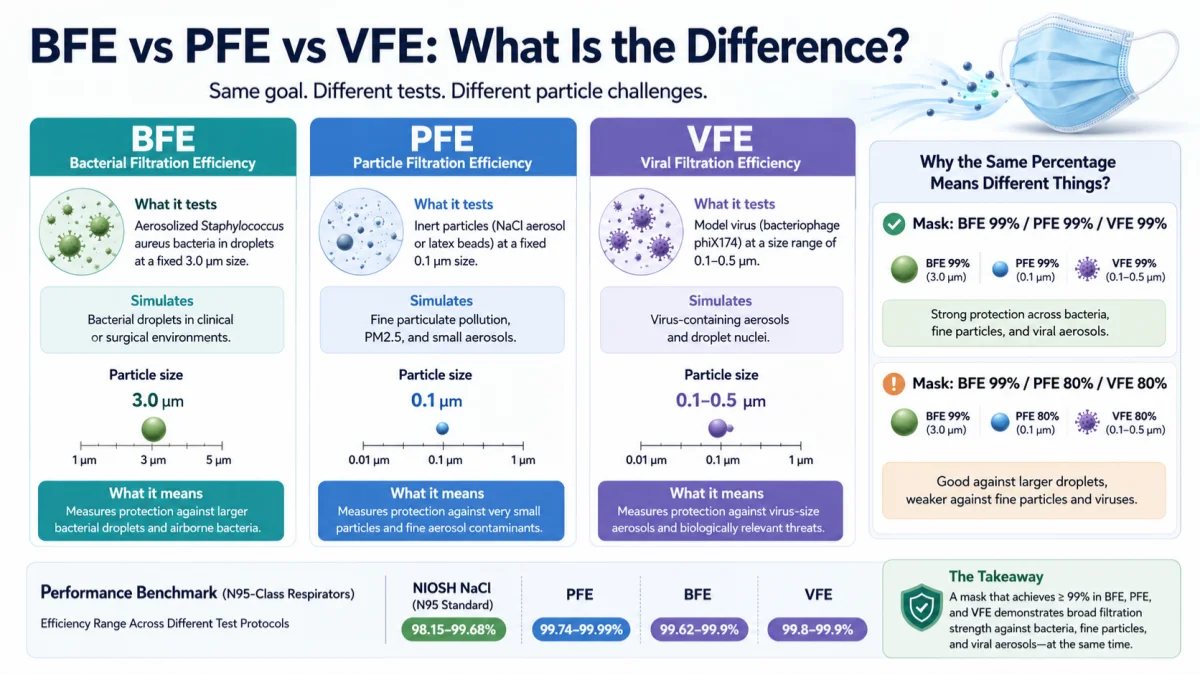
These three ratings come down to one thing: what gets thrown at the mask during testing.
Same concept — filtration efficiency — but three different challenges. Different particle types. Different sizes. Different threat scenarios. Know the difference, and you’ll read mask packaging far better than most people do.
Here’s what each rating measures:
The Test Behind Each Rating
BFE (Bacterial Filtration Efficiency) tests mask material against aerosolized Staphylococcus aureus bacteria suspended in droplets at a fixed 3.0 µm particle size. The test simulates bacterial droplets you’d face in a clinical or surgical setting — larger respiratory droplets, airborne bacteria, that category of threat.
PFE (Particle Filtration Efficiency) swaps living organisms for inert particles — sodium chloride (NaCl) aerosol or latex beads — and cuts the challenge size down to 0.1 µm. That’s 30 times smaller than what BFE tests. PFE is your benchmark for fine particulate pollution, PM2.5 exposure, and very small aerosolized contaminants.
VFE (Viral Filtration Efficiency) uses a model virus — bacteriophage phiX174 — at a size range of 0.1–0.5 µm. It targets virus-containing aerosols and droplet nuclei. This creates a biologically relevant challenge that neither BFE nor PFE replicates.
Why the Same Percentage Means Something Different?
This is where most people get tripped up.
A disposable mask labeled BFE 99%, PFE 99%, VFE 99% sounds bulletproof across the board — and it mostly is. But look at this scenario:
-
BFE 99% → blocking 99% of S. aureus droplets at 3.0 µm
-
PFE 99% → blocking 99% of NaCl particles at 0.1 µm
-
VFE 99% → blocking 99% of phiX174 viral aerosols at 0.1–0.5 µm
Now consider a mask rated BFE 99%, PFE 80%, VFE 80%. That mask handles larger bacterial droplets well. But filtration drops off against smaller particles and virus-size aerosols. The BFE score looks great. The real-world protection against fine aerosols? Much weaker.
PFE and VFE — tested at smaller particle sizes — are the harder challenges. A high BFE score alone doesn’t guarantee strong PFE or VFE performance.
The Performance Benchmark Worth Knowing
Here’s a data point that puts everything in perspective. Researchers tested N95-class respirators across multiple protocols. The results:
|
Test Method |
Efficiency Range |
|---|---|
|
NIOSH NaCl (N95 standard) |
98.15–99.68% |
|
PFE |
99.74–99.99% |
|
BFE |
99.62–99.9% |
|
VFE |
99.8–99.9% |
The takeaway: BFE, PFE, and VFE protocols can produce higher percentages than the NIOSH NaCl test. That’s because the test conditions differ. These ratings are not interchangeable. A mask that clears all three at ≥ 99% shows broad filtration strength across bacteria, fine particles, and viral aerosols — all at once.
That’s the mask filtration rating combination worth looking for.
Why Do Mask Filtration Ratings Matter?
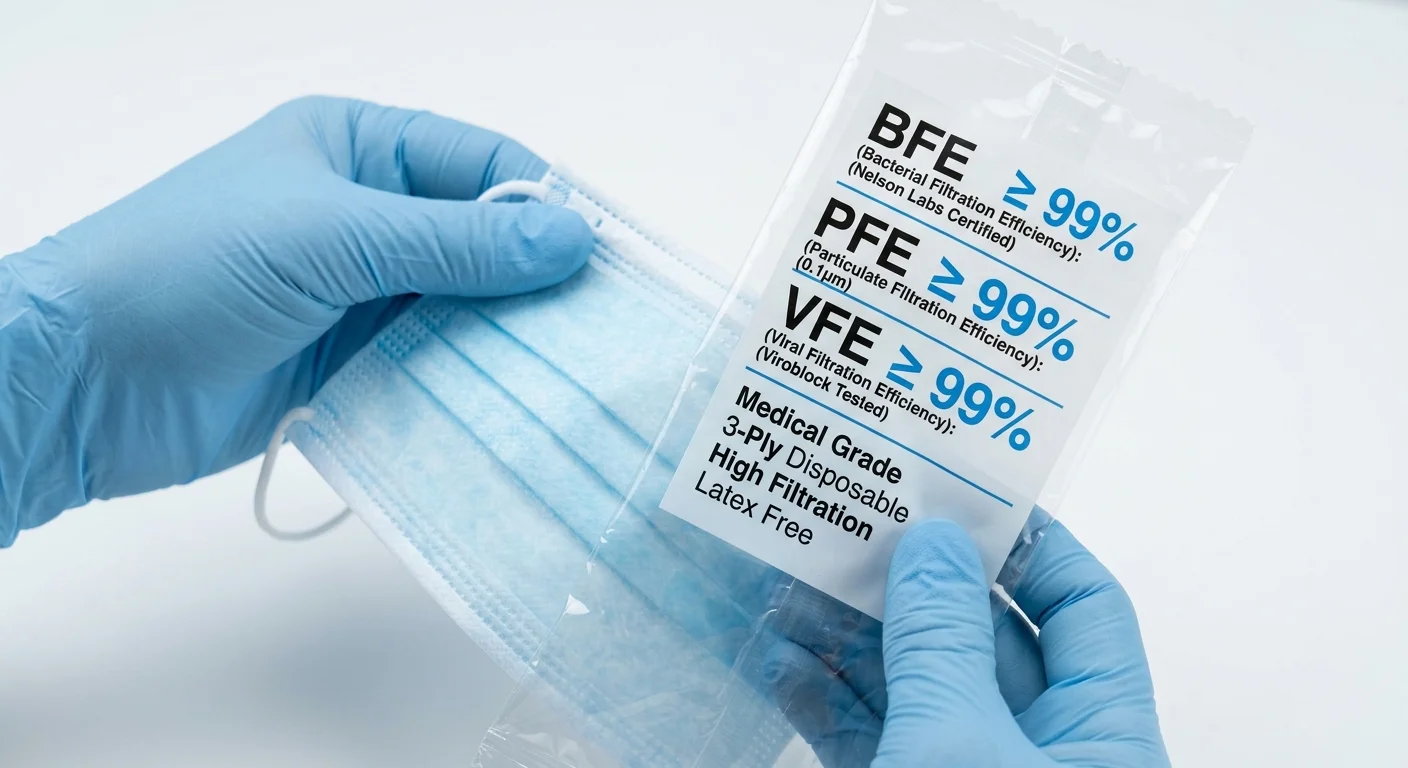
The number on your mask packaging isn’t a marketing figure. It’s a real measurement of how many harmful particles reach your lungs — and the difference is dramatic.
Consider this. Say the air around you contains 1,000,000 particles:
-
A 95% rated mask (N95) lets through ≤50,000 particles
-
A 50% filtration surgical mask lets through ≈500,000 particles
-
A 99.97% rated mask (N100/P100) lets through just ≈300 particles
That’s not a small difference. That’s a 10× gap between an N95 and a low-end surgical mask — and a 1,600× gap between a cloth mask and an N100 respirator.
The Rating Is the Risk Reduction
Each percentage point in a mask filtration rating maps to a change in how much you inhale. Here’s the full breakdown:
-
Cloth masks : ~25–38% filtration (62–75% penetration)
-
Bandanas : ~3% filtration (97% penetration)
-
Surgical masks : ~45–55% aerosol filtration
-
N95 respirators : ≥95% filtration at 0.3 µm
-
N100/P100 : ≥99.97% filtration (HEPA-equivalent)
Switching from a cloth mask to an N95 cuts inhaled particles by 14×. Going from a bandana to an N95? That’s 19× less exposure.
These aren’t guesses. Labs measure and verify these numbers under controlled test conditions. That’s the whole reason ratings like BFE, PFE, and VFE exist.
Ratings cut through the marketing noise. A brand name tells you nothing concrete. A filtration rating gives you a specific protection level, tied to a specific particle size and a specific test standard. Without knowing the rating, you’re guessing. With it, you’re making a real choice.
Which Mask Filtration Rating Matters Most?
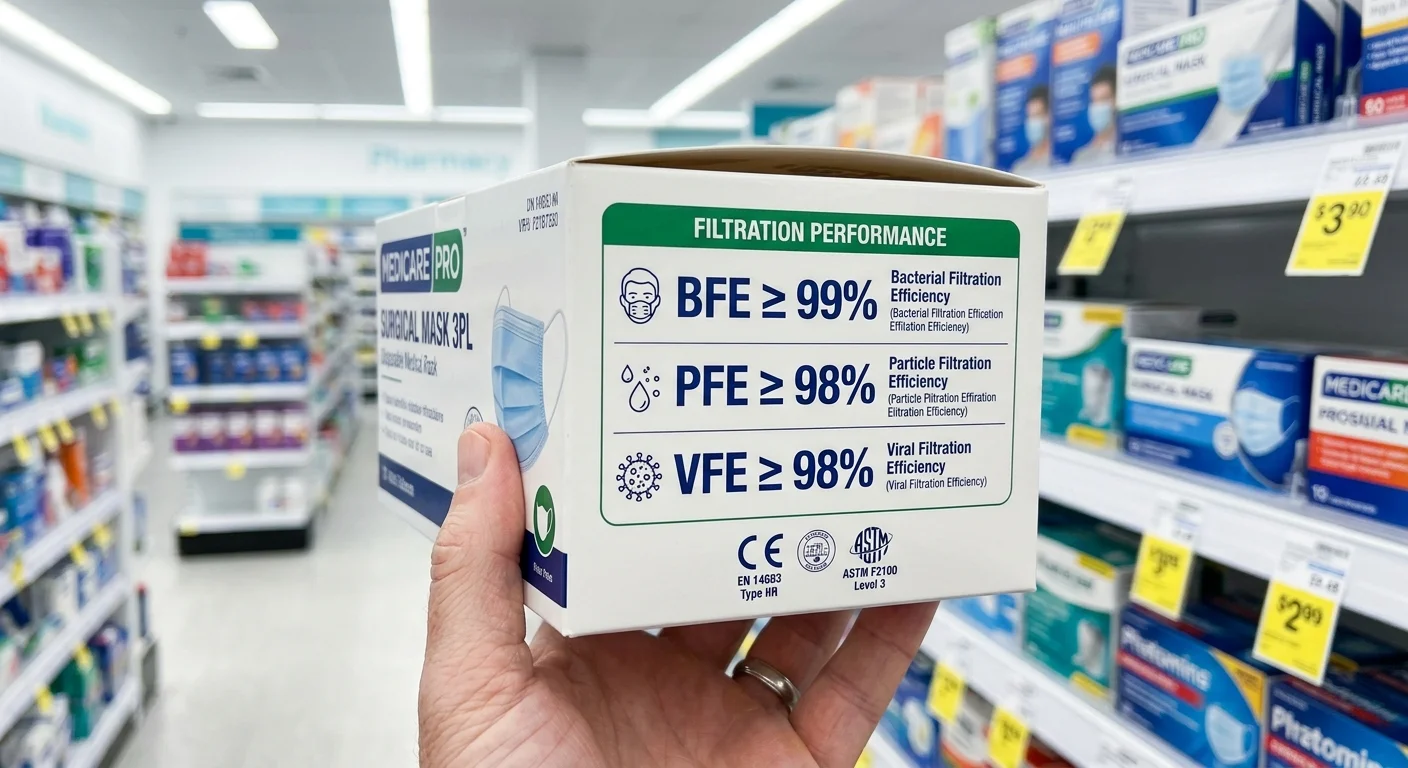
Filtration ratings help you understand how much protection a mask can provide before you buy it.
For example, if one million particles are present in the air:
|
Filtration |
Particles Passing Through |
|---|---|
|
95% |
50,000 |
|
99% |
10,000 |
|
99.97% |
About 300 |
Even a few percentage points can significantly reduce particle exposure, especially during prolonged use.
However, filtration percentages should always be considered together with the testing method. A high BFE rating alone does not necessarily indicate excellent protection against fine airborne particles.
Which Mask Filtration Rating Matters Most?
The answer depends on what you’re trying to protect yourself from.
For everyday respiratory protection
If your primary concern is airborne particles, pollution, or respiratory aerosols, PFE is generally the most informative rating because it evaluates filtration against much smaller particles.
For hospitals and surgical environments
Medical masks typically emphasize BFE because reducing bacterial droplets is critical during surgical procedures and patient care.
For virus-related research
Some manufacturers publish VFE results to demonstrate performance against virus-containing aerosols. Although useful, VFE is less commonly required than BFE or PFE in product specifications.
Quick Recommendation
|
Situation |
Most Useful Rating |
|---|---|
|
Daily commuting |
PFE |
|
Air pollution |
PFE |
|
Medical procedures |
BFE |
|
Surgical masks |
BFE + PFE |
|
Infection-control evaluation |
VFE |
Other Factors That Matter Besides Mask Filtration
Filtration efficiency is only one part of mask performance.
Fit of Disposable Face Masks
Even a high-filtration mask cannot provide its intended protection if air leaks around the edges. A well-fitted mask often improves real-world performance more than choosing a slightly higher filtration percentage.
Certification of Disposable Face Masks
Always verify that the mask complies with recognized standards such as ASTM, EN 14683, EN 149, or NIOSH certification instead of relying solely on marketing claims.
Breathability of Disposable Face Masks
Higher filtration materials can increase breathing resistance. Medical standards therefore balance filtration efficiency with differential pressure to maintain user comfort.
Oil Resistance of Disposable Face Masks
Oil resistance mainly affects industrial respirators .
-
N-Series : Not resistant to oil.
-
R-Series : Resistant to oil for limited use.
-
P-Series : Oil-proof and suitable for prolonged exposure to oil aerosols.
For healthcare or everyday use, oil resistance is usually not a deciding factor.
How to Read a Mask Label Before Buying?
Knowing how to choose a surgical mask starts with the packaging. You grab a box at the store or browse options online. Many shoppers fall into the “percentage trap.” A massive “99%” plastered across the front catches your eye. You assume you have complete protection. But a single catchy number does not tell the whole story. So, take a step back. Review the entire specification printed on the box. Real protection lies in the details. Do not just trust the marketing text.
N95 mask label reading cuts through the technical jargon. Use this checklist before your next purchase. It helps you find the right fit and secures your safety:
-
Check the certification standard first: Do not just take the manufacturer’s word. Look for independent testing standards like ASTM, EN 14683, or NIOSH. These certifications prove the mask passed rigorous lab tests. It underwent more than internal company checks.
-
Verify the BFE, PFE, or VFE rating: A 99% rating means different things. It depends on the letters in front of it. Find out if the mask blocks larger bacterial droplets, fine particulate matter, or viral aerosols.
-
Check the particle size used during testing: Most buyers miss this massive factor. A mask stops 3.0 µm particles in a standard BFE test. That same mask might fail against 0.1 µm particles. Always check the microscopic size they used. Plus, that number explains the impressive percentage.
-
Match the rating to your intended application: Think about your routine. Are you heading into a crowded subway with bad airflow? You need strong PFE or VFE. A hospital setting makes BFE your priority. Tailor the mask to the actual threat.
-
Ensure the mask fits properly: You could buy the most expensive, highest-rated mask. Huge air gaps around your nose or cheeks ruin it. So, the true filtration efficiency drops fast. A snug fit matters just as much as the filter material.
Spend a few extra moments on these steps. This gives you a more accurate assessment of a mask’s real performance. Such a smart approach improves your safety. Stop comparing numbers side-by-side and hoping for the best.
Conclusion
Choosing the right mask isn’t complicated — but you do need to know what you’re buying.
BFE, PFE, and VFE each measure something different. BFE covers bacteria, PFE covers particles, and VFE covers viruses. No single rating covers everything. Match the right rating to your real-world situation. A surgical setting needs different protection than a crowded subway or a dusty warehouse.
Here’s the bottom line: don’t let marketing language fool you. A high BFE percentage means nothing if airborne particles are your main concern. Check all three ratings against your real exposure risks before buying.
Ready to make a smarter buying decision? Use the comparison breakdown in this guide as your personal checklist before your next mask purchase.
At the end of the day, the best mask filtration rating isn’t the highest number on the box — it’s the one built to protect you from what you’re facing.





