
You reach for the nearest pair of rubber gloves before you scoop up the spider in your bathtub — dish gloves, garden gloves, whatever’s closest. It feels like enough. But spider fangs evolved for one job: punching through the shell of an insect. A thin layer of rubber wasn’t part of that design, which raises a question most people never stop to ask until it’s too late to matter: does “wearing gloves” actually mean anything to a spider, or is it just a habit that makes us feel safer?
By the end of this article, you’ll know exactly which spiders can bite through which gloves — and which ones can’t touch you no matter what you’re wearing. You’ll also find out why some people get bitten with gloves on, and it has almost nothing to do with the glove itself.
Which Spiders Can Actually Bite Through a Glove?
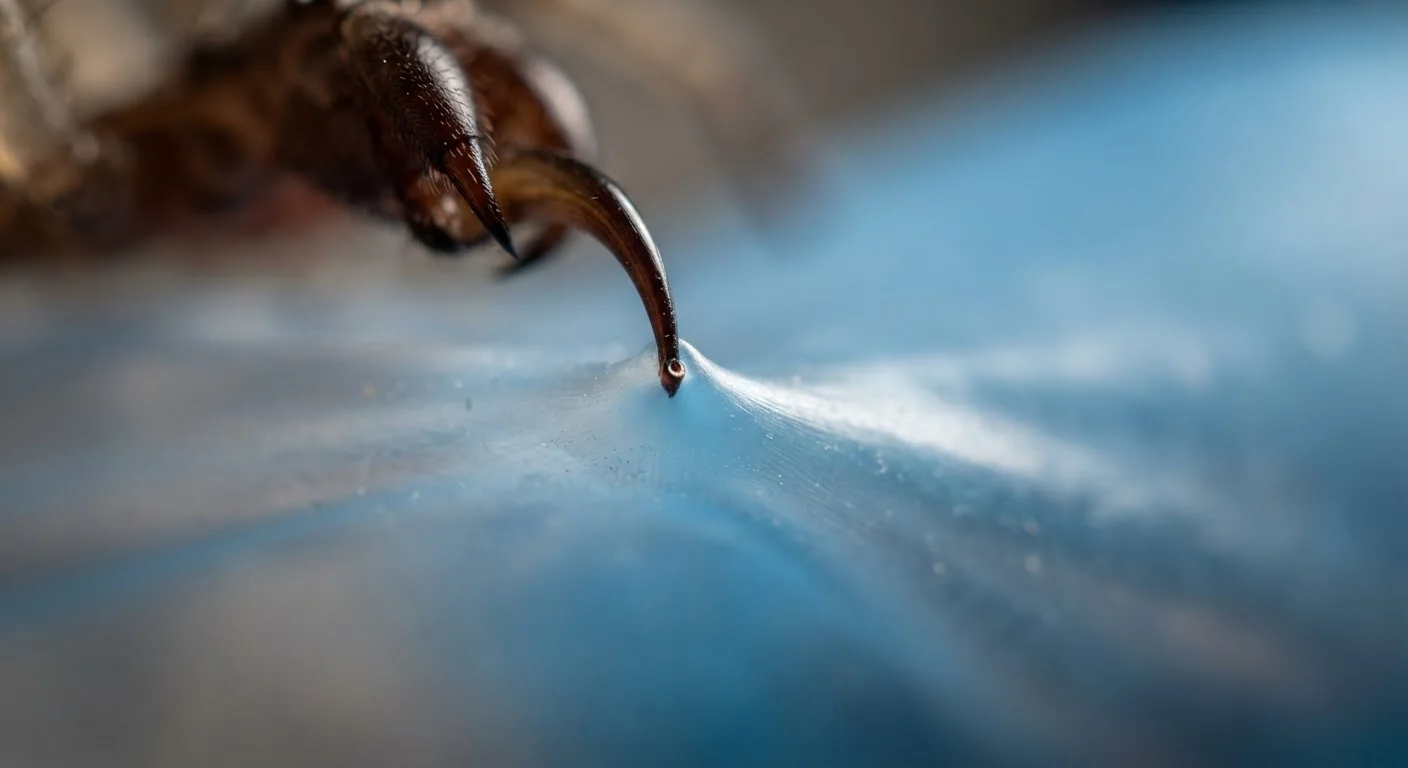
Most spider-and- glove articles lump every spider into one bucket. That’s not accurate — fang size and bite strength vary a lot by species. Here’s the real breakdown:
|
Spider |
Fang Length |
Bite Strength |
Can It Bite Through a Rubber Glove? |
|---|---|---|---|
|
Common house spider / jumping spider |
Very short |
Very weak |
No — fangs can’t reach skin even bare-handed |
|
Wolf spider |
Short to medium |
Weak (feels like a bee sting) |
Almost never — fangs are too short for most glove thicknesses |
|
Huntsman spider |
Medium, sharper |
Moderate |
Rare — can sometimes pierce very thin, worn gloves |
|
Black widow |
Short but sharp |
Moderate |
Only through thin, stretched, or worn rubber |
|
Brown recluse |
Longer, needle-like |
Moderate |
Yes, through thin latex/nitrile — the main real risk |
|
Pet tarantula (large species) |
Long, strong, hinged |
Strong grip, deep puncture |
Yes, through thin gloves — but bites are rare and usually a last resort |
The takeaway: if you’re worried about a random house spider or a wolf spider, almost any glove is overkill. The real planning should center on brown recluse territory, or handling a large tarantula — those are the two situations where glove thickness actually changes the outcome.
Why Rubber Gloves Usually Win (And Sometimes Don’t)
Think of a rubber glove like a trampoline, not a wall. When something sharp presses on it, the rubber stretches and spreads the force out, instead of letting the point punch straight through. This is why a thin, stretchy glove can stop a fang that looks like it “should” go through.
But this trick has limits:
-
Stretched spots fail first. Pull rubber tight over a knuckle, and it gets thinner right there — sometimes thinner than the fang itself.
-
Fresh gloves work best. A glove that’s been sitting in a drawer, or exposed to certain chemicals, gets weaker and tears more easily.
-
A squeeze changes everything. If you press a spider hard against your skin through the glove, you’re not testing “can the fang poke through rubber” anymore — you’re testing “can the fang poke through rubber that’s being crushed flat against skin.” That’s a much easier job for the spider.
So the short version: a normal glove is decent protection for a spider that could bite you but probably won’t try hard. It’s not a guarantee against a strong bite in the wrong spot.
Rubber Glove Material Comparison
Not all rubber gloves are the same. Here’s how the common options — from thin disposable rubber gloves to leather — stack up:
|
Glove Type |
Thickness |
Puncture Protection |
Best For |
|---|---|---|---|
|
Disposable latex |
0.08–0.13 mm |
Medium |
Light, casual contact |
|
Disposable nitrile |
0.10–0.20 mm |
High |
Most spider removal jobs |
|
Neoprene (dive/wetsuit-style gloves) |
1.5–3 mm |
High |
Wet or outdoor conditions, decent puncture resistance from thickness alone |
|
Molded rubber (garden/work gloves) |
0.5–1.5 mm |
Medium — thick, but soft and unreinforced at the fingertips |
Everyday yard work, not high-risk bites |
|
Leather |
1.5–2.5 mm |
Very high |
Outdoor work, thorns, aggressive spiders |
|
Snake-bite gloves (leather + SuperFabric) |
2 mm+ |
Extreme |
Overkill for spiders, built for far bigger bites |
Two numbers to know for comparison: a black widow’s fangs run about 0.25–1.0 mm long, and a recluse’s can reach 2–5 mm. A typical dish glove is only 0.3–0.5 mm thick — right in the “coin flip” zone for a determined recluse.
The weak point in every glove type is the same: fingertips, knuckles, and cuffs. That’s where material stretches thin or simply doesn’t reach. Leather is the one material that doesn’t have this problem, because it doesn’t stretch — which is why it protects best overall.
Does Glove Material Change How a Spider Reacts?
Here’s something almost no comparison chart mentions: the fang isn’t the only variable. What the glove feels and smells like to the spider matters too.
People who handle spiders regularly report a pattern: cloth or leather feels like bark or plant matter under a spider’s feet, so the spider tends to stay calm and simply walk across it. Rubber and nitrile feel and smell different — smoother, sometimes chemical-scented — and some handlers say this can make a spider more likely to act defensively sooner. This isn’t hard science with a controlled study behind it, but it lines up with basic spider behavior: spiders bite out of fear, not aggression, and anything that reads as “unfamiliar and threatening” makes a defensive bite more likely, not less.
Practical takeaway: material toughness protects you if a bite happens. Choosing a glove that keeps the spider calm in the first place is a separate, and arguably more useful, layer of protection — one that pure mm-and-MPa comparisons miss.
The Trade-off Nobody Mentions: Thick Gloves Cost You Dexterity
Every glove comparison focuses on what stops a bite. Almost none mention what a thick glove costs you.
People who handle spiders for a living — vet techs, exotic pet keepers, pest control techs — bring up the same complaint about heavy leather or gauntlet-style gloves: they’re clumsy. You lose fine motor control, which matters when you’re trying to guide a spider into a cup without squeezing it, lift a board without letting the spider run up your sleeve, or work in a tight space like under a sink or inside a shed.
This creates a real trade-off, not a simple “thicker is always better” rule:
-
For a one-time removal job (spider in the bathtub, in a box), maximum protection wins. Grab the thick glove, move slowly, don’t worry about precision.
-
For repeated or close-up handling (checking wood piles regularly, keeping a pet tarantula), many experienced handlers deliberately choose a thinner glove or no glove at all, and rely on technique and calm handling instead — because clumsy hands cause more squeeze-triggered bites than a thin glove risks on its own.
If you only remember one thing from this section: the “safest” glove on paper isn’t always the safest glove in your actual hands. Match the glove to the job, not just to the chart.
Best Rubber Gloves for Spider Removal
Not every rubber glove suits every job. Match the glove to where you’re working:
Indoors (basements, storage boxes, under-sink cabinets):
-
Nitrile, 7–8 mil thick (about 3x thicker than dish gloves )
-
Textured palm for grip
-
Cuff at least 35 cm (about 14 inches), so your forearm isn’t exposed
Outdoors (leaf piles, firewood, garden brush):
-
Thick leather, 1.5–2.5 mm
-
Gauntlet style (long cuff), 35 cm or more
-
Reinforced fingertips
A note on outdoor work: thorns and fangs both poke straight in with a sharp point. “Cut-resistant” gloves are built to stop slicing, not stabbing — a Japanese gardening guide points out they don’t help much against thorns. So for outdoor spider and thorn protection, thick leather beats cut-resistant fabric every time.
Look for the EN 388 label. It’s a small shield icon with four numbers on it. The last number is the puncture rating — higher is better. It’s the easiest way to compare gloves at a hardware store without guessing.
Why Bites Still Happen, Even With Rubber Gloves On
A rubber glove lowers your risk. It doesn’t remove it.
-
Hands and fingers make up over half of all bite injuries.
-
In one study of serious hand bite wounds, nearly 1 in 5 needed some form of surgery to fix lasting damage.
-
About 3 in 10 injured workers were wearing gloves that were damaged, the wrong size, or the wrong type for the job.
-
Gloves cut, puncture and cut risk a lot, but they do nothing to protect against a hard squeeze, a fall, or a fracture.
-
Wrists, knuckles, and cuff edges move during the catch — and moving parts are exactly where gaps open up.
Watch for these warning signs after any bite , glove or no glove: fast swelling, pain when you bend the finger, or heat and redness that shows up hours later. These matter more than what the bite mark itself looks like.
How to Safely Catch a Spider (No Squeezing Required)
Good technique matters more than a thick rubber glove . Most bites happen because someone squeezed the spider’s body against their fingertip — not because a fang beat the material.
The cup-and-card method:
-
Grab a clear cup (250–350 ml) and a stiff piece of card.
-
Move in slowly — spiders read sudden movement as a threat.
-
Lower the cup over the spider until the rim touches the surface and every leg is inside.
-
Slide the card underneath at a shallow angle, then lift.
One more thing to know: spiders bolt straight upward the moment they’re startled, using the nearest edge — including your glove cuff — like a ladder. Keep cuffs tucked in, keep the cup close, and if the spider runs, freeze and re-cover it instead of grabbing with your hands.
Two Layers Beat One
People who handle spiders professionally — tarantula keepers, venomous-species handlers — almost never rely on a single glove. Their standard setup is:
-
Inner layer: 6–8 mil nitrile, for chemical protection and a baseline puncture barrier
-
Outer layer: heavy leather or welding gauntlet, for the actual mechanical stopping power
For extra-high-risk spots (wood piles, crawl spaces, cluttered sheds), some go further and tape the cuff shut before reaching in — closing the one gap that gloves alone can’t cover.
Sizing tip: Measure the width of your hand below the knuckles (no thumb). 152–178 mm usually means EU size 6 / US XS. A glove that’s too big leaves gaps at the wrist — exactly where a spider looks for a way out.
Can Spiders Bite Through Clothes, Boots, or Sleeves Too?
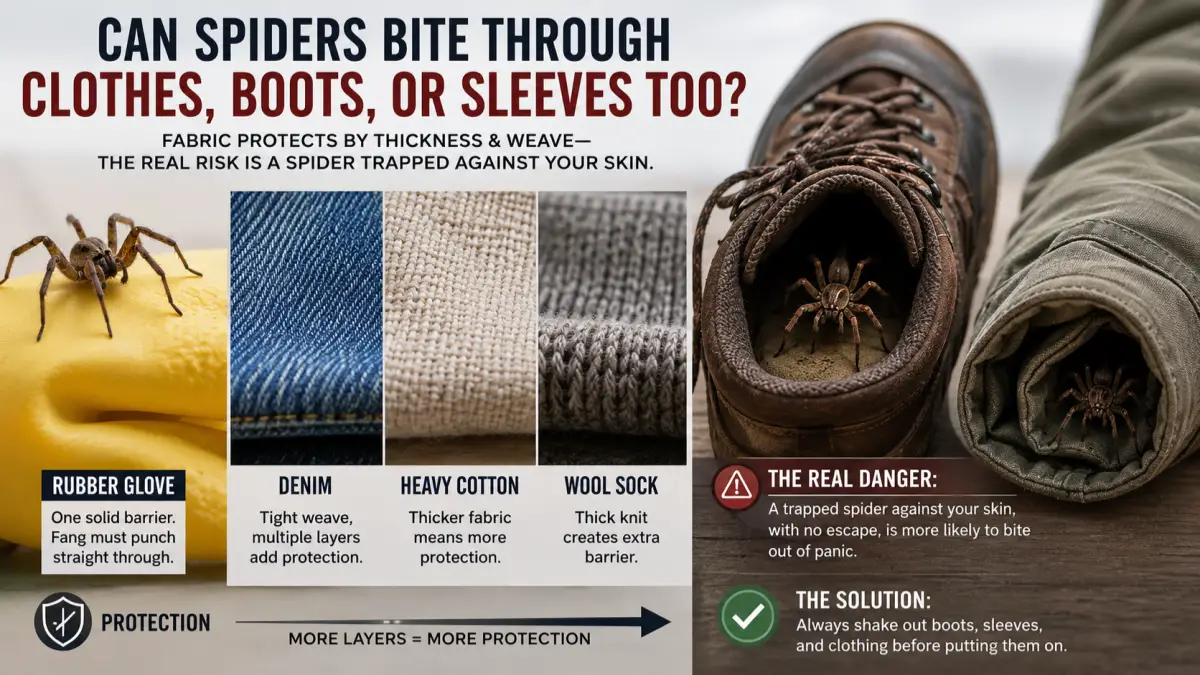
This is a different question than gloves, even though people often mix the two up.
Woven fabric (denim, heavy cotton, wool socks) works differently than a rubber glove. A glove is one continuous sheet — a fang has to punch straight through it. Fabric is made of woven threads with tiny gaps between them, so its protection comes mostly from thickness and tight weave, not stretch. A couple of layers of heavy denim or a thick sock does a good job for the same reason a molded rubber glove does: there’s simply more material between the fang and your skin.
The real danger with clothing isn’t the fabric failing — it’s a spider getting trapped inside a boot, sleeve, or pant leg overnight. A trapped spider against skin, with no way out, is far more likely to bite out of panic than one just crawling across fabric. That’s a behavior problem, not a material problem, and no fabric thickness fixes it. Shaking out boots and gear before putting them on solves it.
FAQ
How thick does a rubber glove need to be to stop a spider bite?
Anything under 0.5 mm is a coin flip against a recluse. Aim for 7–8 mil nitrile (about 0.18–0.2 mm) or thicker for real protection.
Can a recluse bite through nitrile exam gloves?
Yes, if the glove is thin (around 0.06–0.10 mm) and stretched over a knuckle — that’s thinner than the fang itself.
Is latex or nitrile better?
They perform about the same at equal thickness. Thickness matters far more than which material you pick.
Can any spider bite through leather?
Small and medium spiders almost never can. Large tarantulas with long fangs might, but only at a worn seam — not through the leather itself.
Why do bites still happen with gloves on?
Usually it’s compression, not a weak glove. Squeezing a spider against your skin turns a protective layer into a thin pad pressed flat — and that’s much easier to bite through.
Can spiders bite through cloth or leather work gloves?
Leather, almost never — it’s too thick and doesn’t stretch. Cloth gloves depend entirely on thickness; thin cotton gloves offer weak protection, but thick canvas work gloves hold up well against most species.
Can spiders bite through neoprene gloves?
Rarely. Neoprene runs 1.5–3 mm thick, similar to leather, so it holds up well against nearly every spider species, recluse and widow included.
Should I wear gloves to handle a pet tarantula?
Most experienced keepers say no, or use only a thin layer. Thick gloves reduce your control, which raises the odds of an accidental squeeze — often a bigger risk than the bite itself with a calm, well-handled tarantula.
Can spiders bite through jeans or boots?
Usually not, if the fabric is thick and undamaged. The real risk is a spider getting trapped inside — check boots and cuffs before putting them on, especially after items have been sitting outside.
Conclusion
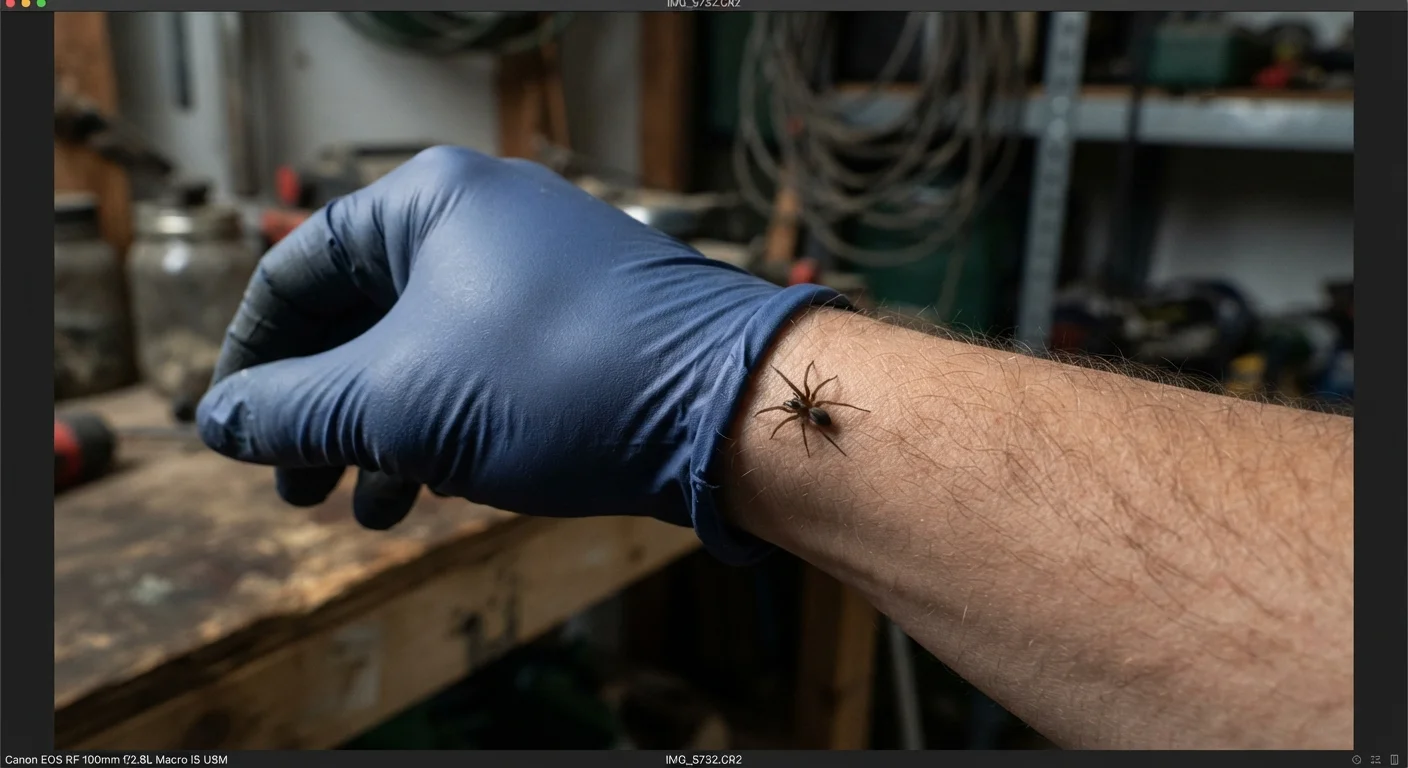
Can spiders bite through rubber gloves ? Mostly, no. A good glove is like a small suit of armor against fangs that were built for soft insects, not rubber. The real risk isn’t the material — it’s the gap at your wrist, the worn spot on your thumb, or the moment you get careless and grab bare-handed because “it’s probably fine.” Pick a glove that’s thick enough and fits well, keep the cuffs sealed, and handle every spider like it might be the exception.





