Finding the right surgical gown manufacturer is never a simple decision. One wrong supplier can mean delayed shipments, failed compliance audits, or worse — compromised sterility in the OR.
Your situation may vary. You could be a hospital procurement manager placing a six-figure bulk order. Or a distributor vetting suppliers for a new product line. Maybe you’re a brand hunting for a solid OEM partner. Either way, the global market for medical protective apparel is crowded, complex, and harsh on expensive mistakes.
That’s why this guide exists. We’ve done the hard work — sorting through hundreds of manufacturers worldwide to hand you the ten that lead in quality certifications, production capacity, product range, and global reach.
How to Choose a Surgical Gown Manufacturer: Key Buying Criteria
Four criteria will make or break your surgical gown manufacturer decision: protection level, material type, certifications, and MOQ flexibility. Nail these, and the rest takes care of itself.
Match AAMI Level to Your Procedure Risk
Not all surgical gowns are equal. Using the wrong level creates a real compliance risk.
-
Level 1–2 : Low-fluid procedures (eye surgery, blood draws)
-
Level 3 : Moderate-risk settings — ER, trauma, IV insertion
-
Level 4 : High-fluid, high-risk surgeries (cardiac, joint replacement) — needs full ASTM F1671 viral penetration testing plus reinforced chest and sleeve panels
SMS vs. Reusable: Know Your True Cost
SMS non-woven surgical gowns run $1–3 per unit. Reusable polyester starts at $10–20. Add $0.50 per laundry cycle on top of that. Barrier protection also breaks down after repeated washing. For high-risk ORs, disposable SMS runs 20–30% cheaper over the long term.
Certifications That Count
Look for manufacturers holding FDA 510(k) + ISO 13485. That combination covers both US and global procurement. For European distribution, CE Mark is a hard requirement — no exceptions.
MOQ Reality Check
Hospital direct buyers need MOQs of 500–2,000 units. Distributors require 5,000–20,000. OEM brand owners scale to 100,000+. Verify seam strength (ASTM burst >300N) before signing any contract. Also, check barrier failure rates — you want them below 1% each quarter.
1. Cardinal Health — Global Scale Surgical Gown Manufacturer for High-Volume Hospitals
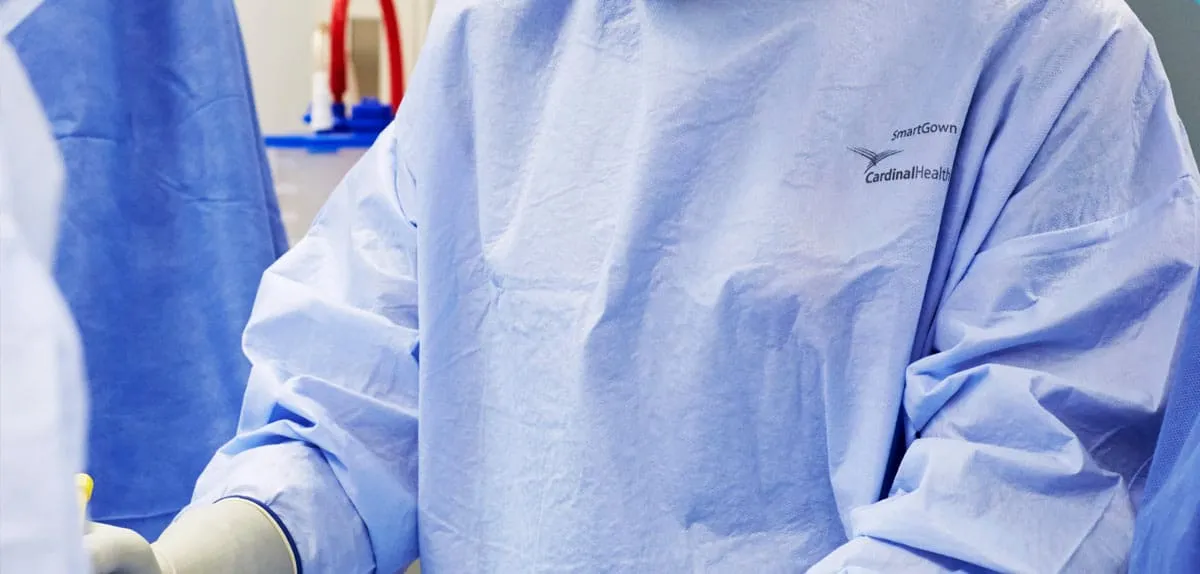
Cardinal Health ships surgical gowns at a volume most manufacturers can’t match. For large hospital systems running high-volume ORs, that production capacity is what procurement teams are looking for.
Based in Waukegan, IL, Cardinal Health 200, LLC makes FDA 510(k)-cleared, Class II disposable surgical gowns under 21 CFR 878.4040. Their core line focuses on single-use SMS non-woven surgical gowns (spunbond-meltblown-spunbond polyolefin). You get AAMI Level 3 barrier protection per ANSI/AAMI PB70:2012 — solid coverage for general surgery, plastic surgery, and high-traffic trauma facilities.
Key specs worth knowing:
– Sterilization uses Ethylene Oxide (EO); both sterile and non-sterile packaging are available
– ISO 13485 certified manufacturing; biocompatibility tested per ISO 10993-1 (non-cytotoxic, non-sensitizing)
– GPO bulk pricing runs around $5–10/unit — competitive for centralized procurement at scale
One caveat buyers need to know: A 2023 FDA alert flagged potential sterility assurance gaps in select Level 3 lots and PreSource packs. No patient harm was reported. Still, pull affected inventory from circulation without delay. Also, Cardinal Health’s model isn’t built for small-batch or custom OEM orders. Regional sterile surgical gown manufacturers will handle those needs better.
2. Medline Industries — Leading Disposable Surgical Gown Manufacturer with Full Product Range
Medline doesn’t just sell surgical gowns. It gives OR procurement teams options that most suppliers don’t offer.
Cardinal Health leans on standardized kits. Medline’s strength is customization depth. You get five distinct fabric configurations, multiple reinforcement styles, and set-in sleeve designs. Procurement managers can match gown specs to specific procedure types. No more forcing your OR to compromise.
Look at the DYNJP2102S SIRUS® as a benchmark. It’s a sterile, fabric-reinforced AAMI Level 3 surgical gown priced at $297.00 per case of 20 — that’s $14.85 per unit. Comparable Level 3 gowns from Cardinal Health run $15–18/unit. At the hospital scale, those savings add up fast.
What makes Medline worth evaluating:
– 5 fabric options covering different reinforcement and sleeve configurations
– Sterile case packs built for bulk OR ordering
– AAMI Level 3 barrier compliance (ANSI/AAMI PB70)
– OEM/private label capability with MOQs starting at 5,000–10,000 units
– Stock lead time: 4–6 weeks; custom fabric runs add 2–4 weeks
Distributors and hospital systems that need a non-woven surgical gown supplier with real product-line depth — not just volume — will find Medline a strong option. The range is there. The pricing is competitive. And the customization goes deeper than most suppliers bother to offer.
3. Mölnlycke Health Care — Premium Sterile Surgical Gown Manufacturer from Europe

Cardiac, orthopedic, and infectious disease ORs across Europe don’t cut corners on barrier protection. Mölnlycke Health Care was built with that in mind.
The Sweden-based manufacturer’s BARRIER® gown line meets EN 13795 -1 — the European standard for surgical gowns as classified medical devices. It carries CE marking and EU MDR compliance. For procurement teams buying across EU markets, that isn’t a nice-to-have. It’s the minimum requirement.
Two technologies define the BARRIER® line:
-
FPP (Fluid Protective Plus) : Covers the full surface with fluid impermeability. You also get virus-proof (VPP) protection against bloodborne pathogens. Built for high-exposure procedures — wet surgery, infectious cases, high-risk cardiovascular and orthopedic operations.
-
Classic SP : Breathable spunlace build with shoulder pleats for free movement. Fluid-repellent and durable. Reduces heat buildup during long procedures.
Pricing runs at $8.18/unit (box of 20) for reinforced configurations — premium by design. EU hospitals with quality-first buying mandates will see the cost as justified. Buyers focused on budget-friendly standard disposables may find better fits elsewhere.
One clear message: Mölnlycke isn’t in the price race. It competes on protection performance and clinical confidence in high-stakes surgical settings.
4. Kimberly-Clark — Trusted Surgical Gown Brand for Infection Control
Kimberly-Clark has spent decades building surgical gowns around one core problem: healthcare-associated infection (HAI) prevention. Their product line covers AAMI Level 2 through Level 4. That means you get options for everything — from routine isolation to high-exposure cardiac and orthopedic cases.
Their standout product is the AERO BLUE Performance Surgical Gown . What sets it apart is proprietary Core technology. It creates a protective inner barrier that blocks fluid under high pressure. At the same time, moisture vapor can still escape — so the gown stays breathable. In head-to-head testing, it delivers 4x greater fluid protection versus non-reinforced Level 3 gowns. You also get 2x more protection compared to standard fabric-reinforced alternatives. That’s a real, measurable gap — not a marketing claim.
For high-risk procedures, check out the MicroCOOL KC400. It reaches AAMI Level 4 — the highest protection tier. It’s tested to ASTM F1671 for bloodborne pathogen resistance and meets ISO 10993 biocompatibility standards.
Pricing runs $5–10/unit for sterile configurations. That’s competitive against comparable 3M reinforced lines, which run $6–12/unit.
Kimberly-Clark moves products through major US distributors — including CIA Medical and Medex Supply. Their global reach extends into Asia, Africa, and Latin America, with both bulk and sterile pack formats available.
5. 3M Company — High-Performance Surgical Drape and Gown Manufacturer
3M didn’t build its surgical gown reputation on marketing — it built it on material science.
The core of their gown line is a 4-layer SMMS non-woven fabric (spun-melt-melt-spun construction). That extra meltblown layer is what sets SMMS apart from standard SMS. You get tighter filtration, stronger fluid resistance, and better tear resistance — all in one lightweight build. Polyamide/polyester cuffs add alcohol repellency and anti-static protection. The result is a gown that holds its barrier under real OR pressure, not just lab conditions.
Three gown lines cover different clinical needs:
-
High Protection (Standard/Reinforced) — top-level barrier for high-fluid, high-risk procedures
-
High Performance (Standard/Reinforced) — solid protection and comfort for general surgery
-
Disposable Lightweight (Standard/Reinforced) — slim, high-comfort option for routine cases
Sizes run Large through XXLarge. Model 7694K is a distributor staple. You can source it through major channels, including USA Medical Surgical and Global Industrial.
The Steri-Drape™ line takes 3M into surgical drape manufacturing. It covers incise drapes, U-drapes, and absorbent drape sheets for full sterile field coverage. 3M also introduced a plant-based, renewable materials version. It keeps the same barrier strength and fluid resistance — a real sustainability upgrade for procurement teams working through ESG requirements.
For high-stakes procedures where sterile field failure isn’t an option, 3M stands as one of the most trusted surgical drape manufacturers in the world.
6. Owens & Minor (Halyard Health) — High-Volume Surgical Gown Manufacturer for Global Supply Chains
Supply chain disruptions have exposed a hard truth: manufacturers that rely too heavily on offshore production break down under pressure. HALYARD doesn’t have that problem.
As part of Owens & Minor’s Global Products Division, HALYARD runs 80% of its manufacturing out of the Americas. That includes dedicated facilities in Texas, North Carolina, and Mexico, plus operations in Thailand. During pandemic-era shortages, offshore-dependent competitors ran out of stock. HALYARD kept delivering. That’s not luck. It’s how the operation is built.
The numbers back it up:
– 99% on-time delivery and 99% order accuracy for U.S. customers
– 40+ distribution centers across the network for fast fulfillment
– Raw material hub in Lexington, NC, keeping nationwide orders moving quickly
The brand portfolio covers $1.2 billion across HALYARD, MediChoice, and Medical Action — sold in 90+ countries. Surgical gowns sit at the core of that product mix, alongside sterilization wraps, drapes, gloves , and custom surgical kits.
For government procurement offices and healthcare group purchasing organizations running centralized bids, HALYARD’s tightly integrated, Americas-based supply chain is a real advantage. Component sourcing stays close to home. That means fewer points of failure — and steady product flow even during a crisis.
One honest caveat: specific AAMI level documentation and SMS/SMMS material specs need direct verification through HALYARD’s product data sheets. Confirm barrier classifications before you finalize any procurement contract.
7. Lohmann & Rauscher — European Surgical Gown and Textile Manufacturer

Based in Germany and Austria, Lohmann & Rauscher (L&R) has built one of Europe’s most respected names in sterile surgical gown manufacturing. Their Sentinex® line is the core reason for that reputation.
The entire range uses Polypropylene SMMS nonwoven fabric — a four-layer spunmelt build that does something rare: it breathes and repels fluid at the same time. Air, heat, and water vapor pass through. Bacteria and fluids don’t. It’s also latex-free and low-lint. That matters a great deal in high-sensitivity OR environments where contamination control is non-negotiable.
The Sentinex® lineup comes in five distinct models:
-
Sentinex SMART Standard — sterile wrap included with 2 towels; fluid-repellent; sizes M/L
-
Sentinex SMART Special — fluid-impermeable reinforced panels on the front and sleeves; available from M/L through XXL
-
Sentinex SMART “Direct” — a stripped-back version with no sterile wrap
-
Sentinex Solo SMMS — the standout model: a patented wall-fixing system lets a surgeon put on the gown alone, no assistant needed in the sterile field
-
Sentinex PRO SMMS — built to cut thermophysiological stress during long procedures; single-use design for wound infection prevention
The Solo model is worth a closer look. Small clinics and low-volume ORs with lean teams will see the value right away. One less person needed in the sterile field means faster prep and lower contamination risk — both at once.
On compliance: L&R products carry CE marking and meet EU MDR requirements for surgical barriers. ISO 13485-compliant manufacturing keeps sterility and quality control consistent across the entire production process.
MOQ flexibility is a real plus here. Carton sizes run 40–52 units per size. That range fits mid-sized and smaller hospital buyers who can’t absorb the bulk minimums that larger PPE manufacturers often require.
For European procurement teams focused on EU MDR compliance, breathable SMMS construction, and flexible order quantities, L&R stands alongside Mölnlycke as a top-tier regional medical protective apparel manufacturer.
8. DuPont — Advanced Fabric Technology Supplier Powering Surgical Gown Manufacturing
Here’s a fact that reshapes how you see the surgical gown supply chain: over 50% of single-use surgical gowns sold to hospitals are made using DuPont’s Softesse™ fabric. That’s not a niche material play. That’s raw material dominance at scale.
DuPont doesn’t manufacture finished gowns. What it does — better than anyone else in the space — is engineer the nonwoven fabrics that determine whether a gown holds up under real OR pressure.
The material lineup covers distinct clinical needs:
-
Tyvek® 500 ES — flash-spun HDPE with 2x the breathability of standard Tyvek® 500; meets EN 13795-1 and EN 14126 for biological hazard protection
-
Suprel® — bi-component polyester/polyethylene build; lowest surface friction among comparable medical fabrics, with fast heat transfer to keep surgeons comfortable through long procedures
-
Tyvek® IsoClean® — cleanroom-grade barrier with patented flash-spinning that locks human contamination inside the garment
For OEM manufacturers, DuPont’s fabric certification delivers something procurement teams care about: built-in traceability. Reference Tyvek® or Suprel® in your gown spec, and that brand carries validated compliance with EU and international standards. That cuts audit risk at every stage downstream.
Sourcing materials for high-spec gown production? Put DuPont at the top of your evaluation list.
9. Hebei ZOJE Medical Equipment — China-Based Disposable Surgical Gown Manufacturer for OEM
Distributors and OEM brand owners shopping for surgical gowns from China often land on Hebei ZOJE Medical Equipment. The factory size is a big reason.
ZOJE is based in Linzhang County, Handan, Hebei. The facility covers 60 acres with 19,800 m² of total construction area. You get sterile workshops, automated production lines, and a built-in manufacturing-to-sales setup. This lets the factory take on medium-to-high-volume OEM orders without the delivery delays you often see from smaller Chinese suppliers.
The core product is a PP non-woven disposable surgical gown — standard hospital blue, classified as medical protective clothing . Beyond gowns, ZOJE also makes syringes, infusion sets, precision filter infusion sets, and sterile masks. The product range covers Class I, II, and III medical devices. So if you’re building a consolidated supplier list, this full-line output is a real advantage.
Key numbers for OEM buyers:
-
MOQ estimate: 10,000–50,000 pcs (consistent with other Hebei-region manufacturers)
-
Wholesale price range: $0.50–2.00/pc for PP non-woven configurations — competitive with Southeast Asian suppliers
-
Lead time: 15–40 days
One thing to check before you commit: ISO 13485, CE, and FDA 510(k) certification status has not been confirmed in available data. Request the actual certificates before placing any volume order. Don’t take compliance for granted, especially for EU or US distribution.
For price-focused procurement and private-label sourcing, ZOJE is a solid option to evaluate. Just get the compliance paperwork verified first.
10. STERIS plc — Sterile Surgical Gown Manufacturer for Operating Room Compliance
STERIS plc holds a position that no other manufacturer on this list can match. They sell sterile surgical gowns and run the sterilization infrastructure that backs them up.
That dual capability matters for high-volume ORs. Academic medical centers running 500+ cases per month need proven sterility. Tier-3 hospitals pushing 100,000+ annual surgeries need the same. So do ASCs with single-use compliance mandates. All of them need one thing — a supplier whose sterility claims come from audited processes, not just product labels.
STERIS backs that up with a certification stack most competitors don’t carry:
-
ISO 13485, ISO 9001, ISO 14971 (risk management)
-
ISO 11135 (EO sterilization) + ISO 11137 (radiation sterilization)
-
FDA QSR/cGMP inspections at US and global facilities
-
EU MDR compliance for international procurement
Their fluid-resistant disposable gowns fit into a full OR PPE workflow. They pair with surgical masks , gloves, and goggles across clean-to-dirty side sterile processing. Pricing runs $5–15/unit for AAMI Level 3/4 sterile configurations. MOQ starts at 100–500 units through the Shop STERIS reorder catalog.
Procurement teams facing Joint Commission audits or WHO Surgical Safety Checklist reviews get something rare with STERIS. You’re not just buying a gown in a bag. You’re getting end-to-end validated sterile process accountability — a fully documented chain that holds up under scrutiny.
Surgical Gown Manufacturer Comparison: How to Match Your Needs to the Right Supplier
Ten manufacturers. Very different price points. Very different strengths. The real question isn’t which one is best — it’s which one fits your specific procurement situation.
Here’s a practical breakdown.
Match your buyer profile to the right supplier type:
-
Large hospital systems : You need FDA 510(k) + ISO 13485 + proven volume capacity. Cardinal Health, Medline, and STERIS are built for this. Budget $5–15/unit for sterile AAMI Level 3/4 configurations.
-
Distributors and resellers : Focus on suppliers with stable bulk pricing, OEM capability, and multi-region certification stacks. China-based manufacturers with CE/FDA compliance land at $0.29–0.65/unit. That’s 70–90% less than US/EU brands.
-
OEM and private-label brands : MOQ 5,000–10,000 units is the standard entry point. Check CE, FDA, and ISO 13485 certificates yourself — don’t trust listing claims alone.
-
Government and centralized procurement : You must work with white-list certified manufacturers. Documented compliance trails are non-negotiable for tender eligibility.
Budget reality by tier:
|
Tier |
Price Range |
Best Fit |
|---|---|---|
|
Premium (US/EU brands) |
$5–15/unit |
High-risk ORs, regulated markets |
|
Mid-range (certified China) |
$0.29–0.65/unit |
Distributors, volume OEM |
|
Budget (basic disposable) |
$0.10–0.15/unit |
Low-risk, emerging markets |
Five steps before you sign anything:
-
Lock your MOQ requirement. Most certified factories start at 5,000–10,000 units.
-
Confirm your target market’s regulatory requirement — FDA, CE, or TGA.
-
Request actual test reports. AAMI level claims need documented proof, not just a label.
-
Add 10–30% shipping cost to your landed price calculation. It adds up fast.
-
Run a 1,000-unit sample order before committing to full volume.
The comparison table gives you a starting framework. The five steps turn that framework into a real decision.
Conclusion
Picking the right surgical gown manufacturer is more than a procurement task. It affects patient safety, regulatory compliance, and how stable your supply chain stays.
The manufacturers on this list set the global standard. Cardinal Health brings an unmatched distribution scale. Mölnlycke delivers clinical-grade sterile precision. Morntrip offers flexible OEM options for buyers who need customization without the extra complications.
Here’s the hard truth: most sourcing mistakes don’t come from choosing the wrong product. They happen because buyers skip the vetting process.
So don’t skip it.
Before you finalize your next supplier contract, check these three things:
-
Verify certifications
-
Request samples
-
Confirm AAMI level compliance for your surgical environment
The right sterile surgical gown partner does more than fill your order. They protect your patients and your reputation.
Ready to source smarter? Contact Morntrip today and get a custom quote within 24 hours.