
Choosing a wheelchair for home use sounds simple — until you’re standing in front of a dozen models that all look the same. Does an 18-inch seat width matter for your hallway? Does your dad need to self-propel at all? These questions add up fast.
Medline wheelchairs appear in more home care settings than almost any other brand, and for good reason. But “popular” doesn’t mean “right for your situation.”
Before you click buy, a few things are worth knowing:
-
The difference between a transport chair and a standard model
-
Which specs shape everyday comfort more than you’d expect
-
Why measuring your doorframes first could save you a frustrating return
This guide cuts through the noise so you can make the call with confidence.
Why Medline Is Common in Home Care Equipment?
Medline didn’t become the largest privately held manufacturer and distributor of medical supplies by luck. That scale matters — you’re equipping a home, not a hospital. The difference is real.
Here’s what sets Medline apart in home care settings:
They built a home from the start. Medline treats post-acute and home care as core priorities. These aren’t side projects. Their equipment — beds, wheelchairs, mobility aids — is built for non-clinical spaces where the caregiver is often a spouse, not a trained nurse.
Their instructions are designed for real people. Larger print. Plain language. Simplified guides written for patients and family members, not clinicians. It’s a small detail that makes a big practical difference.
They cover what home care needs. Mobility, wound care, incontinence, and personal care — Medline spans the categories that home care programs use most. That range lets agencies and DME suppliers work with fewer vendors. Fewer vendors mean lower cost and less complexity.
Their products align with insurance workflows. Medline built its DMEPOS business around Medicare and Medicaid reimbursement models. Their wheelchairs already fit the billing and documentation systems most home health programs use. You don’t need to adapt around them.
For a family buying one wheelchair, that behind-the-scenes structure works in your favor. You get consistent availability, predictable specs, and products already vetted across thousands of home care programs.
The First Decision: Do You Need to Self-Propel or Be Pushed?
This one question shapes everything else — the frame type, the wheel size, the weight of the chair.
A standard Medline wheelchair has large rear wheels with hand rims. The user grips those rims and drives forward. A Medline transport wheelchair has no hand rims. The rear wheels are small. Someone else does the pushing.
These two chairs are not the same thing. Pick the wrong one and the person using it deals with real, everyday frustration — not just a minor inconvenience.
How to Know If Self-Propelling Is Realistic?
Self-propelling a wheelchair takes real physical effort. You need steady upper-body strength — not just arm movement.
Good technique protects your shoulders. The right way: long, deep pushes, then let go and coast. Short, fast pushes feel natural but break down shoulder joints faster than almost any other movement. The person using the chair needs to hold that long-push rhythm through a full day at home. Without that, self-propelling leads to pain — not freedom.
A few straight questions worth asking:
-
Can the user sit upright without slumping? Slouching kills leverage on the rims.
-
Can they open a door, push through, and handle the door at the same time?
-
Can they get up a gentle hallway slope without shoulder pain?
If most of these answers are unclear, the Medline transport wheelchair is the safer, more practical pick.
What the Transport Chair Gets Right?
Transport wheelchairs are lighter. They fold faster, load into a car with less effort, and a caregiver can steer them through tight spaces at home. The trade-off is direct: the user gives up moving on their own, but everything else gets easier.
For home use — narrow doorframes, a caregiver with limited strength, or just occasional trips out — that trade-off makes solid, practical sense.
Wheelchair Size and Capacity: What Affects Daily Use
Size is where most people get it wrong — not because they don’t care, but because they’re measuring the wrong things.
A wheelchair one inch too wide won’t clear the bathroom doorframe. A seat that is too deep digs into the back of the knee all day. These aren’t dramatic failures. They’re the quiet, grinding kind — the ones that show up as redness, numbness, or swelling after a few weeks of use.
Six dimensions drive everyday comfort: seat width, seat depth, seat height, armrest height, back height, and footrest length. Get them right, and the chair disappears into the routine. Get them wrong, and the chair becomes the problem.
The Measurements That Matter Most
Seat width is the starting point. The fit rule is simple: measure the user at the widest point of the hips, then add two inches. That buffer prevents hip pressure and leaves room for clothing and transfers. Medline wheelchairs come in 16″ (narrow), 18″ (standard), 20″ (wide), and 22″+ (extra-wide). Overall chair width runs 24″–30″. That’s why a 32 ” doorway is the standard clearance benchmark before you buy.
Seat depth affects circulation more than most people expect. The correct fit leaves about two inches — three to four fingers — between the seat edge and the back of the knee. Too long compresses the popliteal area. Too short reduces thigh support. Both cause problems over time.
Seat height falls between 19.5″ and 20.5″ for standard Medline models. Footplates sit two inches off the floor for ground clearance.
Armrest height follows one rule: seat-to-elbow measurement, plus one inch. Shoulders should stay level when forearms rest on the armrests. Shoulders hiking up or dropping down means the fit is off.
Back height ranges from 16″ for active users to 20″+ for high-support needs. Self-propellers do better with a lower back — about four inches below the armpit. This lets the shoulders move without restriction.
Footrest length must match the lower-leg length. The footplate should sit one to two inches above the ground.
How to Confirm the Fit Before You Commit?
Run this quick check before finalizing any Medline wheelchair :
-
Width: Both hands slide between the user’s thighs and the armrests with no forcing
-
Depth: Two to three fingers fit behind the knee with the user seated all the way back
-
Back height: About four fingers clear the armpit in a standard setup
Fail any of these checks, and you need to size up or down. A poor fit turns the chair into a source of daily discomfort — and that discomfort is very real.
Measure Your Home Before You Buy (Most People Skip This)
The wheelchair arrives. It’s the right model, the right weight capacity, the right seat width. Then you try to push it through the bathroom doorway — and it doesn’t fit.
This happens more than it should. A few minutes with a tape measure before checkout would have stopped the whole problem.
Your home has fixed dimensions. The wheelchair has to work within them. That’s the sequence. Not the other way around.
The Three Numbers That Matter Most
Doorway width comes first. Standard interior doors run 28″, 30″, 32″, or 36″. A Medline wheelchair with an 18″ seat has an overall frame width of about 24″–26″. That seems like enough room — until you add the user’s hands, the armrests, and a caregiver trying to angle through at the same time. Target a 32″ minimum clear opening for any doorway the wheelchair will pass through each day. The bathroom and bedroom doors are the ones that catch people off guard.
Hallway width matters just as much. Code minimums sit at 36″, but older homes often run narrower. Measure the actual width — not your best guess. A transport wheelchair has a tighter turning radius. It handles narrow hallways better than a standard self-propelled model. That’s worth knowing if your floor plan is working against you.
Turning radius inside the room is the third number to check. A full 180° turn in a wheelchair needs 60″ × 60″ of clear floor space. Check the bathroom, the bedroom corner, and any spot where the user needs to reverse direction.
A Quick Pre-Purchase Checklist
Before you finalize any Medline wheelchair, walk through the home with a tape measure and confirm:
-
Every doorway on the daily route: bedroom → hallway → bathroom → living area
-
Hallway widths at the narrowest points
-
Floor clearance for footrests — thick rugs and carpet transitions can catch footplates mid-roll
-
Turning space in the bathroom and the primary bedroom
Five minutes of measuring now is worth far more than a return shipping label later.
Popular Medline Wheelchair Models Compared
Four Medline wheelchair families. One right answer for your situation — and three that would make life harder without you realizing it.
The easiest way to find yours isn’t to compare spec sheets. Match the chair to the actual day. Think about who’s pushing, how often, where they’re going, and how heavy everything gets. Add the person, the oxygen tank, and the bag together. That total number matters.
Here’s how each type maps to real life.
The Medline Lightweight Transport (12″ Rear Wheels): Built for the Outside World
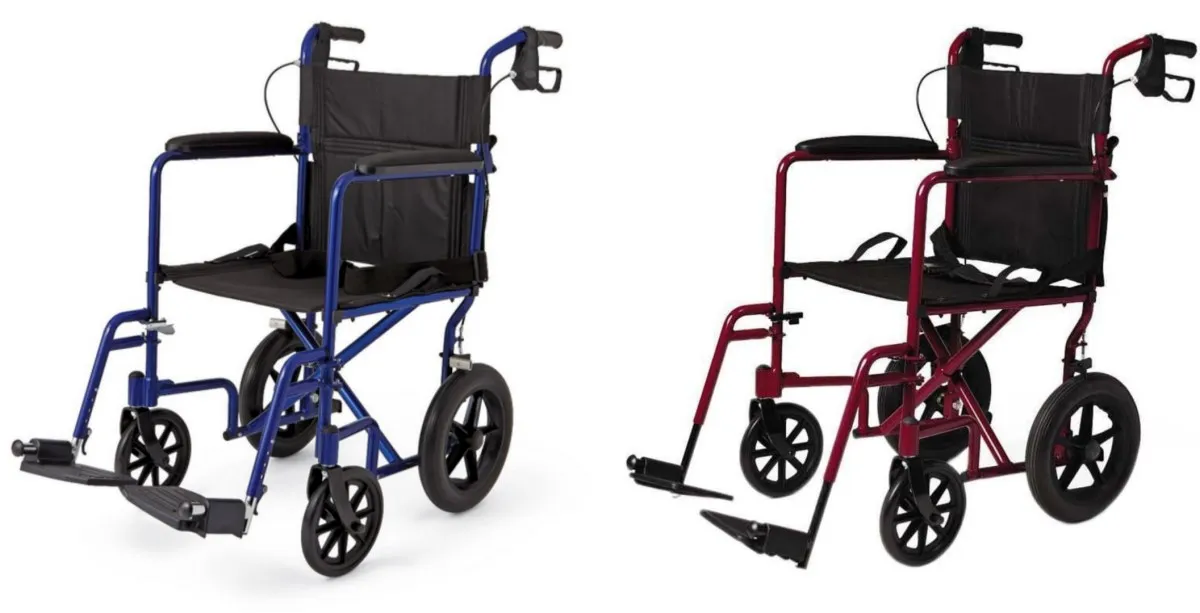
This is the chair that earns its keep in parking lots, hospital corridors, and clinic ramps.
At 23.5 lb without footrests, it’s lighter than most competing transport chairs in its class. Carex’s comparable model weighs 25 lb. That 1.5 lb gap sounds trivial at first. Put a 70-year-old caregiver in front of an SUV trunk, lifting it in and out three times in one day. That gap stops feeling trivial fast.
The bigger differentiator is the 12″ rear wheels. Most budget transport chairs run 8″ casters. Eight-inch wheels perform fine on polished hospital floors. On cracked sidewalks, asphalt parking lots, or grass between the car and the clinic entrance? They catch, sink, and jolt. Twelve-inch wheels roll over those same surfaces with real smoothness you can feel.
Capacity: 300 lb. Practical real-world ceiling: 270–280 lb. Factor in oxygen equipment, bags, and a safety buffer of 10–20%. Your person weighs 290 lb and carries gear? You’re already near the edge. Step up to a Medline bariatric transport instead.
Price: Around $170 — about $20 more than entry-level competitors. The larger wheels explain the difference.
Best fit — Scenario 1: Patient weighs 180 lb. Uses a walker at home but needs a chair for long hospital halls and parking lots. Caregiver needs hand brakes on ramps. This chair was built for that day.
The Medline Ultralight Transport: For the Occasional Outing, Not the Everyday Grind
The Ultralight exists for one specific situation. The caregiver is small. The car trunk is tight. The chair goes out once or twice a week — not every day.
The lighter frame comes from thinner aluminum tubing. That’s the honest trade-off. Thinner tubing means less weight to lift. It also means more flex under load, and that flex grows as users get closer to the 250–300 lb range. For a 160 lb person going to church on Sunday, that flex is a non-issue. For a 270 lb person pushing through rough sidewalks six days a week, it’s a problem that builds over months.
Think of the Ultralight as a travel chair, not a primary mobility device. It works best under three conditions:
-
Outings are occasional
-
Surfaces are smooth
-
User weight stays well below the rated capacity
All three conditions in place? It delivers on every promise.
Best fit — Scenario 2: Older spouse caregiver with limited lifting strength. Patient weighs 160 lb. Outings happen once or twice a week. Frame flex at this weight is not a clinical concern. The lighter lift protects the caregiver — and that matters.
The Medline Standard Lightweight Manual Wheelchair: For Users Who Drive Themselves
The person in the chair has enough upper-body strength to push, even part of the time. That changes everything. Large 24″ rear wheels with hand rims replace the small casters of a transport chair. The user can move on their own.
Standard Medline manual wheelchairs run 32–38 lb with legrests. That’s about 10 lb heavier than a transport chair. You feel that difference when loading the car. Some families solve it with a two-chair setup — a self-propelled Medline for home use, plus a lighter Ultralight transport for car trips. Two chairs, two jobs. It’s a practical approach worth considering.
Seat width options — 16″, 18″, 20″, 22″ — and 24″ rear wheels mean a standard 18″ seat chair runs about 26–27″ total width . That clears a 30″ doorway. Just barely. Measure your doorways first.
Best fit — Scenario 4: Stroke survivor, 190 lb, one functional arm, wants some independence at home. A 16″ or 18″ seat Medline manual wheelchair lets them push through familiar rooms. On car days, the family pulls out the lighter transport. Two chairs, two jobs, zero frustration.
Medline Bariatric Wheelchairs: For Users Beyond Standard Capacity
Standard Medline transport and manual chairs are rated to 300 lb. Good clinical practice keeps the total user weight — person plus equipment — at least 10–20% below that ceiling. Users in the 300 lb range with gear, or anyone above 300 lb, need more than a standard chair. That’s a hard line.
Medline bariatric models are rated at 400–500 lb, with seat widths of 22″, 24″, and sometimes 26″. The frames are heavier. Manual bariatric chairs often run 45–60 lb. Bariatric transports come in around 35–45 lb. That weight makes regular car transfers impractical. Most facilities assign bariatric Medline chairs to specific exam rooms or floors rather than loading them into vehicles on a regular basis.
Best fit — Scenario 5: Non-ambulatory patient, 360 lb, needs a chair for transfers between bed, bathroom, and imaging. A standard 300 lb Medline transport isn’t just undersized — it’s a safety risk. A bariatric transport rated at 400–500 lb, with caregiver-controlled push handles, is the right call here. There’s no practical alternative.
Quick-Reference: Which Medline Type Fits Your Situation
|
Situation |
Best Medline Type |
Key Reason |
|---|---|---|
|
Clinic visits, parking lots, ramps |
Lightweight Transport (12″ wheels) |
Larger wheels handle uneven surfaces |
|
Older caregiver, occasional outings |
Ultralight Transport |
Lightest lift weight; occasional use acceptable |
|
User wants to self-propel at home |
Standard Lightweight Manual |
24″ hand-rim wheels enable independent propulsion |
|
User + gear approaches or exceeds 300 lb |
Bariatric Transport or Manual |
400–500 lb rated capacity required for safety |
The right Medline wheelchair doesn’t just fit the person. It fits the day they live — the surfaces, the caregiver’s strength, the trunk space, the doorways. Get that match right, and the chair becomes invisible. Get it wrong, and you notice it every single time.
Comfort and Daily Use Details That People Often Ignore
Small things break a wheelchair experience. Not the big, obvious problems — the wrong weight capacity or a frame that won’t fold. The quiet ones. They build up over a full day. The person in the chair keeps shifting. The caregiver’s back starts aching. And no one can quite name why.
Check these details before you finalize any Medline wheelchair purchase .
Seat Pressure and Posture Over Time
A wheelchair seat isn’t a couch. It’s a surface someone sits on for hours, and the body notices every imperfection.
Seat edge pressure at the back of the knee is the most common problem people miss. A seat that runs too deep presses the front edge into the soft tissue behind the knee — the popliteal area. Blood flow slows. Legs go numb. The user shifts forward, loses back support, and starts slumping. It takes over 30 to 45 minutes. That slow pace is why most people don’t catch it early.
The fix is simple. Check that two to three fingers fit between the seat edge and the back of the user’s knee while seated upright.
Wrong armrest height makes things worse. Armrests set too high force the shoulders to shrug all day. Too low, and the user leans sideways for support. Both positions push stress into the neck and upper back — the same thing that happens with a badly set office chair, and just as easy to miss.
The Footrest Detail Nobody Checks Until It’s a Problem
Medline wheelchair footrests sit about two inches off the floor. That gap works fine on smooth surfaces.
Carpet transitions and thick area rugs are a different story — both are common in homes. A footplate that clears hardwood flooring can catch on a thick rug edge and jolt the chair mid-roll. Before the wheelchair arrives, walk the full route — bedroom to bathroom to living area — and note every floor transition. Low-pile rugs are manageable. Thick shag or raised door thresholds are real obstacles. Deal with those before the chair shows up.
Cushion Compatibility: Don’t Assume It’s Included
Standard Medline wheelchairs come with a sling-style nylon seat. It works, but it’s not built for long hours of sitting. Users spending more than two to three hours per day in a chair need a pressure-relief cushion. It’s not optional at that point.
Medline wheelchair cushion compatibility comes down to seat width. A cushion made for an 18″ seat won’t fit right in a 20″ frame. It shifts, bunches up, and creates the exact pressure points you’re trying to avoid. Check seat width before ordering a cushion.
-
Gel and foam hybrid cushions work well for most home users.
-
Full air cushions spread pressure better but need regular inflation checks — a step that’s easy to forget.
Armrest and Footrest Adjustability: Worth Confirming Before You Buy
Medline wheelchair armrests come in two setups: fixed and desk-length (flip-back). Desk-length armrests swing out of the way. That makes side transfers — from wheelchair to bed or to a toilet seat — much easier and safer. Fixed armrests stay put. Users who transfer on their own or with minimal help should go with desk-length. It’s the safer choice.
Swing-away footrests work the same way. They pivot to the side so the user can stand straight from the chair without stepping over a footplate. For anyone with some remaining standing ability, swing-away footrests cut fall risk during transfers. Double-check that this feature is included — not every Medline model has it.
These aren’t extras. They’re the details that decide whether life with a wheelchair stays workable — or turns into the hardest part of every single day.
Where to Buy Medline Wheelchairs?

Your options break into four main channels. Each comes with a real trade-off.
Walmart, Walgreens, and Home Depot are the easiest starting points. Medline manual wheelchairs run $180–$350. Transport chairs cost between $120–$250. Many locations offer BOPIS — buy online, pick up in store. You skip the shipping damage risk and inspect the chair before taking it home.
DME e-commerce specialists like 1800wheelchair.com and Easy Medical Store tend to carry the lowest prices on Medline K1 and K4 models. Base configurations can hit $180–$220. Free shipping kicks in over $59 on most of these sites. Bookmark both before you decide.
MedlineDirect — the manufacturer’s own site — is your best source for the full spec sheet, current SKU lineup, and warranty documents. In-stock models ship within three to seven business days.
Local DME dealers are the right call in two situations: you need insurance or Medicare reimbursement, or the user has specific fitting needs. A local dealer can measure seat width, adjust footrest length, and swap arm styles right there. Online retailers can’t do any of that.
Conclusion

Choosing a wheelchair for home use isn’t complicated. But you do need to ask the right questions before you click “buy.”
Get the measurements wrong. Overlook the weight capacity. Mix up a transport chair with a self-propelling model. Any of these mistakes means two weeks dealing with returns — not settling into your home.
Medline wheelchairs earn their place in home care for good reason:
-
Reliable construction
-
A range of sizes to fit different needs
-
Price points that won’t break the bank
But the right Medline wheelchair fits your doorways, your routine, and your body — not just the one with the best reviews.
So take the measurements. Think through how you’ll use it. Let that guide your choice.
Ready to find your match? Browse our Medline wheelchair recommendations and compare the models that matter most for home use — all in one place.





