
At first glance, a newsboy cap and a flat cap look almost the same. Both are vintage. Both carry a British feel. Both are the kind of hat that makes an outfit look deliberate, not thrown together.
But spend time around serious hat wearers, and you’ll see that mixing them up is like confusing a blazer with a sport coat. Easy to do — but it shows. The differences in structure, silhouette, and the subtle signals each hat sends matter more than most people expect.
Drawn to the fuller, paneled crown of the baker boy cap? Or the sleek, close-cut profile of a classic flat cap? Knowing what sets them apart changes how you shop. It also changes how you wear them.
Newsboy Cap vs Flat Cap: 5 Key Differences
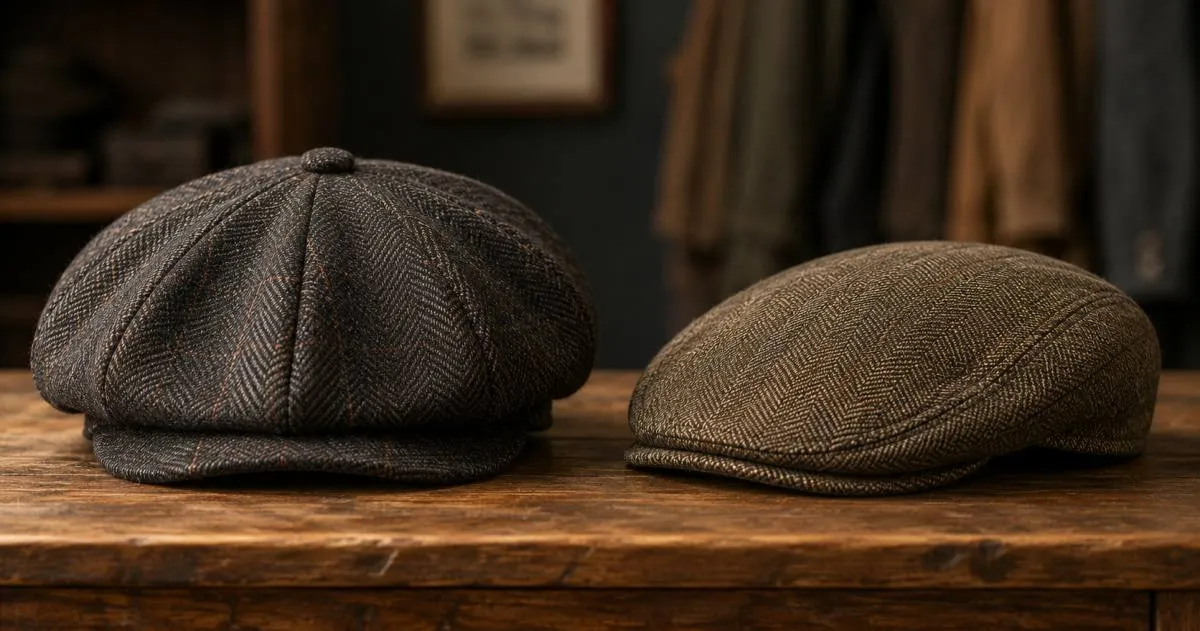
The structure tells the story. Set both caps on a table side by side. The differences stop being subtle fast — they become obvious, almost like two opposing arguments. Five things separate them, and each one matters.
1. Crown Volume & Shape
This is the one you notice first. It’s not even close.
The newsboy cap crown starts with 6 to 8 triangular wedge panels. Each panel gets stitched from the center outward. That construction pushes the fabric up and out. The result is a full, round, puffy dome — a silhouette that takes up space and owns it. You’ll see visible bagginess at the sides. That’s not a flaw. That’s the point.
The flat cap works the opposite way. Its crown uses one, two, sometimes three panels, cut to follow the natural curve of the skull. Those panels attach straight to a stiffened brim. The cap sits low, flat, and close to the head. From the side, the whole thing reads as one lean line from back to front. No dome. No drama. Just a clean, quiet profile.
Two hats. Two different ideas about how much space you want to claim.
2. Panel Count & the Top Button
Flip either cap over. The construction gives it away fast.
The newsboy cap has radial seams running out from a central point — think of a pizza cut into eight slices. All those seams meet at the top, where a fabric-covered button sits. That button isn’t just decoration. It’s structural. It holds the panels together and keeps the crown’s rounded shape intact. No button, no dome.
The flat cap has no top button. It uses fewer panels — often just one or two across the crown. The seams run along the sides and back instead of spreading from the center. The top surface stays smooth and clean. No hardware. Nothing breaks the line.
Not sure which hat you’re looking at? Check for the button. That answers it.
3. Fit Profile on the Head
Same head. Very different feel.
A newsboy cap gives you more interior room. The multiple seams act as flex points. They spread pressure out and adjust to small differences in head shape. Wear it with the band sitting about an inch above the brows. The crown rises into its rounded shape, and the sides may brush the tops of your ears. The hat feels generous, forgiving, lived-in.
A flat cap needs more precision. Fewer seams, less extra fabric — so there’s less room for sizing error. Too tight, and you feel it by mid-afternoon. Too loose, and a strong gust reminds you. A good fit means the cap sits snug and still, tracing the shape of your head. The fabric above the brim stays taut. Nothing flops. Nothing shifts.
Here’s a simple way to think about it: the newsboy cap forgives. The flat cap rewards accuracy.
4. Brim Interaction & Edge Line
Both caps share the same short, forward-facing brim. The difference is how the crown connects to it.
On a newsboy cap, the fuller crown hangs over the brim. The fabric puffs out a bit above the visor edge. Wearers often call these puffy edges — there’s a softness where the crown and brim meet. That break line between crown and brim looks relaxed, almost draped. The extra crown fabric also catches the wind easily, so the hat shifts a little in a strong gust.
On a flat cap, the crown pulls tight down to the brim. The edge line is sharp and clean, with almost no overhang. Less surface area means less wind resistance and more stability. Some flat caps add a front snap or button to lock the brim to the crown. Wear it unsnapped, and the fit loosens — the look suffers too.
Same basic brim. Totally different relationship with it.
5. Stylistic Role & Visual Effect
This is where construction becomes culture.
The newsboy cap — baker boy cap , Gatsby cap, eight-panel cap, call it what you want — works as a statement piece. Its volume reads from across a room. It signals vintage, heritage, and intention. Peaky Blinders put this silhouette on television, and a generation of men saw exactly what it could do. Put one on, and you’re not just adding to an outfit. You’re building it around the hat.
The flat cap — ivy cap, cabbie hat, scally cap, driving cap — works differently. Its profile sits closer to a modern baseball cap than most people expect. That makes it easier to pair across a wide range of looks, from sharp tailoring to relaxed weekend wear. It’s sleek rather than bold, refined rather than theatrical. The flat cap doesn’t compete with your outfit. It completes it.
One hat asks to be noticed. The other just fits in — and somehow that’s enough.
At a Glance — The 5 Differences
|
Newsboy Cap |
Flat Cap |
|
|---|---|---|
|
Crown Shape |
Full, round, puffy dome |
Flat, low, streamlined |
|
Panel Count |
6–8 wedge panels |
1–3 panels |
|
Top Button |
Yes — fabric-covered, structural |
No |
|
Fit Feel |
Generous, forgiving |
Snug, precise |
|
Brim Edge |
Soft overhang, puffy edges |
Clean, tight, minimal overhang |
|
Style Role |
Bold statement, retro focal point |
Sleek everyday, easy to pair |
Which Cap Should You Choose: Newsboy Cap or Flat Cap?
Two questions settle this fast: what does your face look like, and what are you going to wear this hat with?
Neither cap is the better one. They’re built for different jobs, different silhouettes, different purposes. Figure out which one fits your life. It takes about thirty seconds once you know what each cap does.
Match the Cap to Your Style Goal
The flat cap — ivy cap, cabbie hat, driving cap — blends into a well-dressed outfit the way a good watch does. It doesn’t draw attention. Wear it with a blazer, a wool overcoat, or tailored trousers. It looks considered without being showy. You want headwear that moves between smart-casual and business-casual without much effort? This is the one. It doesn’t demand much from the rest of your outfit.
The newsboy cap works the other direction. The puffed crown, the visible panel seams, the baker boy silhouette — these are not background details. They pull focus. Put one on with raw denim, a waxed cotton jacket, or a chunky cable knit. The hat becomes the point of the outfit. That’s not a flaw. That’s the whole idea. You’re drawn to vintage, heritage, or retro-workwear aesthetics? The eight-panel cap belongs in that wardrobe.
Match the Cap to Your Face
This part matters more than most style guides admit.
Round or wide face : The flat cap’s low, close-fitting crown keeps things in proportion. A puffed newsboy crown adds width — that’s not what a round face needs. You prefer a newsboy? Look for styles with a firmer, less exaggerated crown.
Long or narrow face : The newsboy cap adds height and width across the crown. That helps balance a longer face. The flat cap works too, but wear it pulled forward. Stay away from ultra-low, tight profiles — they stretch the face further down.
Small frame or small head : Go with the flat cap. A full newsboy crown can overpower a smaller frame. It takes over the look instead of completing it.
Broad shoulders or larger build : The newsboy cap holds up well here. The bigger crown matches body proportions in a way a flat cap often can’t.
The Three-Step Decision
Still unsure? Run through this:
-
Style direction — Subtle and easy to pair? Flat cap. Vintage and expressive? Newsboy cap.
-
Face shape — Round or wide? Go flat. Long or narrow? Go newsboy.
-
Outfit context — Tailoring and smart-casual? Flat cap is the safer call. Denim, casual jackets, heritage looks? Newsboy fits right in.
Three questions. One clear answer.
How to Wear a Newsboy Cap and Flat Cap

The cap is already doing half the work. Your job is not to overthink the other half.
Both the newsboy cap and flat cap reward one thing above everything else: a fit that disappears. Get that right first. Everything else — the angle, the outfit, the season — falls into place on its own.
Get the Fit Right Before Anything Else
Measure your head circumference about half a centimeter above the ear and across the middle of the forehead. Order from that number. Then run two checks once the cap arrives.
The finger test. Slip one finger between the sweatband and your forehead. One finger means right. Zero fingers means too tight. Two fingers means too loose. Simple as that.
The turn test. Turn your head left, then right — fast. The cap shifts more than half an inch? Size down or add sizing tape. A cap that moves reads wrong. Doesn’t matter how good it looks in the mirror, standing still.
One detail worth knowing for the newsboy cap: even half a size too large makes the eight-panel crown go floppy and shapeless. The volume holds up only when the structure does.
How Each Cap Sits?
Newsboy cap: Band about an inch above the eyebrows. Brim angled to shade the eyes without pressing down. The sides should drape to just above the tops of the ears — not collapse flat against them. From there, small adjustments change the whole read. A zero-to-ten degree tilt keeps things clean and conservative. Push it ten to twenty degrees sideways, and the baker boy cap picks up character fast. Both work. Neither is wrong. Don’t push it back more than two or three centimeters behind your natural hairline. It starts to look perched rather than worn.
Flat cap: Brim forward. Hatband sits snug across the entire forehead with no gaps at the temples. Curve the brim into a soft arc that follows your brow line. Use light pressure. No sharp bends — those leave creases that don’t come out. The cap has a front snap? Keep it snapped. Leaving it unsnapped is one of those small details that separates someone who knows flat caps from someone who just bought one. Do not wear it backwards. That experiment was tried and settled long ago.
Dress Around the Cap, Not Against It
The flat cap’s low profile means contrast does real work here. With a tweed flat cap, avoid pairing it with a jacket in an almost-but-not-quite matching color. A navy cap against a slightly off navy suit looks like a mistake. Either match dead-on — a full tweed suit with a matching flat cap looks genuinely sharp — or go for clear contrast. Start with neutrals: black, brown, grey, navy. They work across every situation without any effort on your part.
The newsboy cap needs modern clothing to stay in proportion. A stylish jacket with designer jeans or tailored trousers, a casual modern-cut suit — these work. Pair a newsboy with full vintage-style tweed suits and antique accessories, and the whole look tips into costume territory. The hat carries enough heritage on its own. Keep the clothes around it present-day.
One rule covers both caps: don’t stack vintage signals. Cap plus braces plus bow tie plus waistcoat reads as a costume set. Let the hat be the period detail. Let everything else breathe.
Season and Fabric
The newsboy cap belongs in fall. Mild, cooler weather is its home — not deep winter, not summer. You can stretch it into winter if the cold stays moderate. In the bitter cold, it’s out of its depth. In real heat, it becomes a problem you brought on yourself.
Flat cap fabric by season is straightforward: linen and lightweight cotton for spring and summer, wool tweed and heavier cotton for fall and winter. Wool flat caps in summer cause overheating and sweat stains. The fabric wasn’t built for that. Respect its limits.
A Quick Do / Don’t Reference
Do:
– Use the finger test and the turn test before wearing it out
– Choose neutral colors first — they pair with almost everything
– Match fabric weight to the season
– Pair a newsboy cap with modern clothing to balance the vintage crown
Don’t:
– Wear a flat cap backwards or with the front snap undone
– Go even half a size large on a newsboy — the crown loses its shape completely
– Wear wool caps in summer heat
– Pile on vintage accessories; the cap is already making a statement
FAQ: Common Questions About Newsboy Caps and Flat Caps
Browse any hat shop — or scroll through a forum — and the same questions keep coming up. Here are the ones that actually need a straight answer.
Can women wear these caps too?
Yes. These caps started as standard menswear. Now, both styles look fantastic on anyone. A simple flat cap adds a sharp edge to a jeans-and-tee outfit. And the newsboy cap? It brings a fun, oversized vintage vibe. This style pairs well with casual fall coats. Skip traditional gender labels. Just find a size that fits your head.
How on earth do I clean them?
Never put your cap in the washing machine. This ruins the stiff brim and shrinks the wool. Use a lint roller for regular dust. Got a stain? Clean the area with a damp cloth and mild soap. Let it air dry. I suggest resting it on a small round bowl. This trick maintains the crown shape during drying.
Are they easy to pack in a suitcase?
The flat cap makes a great travel buddy. It has low volume and lies flat. Tuck it between your folded sweaters. The newsboy cap requires more care. It features a puffy dome shape. Heavy luggage can crush it and cause stubborn creases. Must pack it? Stuff the inside with rolled-up socks first. This supports the crown.
Conclusion
Both caps tell a story — it just depends on which one is yours to tell.
The newsboy cap brings volume, personality, and that devil-may-care swagger. Flat caps weren’t built to carry that kind of energy. The flat cap offers something different: restraint. Clean lines. Quiet confidence. It disappears into an outfit and lifts it at the same time.
You now know the difference — the panels, the silhouette, the heritage behind each brim. So the choice isn’t really about “which is better.” It’s about who you are when you put it on .
Ready to find yours? Explore Morntrip ‘s collection of handcrafted newsboy caps and tweed flat caps. Try one on. Walk out the door. See how the city looks from underneath a hat that fits your story.
That’s the whole point, isn’t it?





