
Sourcing the right cleanroom disposable coverall in Germany is not only a purchasing decision. For pharmaceutical, biotechnology, medical device, semiconductor, electronics, laboratory, and precision manufacturing environments, cleanroom PPE directly affects contamination control, audit readiness, operator comfort, and production stability.
However, buyers should be careful with one common misunderstanding: not every disposable coverall is suitable for cleanroom use, and not every Germany-listed supplier is a direct manufacturer. Some companies manufacture cleanroom garments. Some distribute global cleanroom PPE brands. Others provide cleanroom consumables, sterile apparel systems, or B2B supply channels.
This guide reviews 8 cleanroom disposable coverall manufacturers, suppliers, distributors, and brands relevant to German cleanroom PPE buyers. It also explains how to evaluate ISO and GMP suitability, sterile and non-sterile options, materials, documentation, supplier type, and OEM sourcing alternatives.
Note: In this article, “ISO certified cleanroom PPE” refers to cleanroom PPE used in ISO-classified or ISO-certified cleanroom facilities. Final garment selection should always follow the facility’s contamination control strategy, risk assessment, gowning SOP, cleanroom classification, and applicable regulatory requirements.
What Is a Cleanroom Disposable Coverall?

A cleanroom disposable coverall is a single-use full-body garment designed to reduce contamination from personnel entering controlled environments. Unlike a basic industrial dust suit, a cleanroom coverall is selected to help control particles, fibers, lint, skin flakes, hair, and microbial contamination that may be released by the wearer.
Cleanroom disposable coveralls are commonly used in pharmaceutical manufacturing, biotechnology facilities, medical device production, electronics assembly, semiconductor cleanrooms, laboratories, and other ISO-classified cleanroom environments. Their purpose is not only to protect the wearer, but also to protect the product, process, and cleanroom environment.
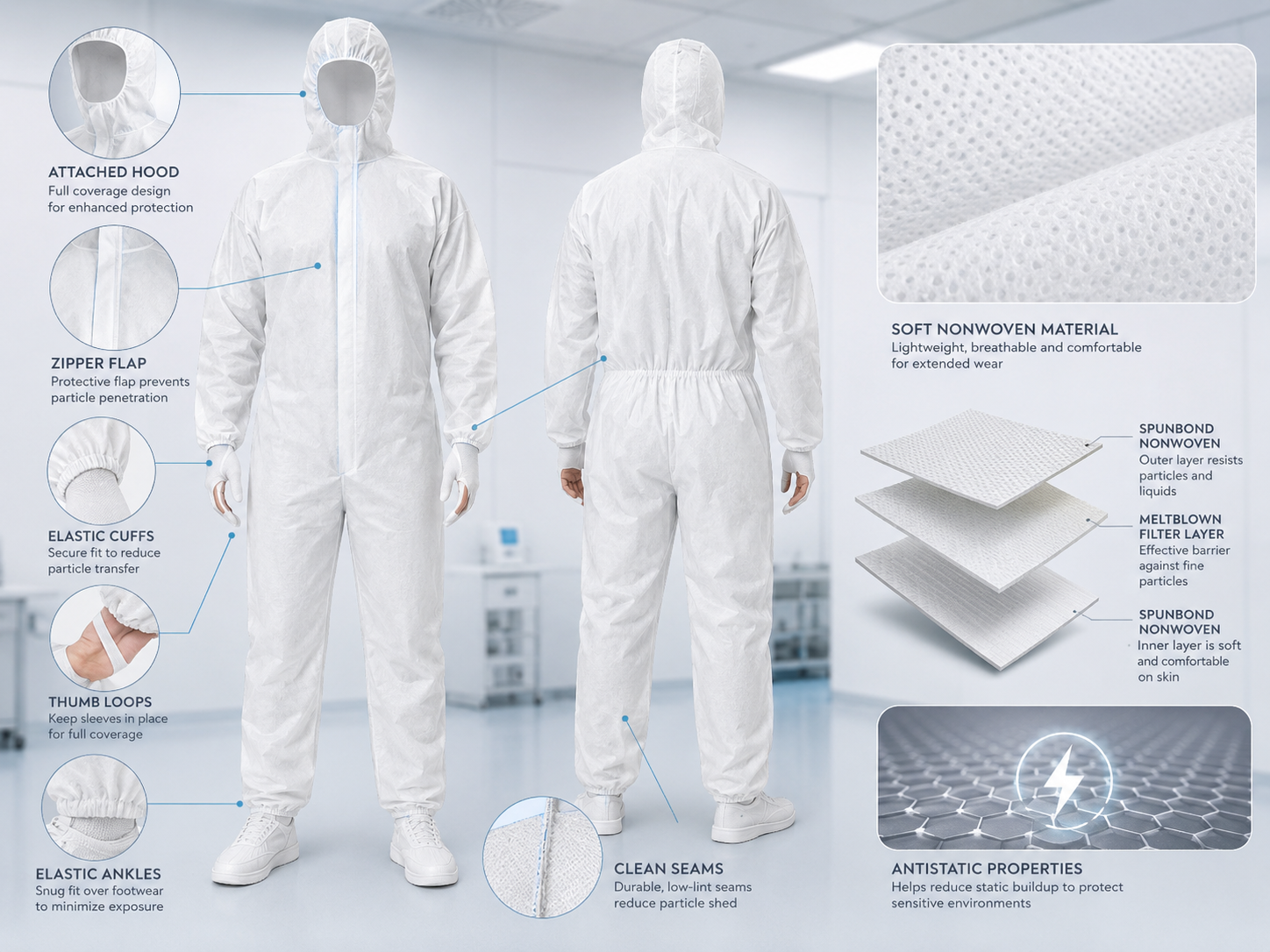
A typical cleanroom disposable coverall may include:
Full-body coverage for torso, arms, and legs
Attached hood or collar depending on the cleanroom grade
Elastic or knitted cuffs
Elastic ankles or integrated boots
Front zipper with protective flap
Thumb loops to keep sleeves in place
Low-lint or low-particle-shedding materials
Cleanroom-compatible packaging
Sterile or non-sterile options depending on the application
Because the human body is a major contamination source in cleanrooms, disposable cleanroom coveralls are often used for visitors, contractors, temporary workers, high-risk tasks, sterile processes, or facilities that do not operate a validated reusable garment laundry program.
Cleanroom Disposable Coverall vs Regular Disposable Coverall
A regular disposable coverall and a cleanroom disposable coverall may look similar, but they are not the same product. A regular industrial coverall may provide basic dust protection, light splash resistance, or Type 5/6 protection, but it may not have cleanroom particle-shedding data, cleanroom packaging, sterile processing, or suitability for ISO-classified environments.
For cleanroom buyers, the key question is not simply whether the coverall is “protective.” The real question is whether the garment is suitable for contamination control in the specific cleanroom class, GMP grade, process risk, and gowning system.
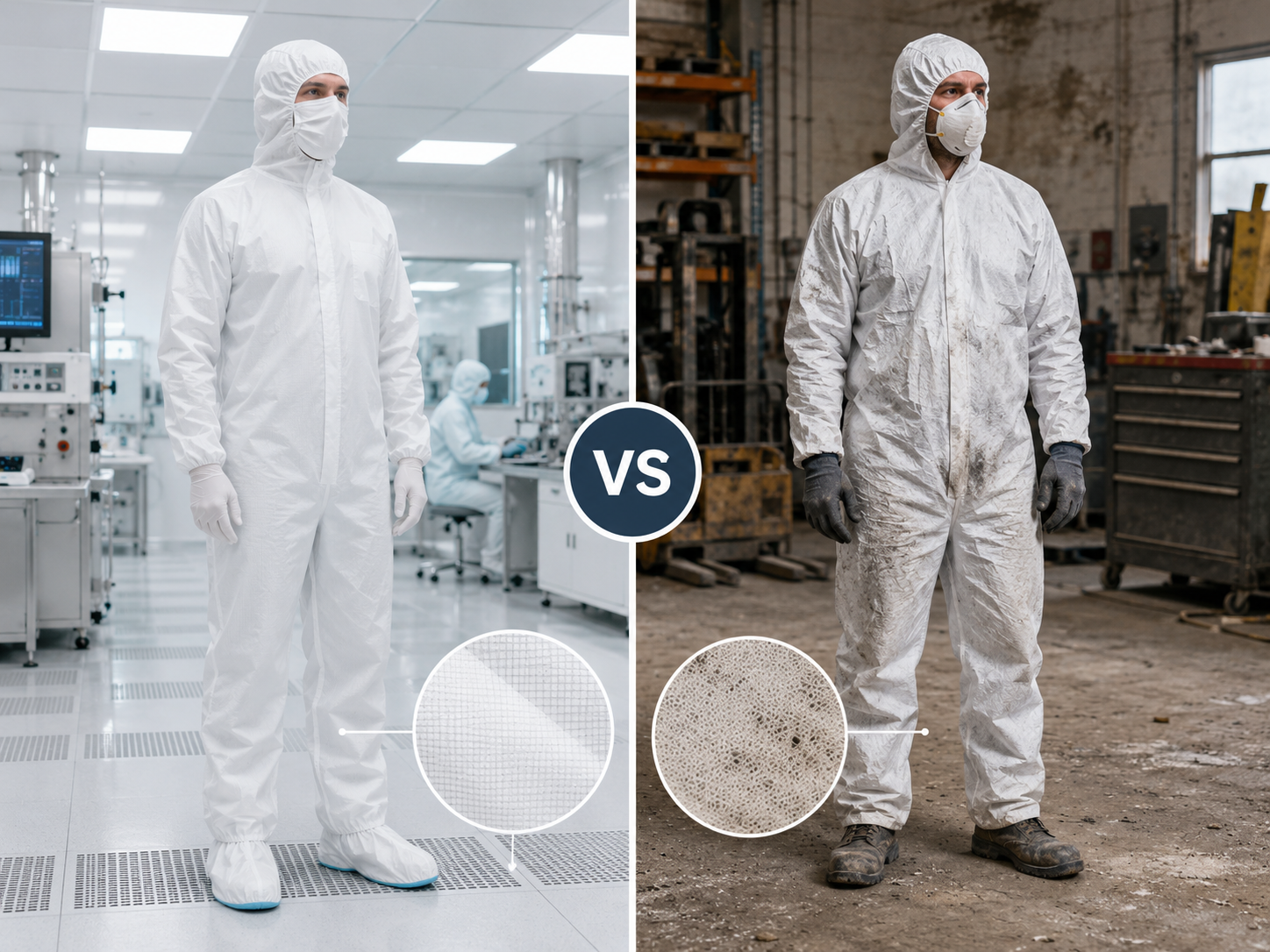
Comparison Point | Cleanroom Disposable Coverall | Regular Disposable Coverall |
|---|---|---|
Main Purpose | Contamination control in cleanrooms and controlled environments | General dust, dirt, splash, or industrial protection |
Particle Control | Low-lint or low-particle-shedding material may be specified | Particle shedding often not validated for cleanroom use |
Cleanroom Suitability | May indicate suitability for specific ISO classes or GMP grades | Usually no cleanroom class suitability statement |
Sterility | Sterile and non-sterile options may be available | Usually non-sterile unless clearly stated |
Packaging | May be individually packed, cleanroom packed, sterile packed, or double-bagged | Often bulk packed for general industrial use |
Typical Applications | Pharma, biotech, medical device, semiconductor, electronics, laboratory cleanrooms | Maintenance, painting, cleaning, construction, general industrial work |
Before approving a garment for cleanroom use, buyers should review the exact product datasheet, material structure, packaging method, sterility status, particle-control information, and supplier documentation. If the product has no cleanroom suitability information, it should not be assumed to be a cleanroom disposable coverall.
Why Germany Is a Key Market for Cleanroom Disposable Coverall Sourcing
Germany is one of the most important cleanroom PPE markets in Europe because of its strong pharmaceutical, biotechnology, medical device, laboratory, semiconductor, optics, automotive electronics, and precision manufacturing sectors. These industries often operate ISO-classified cleanrooms, GMP-controlled areas, or controlled environments where contamination control is critical.
German cleanroom buyers usually expect more than a simple product brochure. They often need clear technical documentation, lot traceability, sterile or non-sterile packaging information, cleanroom suitability data, and reliable supply channels. This is especially important for pharmaceutical and medical device buyers, where cleanroom garments may be reviewed as part of a broader contamination control strategy.
At the same time, the German market includes different supplier types. Some are Germany-based cleanroom garment manufacturers. Some are cleanroom PPE distributors. Some are B2B cleanroom product suppliers. Some carry global brands such as Ansell BioClean, DuPont Tyvek IsoClean, Kimtech, or Lakeland CleanMax. Buyers should understand this supplier structure before comparing prices or placing bulk orders.
Top 8 Cleanroom Disposable Coverall Manufacturers and Suppliers in Germany
The following list is a sourcing reference for global buyers comparing cleanroom disposable coverall manufacturers and suppliers in Germany. It is not an absolute ranking, and not every company listed is a direct disposable coverall manufacturer. Some are cleanroom garment manufacturers, some are Germany-based PPE suppliers, and some are global cleanroom PPE brands available through German or European supply channels.
Company or Brand | Recommended Positioning | Buyer Verification Focus |
|---|---|---|
Dastex Group GmbH | Germany-based cleanroom garment manufacturer and contamination-control supplier | Disposable coverall range, sterile options, cleanroom processing, Helmke Drum data, export support |
DACH Schutzbekleidung | German protective clothing brand and cleanroom PPE supplier | Cleanroom suitability, antistatic performance, product category, material, packaging |
Franz Mensch GmbH | German PPE and hygiene supplier with cleanroom clothing options | Own-brand vs distributed products, sterile/non-sterile options, material and bulk supply ability |
IAB Reinraum-Produkte | German cleanroom products supplier and distributor | Brand origin, ISO/GMP suitability, sterile packaging, lot traceability, documentation support |
HEIN Reinraum | German B2B cleanroom supplier for ISO and GMP apparel | Specific product model, cleanroom class, sterile availability, packaging and datasheets |
Spetec GmbH | German cleanroom technology and accessories supplier | Disposable clothing options, product source, cleanroom compatibility, supplier role |
Ansell BioClean | Global sterile cleanroom PPE brand available through German supply channels | Exact model, sterile certificate, packaging, lot number, expiry date, local distributor access |
Lakeland CleanMax | Disposable cleanroom coverall brand serving European cleanroom buyers | ISO class suitability, sterile/non-sterile configuration, material, size range, supply channel |
1. Dastex Group GmbH
Dastex Group GmbH is one of the strongest Germany-based candidates for cleanroom garment sourcing. The company is relevant because it focuses on cleanroom garments, contamination control, disposable clothing, protective apparel, and cleanroom consumables.
For buyers looking for cleanroom disposable coveralls in Germany, Dastex is worth reviewing because it offers disposable overalls and coveralls, including products that may have PPE certifications, cleanroom processing, sterile or non-sterile options, and particle-emission testing depending on the exact model.
Best for: Pharmaceutical, biotech, medical device, electronics, laboratory, and cleanroom buyers who need a Germany-based cleanroom garment specialist.
Buyers should verify: exact disposable coverall model, sterile or non-sterile status, cleanroom class suitability, Helmke Drum or particle data, packaging format, lot traceability, and whether the product is stocked, distributed, or manufactured directly.
2. DACH Schutzbekleidung
DACH Schutzbekleidung is relevant to cleanroom PPE buyers because it offers protective clothing and cleanroom-related products for controlled environments. Its cleanroom product range includes items such as cleanroom hoods, gowns, protective suits, boots, and contamination-control apparel.
For cleanroom disposable coverall sourcing, DACH should be positioned as a German protective clothing brand and cleanroom PPE supplier rather than automatically described as a direct disposable coverall manufacturer . Some of its products may be more focused on cleanroom accessories, gowns, or protective clothing systems, so buyers should check the exact product type carefully.
Best for: Buyers looking for cleanroom protective clothing, antistatic cleanroom garments, and PPE options for controlled environments.
Buyers should verify: whether the selected product is a cleanroom disposable coverall, whether it has cleanroom class suitability, material details, antistatic performance, packaging information, and applicable EN or PPE documents.
3. Franz Mensch GmbH
Franz Mensch GmbH is a German supplier and manufacturer in the broader protection, hygiene, and packaging market. Its portfolio includes disposable products, protective clothing, hygiene supplies, and cleanroom-related apparel options.
For cleanroom disposable coverall buyers, Franz Mensch may be useful as a German PPE and hygiene supplier with access to cleanroom clothing, disposable garments, sterile and non-sterile protective apparel, and related consumables. However, buyers should separate general disposable protective clothing from true cleanroom-compatible coveralls.
Best for: Hygiene distributors, PPE buyers, food and medical support areas, and cleanroom buyers who need a broad disposable PPE sourcing channel.
Buyers should verify: whether the product is designed for cleanroom use, whether it is own-brand or distributed, material structure, packaging type, sterile status, datasheets, and bulk order availability.
4. IAB Reinraum-Produkte
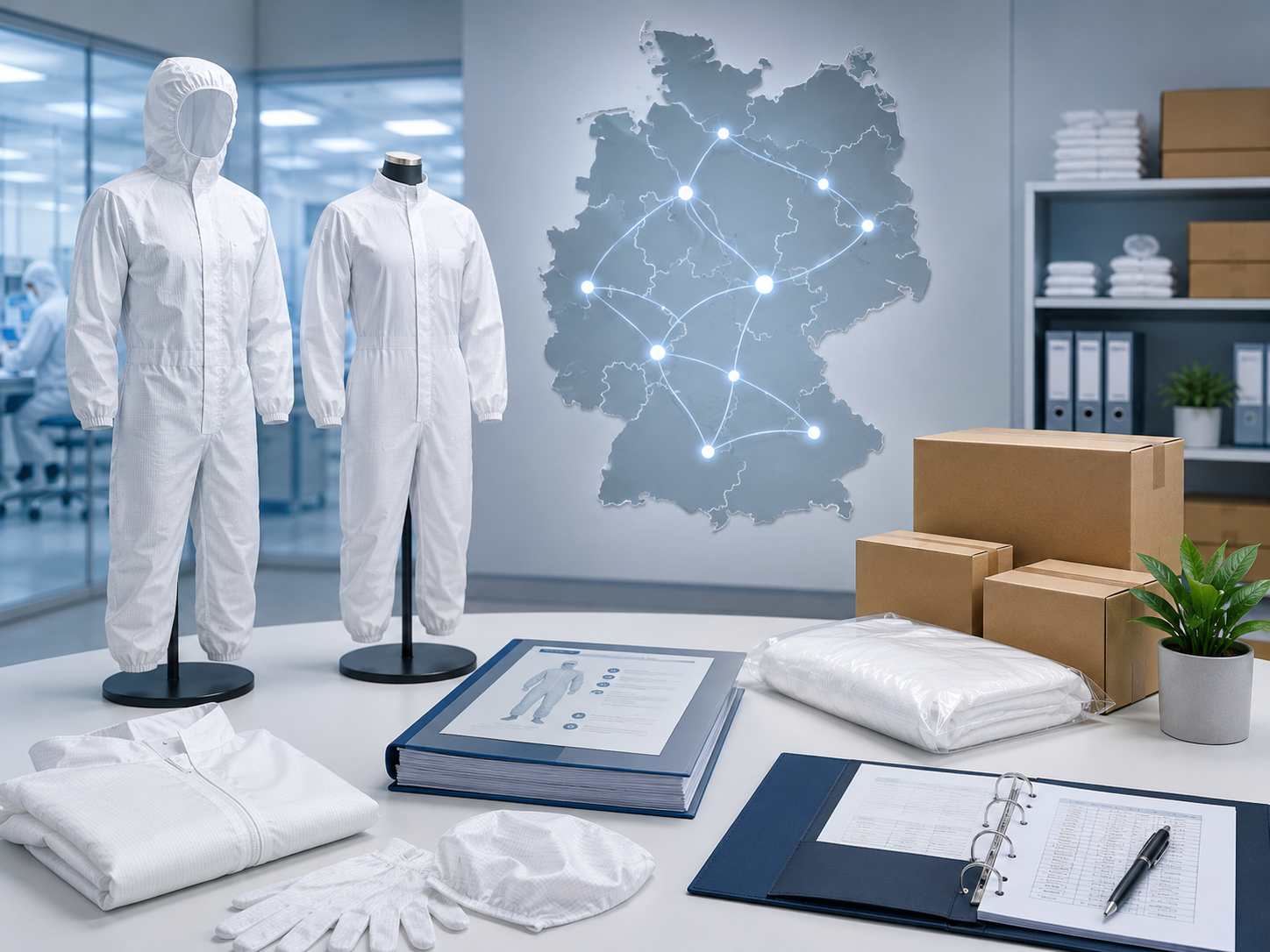
IAB Reinraum-Produkte is a German cleanroom product supplier and distributor. It is relevant for buyers who want access to cleanroom garments, disposable apparel, cleanroom consumables, and brand-specific cleanroom PPE through a German supply channel.
IAB is particularly relevant because it supplies sterile disposable cleanroom coveralls such as BioClean-D models from Ansell. This makes it useful for pharmaceutical, biotech, aseptic processing, medical device, and GMP cleanroom buyers who need sterile disposable cleanroom garments with documentation.
Best for: German and European cleanroom buyers who prefer local distributor access, technical support, and established cleanroom PPE brands.
Buyers should verify: product brand, model number, ISO/GMP suitability, sterile packaging, lot traceability, certificate availability, expiry date, and whether repeat supply is stable.
5. HEIN Reinraum
HEIN Reinraum is a German B2B cleanroom supplier offering cleanroom clothing and related products for different ISO and GMP environments. Its cleanroom apparel range includes overalls, gowns, caps, overshoes, sterile and non-sterile clothing, and disposable or reusable options.
For cleanroom disposable coverall sourcing, HEIN is best treated as a cleanroom B2B supplier rather than only a manufacturer. Buyers can use it to compare ISO/GMP apparel options, sterile and non-sterile coveralls, and cleanroom clothing systems for different cleanroom zones.
Best for: Pharmaceutical, laboratory, electronics, and industrial cleanroom buyers who need a broad cleanroom clothing supplier.
Buyers should verify: exact coverall model, ISO class or GMP grade suitability, sterile status, gamma sterilization information where applicable, packaging format, datasheet, and available size range.
6. Spetec GmbH
Spetec GmbH is a German cleanroom technology and accessories supplier. Its cleanroom accessories range includes disposable clothing, reusable clothing, gloves, hoods, overshoes, mouth protection, and other cleanroom-related items.
Spetec may be useful for buyers who are setting up or maintaining cleanroom environments and need a broader cleanroom consumables supplier. However, disposable cleanroom coveralls may be part of a wider cleanroom accessories portfolio rather than the company’s only product focus.
Best for: Cleanroom project buyers, laboratories, cleanroom operators, and buyers who need clothing together with other cleanroom accessories.
Buyers should verify: whether disposable coveralls are stocked, whether they are cleanroom-compatible, whether they are sterile or non-sterile, and whether technical documentation is available for the specific product.
7. Ansell BioClean
Ansell BioClean is a global cleanroom PPE brand rather than a Germany-based manufacturer. It is included because BioClean sterile disposable cleanroom coveralls are available through German cleanroom supply channels and are highly relevant to pharmaceutical, biotech, medical device, and aseptic manufacturing buyers.
BioClean disposable cleanroom coveralls often focus on sterile protection, low-linting materials, antistatic performance, protective zipper flaps, thumb loops, and controlled packaging depending on the exact model.
Best for: Buyers who need sterile cleanroom coveralls for controlled environments, aseptic processing, pharmaceutical manufacturing, or medical device production.
Buyers should verify: German distributor access, product model, sterile certificate, lot number, expiry date, packaging unit, cleanroom suitability, and whether the garment meets the facility’s gowning SOP.
8. Lakeland CleanMax
Lakeland CleanMax is a disposable cleanroom garment brand serving cleanroom buyers in Europe and other markets. It is relevant because CleanMax disposable cleanroom coveralls are designed for controlled environments and may be available in sterile and non-sterile configurations depending on the model.
CleanMax products may include SMS or microporous material options, attached hoods, attached boots, elastic wrists and ankles, and cleanroom-compatible packaging. This makes the brand useful as a benchmark when comparing cleanroom disposable coverall specifications.
Best for: Buyers comparing disposable cleanroom coveralls for ISO cleanrooms, controlled environments, and industrial or life-science applications.
Buyers should verify: ISO class suitability, sterile or non-sterile configuration, material type, product design, case quantity, size range, distributor availability, and technical documentation.
ISO and GMP Requirements for Cleanroom Disposable Coveralls
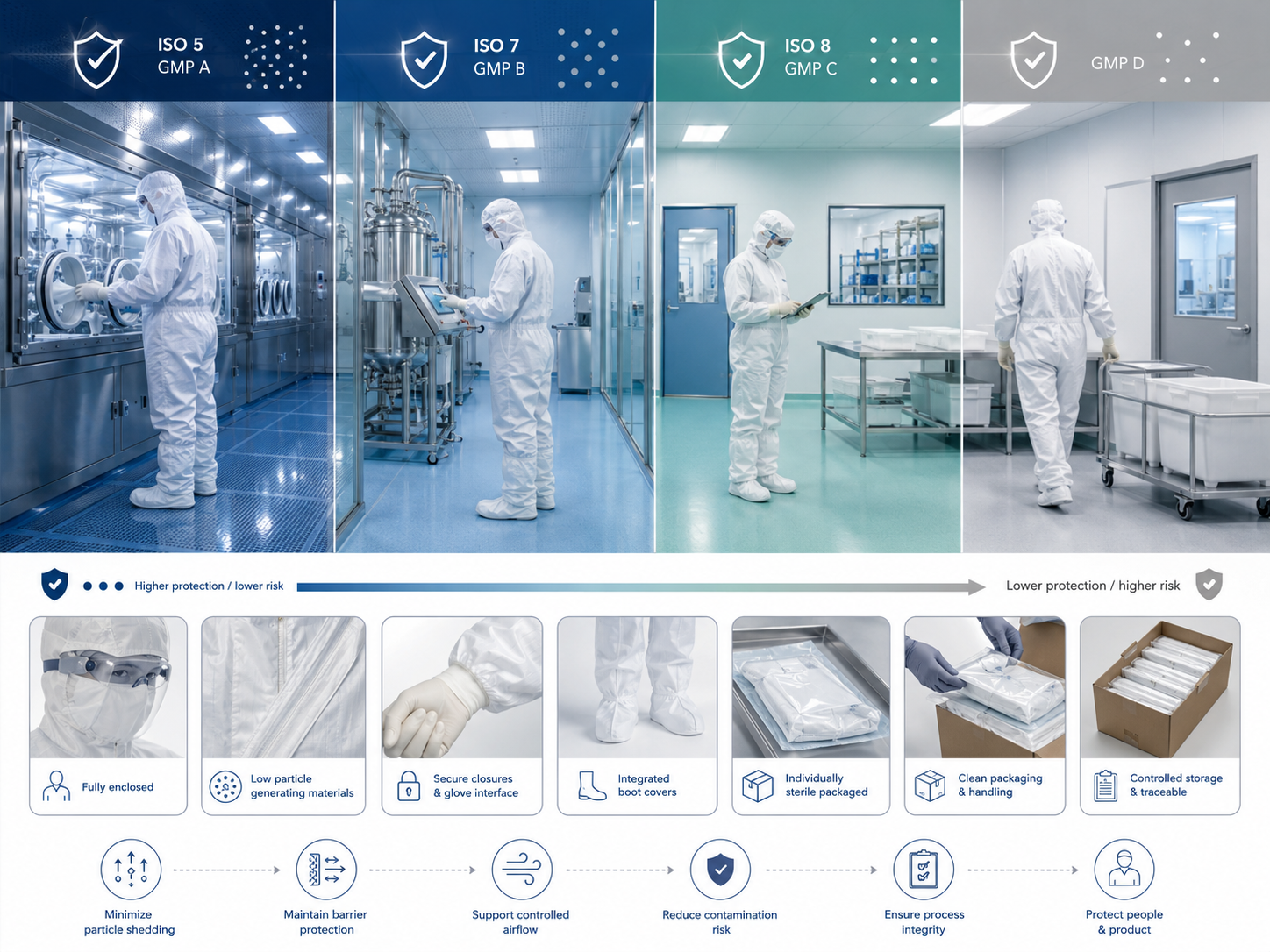
When sourcing cleanroom disposable coveralls, buyers should avoid using the phrase “ISO certified coverall” too loosely. ISO 14644 classifies cleanrooms and clean zones by airborne particle concentration. A coverall is usually selected for use in an ISO-classified cleanroom, but the facility’s process, risk assessment, gowning procedure, and contamination control strategy determine the final garment requirement.
Common cleanroom classifications include ISO 5, ISO 6, ISO 7, and ISO 8. In pharmaceutical and sterile manufacturing environments, GMP grades A, B, C, and D may also be used to define cleanliness expectations, gowning systems, and contamination-control requirements.
In higher-risk cleanrooms, buyers may need sterile cleanroom coveralls, individually packed garments, validated gowning procedures, lot traceability, and supporting documentation. In lower-risk controlled environments, non-sterile cleanroom coveralls may be acceptable if particle control, material cleanliness, and packaging requirements are met.
Cleanroom coverall selection should consider:
Cleanroom class or GMP grade
Contamination control strategy
Microbial and particle risk
Operator activity level
Use of hoods, masks, goggles, gloves, boots, or overboots
Sterile or non-sterile packaging requirement
Material shedding and garment integrity
Facility-specific gowning SOP
Sterile vs Non-Sterile Cleanroom Disposable Coveralls
One of the most important decisions in cleanroom PPE sourcing is whether the facility needs a sterile or non-sterile cleanroom disposable coverall.
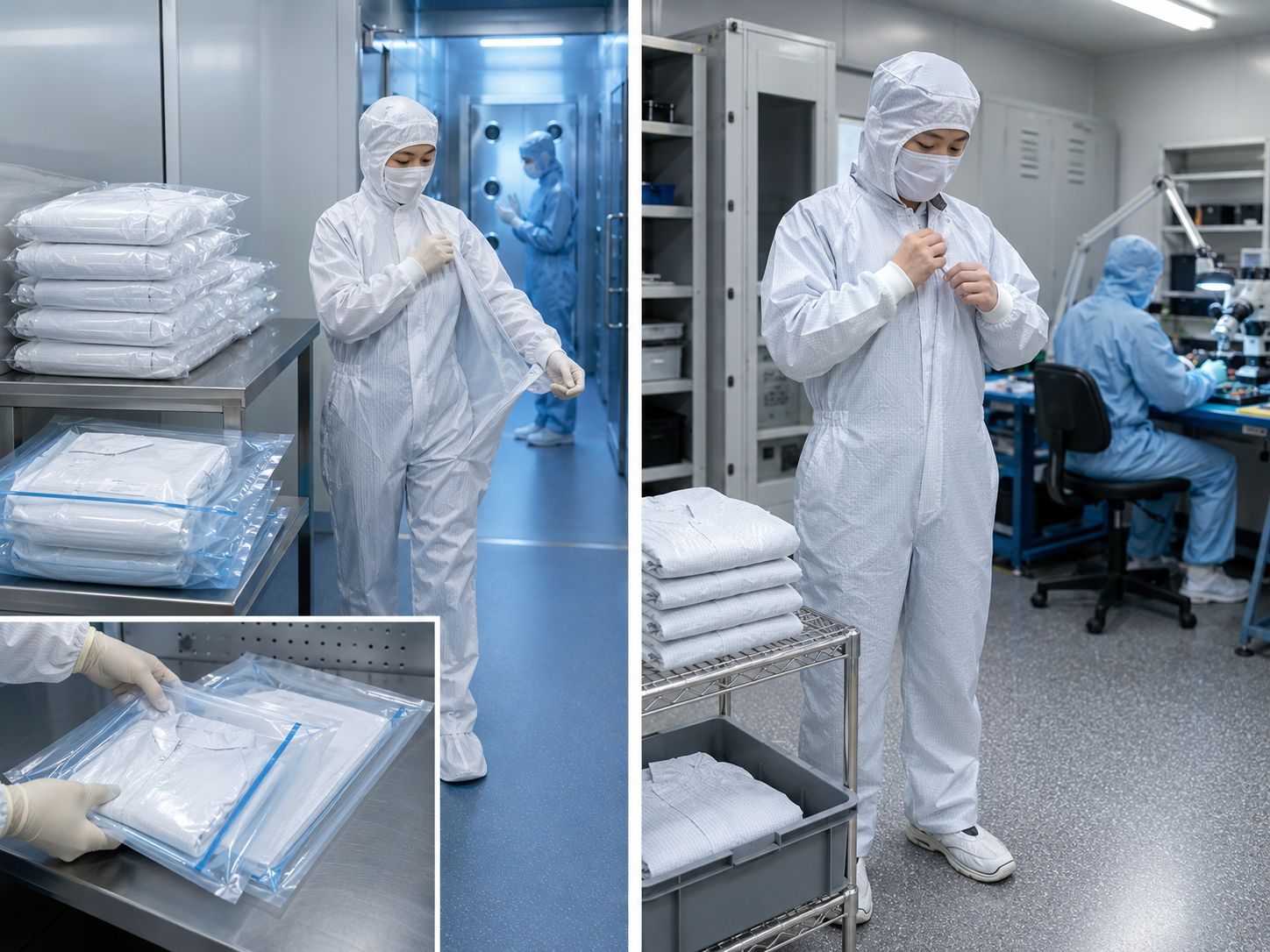
Sterile cleanroom disposable coveralls are commonly used in pharmaceutical, biotechnology, medical device, aseptic processing, and other environments where microbial contamination control is critical. They may be gamma irradiated or sterilized through another validated method, then packaged individually or in a cleanroom-compatible format.
Non-sterile cleanroom disposable coveralls may be used in electronics, semiconductor, optics, industrial cleanrooms, laboratories, or support areas where particle control matters but sterile processing is not required. They can still be low-lint, cleanroom-compatible, antistatic, or individually packed depending on the product.
Requirement | Sterile Cleanroom Disposable Coverall | Non-Sterile Cleanroom Disposable Coverall |
|---|---|---|
Main Purpose | Particle and microbial contamination control | Particle and lint control |
Common Applications | Pharma, biotech, medical device, aseptic operations | Electronics, semiconductor, laboratory, support cleanrooms |
Packaging | Often individually packed, sterile packed, or double-bagged | May be bulk packed or individually packed |
Documents to Check | Sterility certificate, lot number, expiry date, packaging specification | Datasheet, material composition, cleanroom suitability, packaging details |
Buyer Risk | Using non-sterile products in sterile areas | Overpaying for sterile products where not required |
Buyers should not choose sterile coveralls only because they sound more protective. The right choice depends on cleanroom classification, microbial risk, process sensitivity, approved gowning procedure, and regulatory expectations.
Materials Used for Cleanroom Disposable Coveralls
Material selection affects particle control, comfort, breathability, barrier performance, antistatic properties, and cost. For cleanroom disposable coveralls, buyers should review the material structure carefully rather than relying only on generic terms such as “nonwoven” or “protective fabric.”
Common materials include:
SMS or SMMS nonwoven: often used for breathable disposable cleanroom garments and controlled environments.
Microporous film laminate: used where buyers need stronger particle and limited liquid barrier performance.
PP nonwoven: lightweight and cost-effective, but buyers must confirm cleanroom suitability.
PP + PE laminate: used when liquid resistance and disposable protection are important.
Flash-spun HDPE: commonly associated with high-performance cleanroom disposable garments and controlled environments.
Antistatic materials: important for electronics, semiconductor, and environments where electrostatic discharge control matters.
For SEO and procurement clarity, it is also useful to separate material types from brand names. For example, Tyvek IsoClean, BioClean, Kimtech, and CleanMax are product or brand families, while SMS, microporous laminate, PP nonwoven, PP + PE laminate, and flash-spun HDPE describe material structures.
Key Design Features of Cleanroom Disposable Coveralls
Small design details can affect contamination control. A cleanroom disposable coverall should be evaluated as part of a complete gowning system, not as an isolated garment.
Important design features include:
Attached hood: helps reduce gaps between head covering and body garment.
Protective zipper flap: reduces a direct contamination path through the front closure.
Elastic or knitted cuffs: help create a better seal with gloves.
Thumb loops: keep sleeves in place during movement and donning.
Elastic ankles or integrated boots: reduce exposed transition points around footwear.
Low-lint seams: reduce particle release from garment construction.
Bound or taped seams: may be required in higher-risk environments depending on the product and application.
Antistatic performance: important in electronics, semiconductor, or ESD-sensitive cleanrooms.
Proper fit and size range: reduces tearing, poor gowning, and exposed skin risks.
Buyers should test samples with the complete apparel system, including hood, mask, goggles, gloves, boots, or overboots. A coverall that looks good in a datasheet may not perform well if it does not fit the actual gowning process.
Documents to Request Before Buying Cleanroom Disposable Coveralls
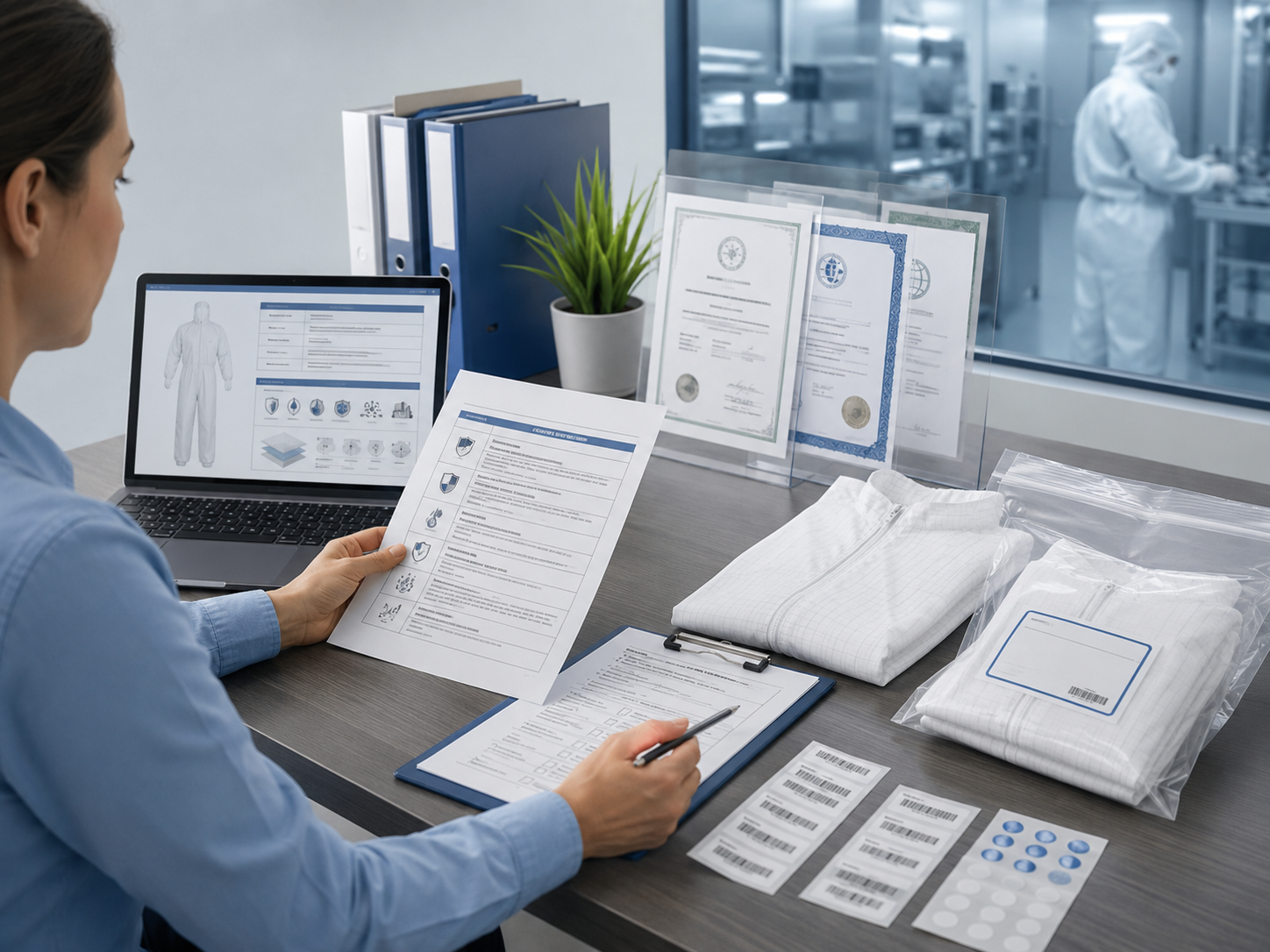
Documentation is critical when sourcing cleanroom disposable coveralls, especially for pharmaceutical, biotech, medical device, and ISO/GMP cleanroom buyers. A supplier’s marketing brochure is not enough. Buyers should request documents for the exact model, size range, packaging format, and batch being purchased.
Important documents include:
Technical datasheet
Material composition sheet
Size chart
Product label and packaging photos
EU Declaration of Conformity or relevant PPE documents where applicable
Cleanroom suitability statement
Particle shedding or Helmke Drum data where available
Sterilization certificate for sterile products
Lot number and batch traceability
Expiry date for sterile products
Packaging specification, such as individually packed, double-bagged, sterile packed, or cleanroom packed
Donning, doffing, storage, and disposal instructions
If a supplier cannot provide basic product documents, buyers should be cautious before approving the garment for cleanroom use. For long-term supply, sample approval and pilot testing should happen before large-volume orders.
Cleanroom Disposable Coveralls vs Reusable Cleanroom Garments
Cleanroom disposable coveralls and reusable cleanroom garments serve different procurement needs. Neither option is automatically better. The right choice depends on contamination risk, process type, laundry availability, validation requirements, sustainability goals, and total cost of ownership.
Comparison Point | Disposable Cleanroom Coveralls | Reusable Cleanroom Garments |
|---|---|---|
Initial Cost | Lower per garment | Higher initial garment investment |
Use Pattern | Single-use, consistent per batch | Repeated use after cleanroom laundry |
Laundry Requirement | No cleanroom laundry required | Requires validated cleanroom laundry and lifecycle control |
Traceability | Lot-based and packaging-based traceability may be easier | Requires garment lifecycle and laundry-cycle tracking |
Waste | More disposable waste | Lower garment waste, but laundry and logistics are required |
Best Fit | Visitors, contractors, sterile processes, high-risk tasks, flexible demand | Stable long-term cleanroom garment programs |
Disposable cleanroom coveralls are often practical when a facility needs consistent single-use performance, sterile packaging, quick scaling, or visitor/contractor garments. Reusable garments may be better for stable operations with validated laundry systems and long-term garment management.
How to Compare Cleanroom Disposable Coverall Suppliers in Germany
A supplier list is only useful if buyers know how to compare the companies behind it. For cleanroom disposable coverall sourcing in Germany, buyers should compare supplier type, product evidence, documentation, packaging, and long-term supply ability.
Comparison Factor | What Buyers Should Check |
|---|---|
Supplier Type | Is the company a manufacturer, brand owner, distributor, B2B shop, or global brand channel? |
Cleanroom Suitability | Does the product indicate suitability for the buyer’s ISO class or GMP grade? |
Sterile Options | Is the product sterile, non-sterile, individually packed, or double-bagged? |
Material | Is it SMS, SMMS, microporous laminate, PP, PP + PE, or flash-spun HDPE? |
Design | Does it include hood, zipper flap, thumb loops, elastic cuffs, boots, or low-lint seams? |
Documents | Can the supplier provide datasheet, product label, packaging details, and traceability documents? |
Stock and Lead Time | Can the supplier support urgent orders, repeat orders, and stable supply? |
OEM Support | Can the supplier support private label packaging, size mix, carton labels, or custom specifications? |
For cleanroom PPE procurement, a verified distributor with strong documentation may be safer than a vague low-cost manufacturer. Likewise, a direct PPE manufacturer may be better for OEM, private label, and high-volume cleanroom disposable coverall programs.
Common Mistakes When Sourcing Cleanroom Disposable Coveralls
Many sourcing problems happen because buyers focus only on price, brand name, or a short product description. Cleanroom PPE requires more careful verification.
Common mistakes include:
Treating all disposable coveralls as cleanroom coveralls. A general industrial coverall may not have cleanroom particle-control evidence.
Ignoring sterile vs non-sterile requirements. Sterile pharmaceutical environments may require sterile, individually packed garments.
Relying only on the word “ISO.” Buyers should confirm the exact cleanroom class or GMP grade suitability.
Skipping packaging verification. Cleanroom entry procedures may require specific packaging formats.
Not checking particle shedding. Low-lint and low-particle-release performance matters in controlled environments.
Ignoring ESD needs. Electronics and semiconductor cleanrooms may require antistatic or ESD-compatible apparel.
Buying the wrong size range. Poor fit can increase tearing, exposed skin, and gowning errors.
Assuming every German supplier is a direct manufacturer. Many are distributors or B2B cleanroom product suppliers.
Skipping sample testing. Datasheets cannot fully show fit, comfort, donning, and movement performance.
Not verifying long-term supply. Cleanroom programs require stable repeat orders, not one-time availability.
The safest approach is to define the required cleanroom class, sterile status, material type, packaging, documents, and sample approval process before asking suppliers for quotes.
Germany Suppliers vs China PPE Manufacturers for Cleanroom Disposable Coverall Orders
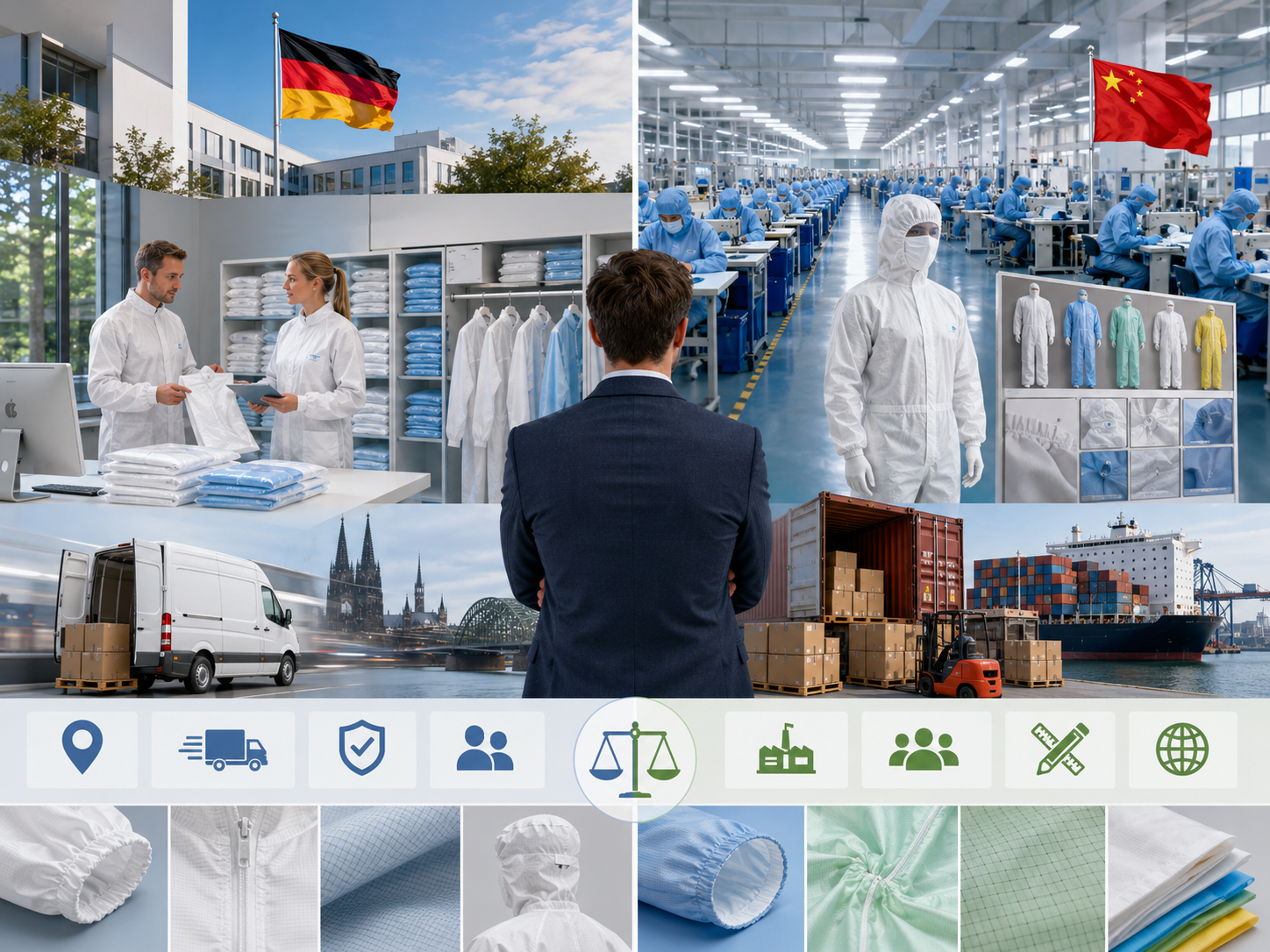
Germany suppliers and China PPE manufacturers can both be useful for cleanroom disposable coverall buyers, but they usually serve different procurement needs.
German suppliers may be better for local EU availability, urgent replenishment, established cleanroom brands, smaller orders, German-language support, and easy access to technical documents from known brands. For buyers in Germany or nearby EU markets, this can reduce communication time and simplify urgent purchasing.
China PPE manufacturers may be stronger for OEM cleanroom disposable coveralls, private label packaging, customized materials, custom size ranges, carton labeling, sterile or non-sterile programs, and large-volume production. For distributors, PPE brands, and long-term cleanroom PPE buyers, manufacturer-direct sourcing may offer more flexibility and cost control at scale.
Factor | Germany Suppliers | China PPE Manufacturers |
|---|---|---|
Best Fit | Local projects, urgent replenishment, smaller orders, established cleanroom brands | OEM programs, private label orders, long-term bulk supply, customized packaging |
Lead Time | Often faster for in-stock products in Germany or the EU | Requires production and international shipping planning |
Customization | May be limited if the supplier is a distributor | Stronger for material, size, packaging, label, and carton customization |
Documentation | Often easier when buying established cleanroom brands | Must be verified carefully before bulk orders |
Cost Structure | Convenient for local supply but may be higher for branded products | More suitable for large-volume cost control |
Buyer Responsibility | Verify exact product model, documents, packaging, and cleanroom suitability | Verify factory capability, samples, documents, consistency, and export compliance |
Buyers should not choose based on country alone. A qualified German supplier is better than an unverified low-cost factory. A qualified PPE manufacturer is better than a distributor that cannot provide stable documentation or repeat supply. The right decision depends on cleanroom risk, order volume, documentation needs, customization requirements, and long-term procurement strategy.
For buyers comparing German cleanroom PPE suppliers with an overseas PPE manufacturer, it is useful to prepare a clear RFQ that includes cleanroom class, sterile status, material preference, coverall design, packaging method, required documents, order quantity, sample requirements, and private label needs.
Conclusion: Choosing the Right Cleanroom Disposable Coverall Supplier
Choosing a cleanroom disposable coverall supplier in Germany requires more than comparing product names and prices. Buyers should first define the cleanroom class, GMP grade, sterile or non-sterile requirement, material preference, packaging method, documentation needs, and gowning procedure.
The Top 8 companies and brands in this guide can serve as a useful starting point. Dastex, DACH, Franz Mensch, IAB, HEIN, and Spetec represent different parts of the German cleanroom PPE and cleanroom product supply chain. Ansell BioClean and Lakeland CleanMax are global cleanroom PPE brands that may be available through German or European channels. Buyers should verify the exact product model, supplier role, documents, and cleanroom suitability before ordering.
For local projects, German suppliers may offer faster access, recognized brands, and convenient documentation. For OEM cleanroom disposable coveralls, private label PPE, bulk orders, custom packaging, and long-term supply, working directly with a PPE manufacturer may provide more flexibility.
As a professional PPE manufacturer, we can support global buyers with cleanroom disposable coverall customization, sterile and non-sterile options, private label packaging, bulk production, material selection, carton labeling, and ISO/GMP cleanroom PPE sourcing support. If you are comparing German suppliers with a PPE manufacturer for long-term cleanroom disposable coverall orders, focus on sample testing, documentation, packaging, batch consistency, and stable supply before making a final decision.





