
You get a quote for $0.85 per unit. Another supplier says $1.20. Both use the same SMS material, the same 65gsm weight, same EN14126 certification. The 40% gap comes from what happens between raw Polypropylene granules and the sealed poly bag on a pallet. One factory is cutting corners, or margins, that the other isn’t.
The real problem with sourcing disposable coveralls is that most buyers negotiate blind. They know the target price but not what drives protective coverall production cost. Understanding those drivers separates a fair deal from an inflated one.
This breakdown covers nonwoven fabric coverall cost structures, material-by-material pricing (PP vs SMS vs microporous), and how order volume, certification level, and manufacturing region shift your final unit price. Your next negotiation can start from data.
Disposable Coverall Manufacturing Cost Range
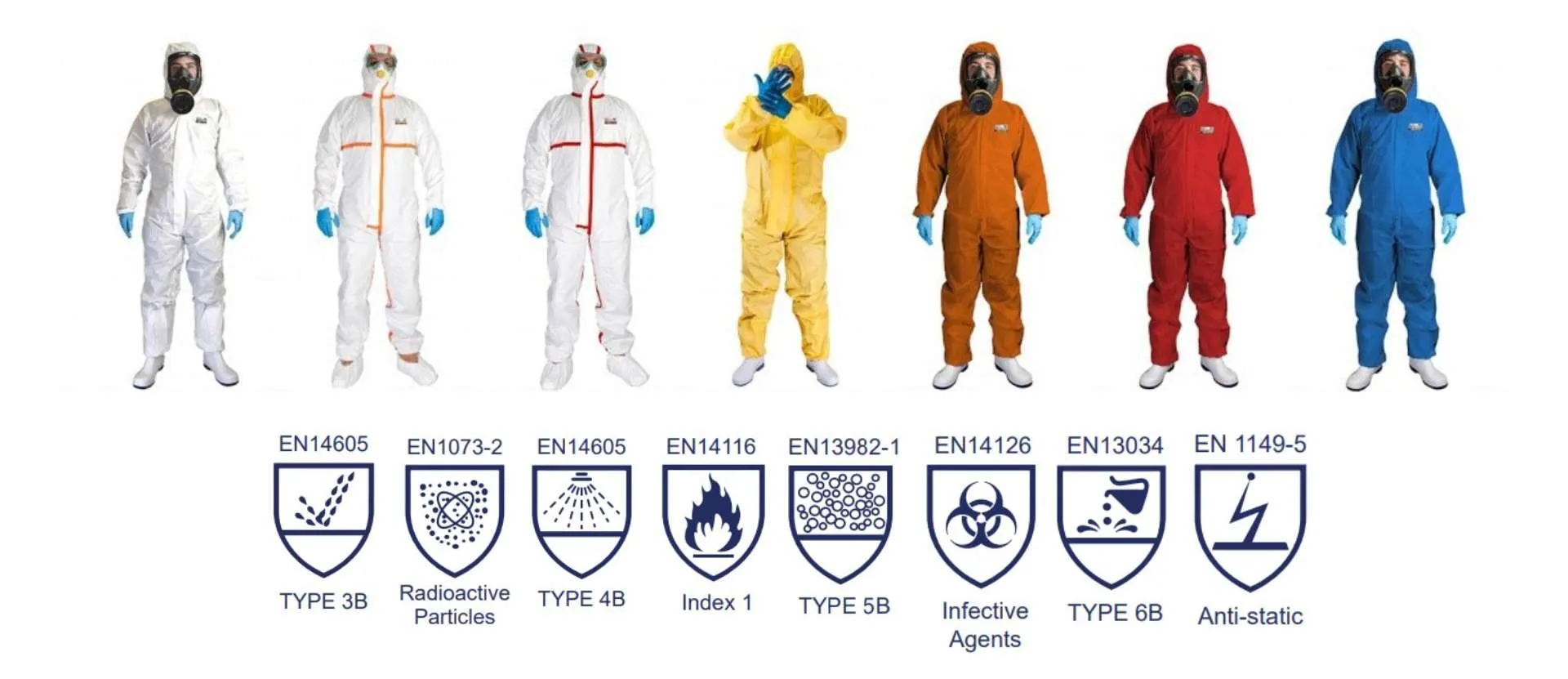
Manufacturing cost for basic Type 5/6 disposable coveralls runs $0.40–$1.20 per unit. Medical-grade sterile and cleanroom versions jump to $2–$5+ per unit. That’s the factory floor cost before margin, freight, or distributor markup gets added.
Three price layers exist.
Manufacturing cost: fabric, sewing, labor, QA, packaging
Ex-factory (FOB) price: manufacturing cost + 10–30% factory margin
Retail price: ex-factory price + freight + importer/distributor margins (often 2–5× the manufacturing cost)
Coverall Type | Manufacturing Cost | Ex-Factory Price |
|---|---|---|
Basic Type 5/6 (PP/SMS) | $0.40–$1.20 | $0.80–$1.50 |
Reinforced SMS/microporous | $0.70–$1.80 | $1.35–$1.70 |
Medical sterile | $2–$5+ | $6–$15+ |
ISO 5/6 cleanroom sterile | $3–$8+ | $12–$35 |
A good rule is that manufacturing cost equals 50–70% of the FOB price. A quote below $0.50 FOB for standard EN13485 Type 5/6 coveralls means thin fabric or skipped QA.
Cost Breakdown Structure: What Makes Up the Manufacturing Cost
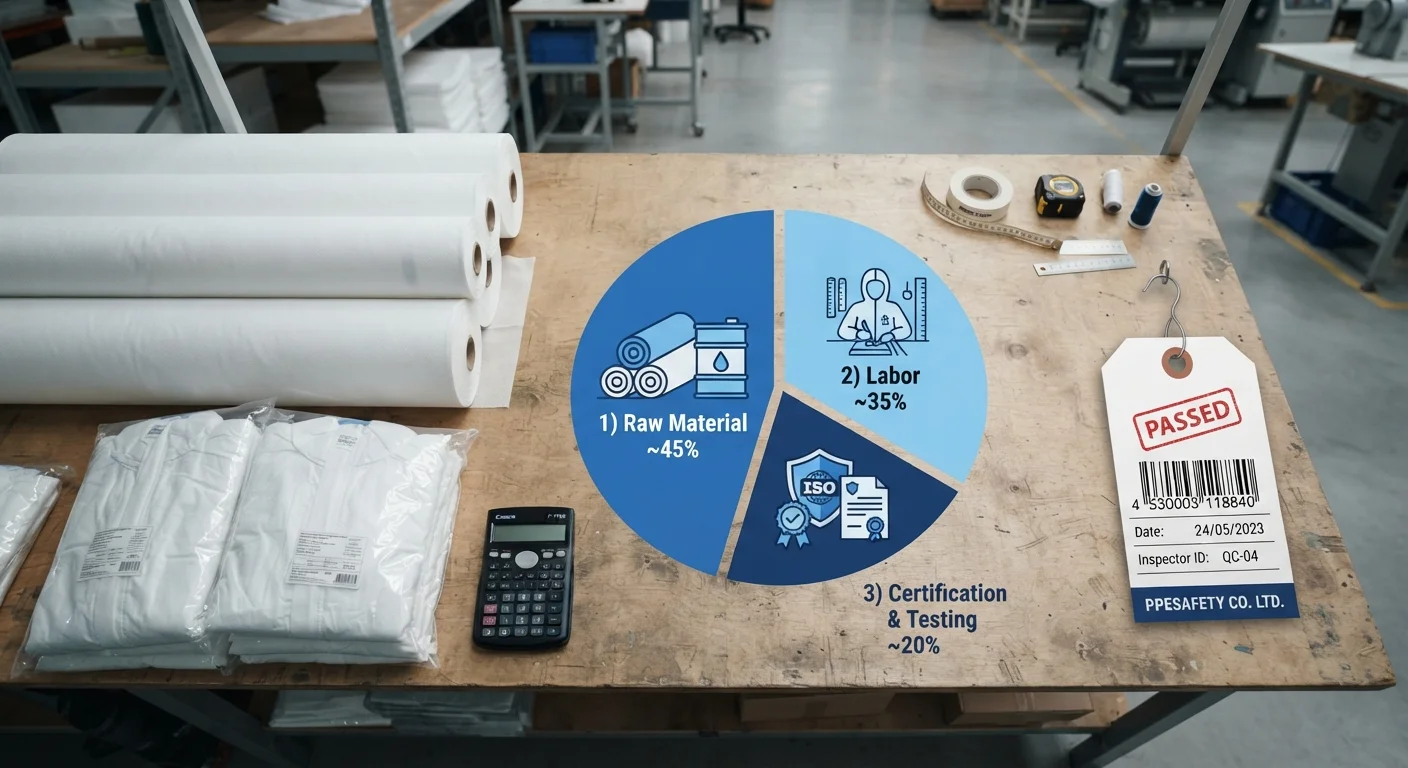
Every disposable coverall quote comes from seven cost buckets. Raw material takes the biggest share, but the other six tell you whether your supplier runs lean or pads margins.
Raw Material (55–75% of manufacturing cost)
This is where nonwoven fabric coverall cost starts. PP SMS runs $1.8–3.5/kg, depending on layer structure and finish — flame-retardant, antistatic, or hydrophilic. Coverall gsm matters more than buyers realize: every +10 gsm adds 8–20% to material cost. Move from single-layer spunbond to SMS or SSMMS, and the material unit price jumps 20–60%, pushing total material cost to 1.3–2× the base coverall. Film
Manufacturing Cost by Coverall Type (PP vs SMS vs Microporous vs Sterile)
Four material tiers explain almost every price gap on a coverall quote sheet. Each tier trades cost for protection level. Skip that logic, and you might overpay for barrier performance you don’t need or underpay for protection you actually require.
PP (spunbond polypropylene) costs $0.12–$0.25/unit. Single-layer nonwoven construction keeps raw material and conversion cost low. Filtration hovers at 85–90%, liquid resistance stays under 100 mmH₂O. Fine for dry dust, dirt, and non-hazardous particulates. Wrong choice for anything wet.
SMS coverall manufacturing runs $0.40–$1.20/unit. The jump comes from a three-layer composite (spunbond, meltblown, spunbond) instead of a single layer. That middle meltblown layer traps finer particles, pushing filtration to 95–98% and liquid resistance to 800–1200 mmH₂O. This is the workhorse tier for general industrial use and light splash exposure.
Microporous coverall production costs $0.60–$1.40/unit. You’re laminating a PE microporous film onto PP fabric. That lamination step introduces yield risk and extra QC, which is why the price climbs even though the fabric weight often looks similar to SMS on paper. You get 99.9% particulate filtration and liquid resistance above 2000 mmH₂O. This tier handles bio-fluids, paint spray, and diluted chemical splash.
Sterile cleanroom-grade coveralls jump to $12–$35/unit. The material cost barely moves the needle here. Sterility validation, gamma irradiation, individual sterile packaging, and ISO 5/6 cleanroom manufacturing controls drive the price. You’re paying for a documented sterile process.
Matching Material to Hazard
Material | Filtration | Liquid Resistance | Best Use |
|---|---|---|---|
PP | 85–90% | <100 mmH₂O | Dry dust, low-risk cleaning |
SMS | 95–98% | 800–1200 mmH₂O | General industrial, light splash |
Microporous | 99.9% | >2000 mmH₂O | Chemical spray, bio-fluid splash |
Sterile | N/A | N/A | ISO cleanroom, sterile handling |
Before comparing quotes, ask for GSM, tensile strength, tear resistance, seam type, and certification. High GSM alone doesn’t mean better barrier performance. A heavy PP coverall can still fail a liquid-splash job that a lighter microporous garment passes easily. For any liquid-risk application, insist on heat-sealed or taped seams. Sewn-only seams leak, no matter how good the fabric is. Match the hazard first. Price comparison only makes sense after that.
Key Cost Drivers That Affect Your Quote
Five variables move your quote up or down. Ignore any one of them during negotiation, and you’re guessing.
GSM increments. Every 10 gsm added to SMS/SMMS fabric raises material cost 8–15%. Go from 40 gsm to 50 gsm and your per-unit fabric cost climbs from $0.50 to $0.58–0.60. The meltblown layer drives most of that jump — it’s 40–60% of total fabric cost, so adding meltblown weight (say 8 gsm to 12 gsm) alone adds $0.05–0.12 per unit.
Certification testing. EN14126 full type-testing runs €4,000–8,000. EN14605 chemical-splash testing costs €5,000–9,000. Someone pays for that — you, through amortization. On a 5,000-unit order, a €6,000 test fee adds $0.65–0.70 per coverall. Push volume to 50,000+ units and that same fee shrinks to $0.12–0.15 per unit. Small orders absorb testing costs heavily, which is why sub-1,000-unit quotes on certified coveralls look inflated.
Design complexity. Taped seams add $0.20–0.70 per unit versus sewn-only construction. Attached hoods add $0.05–0.12. Integrated boot covers add $0.10–0.25. Double-zipper closures add another $0.10–0.25. Stack all four features and you’ve added $0.45–1.32 to a base coverall — before certification or margin.
Labor market. Chinese sewing labor runs $3–6/hour, loaded with all costs. Western Europe and North America run $18–35/hour. A basic coverall taking 6–8 minutes to sew costs $0.30–0.80 in China, $1.80–4.00 in the West. Add taping (10–14 minutes total), and China stays at $0.50–1.20 while Western production hits $3.00–6.00. That gap alone explains why China-made coveralls typically total 25–40% of Western manufacturing cost.
Order volume. Fixed costs (tooling, testing, setup) get divided across units. A 1,000-unit order might carry $8.00 in amortized fixed cost per unit; at 100,000 units, that drops to $0.08. FOB China quotes fall from $10–12/unit at 1,000 pieces to $2.20–2.50/unit at 100,000 pieces — same coverall, same factory.
China Manufacturing Cost vs Other Markets (India, Western Plants)
India’s factory labor costs less than China’s — sometimes half. That fact alone convinces a lot of buyers that India should win on price. The math doesn’t hold up once you factor in production speed.
Manufacturing hourly wages (2025):
China: $5.5–6.5/hour
India: $2.2–2.4/hour
Vietnam: $2.7–3.0/hour
China’s labor costs run 2.3–3x higher than India’s. Yet China still wins on landed manufacturing cost in many cases. Efficiency erases the gap.
Chinese factories compress unit labor time to 50–70% of what Indian plants need for the same coverall spec — same seam count, same taping steps. Higher automation, tighter QC, lower rework rates. Run the actual math: India’s labor cost index sits near 0.4 versus China’s 1.0, but slower output pushes India’s real cost index back up to roughly 0.56. Blend that with material and overhead, and total cost indexes for both countries often land within a few points of each other. Sometimes China edges lower.
Western plants aren’t competitive on protective coverall production cost at all. Loaded labor runs $18–35/hour versus China’s $3–6/hour. A basic coverall taking 6-8 minutes to sew costs $0.30–0.80 in China, $1.80–4.00 in Western facilities — the same gap covered earlier in labor market analysis.
Where India wins: tariff exposure. U.S. Section 301 tariffs add 10–25%+ to Chinese imports. India avoids that hit entirely. For buyers sourcing industrial coverall bulk price from the U.S. market, factory cost favors China. Landed cost, after tariffs, sometimes favors India by 25–35%. Check both numbers before signing a PO.
How to Get an Accurate Manufacturing Quote for Your Order ?
An incomplete RFQ is behind nine out of ten inflated quotes. Factories fill in the blanks with their own assumptions, and those assumptions almost never favor you. Send a vague inquiry, and you’ll get a vague price that changes once specs are clarified.
What your RFQ must include?
Material and GSM spec – name the fabric type (PP, SMS, microporous) and exact GSM. “Nonwoven fabric” alone isn’t a spec.
Certification requirements – EN14126, AAMI level, ISO 13485, whatever applies. Skip this, and the quote won’t include testing amortization; then it spikes later.
Seam type – taped, heat-sealed, or sewn-only. This alone swings price by $0.20–0.70 per unit.
Design features – hood, boot covers, zipper type, elastic vs. thumb loops.
Quantity tiers – request pricing at 1,000, 10,000, and 50,000+ units. One number hides the volume discount curve.
Incoterm and destination – FOB Shenzhen and DDP Los Angeles aren’t the same conversation.
Avoid the landed cost trap
Factory ex-works price isn’t your real cost. Add freight, duties, customs clearance, and inland trucking. Then calculate total landed cost divided by units received in acceptable condition. That’s your true per-unit number for medical coverall production cost comparisons.
Get quotes you can compare
Send the same RFQ template to 3–5 coverall manufacturers. Same specs, same quantity tiers, same format. Anything less is guesswork, and guesswork is what gave you that 40% price gap.
Frequently Asked Questions About Disposable Coverall Manufacturing Cost
Buyers ask the same six questions before signing a PO. Here is the data that answers them.
What’s the minimum order quantity for disposable coverall manufacturing?
Most factories set MOQ at 1,000–5,000 units. Some large OEMs push that to 10,000+. A standard 40HQ container, packed 1 pcs/bag and 50 pcs/carton, holds roughly 59,000 units. Factories call that the standard bulk MOQ. Chinese wholesale quotes of $0.98–$1.50/unit typically require orders of 1,000–3,000+ pieces. Push past 1,000 units and unit cost drops to roughly 60–70% of small-batch pricing.
How much does custom logo printing or packaging add?
Single-color screen-printed logos add $0.02–$0.06/unit. Multi-color heat transfer runs $0.05–$0.10/unit. Printed cartons or custom poly bags add $0.004–$0.01/unit (based on 50 units/carton). New pattern development costs $200–$500 per style, plus $300–$600 for two rounds of sampling. Amortized over 3,000–10,000 units, that works out to $0.05–$0.30/unit.
How do I spot an inflated quote fast?
Compare against a benchmark: Chinese ex-factory pricing for standard Type 5/6 sits at $0.98–$1.50/unit. If a non-sterile quote exceeds $2/unit FOB China port with no premium material or certification behind it, ask questions. Also check whether freight and duties (typically 10–15% of production cost) are baked into the price or tacked on later.
What percentage of total cost is freight?
Ocean freight for full containers runs 10–20% of landed cost. Small-batch air freight can hit 30–50%. Factor that in when you compare quotes across suppliers.
Conclusion
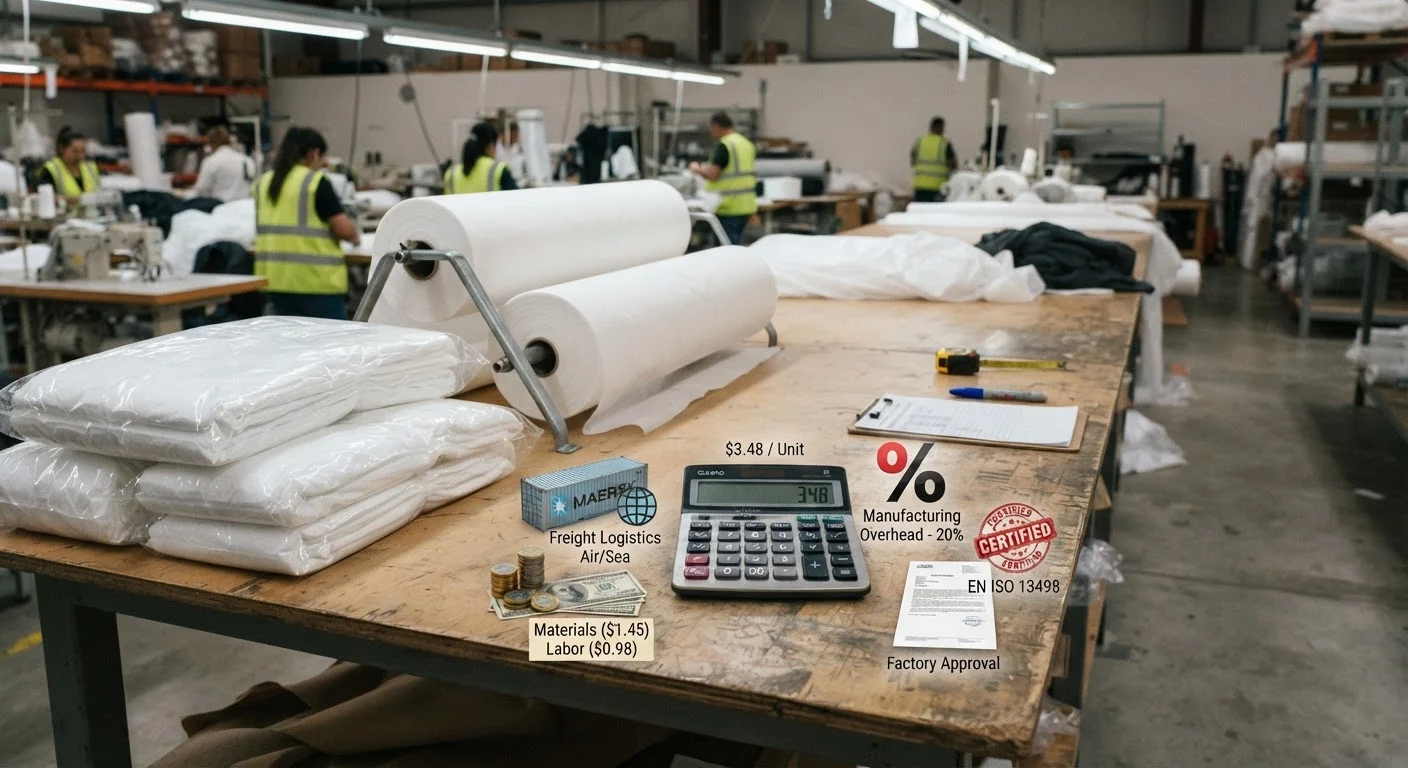
The price tag on a disposable coverall comes down to math. Raw materials (SMS or microporous fabric), labor, certification testing, and order volume each pull the number in a different direction, and now you know how much weight each factor carries.
Two things matter most here. Protective coverall production cost swings by 30-40% between China and Western factories, mostly due to labor and compliance overhead, not corner-cutting. And MOQ and customization always cost more than off-the-shelf—budget accordingly.
Use this breakdown the next time a supplier quote lands in your inbox. If the numbers don’t add up, ask why.
Ready to see real pricing instead of guesswork? Send us your specs—material type, GSM, certification needs, and order quantity—and Morntrip will get back to you with a factory-direct quote within 24 hours. No middlemen, no markup mysteries.





