
You spotted mold in the bathroom, maybe crawling across a basement wall, and now you’re standing in the cleaning aisle wondering: do you need a hazmat-style suit for this, or is that overkill?
It depends. Mold spores are microscopic troublemakers that don’t care about your DIY confidence. A small patch on tile? Different rules than a moldy crawlspace after a flood. Pick the wrong disposable coveralls , and you’re either wasting money on unnecessary gear or exposing yourself to spores that trigger real health problems.
This guide covers when protective gear is non-negotiable, which coverall type matches your specific job, and what a complete mold removal protective gear checklist looks like—so you can clean confidently instead of guessing.
Do You Really Need Disposable Coveralls for Mold Removal?
Size matters more than instinct.
A small patch under 10 sq ft—say, moldy grout—doesn’t legally require disposable coveralls. Long sleeves, gloves , goggles, and an immediate hot wash afterward will cover you.
Cross that 10 sq ft line, and the EPA treats Tyvek-style protective clothing as a core requirement. Between 10 and 30 sq ft, disposable coveralls join the standard PPE lineup alongside gloves and a respirator. Past 30 sq ft, you’re in full-suit territory: hood, integrated booties, taped wrists and ankles.
“Need” is about your risk—dust disturbance, sensitivities. “Must” kicks in when you hit those EPA/OSHA thresholds. Bigger job, more disturbance, higher stakes. Coveralls stop being optional and become the baseline.
Mold Area Size Determines Your Protection Level
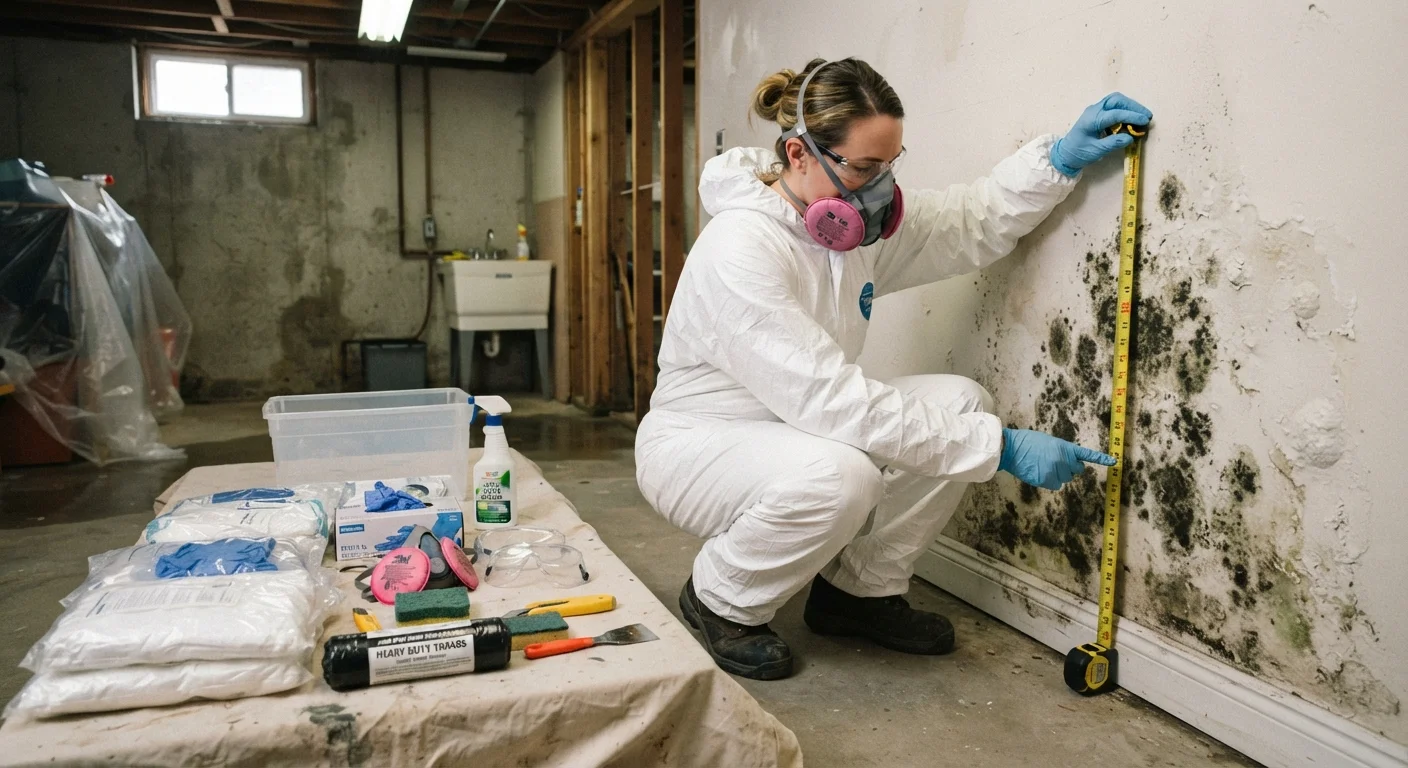
Grab a tape measure before you grab anything else. That’s the real first step in mold removal protective gear selection—not guessing, not eyeballing it from across the room.
Here’s the quick math: measure the mold’s height and width in feet, multiply, and you’ve got your square footage. A standard floor tile is 1 sq ft, so if you’re staring at 10+ tiles worth of mold, you’re already past the “wipe it and move on” zone.
Under 10 sq ft (think a moldy tile grout line or a small ceiling spot): N95 mask for mold removal, nitrile gloves, tight-fitting goggles, long sleeves. No coveralls needed—yet.
10 to 100 sq ft: This is where disposable coveralls for mold removal earn their keep. Pair a hooded, one-time-use suit with a half-face respirator rated P-100 with organic vapor cartridges. Add chemical-resistant coveralls if you’re mixing bleach or biocides—those chemicals eat through flimsy fabric fast. Seal the room with 6-mil polyethylene sheeting and tape off HVAC vents.
Beyond 100 sq ft: You’re building a hazmat suit mold scenario now—full-body coverage, boot covers, double-gloving, full-face respirator. Add double-layer poly barriers and negative air pressure if you can manage it.
One more thing: if an entire wall is affected (say, 8 ft by 12 ft—that’s 96 sq ft), you’re knocking on professional-remediation territory. Measure twice, suit up once.
Why Skipping Coveralls Puts You at Risk?
Your regular clothes are terrible mold barriers. Street fabric lets fine particulates through at rates often exceeding 50%. Coveralls built for chemical-resistant protection cut that penetration down to single digits. That gap is where health problems live.
Mold spores measure just 1–20 microns. They are small enough to drift through the air, settle into fabric fibers, and lodge in skin creases without you noticing. Walk through a contaminated room for an hour, and your clothing can pick up anywhere from 10,000 to over a million particles. Sit down on your couch afterward, and 10–30% of those particles re-aerosolize straight into your living room air.
Damp, moldy environments correlate with 30–50% increases in respiratory and asthma symptoms. Emergency room visits and medication use climb 20–40% higher in moldy housing versus dry housing. Sensitized people react to just hundreds of spores per square meter. You blow past that threshold the moment you disturb visible mold.
Skin exposure carries its own risks. Species like Stachybotrys chartarum and certain Aspergillus strains produce mycotoxins that cause burning, rash, and blistering on contact. The UK’s Health and Safety Executive found that workers who wore coveralls incorrectly (zips undone, sleeves rolled) still showed high skin contamination. Full closure dropped that contamination to near-zero. The difference was wearing them right.
Taking contaminated clothes home is another risk. Spores trapped in fabric release with every movement, including sitting, bending, and tossing clothes in the family wash. That is how a bathroom mold problem becomes a bedroom mold problem. Coveralls exist to stop that transfer before it starts.
Types of Disposable Coveralls: Which One Is Best for Mold Removal?
Not all coveralls are created equal. Grab the wrong one, and you’re wearing a paper towel to a chemical fight.
Paper/ PP coveralls are the lightweight option—thin polypropylene nonwoven, usually 25-40 g/m². They’re cheap (30-50% less than Tyvek), but they only stop dry dust. No liquid barrier. Save these for non-hazardous cleanup, not mold.
SMS coveralls step things up with three layers: spunbond, Meltblown, spunbond PP. At 45-55 g/m², they handle moderate liquid mist and dust. Good for mold inspection and medium-risk remediation.
Microporous film suits add a PE film layer over PP fabric. That combo blocks liquid chemicals and fine particulates while staying more breathable than solid-coated options. Useful when you’re mixing biocides.
PP+PE laminated coveralls resist liquid and oil. These are chemical-resistant coveralls built for spraying and splashing. They often replace Tyvek at a lower price when particle protection isn’t the main concern.
Tyvek® coveralls for mold sit at the top. Flash-spun high-density polyethylene blocks particles larger than 1 micron—smaller than most mold spores—while still letting air through. This is your go-to for asbestos, lead paint, and serious mold remediation equipment.
Type 5/6: The Label That Matters
Look for EN ISO 13982-1 (Type 5) for particle protection and EN 13034 (Type 6) for light splash resistance. Mold work needs both—airborne spores call for Type 5, disinfectant sprays call for Type 6.
Design matters too. Hooded suits with elastic wrists and ankles seal the gaps where spores sneak in. Boot covers stop you from tracking contamination out the door.
Complete Mold Remediation PPE Checklist
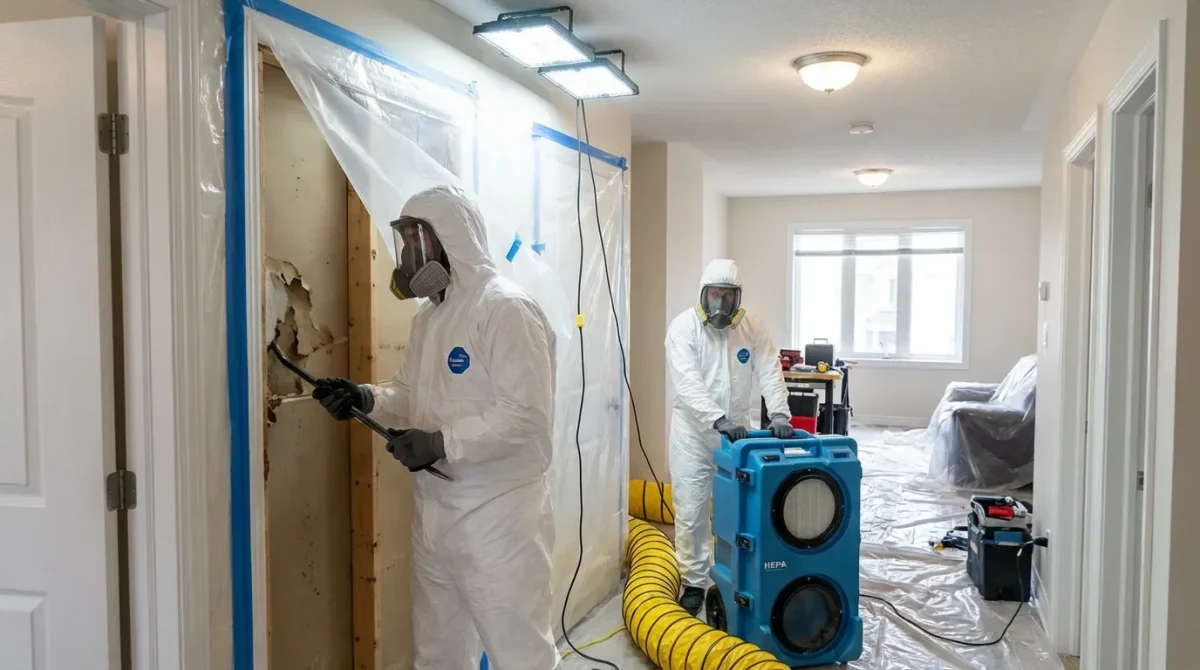
Coveralls are only one piece of the puzzle. Skip the gloves, and you’ve still got exposed skin. Print this list, tape it to your supply closet, and use it every time.
Respiratory protection scales with square footage. Small jobs get an N95 mask for mold removal—NC State backs this for anything under 10 sq ft. Push into 10-30 sq ft territory, and you need a NIOSH-approved N95 at minimum. Cross 30 sq ft, and you’re upgrading to a half-face respirator with P100 filters. Mixing bleach? Add cartridges rated for organic vapors, since P100 alone won’t stop those fumes.
Eye protection means sealed, non-vented goggles. Not the vented safety glasses gathering dust in your garage. Spores find gaps, and vents are gaps. For chemical spraying, layer a face shield over your respirator.
Gloves start with disposable nitrile or latex. That’s the baseline across every job size. Heavier remediation calls for long nitrile or rubber gloves reaching your mid-forearm. Your standard wrist-length pair won’t cut it once you’re scrubbing walls.
Foot protection often gets forgotten until someone tracks mold across clean carpet. Closed shoes with disposable boot covers work for most jobs. Wet basements need rubber or PVC waterproof boots with slip-resistant soles.
Head protection is the easiest thing to skip and the easiest thing to regret. A disposable hood or hair cover keeps spores out of your hair. Many Tyvek coveralls for mold already include this built in.
Your Pre-Entry Checklist
Before you walk into that room:
-
Respirator : N95 or P100, matched to job size
-
Goggles : sealed, non-vented
-
Gloves : nitrile or latex, upgraded to rubber for heavy jobs
-
Coverall : disposable hazmat suit for medium/large areas
-
Boot covers : slip-resistant if surfaces are wet
-
Hood : attached or separate hair cover
-
Disposal bags : seal contaminated PPE immediately after use
One more number worth remembering: dry any wet, mold-free materials within 48 hours. Miss that window, and you’ll be suiting up again soon.
DIY Homeowner vs Professional Remediation Company: Different Needs
A scrubby patch of grout mold and a flooded crawlspace are not the same job. They don’t call for the same gear, either.
DIY makes sense when these six things are true: the area is under 10 sq ft, it’s on non-porous surfaces like tile or glass, nobody in the house has asthma or a compromised immune system, and there’s no lingering musty smell. Check those boxes, and your N95-goggles-gloves combo handles it fine.
Call a professional the moment any of these show up:
-
Water damage exceeds 40 sq ft or touches structural elements like beams, joists, or subfloor
-
The water is Category 2 or 3 (sewage, floodwater, gray water) — IICRC S500 flags this as professional-only
-
Porous materials are involved: drywall, insulation, carpet, wood flooring
-
HVAC ductwork or coils show contamination
-
Water sat for more than 24–48 hours without drying
-
You smell mold but can’t find it — hidden mold means professional inspection, not guesswork
-
Mold keeps returning after repeated DIY attempts
-
You’re filing an insurance claim. Documentation matters here.
Professional remediation companies operate at a different scale. They stock full-body coveralls in sizes M–XXL, categorized by risk level — standard mold jobs versus black-water disasters — so crews grab the right suit without delay. Each disposable suit costs a few dollars, cheap enough that one-time use per job makes financial sense. Quick-donning designs matter too. Crews moving between contaminated sites need suits that come off fast without smearing spores across clean surfaces.
What to Look for Before Buying Disposable Coveralls for Mold Removal?
Not all coveralls fit the same, and fit is where protection quietly fails. Before you add anything to your cart, check five things.
Seam construction first. One-piece coverall designs cut exposure risk at connection points by 30–50% compared to separates. Look for coverage that runs neck to ankle in one continuous piece—no gaps at the waist or shoulders.
Cuffs and ankles need overlap. Sleeves should overlap your gloves by at least 7–10 cm. Ankle elastic should fit a 20–30 cm range without slipping when you crouch. Seam strength matters too—EN ISO 13935-2 rated above 75 N holds up under real movement.
Material is a tradeoff. PP nonwoven (35–60 g/m²) filters 90–95% of particles and costs 30–60% less than Tyvek. Tyvek hits 99% filtration at 0.5–1 micron and earns Type 4/5/6 certification, but runs hotter. For a $2–3 per suit price difference, small jobs skip Tyvek. For chemical spraying or asbestos-adjacent mold, pay for Tyvek.
Check hood-to-respirator overlap (3–5 cm minimum) and require a storm flap over the zipper, at least 4–5 cm wide. That’s where spores sneak in when nobody’s looking.
Recommended Disposable Coveralls for Mold Removal: Find the Right One for Your Situation
Two scenarios, two shopping lists. Match yours below.
For household mold spots (a corner of drywall, a musty baseboard, that ring of mildew behind the toilet), skip the industrial gear. Morntrip’s lightweight disposable coveralls —hooded, elastic wrists, elastic ankles, zip front—cover the areas spores love to sneak into. White, breathable, quick to put on and toss. Good for garage corners, bathroom humidity spots, one wall’s worth of mildew. Not built for full remediation, and it doesn’t need to be.
For remediation crews and bulk buyers , look at Tyvek-style full-body suits instead. Two anchor options worth knowing:
-
Tyvek® 500 : hooded, sizes SM–3XL, elastic at face/wrist/ankle, taped seams, zip storm flap. Built for lab-grade biohazard work.
-
Tyvek® 400 : hooded, stitched seams, elastic wrists/ankles/face, white. Skip it for flame or radiation exposure because it’s not rated for that.
Suit-up order matters regardless of which you choose: hood, respirator , coverall, goggles, boot covers , then gloves last. Glove cuffs go over the coverall sleeve.
Match your protection to your exposure. Check hood, cuffs, ankles, and low-lint fabric first. Those four details decide how the suit actually performs once you’re standing in the mold.
Conclusion
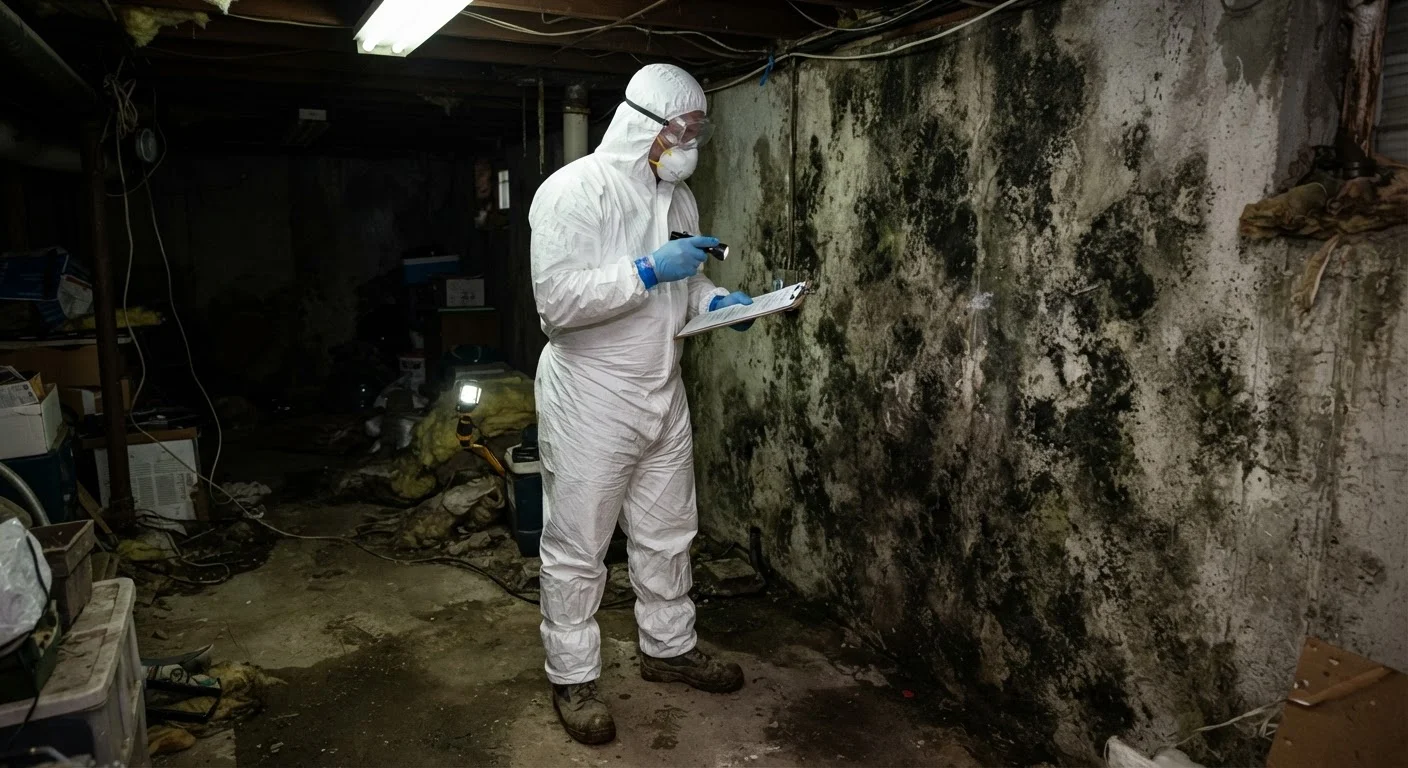
Mold doesn’t negotiate. It doesn’t care if you’re a weekend DIYer tackling a bathroom ceiling or a remediation pro handling a basement disaster—spores get where they can, and your lungs, skin, and sinuses pay the price if you’re unprotected.
Match your coveralls to the contamination level: Type 6 for a small job, Type 5 for anything sprawling or toxic. Never skip the N95-or-better mask, and treat gloves and goggles as essential.
Disposable coveralls for mold removal are the difference between a clean job and a costly, itchy regret.
So before you rip into that moldy drywall, gear up properly. Browse Morntrip’s coverall lineup and find the fit and protection level that matches your project.





