
A surgeon Scrubs in, snaps on gloves, double-checks the sterile field, then reaches for a surgical cap that leaves both ears exposed. Infection control data says that sliver of uncovered hair near the ear canal has been flagged in contamination studies. That is why AORN guidelines require covering the ears, not just wearing a cap.
Not all caps are built the same. A bouffant cap and a traditional skull cap handle ear coverage differently, and in a live OR that difference is bigger than most training manuals suggest. The guidelines explain why ear coverage ties directly to sterile field integrity and how to tell whether the cap your facility stocks is doing its job. If you stock the right cap, that moment of doubt mid-scrub-in about whether a cap should be tucked goes away.
Should A Surgical Cap Cover The Ears? (Quick Answer)

No, not anymore, not officially. AORN guidelines from 2014-2018 did say caps must “completely cover the ears, scalp skin, sideburns, and nape of the neck.” That single sentence became gospel in a lot of ORs. But the current AORN Guideline for Surgical Attire walks it back. The updated language states: “No recommendation can be made for covering the ears.” That’s a real shift—from mandate to open question.
The American College of Surgeons went further, joining a multi-society statement that flat-out says ear coverage “is not supported by sufficient evidence” and can be “counterproductive” for surgeons and anesthesiologists who need clear hearing and unobstructed movement.
AORN’s own senior director, Lisa Spruce, has publicly hinted that the next revision will plainly state that ears don’t need to be covered. Research on ear coverage and surgical site infection (SSI) rates has been inconclusive.
What’s still non-negotiable: full scalp coverage, all hair contained, and sideburns and nape covered when they’re loose enough to shed.
Ears are labeled a “potential reservoir for pathogens”—but reservoir status isn’t the same as proven risk. That distinction matters when you’re stocking OR hats.
Evidence and Guideline Logic for AORN and Infection Control Guidelines

Most people skip this part, but AORN doesn’t just publish rules. Every recommendation sits inside an Evidence Table with study type, sample size, intervention versus control, outcome, and a consensus score that tells you how confident the expert panel actually is. That score matters. High consensus means airtight evidence. Low consensus means the recommendation leans closer to “best guess” than “proven fact.” Ear coverage has been sitting in that lower-confidence zone for years.
Why “cover all exposed skin” became the baseline logic
AORN’s broader PPE framework was built for high-risk exposure zones like sterile processing. It says protective gear should cover all exposed skin, not just visible contamination points. The reasoning: skin and hair aren’t just barriers against splashes. They shed microorganisms. Hair gets flagged specifically because environmental microbial studies show uncovered hair raises airborne colony counts in the OR. That’s the evidence AORN leans on for full hair containment. Not a single ear-specific trial, but a body of surface and airborne-contamination research folded into the guideline’s supporting data.
Where WHO and CDC diverge from AORN
WHO’s Global Guidelines for SSI Prevention list surgical caps as one of 26 recommended perioperative measures, framed around reducing hair and skin flake shedding. But WHO’s language stays principle-level: “control hair and dander,” without spelling out ear-specific coverage rules.
CDC takes a similar stance. Cover hair, reduce microbial shedding, but leave ear coverage to institutional policy. Neither body treats the ear as a standalone risk category the way older AORN language once implied.
AORN’s differentiator is operational depth. Instead of stopping at “cover hair,” AORN pushes facilities to build risk-based checklists. Inspect hair and skin exposure before scrubbing in. Verify cap fit. Standardize the sequence of putting on PPE.
The mask -strap detail nobody talks about
Ear-loop masks and goggles use the ear and temple as anchor points. Every time someone adjusts a mask strap or pushes up goggles, that motion sweeps across ear-adjacent hair and skin, displacing exactly the coverage a cap was supposed to provide. That’s a mechanical contamination pathway most training programs never mention, and it’s a strong argument for choosing cap designs where the ear sits fully inside the fabric, not underneath a strap.
Bouffant Surgical Cap vs Skull Cap: Ear Coverage Comparison
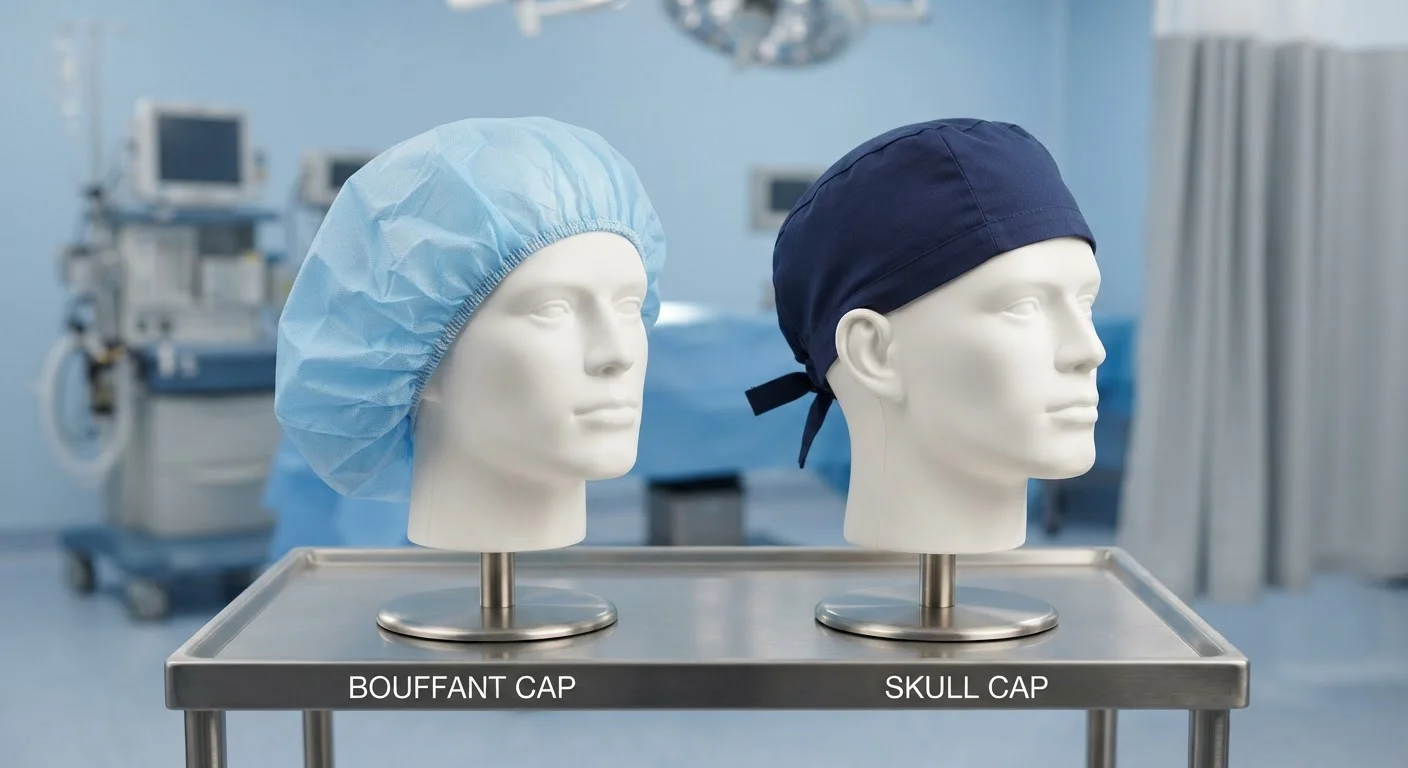
Pull apart the two most common OR hats and the ear-coverage debate gets a lot less abstract.
A disposable bouffant cap is built mushroom-style, with a full elastic perimeter and spunbond PP fabric ranging from 10 to 30 gsm. It comes in S/M/L/XL, so the elastic band can seal around the skull base and ear line regardless of head size. The design tucks temples, sideburns, nape, and ear canal under fabric. “No hair visible at any angle” is the standard most cleanroom and surgical protocols use to judge fit.
A skull cap works differently. It’s tailored, fitted, and often tied at the back instead of elasticized all the way around. Top and side hair coverage is solid, but the ear itself usually sits exposed or half-exposed by design.
Fabric testing shows cloth skull caps have smaller average pore size and lower particle penetration than disposable bouffants. One passive-settling study found bouffants shed more microbial colonies than skull caps, despite covering more skin. Full coverage does not automatically mean better barrier performance.
SSI data backs that up. A multicenter study found bouffant caps carrying an 8% SSI rate versus 5% for skull caps (p=0.016). But once researchers adjusted for surgery type, that gap disappeared. Another study spanning over 15,000 Class I procedures found mandating a switch from skull caps to bouffants produced no measurable SSI reduction.
Speech matters too. Bouffant caps paired with masks measurably reduced speech intelligibility in OR noise conditions (p<0.05). Skull caps, leaving ears partly open, did not show that same communication penalty.
One institutional wrinkle: AORN ’s 2016 language technically restricts skull caps in semi-restricted zones, requiring bouffant-style coverage instead. That is separate from the newer “no recommendation” stance on ears specifically.
Why does ear coverage matter in the OR?
A scrub nurse does a final headcheck before the patient rolls in. She’s not looking at the surgeon’s technique. She’s looking at hair — specifically, whether any strand near the ear is about to fall onto the sterile field. That thirty-second check is where surgical hair covering standards actually live. Not in a policy binder, but in a mirror, right before the case starts.
The real-world rule is simple: once the cap is on, you shouldn’t see any hair. Full stop. That’s the practical test infection control teams use, and it’s paired with another rule you’ll notice in every OR — no earrings, no watches, no rings. Ears, hairline, and neck all get treated as the same category: contamination risk points.
Where uncovered ear hair causes problems
Skipped ear coverage doesn’t just violate a checklist. It creates specific exposure risks near the sterile instrument table, open implant or graft preparation zones, incision edges and drape borders, and the ear canal and post-auricular incisions during otologic procedures.
That last one matters most. In middle ear surgery, the tympanic membrane is the only barrier separating the middle ear from the outer ear canal. If it ruptures, patients face recurring infection, drainage, and hearing loss. Post-op instructions for ear surgery are blunt about this — keep the ear dry, keep water off the wound, control drainage and pain. That’s how sensitive this anatomy is. A stray hair near the incision isn’t a hypothetical.
Beards, sideburns, and why size matters
Long sideburns don’t stay put under a fitted cap . Neither does a full beard near the jawline and cheek. A standard skull cap often can’t hold that boundary once someone turns their head mid-case. A larger bouffant cap earns its keep here — more room to fully enclose sideburns, post-auricular hair, and hairline without gapping after movement or sweat.
A 15-second pre-op check
Before the patient enters:
-
Check front, side, and back angles.
-
Confirm no hair at the ear rim, behind the ear, or at the sideburns.
-
Have the wearer look down, up, then turn head both directions.
-
Recheck the ear zone.
If hair shows at any angle, swap for a larger bouffant cap immediately.
And because covering the ear does reduce speech clarity in a noisy OR, pair that coverage with slower, clearer verbal confirmations — not less coverage.
How to Choose Compliant Surgical Caps/Head Covers (Buying Guide)
Six parameters separate a compliant cap from a liability. Skip any one, and you’re gambling with sterile field integrity.
Ear coverage spec. Look for explicit language: “covers hair, ears, sideburns and nape.” The elastic edge must sit at the ear line, not the forehead. That’s the difference between full coverage and false confidence.
Elastic performance. The band should stretch ≥100% without tearing and rebound ≥85%. Test it yourself: wear it for 2-4 hours. Red marks or ear pain mean the fit failed, not the wearer.
Capacity for hair volume. Long or thick hair needs a bouffant cap with enough dome space to hold a bun without pressing into the scalp. Short hair fits a skull cap fine; there’s no bulk to contain.
Material weight. nonwoven fabric, ≥25 g/m² per YY/T 0313-2014. High-risk implant procedures push that to 25-30 g/m² fluid-resistant, low-lint stock. Anything lighter works for routine outpatient work and nothing else.
Structural check. No holes, no loose stitching, seams sealed flat with no bubbling. Batch-inspect at least 1% or 50 units before use.
Regulatory paperwork. Sanitation license, inspection certificate, expiration date, intact packaging. Expired or torn packaging gets tossed, no exceptions.
When Bouffant Is Non-Negotiable?
Class I incisions, implant surgery, mixed-hair-length teams, laminar flow ORs. Bouffant only. Skull caps stay in play for short-haired staff doing low-risk, non-implant work, provided facility policy signs off.
Morntrip ‘s Full Coverage line labels this clearly: coverage level, recommended use, ear-fit verified. Procurement teams stop guessing and start matching cap to case.
Frequently Asked Questions About Surgical Cap Ear Coverage
Policy gaps are where most cap-compliance mistakes happen. They live in the space between what a document says and what actually gets enforced on a Tuesday morning shift change. Here’s what to do with that gap.
Q: Does every OR require ear coverage, or does it vary by facility?
It varies — a lot. Country, hospital, department, even shift supervisor. Check your facility’s infection control manual first. If it says “cover ears” explicitly, that settles it. If it just says “minimize exposed hair and skin,” treat ears as a high-risk zone anyway. Most Level I trauma centers and high-acuity departments, cardiac, ortho, joint replacement, default to full ear coverage in practice, even when the written policy is vague. Non-compliance there gets flagged in audits.
Q: Will covering my ears mess with hearing or team communication?
Subjective hearing loss under a standard nonwoven bouffant sits around 0-5 dB, comparable to ambient OR noise. The real friction is habit. New wearers feel muffled for a shift or two, then adjust. Fix it with louder baseline volume, facing your teammate when you speak, and read-back confirmation on critical instructions. Run your own test: compare covered vs. uncovered ears during a mock noisy scenario, score clarity 1-5. If the gap is one point or less, it’s a non-issue.
Q: My department hasn’t updated its ear-coverage policy. What do I do in the meantime?
Default to the strictest option. Wear a bouffant cap. Flag the gap to your infection control committee afterward so it gets written into policy instead of left to guesswork.
Q: How do I know if my current cap is actually doing its job?
Three-point mirror check:
1. No hair visible, any angle.
2. Both ears fully inside the cap.
3. No loose strands at the sideburns or nape.
Fail any one, swap for a larger bouffant immediately.
Q: Why do high-risk procedures push bouffant caps specifically?
Ear-adjacent skin sheds more dander than forehead or scalp skin. Add earrings or studs, and you’ve got a contamination magnet sitting inches from the sterile field. Bouffants close that gap entirely — hair and ears, one seal.
Conclusion
Ears are not optional real estate in the OR. AORN guidelines are clear, and the evidence backs it up: hair near your ears sheds bacteria that has no business near a sterile field. That’s why a bouffant cap consistently outperforms a skull cap when full coverage is the goal.
If you’re auditing your facility’s OR dress code, focus on compliance first. If you’re a nurse, surgeon, or procurement lead deciding between disposable and reusable options, choose the surgical cap style that leaves zero exposed hair, zero guesswork, and zero risk to the sterile field.
Morntrip’s full-coverage bouffant caps are built exactly for this standard. Your patients’ safety should depend on the science, not a style preference. Cover the ears every time.





