
Behind every reliable surgical cap sitting on an operating room shelf is a manufacturing process most buyers never see—and that’s exactly the problem. When you’re sourcing disposable surgical caps for a hospital network or evaluating a new supplier for private-label production, specs on a product page only tell half the story. What actually separates a compliant, comfortable surgical cap from one that fails mid-shift?
This guide pulls back the curtain on how surgical caps are actually made, from raw non-woven fabric selection through cutting, sealing, quality control, and final packaging. You’ll see where quality control happens, why some factories choose ultrasonic sealing over traditional sewing, and what specifications actually matter when you’re comparing manufacturers. If you’re making a sourcing decision, this is the process knowledge that helps you ask the right questions before you sign a purchase order.
Selecting Materials for Surgical Cap Production
Every surgical cap starts as a roll of fabric on a shelf. The gsm number stamped on that roll determines almost everything downstream: breathability, barrier performance, and ultimately whether a hospital’s infection control team approves it for use.
PP Spunbond vs. SMS Nonwoven Fabric
Most disposable surgical caps are built from one of two nonwoven fabrics:
-
PP (Polypropylene) Spunbond — 10–40 g/m². Export-grade medical caps often list 20–40 gsm. This is the go-to fabric for doctor caps and bouffant-style caps with ties or elastic bands.
-
SMS (Spunbond-Meltblown-Spunbond) — a three-layer composite running 25–65 g/m². The meltblown middle layer gives SMS significantly better bacterial and liquid barrier compared to plain PP.
The weight range dictates the use case:
|
Fabric & Weight |
Breathability |
Protection Level |
Best Fit |
|---|---|---|---|
|
PP 10–25 g/m² |
High |
Basic particle control |
Visitor caps, general ward, outpatient use |
|
PP 20–40 g/m² |
Moderate |
Basic strength/liquid resistance |
General doctor caps, standard OR (non-critical) |
|
SMS 25–45 g/m² |
Lower |
High bacterial/fluid barrier |
Standard surgeon caps |
|
SMS ≥45–65 g/m² |
Lowest (denser) |
Highest barrier |
High-infection-risk departments (ortho, cardiac) |
Factories designing surgeon-style caps for high-splash environments target ≥35 g/m² SMS, matching the barrier logic used in surgical gown standard YY/T 0506.2.
How Fabric Weight Affects Surgical Cap Performance?
Weight alone doesn’t guarantee quality. Factories test tensile strength at incoming inspection:
|
Nominal Weight (g/m²) |
Machine Direction ≥ (N) |
Cross Direction ≥ (N) |
|---|---|---|
|
15 |
10 |
7 |
|
20 |
20 |
14 |
|
25 |
20 |
14 |
|
30 |
30 |
23 |
|
40 |
37 |
27 |
|
50 |
52 |
45 |
Weight deviation tolerance is fixed at ±10% against the labeled gsm, tested per GB/T 4669, with strength verified via GB/T 3923.1.
Microbial & Cleanliness Requirements
Before any fabric enters production, it needs to clear baseline hygiene thresholds:
-
Bacterial colony count: ≤200 CFU/g
-
Fungal colony count: ≤100 CFU/g
-
E. coli, Pseudomonas aeruginosa, Staph aureus, hemolytic streptococcus: not detectable
-
EO residue (if ethylene oxide sterilized): ≤10 μg/g (≤10 mg/kg)
Reusable Surgical Cap Fabric: Cotton & Poly-Cotton
For hospitals running their own laundry/sterilization loop, reusable surgical caps use woven fabric instead of nonwoven:
-
65/35 or 50/50 poly-cotton blend is standard; pure cotton offers more comfort but weaker heat resistance.
-
Fabric weight: 160–200 g/m², balancing coverage, strength, and wash durability.
-
Colorfastness: grade ≥3–4, resisting fading from sweat and friction.
-
Wash cycle durability: 50–100 washes at 60–90°C without fraying or holes.
-
Autoclave tolerance: ≥50 cycles at 134°C (2–5 min).
-
Shrinkage after washing: ≤3–5% in both directions — critical for maintaining fit.
Incoming Inspection: Where Supplier Discipline Shows
A serious manufacturer doesn’t take a fabric roll at face value. Standard incoming checks include:
-
Weight verification — 5+ samples pulled per batch, must fall within ±10% of labeled gsm
-
Tensile testing — machine and cross direction, minimum 5 sample sets per batch
-
Visual inspection — no holes, clumping, hard spots, discoloration, oil stains, or mold
-
Microbial testing — per GB 15979 Appendix B
-
Biocompatibility documentation — skin irritation and sensitization reports per GB/T 16886 (ISO 10993)
Cost Tiers and What They Buy You
Material choice is a budget-and-risk decision:
-
Low-gsm PP (10–20 g/m²) — cheapest option, fits visitor/general ward use.
-
Mid-gsm PP (20–40 g/m²) — standard doctor caps, moderate protection.
-
Low-mid SMS (25–45 g/m²) — runs 20–40% higher cost than equivalent PP, but adds real barrier performance for standard surgical use.
-
High-gsm SMS (45–65 g/m²) — another 15–30% price jump, reserved for high-infection-risk departments.
-
Woven cotton/poly-cotton reusable caps — higher unit price, but amortized over 50–100 uses, often cheaper per-wear than premium SMS — provided the hospital has laundering infrastructure in place.
For buyers sourcing at scale — say, over 10,000 units a month for general ward use — 10–20 gsm PP bouffant caps with verified incoming inspection data is usually the right call. Specialty surgical hospitals should be writing minimum SMS gsm and barrier test results into the purchase agreement, not assuming it.
Cutting and Forming the Surgical Cap
A quarter-millimeter mistake here, repeated across six panels, adds up to a cap that doesn’t fit right. That’s the reality of turning flat rolled fabric into a three-dimensional surgical cap: precision compounds, for better or worse.
Die-Cutting vs. Slitting: Two Paths to the Same Panel
Factories cut roll goods one of two ways. Slitting (rotary blade) holds width tolerance around ±0.05–0.15mm on standard lines, tightening to ±0.03–0.05mm on premium setups. Burr height stays under 0.03–0.05mm when blade shafts run true. Die-cutting (mechanical or servo-fed) handles length dimensions. Basic machines land within ±0.5–1.0mm; servo-assisted units tighten that to ±0.2mm.
A ±0.5mm error on one panel, multiplied across 4–6 panels stitched together, can push a stated 58cm head circumference to 57 or 59cm. Reputable factories hold batch-to-batch head circumference variance to ≤±1cm. That means panel cutting has to stay in the ±0.3–0.5mm range, backed by servo feeding and fixed die positioning.
Pleating: Where Capacity Gets Built In
Bouffant-style caps rely on pleating to create hair-storage volume without oversizing the fit. A 60cm panel with 20 regular pleats (10mm width, 50% depth) can expand to roughly 70cm at the crown, about 20–40% more internal volume than the stated head size suggests. Pleat spacing typically runs 10–20mm; too tight and the cap turns stiff, too loose and volume drops. Forehead zones stay pleat-light (under 25% depth) to keep contact pressure below roughly 2 kPa, which is comfortable for extended wear.
Elastic Channel & Tie Placement
Channel width needs to run 1.5–2.5mm wider than the elastic or tie itself: an 8mm elastic band needs a 10–11mm channel, not a snug fit. Fold height typically sits at 8–12x material thickness. Elastic bands themselves are pre-tensioned to 80–90% of target head circumference, with a 10–20% stretch margin. That is enough to hold the cap secure without leaving a pressure mark after a six-hour shift.
Joining the Fabric: Ultrasonic Sealing vs. Traditional Sewing
Three seconds. That’s roughly how long it takes to weld a disposable surgical cap shut on a modern ultrasonic production line. A single-point fusion happens in under 0.3 seconds. Traditional sewing can’t touch that speed, and it isn’t supposed to.
Ultrasonic sealing uses high-frequency vibration to generate localized heat at the material’s contact points, fusing polymer fibers under pressure into a seamless, pinhole-free bond. It’s built for thermoplastic synthetic fibers, though blends with up to 40% natural fiber content can still run through the process. You get clean edges, no thread, and no needle holes. That’s exactly what you want for disposable, non-woven surgical caps and doctor caps produced at scale. No stitching also means no needle changes, no thread breaks, no consumable waste piling up on the line.
Traditional sewing runs on a different sequence: panel positioning, stitching, elastic/tie installation, edge binding, and inspection. Reusable scrub caps often add rolled or bound edges to improve wash durability and comfort. This method wins on flexibility. It handles multi-size runs, custom prints, structural reinforcement, and odd-shaped panels that ultrasonic tooling can’t handle economically.
Seal Strength & Hygiene: The Real Difference
The pinhole issue matters more than it sounds. Sewn seams create needle holes plus a bulky overlapping layer. Both weaken structure and open a path for liquid, particulate, or bloodborne pathogen penetration. Ultrasonic seams skip that entirely, producing high-strength, high-integrity bonds with no mechanical perforation for microbes to hide in.
Which Process Fits Your Order?
Ultrasonic sealing works best for disposable surgical caps, bouffant caps , and non-woven protective caps. It prioritizes speed, appearance, pinhole-free hygiene, and batch consistency. It’s ideal for continuous lines running 50–100 pieces per minute on thermoplastic non-woven fabric.
Traditional sewing suits reusable scrub caps, fabric surgical caps, and custom medical headwear. It prioritizes adjustable fit, structural strength, and hand-finished detail. It’s best for small-batch, sampling, or custom orders needing rolled edges and manual shaping.
Quality Control Throughout Surgical Caps Production
One in a million. That’s the failure rate a sterile surgical cap has to hit — a Sterility Assurance Level of 1×10⁻⁶, meaning no more than one unsterile unit per million produced. Getting there is required by regulation.
Sterile vs. Clean Non-Sterile: Two Different Rulebooks
Not every surgical cap needs terminal sterilization. Sterile surgical caps — the kind used in ORs and catheter labs — go through gamma or EtO sterilization and must show zero detectable microorganisms. Clean non-sterile caps, worn in general wards or by visitors, skip terminal sterilization entirely. They only need to clear a microbial limit of ≤200 CFU/piece, with no pathogenic organisms detected.
On-Line QC: Three Checks That Catch Problems Early
-
Seam strength — pulled at 1–5% of each batch or 10+ pieces per hour, tested at 75–100mm grip distance, with a ≥30N pass threshold on cross-direction pull.
-
Elastic band adhesion — minimum 10 samples per batch, tested at 100mm per minute pull speed, ≥15–25N before separation. Premature peeling means insufficient adhesive or wrong stitch pitch.
-
Circumference tolerance — standard sizing runs 54–62cm, checked against a ±1.0–1.5cm window, with first-piece and hourly sampling (5+ units) to catch drift before it becomes a batch issue.
Gamma Irradiation vs. EtO: Choosing the Sterilization Method
Gamma (Co-60) runs 15–35kGy, ideal for high-volume nonwoven caps, with dose uniformity ratio kept ≤1.3. EtO operates at 37–55°C, 40–80% humidity, with residue capped at ≤10μg/g per GB/T 16886.7. It works better for layered or heat-sensitive builds, though cycles stretch to a week including aeration.
Factories certified to ISO 13485 document this entire chain — raw material through sterilization confirmation — with batch-level traceability codes.
Packaging, Labeling & Traceability
A sterile surgical cap that can’t be traced back to its lot number is a liability sitting in a warehouse, not a finished product. Packaging is the physical carrier for the traceability data buyers need when something goes wrong.
Two-Layer Packaging: Individual Pouch + Carton
Standard configuration uses inner packaging (a medical-grade individual sealed pouch) plus outer packaging (a carton box). This design binds the minimum traceable unit to the logistics unit. Traceability runs on a lot/batch basis, linking the finished cap back to its raw material source, production line, and sterilization process.
What Belongs on the Label?
A compliant label generally carries at minimum:
-
Material and specification
-
Lot/batch number
-
Production and expiry dates
-
Packaging tier (pouch/carton)
-
Status (sterile/unopened)
The lot number acts as the connecting field. It effectively links the raw material batch, production batch, and finished goods batch into one unbroken chain.
Why It Matters: Recall Ability?
This is where strict pouch/carton traceability proves its value. If a quality issue ever surfaces, this tracking mechanism allows a factory or hospital procurement team to use the exact lot number to locate the affected batch within hours. They can immediately freeze any remaining inventory and precisely define the recall scope. Instead of discarding perfectly good stock, facilities just trace the specific lot backward through the manufacturing process to identify and fix the root cause.
Key Specifications Buyers Should Verify Before Ordering
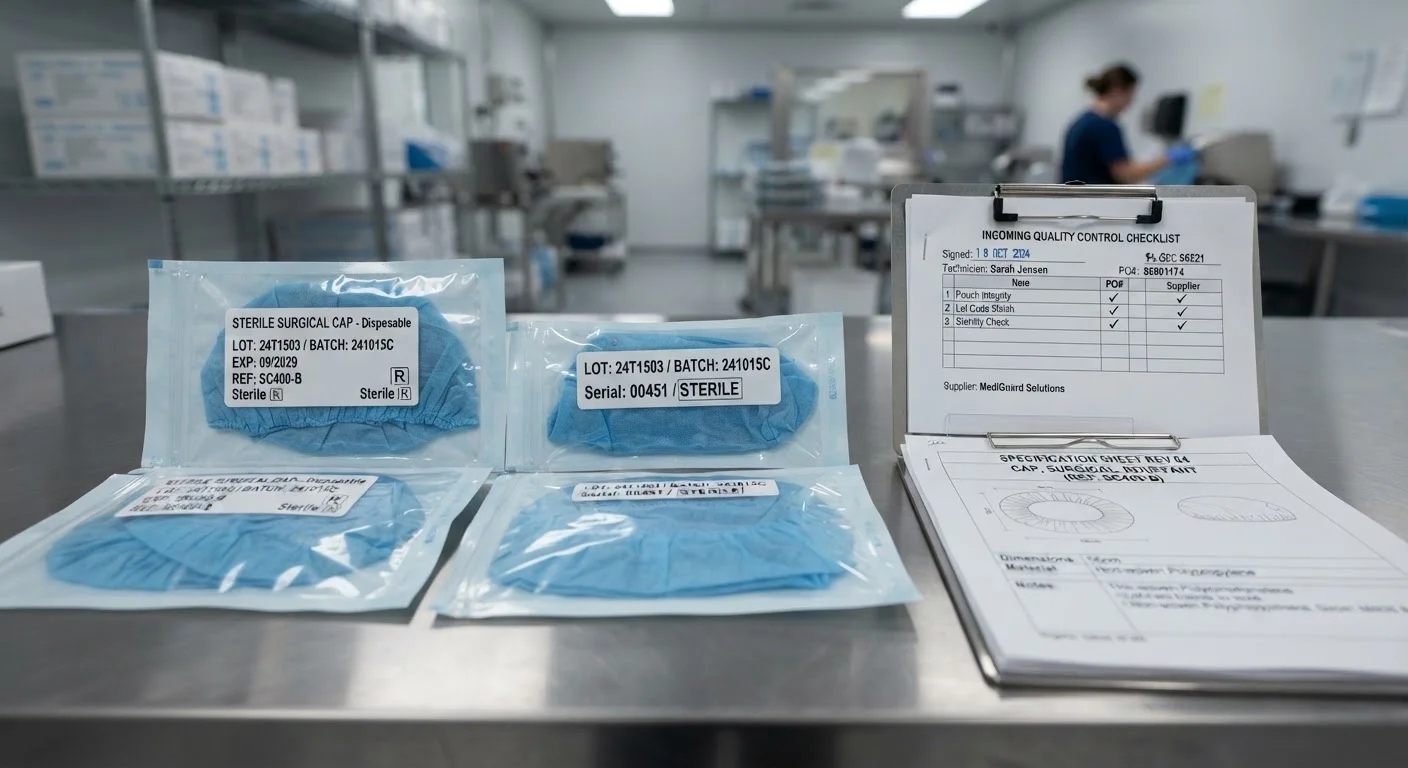
A supplier’s spec sheet means nothing until you’ve asked for the paperwork behind it. Before signing a PO, run every quote against this checklist.
Documentation to Request
-
Material spec sheet : exact gsm value with tolerance (e.g., 25±2 g/m²), plus PP/SMS structure confirmation.
-
Production method statement : written confirmation of sealing type—ultrasonic (with equipment model) or stitching (with thread gauge and stitch pitch range).
-
Sterile status : EO or gamma, with residue test results (target ≤10 μg/g) and batch verification report.
-
Microbial report : bacterial count, fungal count, and confirmation that E. coli, Pseudomonas, Staph aureus, and hemolytic streptococcus are not detected.
Dimensional Tolerances by Cap Style
Don’t accept vague sizing. Get style-specific numbers in the contract:
|
Cap Style |
Nominal Size |
Tolerance |
|---|---|---|
|
Flat cap |
140×640mm |
±10% length/width |
|
Bar cap |
520×520mm |
Elastic 400mm ±10% |
|
Round cap |
Φ300mm |
Elastic 455mm ±10% |
Tie & Elastic Strength
Ask for pull-test data, not just claims: tie strength should hold ≥15N without breaking for 10 seconds, sampled at 1% per batch.
Appearance & Cleanliness Records
Caps need to arrive clean, odor-free, color-consistent, with no skipped stitches, loose threads, or holes. Request the last 12 months of particulate/lint-shedding test records, matched to batch numbers—not just a one-time certificate.
OEM/Private Label Checkpoints
For private-label runs, standard MOQ sits around 5,000–10,000 pieces for basic packaging; complex boxes or multi-language inserts push that threshold higher. Confirm this before committing to design work.
How Production Volume Affects Surgical Cap Manufacturing Methods?
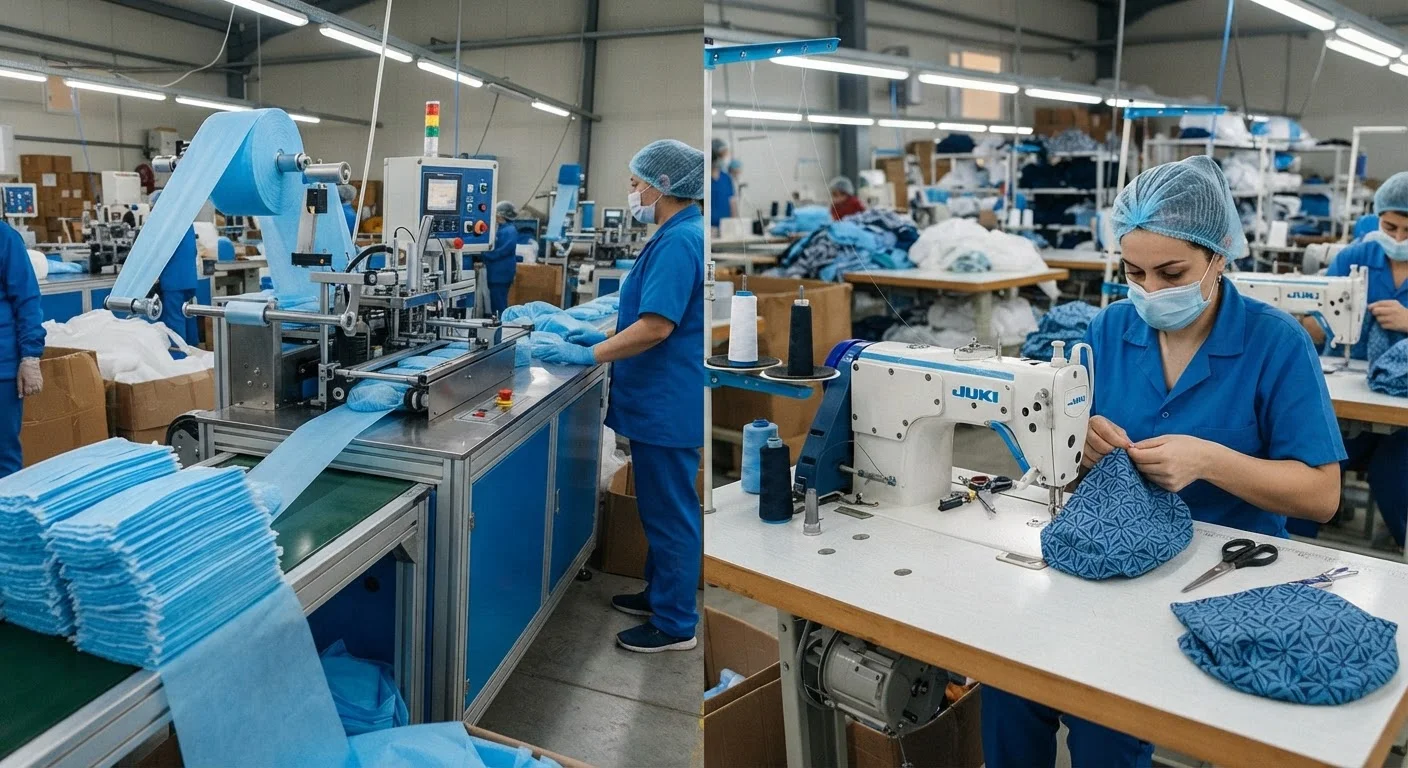
A single ultrasonic line can produce 100 caps in the time a skilled worker finishes three. That gap is the entire story behind machine-made versus hand-made surgical caps. Picking the wrong one costs you money either way.
The Numbers That Separate the Two
|
Metric |
Machine-Made |
Hand-Made |
|---|---|---|
|
Output |
50–100 pcs/min per machine |
3–6 pcs/hour per worker |
|
Daily capacity (single line) |
240,000–480,000 pcs |
24–48 pcs |
|
Labor time per unit |
<2–5 seconds |
10–20 min (custom fabric: up to 30 min) |
|
Material waste rate |
3–5% |
8–15% |
|
Wholesale unit price |
$0.02–0.08/pc (SPP 20–35gsm) |
$3–15/pc |
|
Lead time |
24–72hrs from stock |
3–7 days sampling, 7–21 days production |
That 100–300x price gap between disposable non-woven caps and custom fabric caps means they are different product categories.
Match the Method to the Order
-
Hospital/group procurement (10,000+ units, recurring): go machine-made. Standard specs: SPP /SMS, 20–35gsm, blue/green/white, 100pcs/bag, 10 bags/carton. At $0.03/pc, 100,000 units runs roughly $3,000/month.
-
Clinic branding/department identity (dozens to hundreds): handmade or hybrid wins. Embroidered names, department themes, pediatric prints. Named surgical caps measurably improve team communication.
SSI rates between bouffant and skull-style caps show no statistically significant difference (~8% vs 5%). Order volume and branding need to be decided.
Conclusion
From raw non-woven fabric to a sealed, sterile package, every cap from a serious factory is built on precision. Look for three things in a surgical cap partner: material traceability, sealing method (ultrasonic or sewn), and documented quality control at every stage. Skip any of these, and you’re gambling with compliance, comfort, and your hospital or brand’s reputation.
At Morntrip , we make disposable surgical caps with certified processes and full production transparency. Request a factory audit, ask for batch traceability records, or order a sample run to see the craftsmanship firsthand.
Reach out today. We will show you what goes into every cap before it reaches an OR.





