
Ask three different suppliers for a quote on the same nonwoven fabric, and you’ll likely get three very different numbers—sometimes with a 20-30% gap between the highest and lowest. That’s not always a red flag. It usually means the quotes are based on different assumptions about GSM, PP resin grade, or production run size, and buyers who don’t know what’s driving the difference end up either overpaying or getting burned by a supplier cutting corners.
Nonwoven fabric pricing isn’t random. It follows a predictable structure once you understand what’s inside the cost—raw material sourcing, weight specifications, manufacturing overhead, and broader market swings tied to crude oil and PP resin supply. Once you can break a quote down into these parts, you stop guessing and start negotiating from a position of knowledge. That’s what we’ll walk through here, piece by piece, so the next quote that lands in your inbox makes sense.
The Biggest Factors That Affect Nonwoven Fabric Prices
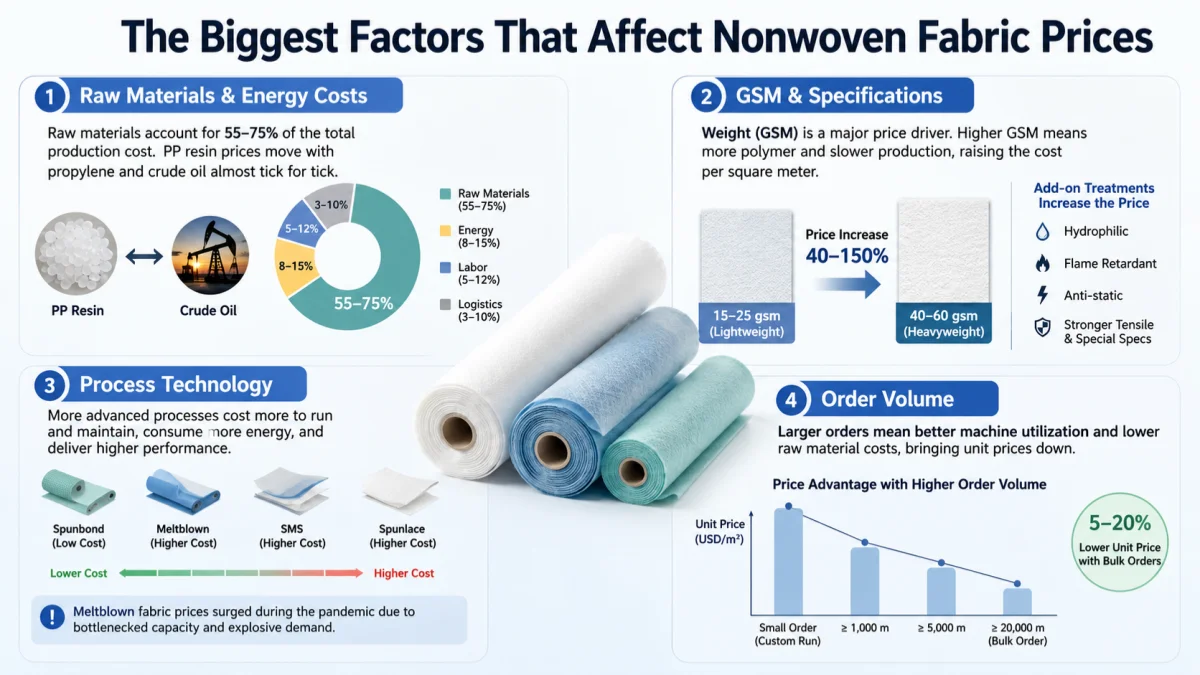
Raw materials sit at the top of every cost sheet. For most commodity hygiene and medical nonwoven fabrics, Polypropylene, polyester, viscose, or PLA accounts for 55–75% of the total production cost. Energy adds another 8–15%, labor runs 5–12%, and logistics eats 3–10%. When PP resin prices move, they move the whole quote—PP tracks propylene and crude oil almost tick for tick. A spike in oil prices doesn’t take weeks to show up in a spunbond nonwoven fabric quote; it shows up in days.
GSM and Specifications Change the Math Fast
Weight is the second biggest lever. Nonwoven fabric price scales almost linearly with GSM. Moving from a light 15–25 gsm fabric to a heavier 40–60 gsm grade pushes the price per square meter up 40–150%, because more polymer goes in and the line runs slower. Add surface treatments like hydrophilic, flame retardant, or anti-static, or tighter tensile strength requirements, and the price climbs again. This is why two suppliers quoting “nonwoven fabric” at wildly different numbers might not be lying to you. They might just be quoting different weight classes.
Process Technology Sets a Price Ceiling
Simple PP spunbond stays cheap because the process is fast and capital-light. Meltblown, SMS, and spunlace lines cost more to run and maintain, use more energy, and deliver finer filtration or softness in return. That’s why meltblown fabric price jumped so sharply during the pandemic—bottlenecked capacity met surging mask and gown demand, and prices had nowhere to go but up.
Order Volume Rewrites the Unit Price
Scale matters more than most buyers expect. One major Chinese producer sets a minimum order of 1,000 meters, and unit price drops meaningfully above that threshold. Industry benchmarks put the swing between small custom runs and bulk orders at 5–20%—driven by better machine utilization and lower per-unit procurement cost on raw material.
Raw Materials: Why PP Resin Has the Biggest Impact on Price
Every nonwoven fabric quote traces back to one number: the price of polypropylene resin. PP resin isn’t just an input—it’s the input. Industry pricing models break PP resin cost into three parts: propylene monomer (50–70%), conversion costs like energy and labor (10–20%), and margin (5–15%). Propylene is called the “number one determiner” of PP prices for a reason—PP is made almost entirely from this single monomer, and it moves in near lockstep with propylene, often within weeks.
That tight linkage explains why raw materials account for 70–80% of total manufacturing cost in downstream plastics. So when PP resin climbs 20%, total production cost can rise 14–16%, even if labor and overhead stay flat.
Crude Oil to PP Resin: A Direct Chain Reaction
The chain runs from crude oil to naphtha to propylene to PP resin, and it moves fast. Sustained crude moves of $10–15 per barrel typically show up in resin prices within days to weeks. The numbers from early 2026 make this concrete: PP prices surged 28.8% after a 50% jump in feedstock costs. Polymer-grade propylene spot hit 51 cents/lb, up more than 50% in a single month. During the Iran-US conflict, feedstock costs jumped roughly 60%, spot premiums reached Rs 100/kg, and Indian PP prices hit $1,600/tonne—$300–350/tonne above Southeast Asian benchmarks.
Regional gaps tell the same story. March 2026 benchmarks put PP at $1.01/kg in Northeast Asia, $1.57/kg in Europe, $1.08/kg in India, and $1.24/kg in North America—all reflecting local crude and propylene conditions, not manufacturing differences.
What This Means for Your Purchasing Strategy?
Track propylene spot prices, not just finished fabric quotes. When propylene drops more than 10%, push suppliers for equivalent PP resin fabric price cuts within 4–6 weeks—the linkage is documented and fast enough to justify it. Feedstock-indexed pricing formulas tied to published propylene indices remove the guesswork and keep quotes honest on both sides.
Product Specifications Can Change the Price More Than You Think
A single certification checkbox or a half-meter width change can swing a nonwoven fabric supplier price more than a week of crude oil volatility. Specs work like a menu of add-on charges. Once you see the pricing logic behind them, the “surprise” line items on a quote stop being surprises.
Certifications and Treatments Carry Real Price Tags
OEKO-TEX certification, antibacterial finishing, UV resistance, and flame-retardant treatment each get priced as discrete add-ons. Suppliers typically structure these as a fixed amount per meter, a percentage of the line total, or a tiered surcharge, the same way telecom providers price bandwidth upgrades in steps. A jump from standard to a higher tensile-strength tier can add 5–15% to the line total on its own, independent of GSM or resin cost.
Width, Color, and Packaging Aren’t Free Extras
Custom width cuts, non-standard roll lengths, printed logos, and specialized packaging (anti-static bags, pallet configurations) each carry their own markup formula. Spec differences alone can account for up to 30% of price variation between otherwise similar technical products, and nonwoven fabric follows the same pattern. Two quotes with identical GSM and resin can still land 10-20% apart once you stack three or four of these add-ons.
What to Ask Suppliers to Break Down?
Request a spec-by-spec breakdown. Ask which line items are per-unit fixed fees, which are percentage-based, and which are tiered. That structure turns a black-box quote into something you can negotiate against, feature by feature.
Manufacturing Costs and Order Size
Every production run carries two kinds of cost, and most buyers only see one of them. One cost scales with quantity—resin, energy, labor per unit. The other stays the same no matter how many meters you order. That second bucket is where order size quietly rewrites your nonwoven fabric wholesale price.
Fixed Costs Per Order
Machine setup and changeover time is billed once per order, not per unit. Setup takes 2 hours at $60/hour, so $120 in fixed cost per order, whether you order 100 meters or 10,000. Running time adds on top of that—say 0.05 hours per unit at $60/hour, or $3 per unit variable. On a 100-unit order, total labor is $420, or $4.20 per unit. Scale that to 1,000 units and total labor becomes $3,120, or $3.12 per unit. Same rates, same process, 26% lower unit cost from spreading fixed cost over more volume.
The Double Penalty of Small Batches
Setup cost can eat 10–30% of total labor cost on small runs, compared to under 10% on large ones. Scrap compounds it. A 5% scrap rate on a 1,000-unit order leaves only 950 good units, so the fixed cost per order gets divided across fewer pieces, nudging price up again. Suppliers enforcing MOQs of 500–1,000 units typically quote 5–15% lower unit cost than lot-for-lot pricing, though you’ll carry 2–5x more inventory in exchange. Ask suppliers which lot-sizing rule they use (fixed order quantity, MOQ, or period-based grouping) before comparing quotes side by side.
Market Conditions Also Influence Nonwoven Fabric Prices
Timing matters as much as specs. The same fabric, same GSM, same supplier can cost 15-20% more or less depending on when you place the order—because market conditions shift faster than most buyers track.
Regional Snapshots Tell the Real Story
North America’s Nonwoven Fabric Price Index climbed through Q1 2026 as PP feedstock costs firmed and industrial demand held steady. Spot prices rose again in March on tight availability. Compare that to Asia in early 2025: PP prices drifted down weekly, inventories stayed high, and nonwoven fabric wholesale prices held flat through Lunar New Year despite soft demand. Same commodity, opposite trajectories—driven entirely by regional feedstock and inventory conditions, not manufacturing changes.
Geopolitics Moves Prices Within Weeks
The 2026 Strait of Hormuz crisis pushed naphtha costs up almost overnight, squeezing PP, PE, and PET margins across North America and Europe. Ocean freight surcharges spiked in parallel. Buyers who stockpiled preemptively drained qualified capacity fast, handing suppliers room to push quotes higher. Currency swings—especially USD against CNY or EUR—layer on top, quietly shifting landed cost on every cross-border order.
What This Means for Timing Your Purchase
Historical benchmarks around $1,500–1,600/tonne in tight Asian markets serve as a useful ceiling. If a quote sits well above that with no supply disruption behind it, push back—it’s opportunistic, not market-driven.
How to Tell Whether a Nonwoven Fabric Quote Is Reasonable?

Two numbers on a page mean nothing until you convert them to the same unit. A supplier quoting $2.00/kg for 25 GSM PP spunbond works out to $0.05/m². Another supplier quoting $0.065/m² for the identical spec is roughly 30% more expensive—unless they’re backing it with certifications or a stronger quality guarantee. Before comparing anything else, normalize every quote to cost per square meter.
Run the Cost-Structure Math Yourself
Factory pricing follows a formula: (GSM × raw material $/kg ÷ 1000) + processing + margin + logistics. For 40 GSM PP spunbond at $1.40/kg resin, material alone lands near $0.056/m². Add processing ($0.02/m²) and margin plus logistics ($0.02–0.04/m²), and a reasonable FOB window sits at $0.096–0.116/m². A quote at $0.03/m² for that same spec means downgraded resin or shaved GSM.
Verify GSM on the Actual Sample
Cut a 10cm × 10cm square, weigh it in grams, and multiply by 100. That’s your real GSM. If a supplier quotes 40 GSM and your sample weighs in at 30–33 GSM, you’re paying full price for fabric that’s 20–25% lighter than promised.
Build a Reasonable Band, Not a Single Number
Fix one exact spec—polymer, GSM, width, strength—and collect three or more quotes for it. Normalize all to $/m². Exclude anything more than 25–30% off the cluster without clear justification. What’s left is your market band. A quote 15–20% below that band needs a factory audit before you trust it. One 15–20% above only earns its premium with proven QC or delivery reliability behind it.
When the gap between two quotes sits under 10%, stop comparing price. Start comparing track record—ISO certification, years in the specific nonwoven type, documented output. That 5–10% premium usually costs less than one bad shipment.
FAQ About Nonwoven Fabric Prices
How much does nonwoven fabric cost per kilogram?
Generic nonwoven runs $2–5/kg globally for common grades. Organic or specialty eco fabrics push past $5/kg. In India, standard PP spunbond starts around ₹85–99/kg.
What’s the price per square meter?
Worldwide, you’re looking at $0.50–5.00/m² depending on GSM and treatment. Bulk Indian spunbond (15–50 GSM) is ₹20–50/m². Meltblown climbs to ₹50–100/m². Needlepunch sits at ₹30–70/m².
What does 50 GSM cost per meter?
A 50 GSM, 160cm-wide PP spunbond roll prices around ₹8/meter. Back-calculate that, and you get roughly 0.094 kg of fabric per meter.
How do I convert ton pricing to per-m²?
Use this formula: (ton price ÷ 1000) × (GSM ÷ 1000). At $1,500/ton and 50 GSM, that’s about $0.075/m².
Which nonwoven type is cheapest?
Standard PP spunbond. Continuous production and lower resin demand keep it below meltblown and needlepunch every time.
Conclusion
Nonwoven fabric prices aren’t random. Every quote reflects PP resin costs, GSM specs, order volume, and market conditions. Once you understand how those pieces fit together, you stop guessing and start negotiating from a position of knowledge.
That’s the real advantage. When you know why nonwoven fabric prices fluctuate, you can time your purchases smarter, spot an inflated quote in seconds, and push back with facts instead of frustration.
So don’t take the next supplier price at face value. Compare it against what you now know about raw materials, specs, and market timing — then reach out to a team that can walk you through your specific requirements.
Ready to get a quote that actually makes sense? Contact Morntrip ‘s team for transparent, data-backed pricing on your next nonwoven fabric order.





