
You’ve just pulled a tray of something hot and delicious from the oven, and your kitchen mitts are nowhere in sight. So you grab the rubber gloves by the sink instead. Smart move—or a one-way ticket to a burn?
Not all rubber gloves handle heat the same way. Some laugh in the face of scalding water. Others start melting the second they meet a hot pan. So, are rubber gloves heat resistant? The honest answer is “it depends,” and that’s what we’re unpacking here.
We’ll look at the science behind glove materials and temperature thresholds, compare how nitrile stacks up against latex (and everything in between), and walk through real scenarios—steam, hot oil, boiling water—so you know which glove to reach for, and when.
Understanding Rubber Glove Heat Resistance: Material Science and Temperature Limits
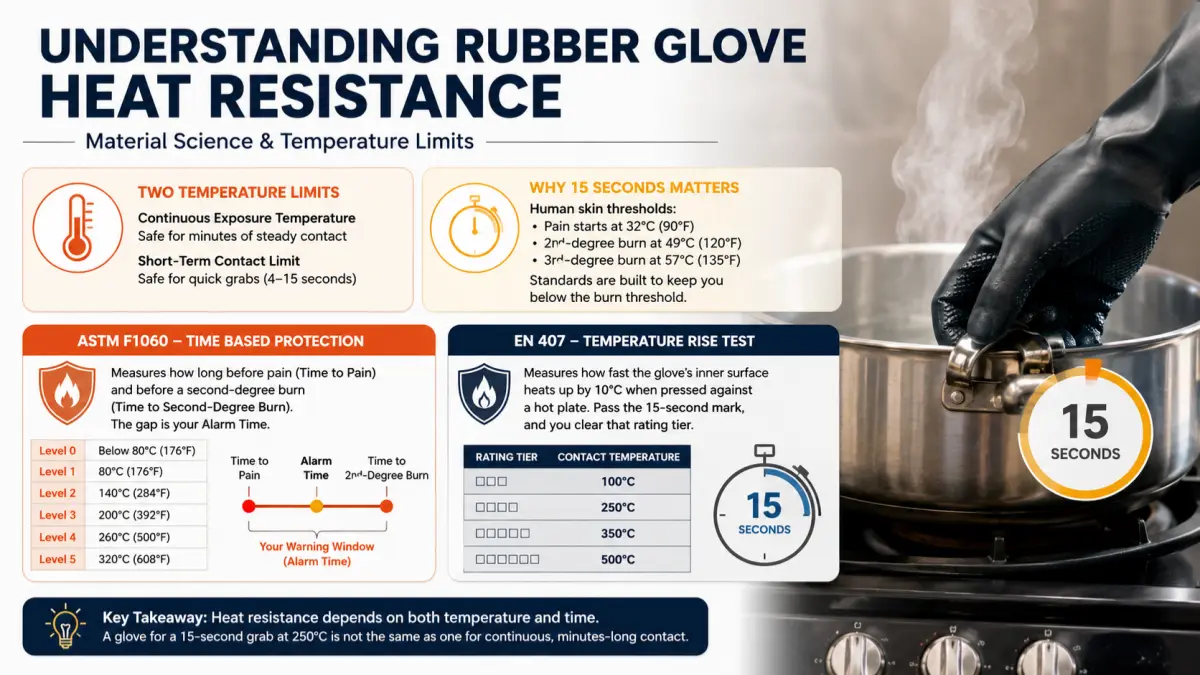
“Heat resistant” isn’t one number. It’s two, and mixing them up is exactly how kitchens end up with singed fingertips.
Continuous exposure temperature is how hot something can get while you’re touching it for minutes at a time, with no breakdown, no melting, no drama. Short-term contact limit is different—it’s the ceiling for a quick grab, usually 4 to 15 seconds, before the material fails or your skin does.
Standards testing bodies actually measure this. Two matter most:
ASTM F1060 rates gloves by how long they protect you before pain (Time to Pain) and before a second-degree burn (Time to Second-Degree Burn). The gap between those two moments is called Alarm Time. That’s your body’s warning window.
Level 0: below 80°C (176°F)
Level 1: 80°C
Level 2: 140°C (284°F)
Level 3: 200°C (392°F)
Level 4: 260°C (500°F)
Level 5: 320°C (608°F)
EN 407 works similarly but measures how fast a glove’s inner surface heats up by 10°C when pressed against a hot plate. Pass the 15-second mark, and you clear that rating tier: 100°C, 250°C, 350°C, or 500°C.
Why does 15 seconds matter so much? Because human skin has its own thresholds. Research from Protective Industrial Products shows pain starts around 32°C (90°F), second-degree burns hit around 49°C (120°F), and third-degree burns arrive near 57°C (135°F). Standards are built backward from these numbers. They keep your skin below the burn threshold for that critical window.
So when someone asks “are rubber gloves heat resistant,” the real question is: resistant for how long, and at what temperature? A glove rated for a 15-second grab at 250°C is not the same as one meant for steady, minutes-long contact. That distinction shapes everything else we cover next.
Nitrile vs Latex vs Other Materials: A Comparative Heat Resistance Guide
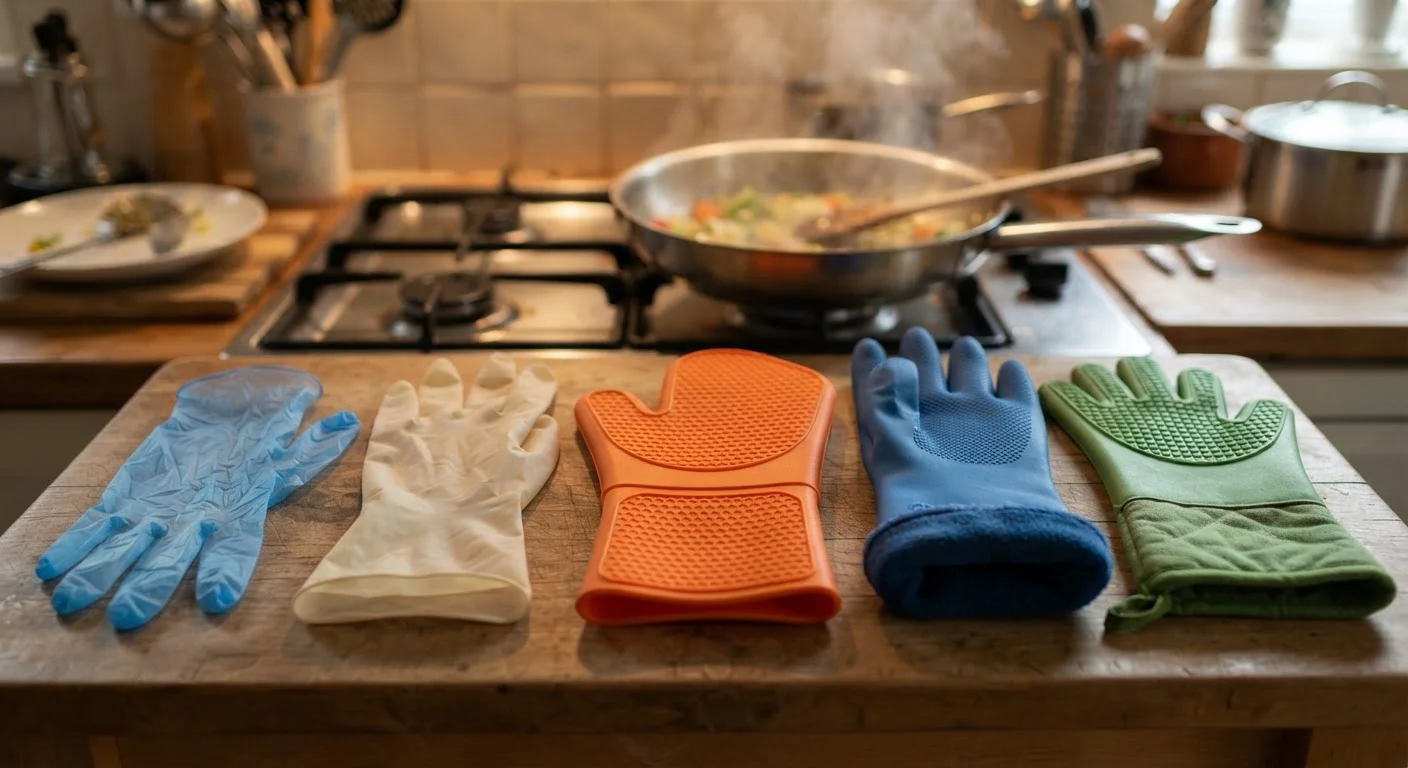
Grab five different gloves, and you’ve got five different heat stories. Here’s what matters when you’re standing at the stove.
Nitrile is the workhorse of disposable gloves , but heat isn’t its strong suit. Thin nitrile (0.06–0.10mm) starts softening past 60–70°C, and most safety guidance flat-out says it’s “not recommended for high-heat environments.” You might get away with 80–100°C for a couple of seconds, but that’s pushing it.
Latex edges out nitrile here. Natural rubber’s elasticity gives it a slight advantage—think 90–110°C for brief contact versus nitrile’s lower ceiling. Harmony Safety puts it plainly: latex handles “slightly higher temperatures than nitrile.” Better stretch, better grip, marginally better heat tolerance. Still not oven-mitt territory, though.
Vinyl/PVC comes in last. It softens around 50–60°C and manufacturers routinely flag it as the weakest performer of the three. If you’re comparing heat resistance across disposable types, vinyl loses every time.
Beyond Disposables: The Reusable Contenders
Once you leave disposable gloves behind, the numbers jump dramatically.
Neoprene/chloroprene : rated up to ~120°C continuous—a solid step above latex or nitrile
Silicone : the real heavyweight, handling 200–230°C continuous and spiking to 260°C+ for brief contact (hello, BBQ mitts)
Fabric/aramid blends : built for extremes, with specialized styles rated 250–500°C for short contact in foundry-style work
The Practical Cutoffs
Here’s your quick-reference logic:
Under 80°C : latex disposable > nitrile disposable > vinyl
90–150°C : switch to coated work gloves —some nitrile-coated versions reach 149°C
Above 150°C : only silicone or aramid gloves are doing real work; nitrile and latex will fail
Liners also make a difference. A cotton or fleece liner behind nitrile or neoprene coating boosts both time-to-pain and overall contact tolerance.
Real-World Heat Exposure Scenarios: Hot Water, Steam, Ovens, and Hot Oil
Five seconds. That’s how long it takes 60°C water to cause a third-degree burn on unprotected skin.
Hot Water: Faster Than You Think
Boiling water sits at 100°C (212°F). Most US households run tap water at 49–60°C (120–140°F)—and at the top of that range, five seconds of immersion causes full-thickness damage. Thin nitrile gloves in near-boiling dishwater? Expect intolerable pain within 1–2 seconds. They’re splash-only gloves.
Steam: The Sneaky One
Steam is worse than boiling water at the same nominal temperature. Steam in food-service settings can exceed 400°F (204°C), and industrial pressurized steam hits 375°C (707°F). When steam condenses on your skin, it releases latent heat, causing deeper and faster burns than liquid water.
That’s why safety guidance is specific: tilt the far edge of a pot lid up first to vent steam away from your face. Don’t lean over kettles or pasta pots to check contents. Espresso machines and steam ovens cause documented burns for this reason.
Hot Oil: The Most Punishing of the Three
Pan frying runs 175–200°C (347–392°F). Deep frying, including turkey fryers, hits 160–190°C (320–374°F). Hot oil scalds outrank hot water burns in severity because oil runs hotter and clings to skin longer instead of running off.
Never introduce water or ice to hot oil. It flashes to steam and expands roughly 1,700 times in volume, launching scalding oil outward instantly.
Ovens: Deceptively Ordinary, Genuinely Dangerous
Home ovens run 176–232°C (350–450°F); broil settings often exceed 260°C (500°F). Pot handles above boiling water can reach over 150°C (302°F), enough for contact burns in under a second on unprotected skin.
With equal contact time on bare skin, hot oil causes the most severe burns, followed by pressurized steam, and then boiling water and oven surfaces, which are severe but more localized.
How to Choose the Right Heat-Resistant Glove: Key Features and Standards
Buying a glove isn’t like buying socks. Get the wrong pair here, and you find out the hard way—mid-task, with something hot in your hand.
Start with two questions: How hot, and for how long? Home baking gloves handle 230–260°C (446–500°F) for short grabs under 10 seconds. Industrial thermal work spans 150°C to over 1000°C, so the material—Kevlar, Nomex, aluminized composites—has to match the job. One ASTM benchmark: press a glove against 300°C (572°F) for 10 seconds; internal temperature rise can’t exceed 30°C to pass.
Then identify the heat type. Contact with hot surfaces needs a strong EN 407 contact-heat rating. Flame or sparks require flame resistance plus radiant heat protection. Molten metal splash needs EN 407’s dedicated splash rating. Steam or hot liquids? Go long-sleeve, waterproof rubber or silicone.
Thickness, Lining, and Grip
Thickness trades insulation for dexterity. Kitchen silicone gloves run 3–5mm thick, good for 3–10 seconds at 230–260°C. Industrial Kevlar and fiberglass composites reach 6–10mm for 500°C+ environments—bulkier, but they hold up longer against heat.
Lining matters. Cotton breathes well but soaks through in steam. Polyester dries fast but melts near 250°C without a solid outer layer. Aramid linings handle sustained heat above 350°C but cost more.
Check texture for grip—diamond or honeycomb patterns that still work when wet or oily. Match sleeve length to the risk: short cuffs for oven work, 30–45cm sleeves when splashes or molten metal are possible.
Standards Worth Checking
ANSI/ISEA 105 rates contact heat 1–5, roughly 100–300°C+. EN 407 uses a six-digit code (X12345) covering flame resistance, contact heat, convective heat, radiant heat, and metal splash—each scored 0–4. Ask suppliers for full test reports, not just the rating number.
Maintenance and Longevity: Cleaning, Storage, and Testing Rubber Gloves for Heat Degradation
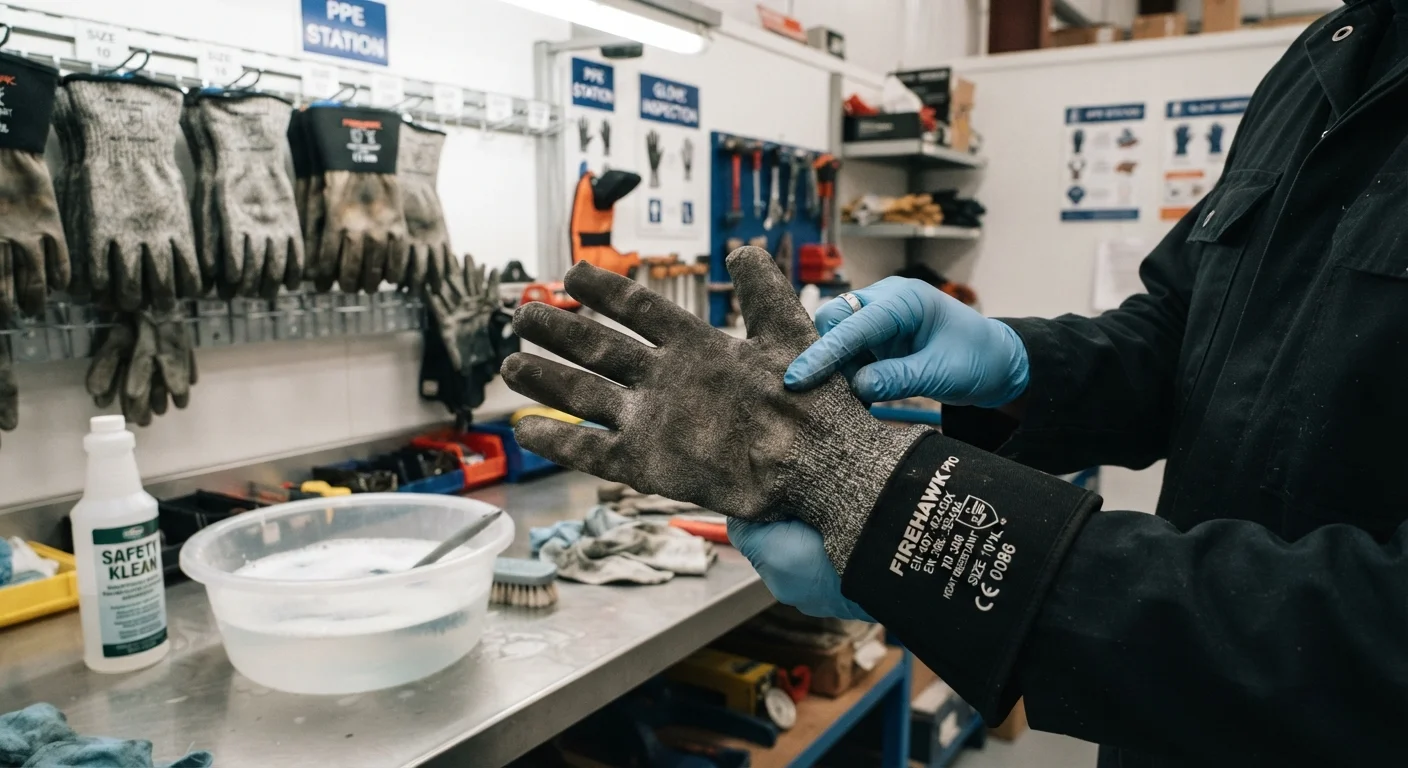
A glove that survives one hot-oil splash isn’t automatically good for the next ten. How you clean, dry, and store rubber gloves determines whether their heat resistance holds or quietly disappears.
Cleaning: Wash after every use with mild soap and water at or below 40°C (104°F). Skip bleach and harsh alkaline cleaners on latex; they speed up chemical and heat aging together. Wipe with a soft cloth, not a scrub brush. Microcracks from aggressive scrubbing expand fast once heat gets involved. Skip a wash after oil contact, and latex gloves can lose 30–50% of their usable life.
Drying : Never use a dryer, heat gun, or oven to dry rubber gloves. Air-dry at room temperature (20–25°C), turned inside out. Radiators, steam pipes, and direct sun push local temps past 50°C, doubling the aging rate. Heat-dried gloves often turn brittle and crack within 1–3 months, half their normal lifespan.
Storage : Keep gloves in a 10–25°C range, away from solvents, sunlight, and heat sources. Store flat or hanging, never folded under weight; stress points crack first under heat.
Signs of Heat Degradation : Watch for hardening, discoloration, tackiness, or a scorched smell. Sticky surfaces respond to a wipe with 75% alcohol; light hardening sometimes softens after a 30-minute soak in 40°C water with a splash of vinegar. Once cracks appear or tacky areas cover more than 30% of the surface, retire the glove—don’t gamble with heat protection.
DIY Heat Test : Fill a heat-safe cup with water at 60°C, 70°C, and 80°C. Wear the glove, press it against the cup for 10–20 seconds, and check with an infrared thermometer. If the glove surface temperature sits within 10°C of the water (versus 20°C+ on new gloves), heat resistance has dropped—time to replace.
FAQ
Real questions need real numbers. Here’s what the data actually says.
What’s the max temperature rubber gloves can handle? Household latex or neoprene cleaning gloves top out around 49–60°C (120–140°F) for continuous use. Push past 71°C (160°F), and most consumer latex softens fast.
Can rubber gloves handle boiling water? Not safely. Thin disposable latex or nitrile hits pain-range temperatures on the inside surface within 1–3 seconds against 100°C water. They’re splash protection only.
Is nitrile more heat resistant than latex? Barely, if at all. Tests on 0.08–0.12mm gloves show both reach painful inner-surface temps within 2–4 seconds at 70–80°C. Base your choice on chemical resistance.
How long can I hold a hot pan wearing rubber gloves? Thin disposables add maybe 0.5–1 second before your skin feels 200°C metal—basically nothing. Thicker household gloves (0.5–0.8mm) buy 2–5 seconds. Rated silicone or neoprene mitts (2–3mm, 450–500°F) can stretch that to 5–15 seconds on dry cookware.
Does glove thickness actually matter? Yes, significantly. Doubling thickness cuts heat flux by roughly 30–50%. On a 150°C surface, a 0.1mm glove buys you 1–2 seconds; a 0.5mm glove stretches that to 4–6 seconds.
Best glove for hot oil? Skip thin nitrile or latex entirely—oil penetr ates them and spikes inner temps above 60°C almost instantly. Go with neoprene-coated or silicone gloves rated ≥400°F, at least 2mm thick, with extended cuffs for splash coverage.
Conclusion
Not all rubber gloves are heat resistant. Assuming otherwise causes burns. Nitrile and neoprene outperform latex when temperatures rise. A glove rated for hot water won’t survive contact with hot oil or an open flame. Even the best heat-resistant gloves degrade with wear, so test them regularly.
Knowing which gloves, for which task, at which temperature keeps your hands safe.
So before your next job that involves heat, steam, or hot liquids, check the manufacturer’s temperature rating against your actual use case. Don’t guess. Match the glove to the task, inspect it before each use, and replace it the moment you spot cracking or thinning.





