
You’ve just peeled off another pair of rubber gloves after scrubbing dishes, cleaning grout, or handling something you’d rather not touch with bare hands—and now you’re staring at them, wondering if the trash bin is really their only destiny. Good instinct. Not all rubber gloves are created equal, and that matters more than you’d think for recycling.
Some can be recycled through the right channels. Others cannot be recycled curbside. We’ll break down which types qualify, where they actually belong (your regular recycling bin probably isn’t it), and how a little prep work can make all the difference. Plus, if recycling isn’t in the cards, we’ve got some clever ways to give those gloves a second life instead of a landfill sentence.
Understanding Rubber Glove Types and Recyclability
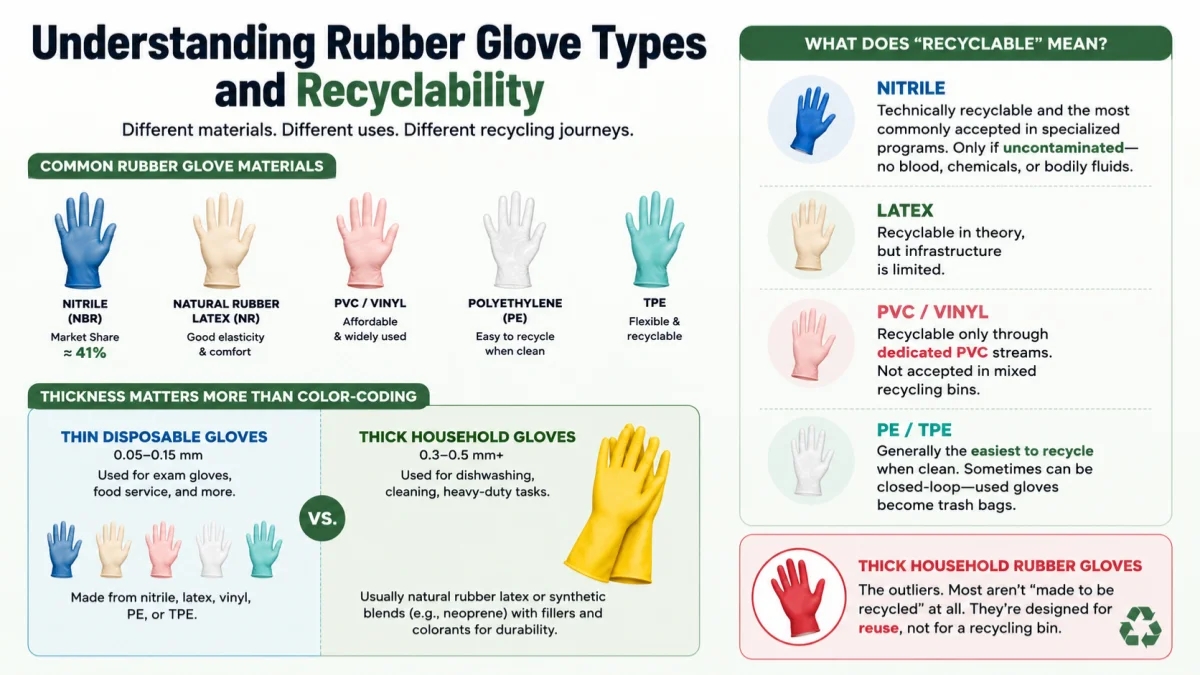
Rubber gloves are a family of polymers, all wearing the same disguise.
The most common players are nitrile (NBR), natural rubber latex (NR), PVC/vinyl, Polyethylene (PE), and TPE. Nitrile dominates the market, making up roughly 41% of all gloves sold. That’s exactly why most recycling programs build around it.
Thickness matters more than color-coding
The two glove categories are thin disposable and thick household, and they differ greatly in recyclability.
-
Thin disposable gloves (0.05–0.15 mm) are used for exam gloves and food service. They are made from nitrile, latex, vinyl, PE, or TPE.
-
Thick household gloves (0.3–0.5 mm+) are your dishwashing gloves . They are usually natural rubber latex or synthetic blends like neoprene, loaded with fillers and colorants for durability.
Thin disposables get all the recycling attention. Thick household gloves are largely ignored by existing programs. They’re built for scrubbing pots, not for a second life.
What does “recyclable” actually mean here?
-
Nitrile gloves are technically recyclable and the most commonly accepted material in specialized programs. But only if they’re uncontaminated—no blood, chemicals, or bodily fluids.
-
Latex gloves are recyclable in theory, but infrastructure is thin on the ground.
-
PVC/vinyl gloves are recyclable only through dedicated PVC streams. If you toss them in your mixed recycling bin, they become contamination, not content.
-
PE and TPE gloves are generally the easiest to recycle when clean. Sometimes they can even be closed-loop, with used gloves reborn as trash bags.
-
Thick household rubber gloves are the outliers. Most aren’t “made to be recycled” at all. They’re designed for reuse, not for a recycling bin.
Can You Recycle Rubber Gloves?
Toss those gloves in the blue bin, and you’re setting someone up for a bad day at the recycling facility. Curbside recycling doesn’t want your rubber gloves. Not the disposable nitrile pair from last night’s kitchen cleanup, not the latex ones from your first-aid kit, not vinyl, not PVC.
Gloves are small and flexible, exactly the kind of item that jams sorting equipment at material recovery facilities. Municipal guidance treats them as trash. Pittsburgh’s city recycling program puts it in black and white: no Disposable gloves are accepted. If those gloves have touched blood, bodily fluids, or medical waste, they’ve crossed into hazardous waste territory, which requires a different disposal path.
Specialized programs handle what curbside won’t.
TerraCycle’s disposable gloves Zero Waste Box accepts latex, nitrile, PVC, polyethylene, and vinyl gloves, any brand, no sorting required. Earth911 found this is the only program that casts such a wide net. It’s a paid, mail-in system: you buy the box and ship your gloves off.
Manufacturer and institution-run programs offer a free alternative with narrower rules. WHOI’s glove program accepts only nitrile gloves and requires enrollment, staff training, labeled bins, and scheduled pickups when a box fills. Kimberly-Clark has run similar nitrile-only collection setups for lab environments.
Nobody takes biodegradable PLA gloves, cloth or fabric gloves, coated synthetic gloves, or leather gloves.
Here’s the sorting rule: clean household gloves go in the trash unless your area has a specialty program. High-volume business or lab gloves go to mail-in boxes or manufacturer take-back. Contaminated or medical gloves go to regulated hazardous waste disposal.
You can pay for TerraCycle’s breadth or find a free but narrower program through your workplace or a manufacturer. The curbside bin isn’t the answer.
How to Clean and Prepare Rubber Gloves for Recycling?
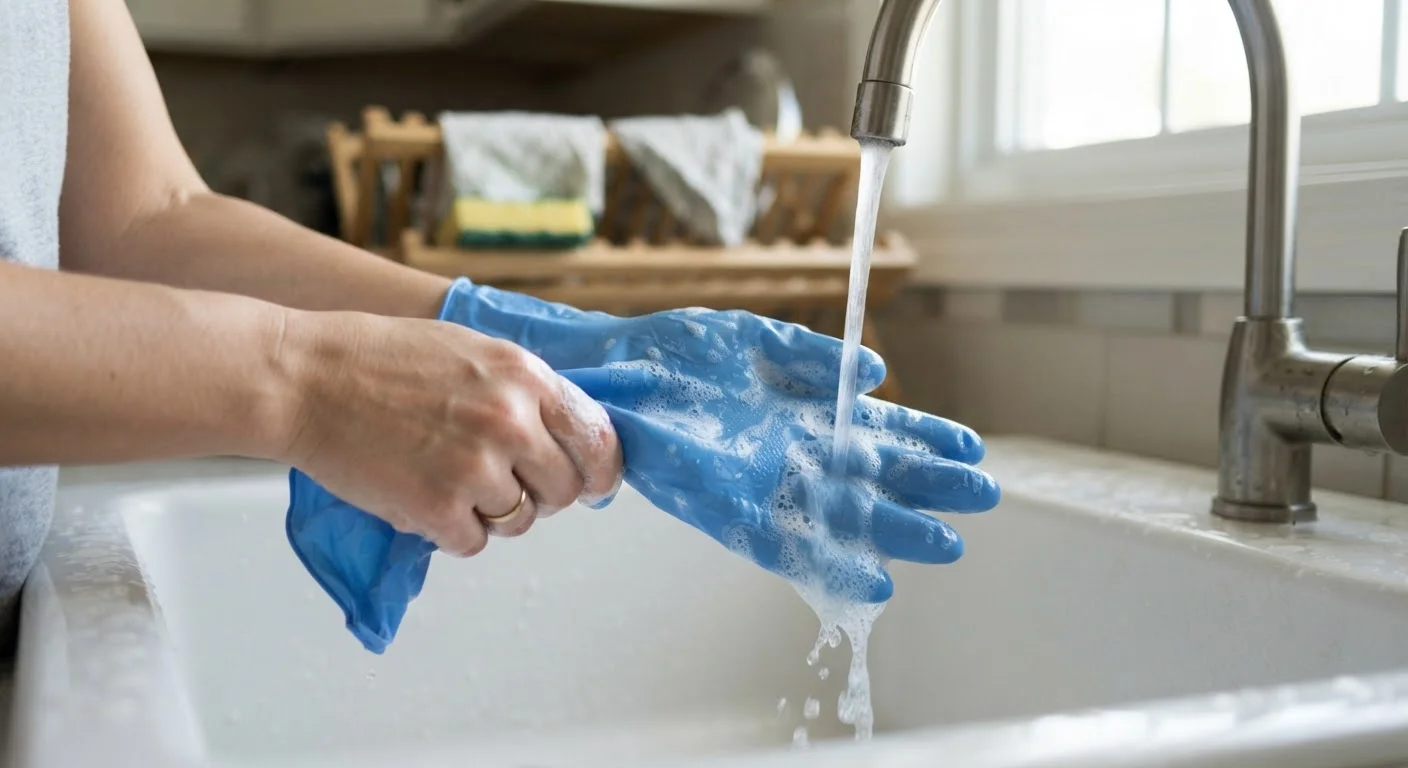
A dirty glove ruins the whole batch. Recycling programs won’t touch rubber gloves that still carry chemical residue, oil, or grime. Clean and dry is the only ticket in. Skip this step, and your gloves land in general waste no matter how good your intentions were.
Start with a sort
Pull out anything torn, punctured, discolored, tacky, or crusted with residue. Damaged gloves get rejected anyway, so don’t waste water on them. If you can, separate by material. Nitrile handles warm water and mild chemistry better than latex, which is fussier about heat and harsh cleaners.
The wash itself
Shake or brush off loose dirt before anything touches water. Then wash with plain water and a pH-neutral soap. For household rubber gloves , gentle is the rule. Aggressive chemicals and bleach can embrittle both nitrile and latex, so skip them if you can.
-
Shake off loose debris
-
Wash the outside with mild soap
-
Rinse thoroughly under running water
-
Turn gloves inside out and repeat the wash
-
Rinse again, two passes for light soil, three for anything heavier
-
Air-dry completely in a shaded, ventilated spot, away from direct heat or sun
Inspect after drying
Once dry, check again. Stretch the cuffs gently. Brittle spots mean the material’s failing. Sniff for lingering odor. If there’s any tackiness or residue, that glove doesn’t go in the recycling bag. Pack only the ones that pass, sorted by material, and label the bag clearly.
Eco-Friendly Alternatives to Recycling: Reuse, Upcycling and Composting
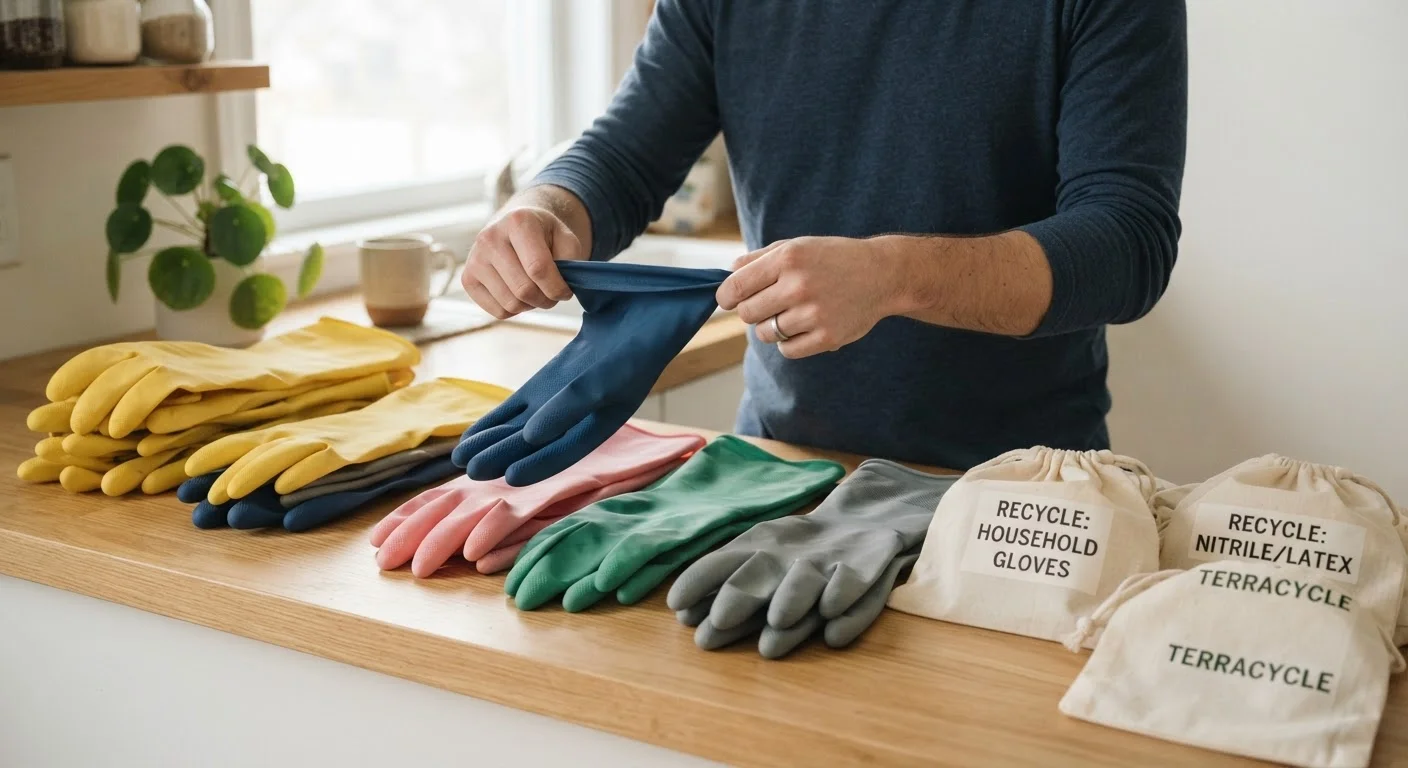
Forget the recycling bin for a second. The real win happens before that glove ever needs disposing of at all.
Reuse first, always
One sturdy pair of household rubber gloves, used again and again for dishes and cleaning, can replace 50 to 100 disposable gloves a year. That’s the math for a household tossing 1-2 gloves weekly. No recycling program, no mail-in box. Just don’t throw them away after one use.
When gloves get damaged, upcycle them
Torn fingers or a punctured palm means the glove is ready for a new job.
-
Pet toys : Cut sturdy fingers into 1-2 cm strips, braid them around a knot, and you’ve got a dog tug toy using roughly 20-30 grams of material. For cats, thin ring-shaped strips tied to a string make a decent dangling toy. Keep it under 30 cm for safety.
-
Anti-slip pads : Slice palm sections into 3-5 cm squares and tuck them under chair or table legs. Wrap narrow strips around broom or rake handles for a better grip, secured with wire or twine.
-
Garden ties : Long strips (10-20 cm) flex better than wire and won’t cut into plant stems. Thicker cuffs also work as blade guards for storing sharp tools.
Composting: the frontier nobody’s mapped yet
Natural rubber latex gloves are mostly polyisoprene, technically biodegradable depending on additives. In warm, active compost piles, thin glove material (0.1-0.3 mm) can crack and erode within months to a few years. Full breakdown into CO2 and biomass takes 2-5 years in an unmanaged home pile.
If you’re curious, cut gloves into 1-2 cm pieces, bury them in the warm, active center of your pile, and check back periodically. If fragments remain after a year or two, pull them out. They’re not compostable; they’re just stubborn.
Recycling Rubber Gloves at Scale: Businesses and Bulk Disposal
A hospital doesn’t toss gloves one pair at a time. It generates hundreds of kilograms each month, and that changes the entire disposal equation. Scale demands infrastructure a household never needs.
The hazmat line matters first. Gloves contaminated with blood or bodily fluids count as regulated medical waste under RCRA. They go to permitted medical waste facilities, full stop. TerraCycle and similar programs reject anything hazardous, infectious, or contaminated. Only clean, non-hazardous rubber gloves qualify for recycling.
TerraCycle scales with you. A Zero Waste Pouch runs $34 for small operations, like salons and small offices. Boxes step up from there with prepaid UPS shipping included. Pallets handle serious volume, hundreds of kilograms per month, though you’ll cover freight yourself. UBC’s pilot program shipped over a ton of nitrile gloves this way, turning them into lawn furniture.
Kimberly-Clark’s RightCycle targets cleanroom-heavy industries—pharma, biotech, semiconductors. UC Santa Cruz runs collection boxes across at least seven buildings, funneling KC-branded nitrile gloves toward TerraCycle processing. It’s brand-specific and institutional only.
EPI Canada offers seven container sizes for latex, vinyl, and vinyl-nitrile gloves, all with prepaid labels, built for clinics and labs.
For reusable industrial rubber gloves , Bates Enterprises and Closed Loop Recycling launder and return them, cutting glove purchasing 30-50% for some factories.
Europe’s Gloovy model proves closed-loop viability at massive scale. 30,000+ cleaning company locations, gloves reconditioned and then sold as recycled rubber into shoe manufacturing once retired.
The math for planning: Roughly 4-6 grams per nitrile exam glove means 10,000 gloves weigh 40-60 kg. Audit your volume before choosing a channel.
FAQ
Straight answers to the questions that keep coming up.
Do any curbside programs accept rubber gloves?
None that we found. Standard municipal FAQs list gloves under “not accepted,” right alongside plastic bags and textiles. If your city’s list doesn’t mention rubber gloves by name, assume trash.
How much does TerraCycle’s box actually cost?
Expect $80–150, depending on size. A small box holds 600–800 gloves (4–5 kg); a large one handles 3,000+ gloves (20–25 kg).
Is there a minimum volume for programs like RightCycle?
Kimberly-Clark’s nitrile program typically requires around 90 kg per year per site. That’s why it’s built for labs, not households.
What’s a quick reuse idea besides pet toys or garden ties?
Cut a finger into rings for DIY rubber bands—one finger yields 8–12 bands. Or flatten a palm section over a shower drain as a hair catcher, swapped every 2–4 weeks.
Can I compost gloves without certification?
Skip it. Only gloves stamped ASTM D6400 or
EN 13432
belong in compost. Standard rubber gloves lack that certification and can leave micro-fragments behind.
Conclusion
Rubber gloves are a resource waiting for the right destination. Skip the curbside bin, which is rarely equipped to handle latex or nitrile, and lean into specialised recycling programs, TerraCycle drop-offs, or your own creative reuse projects. A quick rinse and dry is often all it takes to turn a “waste” item into something with real second-life potential, whether that’s a garden glove , a cleaning tool, or a properly recycled material stream.
The bigger win is that every pair you divert from landfill chips away at the mountain of disposable products we’ve normalized without question. Check your local programs, ask your employer about bulk recycling options, or start a small upcycling habit at home. Small decisions, repeated often, become the sustainable systems we actually need. Your gloves deserve a better ending than the trash can, so give them one.





