
Finding a disposable lab coat manufacturer you can trust shouldn’t feel like a gamble. As hospitals, labs, and PPE distributors ramp up procurement for 2026, the stakes—and the noise from countless suppliers claiming ISO, CE, or FDA compliance—have never been higher. So which factories can actually deliver on capacity, quality, and lead times when your reputation is on the line?
This guide cuts through that noise. We’ve vetted the world’s leading disposable protective clothing manufacturers, from material science giants like DuPont to specialized nonwoven lab coat factories set up for OEM/ODM flexibility. You’ll get a side-by-side comparison of certifications, production scale, and regional strengths, plus the factors that separate a good supplier from a great long-term partner: MOQ, customization, and delivery reliability. Whether you’re a hospital buyer or a cross-border reseller, the right match is closer than you think.
Global Disposable Lab Coat Market Size and Growth Trends for 2026
The global disposable lab coat market is no longer a niche category. Future Market Insights pegs the market at USD 3.50 billion in 2026, with an expected climb to USD 8.68 billion by 2036. That’s a compound annual growth rate of 9.5%. The market is on track to double in size within a decade.
Zoom out to the broader lab safety clothing category, and the trajectory holds. The Business Research Company reports growth from USD 2.47 billion in 2025 to USD 2.71 billion in 2026, also at a 9.5% CAGR. Fact.MR’s wider lab safety clothing forecast lands at USD 3.1 billion in 2026, reaching USD 5.9 billion by 2036. The scopes differ, but the direction is upward and fast.
Three factors are fueling this growth.
-
Tightening infection control regulations. Growth rates in lab apparel outpace general industrial PPE (3–7%), driven directly by stricter FDA, EMA, and GMP compliance demands.
-
Material shift toward polypropylene. PP is projected to hold 54.0% of material share by 2026. It is the backbone of most nonwoven lab coat factory output today, prized for its low cost and reliable barrier protection.
-
Asia-Pacific’s manufacturing dominance. China and Southeast Asia are consistently flagged as the fastest-growing production regions, often exceeding 7–9% CAGR, reshaping how PPE manufacturer China networks supply the rest of the world.
For buyers, this growth curve signals that supplier capacity and reliability will matter even more heading into 2026.
DuPont de Nemours (Tyvek) — Material science behind a global PPE leader
Sixty years. That’s how long DuPont has held a near-monopoly on flash-spun HDPE nonwoven technology, the science behind Tyvek. Invented in 1955 and scaled to mass production by 1967, Tyvek is a proprietary material that combines paper, film, and fabric properties. It’s waterproof, breathable, and 10 to 100 times more tear-resistant than standard paper-based alternatives. Fiber diameters run as fine as 0.5 to 10 μm.
Where the material comes from
All Tyvek raw material is made at two plants—Richmond, Virginia, and Luxembourg—then distributed through DuPont’s authorized channels worldwide. That includes a dedicated China protective technology center in Shanghai Pudong (hotline: 400 8851 888). This centralized production model generates over RMB 2.5 billion annually from Tyvek alone, reflecting its premium pricing across chemical protection, medical packaging, and lab apparel.
Certifications buyers should verify
Tyvek-based lab coats usually carry: – EN ISO 13982-1 (Type 5 particulate protection) – EN 13034 (Type 6 light chemical splash) – EN 14126 (biological hazard protection) – EN 1149-5 (antistatic performance, where applicable)
Always request the specific model code, CE certificate number, and issuing body. Not all lab coat SKUs carry the same Type rating.
The patent landscape is shifting
Hundreds of core flash-spinning patents expired around 2024, which led DuPont to file a Section 337 case against 18 Chinese manufacturers that same year. Domestic Chinese alternatives now reportedly undercut Tyvek pricing by roughly 30%. That is useful leverage for bulk buyers negotiating long-term contracts as this medical disposable garment manufacturer faces new competitive pressure.
Morntrip — China’s OEM/ODM Disposable Lab Coat Manufacturer

A factory that turns out 30,000 disposable protective garments daily doesn’t happen by accident. Morntrip built that capacity over more than 20 years in PPE manufacturing, and the company formalized its own brand in 2015 to sell directly to OEM/ODM buyers worldwide. Based in Wuhan, Hubei, the company now runs one of China’s more complete disposable Protective clothing production lines: lab coats, isolation gowns, Surgical gowns , coveralls, shoe covers, and caps all come off the same integrated supply chain.
Certifications and capacity that matter to buyers
-
CE Type 4/5/6 and EN 14126 compliance across all protective garments
-
30,000 protective coveralls and lab coats per day (roughly 660,000 monthly)
-
5 million surgical masks and 300,000 respirators daily, useful for buyers bundling PPE kits
The OEM/ODM process, step by step
-
Submit application details (lab setting, chemical exposure level, fabric weight)
-
Confirm fabric type, EN 14126 or Type 4/5/6 requirements, and garment style
-
Receive custom design, logo placement, and packaging options
-
Get pricing and MOQ, typically several thousand units per style
-
Review pre-production samples—under 5 days for small items, about a week for garments
-
Move to bulk production: 20–30 days for standard PPE, 30–40 days for lab coats and coveralls
For buyers wanting one supplier for an entire lab protection kit rather than juggling multiple factories, that’s the pitch. Reach the team via email ([email protected]).
3M Company — A Technology-Driven Medical PPE Manufacturer
Fifty-one. That’s how many core technology platforms 3M runs across filtration, biology, surface science, and materials science. They power everything from N95 respirators to surgical tape and sterilization indicators. Few disposable protective clothing manufacturer names carry that kind of R&D depth.
Where the technology shows up in the product line
3M bundles lab coats into full occupational protection systems for hospitals, ICUs, and labs, covering respiratory, eye/face, hearing, and body protection together. The standout piece is the Versaflo PAPR system:
-
Weighs roughly 1.3 kg per unit
-
Delivers 170–220 L/min of continuous airflow
-
Cuts breathing resistance by about 95% versus standard negative-pressure respirators
-
NIOSH-certified for APF 25–1000, depending on hood configuration
3M also embeds RFID into its respirators through a smart safety management system, tracking maintenance cycles and cutting oversight labor by roughly 7.5%. That’s a real efficiency gain for hospitals managing large PPE inventories alongside their medical disposable garment stock.
Global scale, tiered pricing
3M manufactures over 60,000 products globally, with production spread across North America, Europe, and Asia-Pacific. China buyers get dedicated support: a procurement hotline (021-22104388) and a technical line (4009203595).
Pricing splits into two tiers. High-risk departments (ICUs, pharma cleanrooms) typically justify PAPR investment despite higher upfront costs. Routine clinics and small labs lean on 3M’s standardized disposable masks, basic protective eyewear, and entry-level lab coats instead, keeping per-unit costs closer to what a typical Polypropylene lab coat factory or SMS lab coat manufacturer would charge. For buyers comparing a technical medical disposable garment manufacturer against pure-play PPE factories, 3M’s edge is flexibility across the price spectrum, offering both premium and more affordable options.
Medline Industries — The Private-Label Supply Chain Expert for Medical Supplies
Analysts call it the “Costco of Healthcare,” and the label fits. Medline built its business not on inventing new materials, but on locking down distribution and quietly swapping name-brand products for its own house label once it’s inside the door.
The numbers behind the strategy
Medline signed $2.1 billion in new Prime Vendor contracts during the first nine months of 2025 alone—double its historical run rate. These deals run 5 years and commit hospital systems to routing over 80% of their med-surg purchasing through Medline. Retention on these contracts sits at 98%.
New hospital clients start out buying about 13% Medline-branded product. Management’s target is to push that to 60% over the contract term. Gross margin jumps from 5% on third-party brands to 26% on Medline’s own label. That margin math drives their “land and expand” playbook: win the distribution contract first, then replace 3M or J&J products with Medline versions, often sweetened with a 15% price discount.
Private-label access for smaller buyers
Medline segments partners into OEMs, Industry Partners, Kit Packers, and Private-Label Customers, with MOQs running 10,000 to 100,000 units per SKU. Smaller labs and clinics get in through cooperative platforms like OMNIA Partners and E&I Cooperative Services, plus a dedicated “Academic, Research & Medical Essentials” catalog ordered via 1-800 MEDLINE.
Regional footprint matters too. Contracts like Penn State’s CR001452 (2025–2029) and Texas’s UTMB switch show how Medline’s warehouse-and-fleet network, delivering at a 99% fulfillment rate, keeps winning renewals against smaller disposable lab coat manufacturer competitors.
Cardinal Health — A Global Integrated Medical Distribution and Manufacturing Enterprise
Ninety-four percent of Cardinal Health’s FY2024 revenue comes from Pharmaceutical and Specialty Solutions, its drug distribution business. The manufacturing side lives inside the Global Medical Products and Distribution segment (GMPD), which accounts for roughly 5% of total revenue. Cardinal Health is a distribution giant that also produces its own house-brand medical consumables on the side.
What GMPD makes
GMPD’s self-branded lineup covers exam and surgical gloves , needles, syringes, sharps disposal, anesthesia supplies, wound care products, disposable surgical drapes, surgical apparel, fluid suction and collection systems, and OR supplies. Lab coats and isolation gowns sit inside this basket. They are standardized, high-turnover SKUs bundled with gowns and gloves in hospital procurement catalogs.
Reach that smaller factories can’t match
Cardinal Health reportedly services more than 75% of U.S. hospitals. That penetration, paired with national warehouse networks and EDI ordering systems, gives it distribution muscle few disposable isolation gown suppliers can replicate. For buyers, the appeal is catalog depth, supply reliability, and GPO-negotiated pricing at scale. These are competitive advantages built on logistics.
Ansell Limited — A Specialist Brand in Industrial Chemical Protection
Ansell’s Microgard/AlphaTec ventilated suits hit a nominal protection factor of 50,000 under EN 1073-1, Class 5/5, a radiation protection tier most general-purpose PPE manufacturer catalogs don’t even attempt. Ansell built its Microgard and AlphaTec lines for the chemical, nuclear, and biohazard extremes that competitors treat as edge cases.
Certification depth over breadth
Every Microgard and AlphaTec suit is certified under EU PPE Category III, the highest risk classification. Coverage spans:
-
EN 14605 Type 3/4 : liquid-jet and spray-tight protection for chemical loading, tank cleaning, and pesticide spraying
-
EN ISO 13982-1 Type 5 : dry particulate barrier for pharma powder and petrochemical dust
-
EN 13034 Type 6 : light splash protection for labs and maintenance work
-
EN 14126 : infectious agent barrier, relevant for outbreak response and clinical settings
-
EN 1149-5 : antistatic performance for explosive (EX) zones
Chemical breakthrough times that matter
The Microchem 4000/5000 suits hold breakthrough times of over 480 minutes against 50% and 95% sodium hydroxide solutions—the top tier on Ansell’s own classification scale, where anything under 10 minutes gets flagged as “not recommended.”
Where they operate
Technical and design operations run out of Kingston upon Hull, UK, with dedicated support for Europe, the Middle East, and Africa. Using Ansell’s broader Asia-Pacific glove and PPE manufacturing network, AlphaTec extends Category III-certified supply to chemical and pharma buyers well beyond Europe, useful for any medical disposable garment manufacturer sourcing across regions under one compliance standard.
Lakeland Industries — A Niche Leader in Customized Protective Clothing
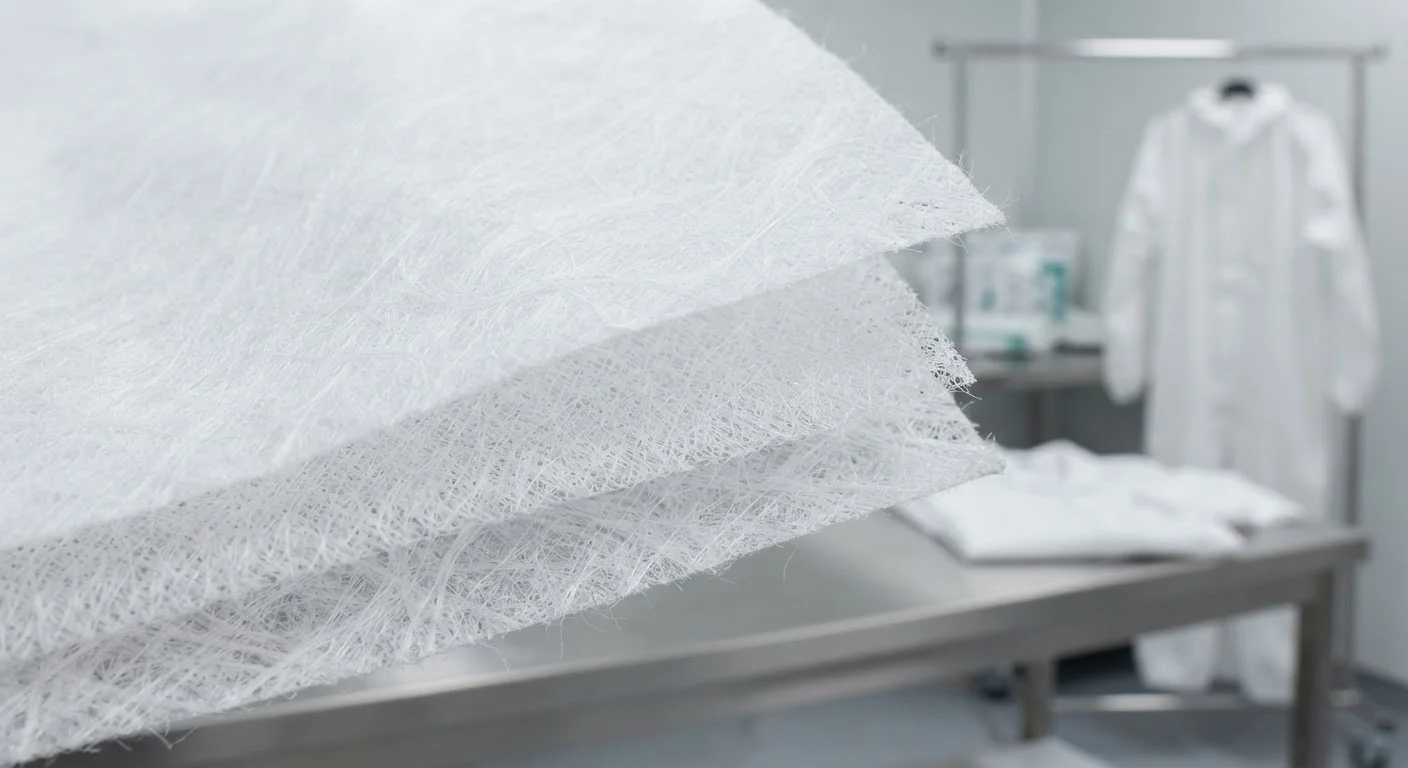
Lakeland’s playbook is standardization with just enough flexibility. The term “customization” gets thrown around loosely in the PPE space, but SafeGard SMS shows how it actually works. The SafeGard® SMS line anchors their Type 5/6 offering with a 3-layer build: spunbonded filaments outside and melt-blown polypropylene microfibers inside. It breathes well without giving up on particulate and light liquid aerosol protection.
Where the flexibility lives
-
Colors : White and Sky Blue are confirmed for SafeGard SMS. Order Sky Blue by adding “B” to the style number. The regional SafeGard GP catalog adds Blue, Red, and Orange.
-
Structure : Coverall C8428 ships with a zipper closure and attached hood. The broader coverall line uses a deluxe pattern with 2 sewn pockets and elastic backing.
-
Fabric weight : SafeGard Economy SMS runs 45 gsm, meeting ANSI/ISEA 101-1996 sizing. The GP variant steps up to 55 gsm for added breathability.
No public price sheet or MOQ exists. This disposable coveralls manufacturer sells through distributors and direct sales contacts, not online bulk pricing. Standard SKUs and color-suffix variants typically move faster through small-order approval than full pattern redesigns like cuff or pocket relocation.
Buyer takeaway: verify style number, color suffix availability, and gsm against your protection tier before assuming deep customization is on the table.
Alpha Pro Tech — A North American Disposable Lab Coat Manufacturer
Alpha Pro Tech sells the full kit, not just a mask. Its disposable protective apparel line covers lab coats, frocks, gowns, coveralls, shoecovers, bouffant caps , face masks , and face shields. Most competitors who make disposable lab coats split these categories across separate vendors.
A dedicated lab coat product family
The lineup breaks into named product lines: NuTech® Lab Coats, ComforTech® Lab Coats , AlphaGuard® Lab Coats, GenPro® Lab Coats, and NuTech® Frocks. AlphaGuard is the standout. It uses breathable SMS material with knit wrists, snap closures, and pockets, built for cleanroom and critical-environment work rather than basic lab use. Per its 10-Q filings, masks and apparel move through the same distribution channels, all as single-use PPE.
Where the manufacturing happens
North American production centers on masks. The surgical face mask facility sits in Salt Lake City, Utah, at 34,500 square feet. Apparel is a different story. Public filings point to an India joint venture as the historical primary source for coveralls, gowns, lab coats, shoecovers, and bouffant caps. COVID lockdowns exposed that dependency when they shut the plant down, pushing the company toward alternative manufacturers.
Pandemic-era demand signals still relevant
During 2020, N95 orders backlogged hard enough to trigger two expansion phases: phase one by early May, phase two by late summer. Disposable protective garments grew 23.8%, face masks 28.8%, face shields 8.0%. The N95 line carries NIOSH approval and CDC-approved-supplier status, which still matters for hospital and government contracts. Buyers should verify which categories run on U.S. soil versus offshore JV supply before locking in volume.
International Enviroguard — Industrial/Medical Dual-Use Protective Clothing Expert
Ebola care and pharmaceutical cleanrooms rarely show up in the same sentence. International Enviroguard designs for both. Headquartered at 2400 Skyline Dr, Mesquite, Texas, this disposable protective clothing manufacturer built its lineup around a dual-use philosophy rather than picking a single lane.
Two product families, one technology platform
-
GammaGuard CE® targets pharmaceutical and lab cleanrooms rated ISO Class 5 / Federal 209E Class 100. Every unit is gamma-sterilized to a 10⁻⁶ Sterility Assurance Level, tighter than the 10⁻⁴ SAL common among competitors, and produced without EtO residue or fabric yellowing.
-
ViroGuard® 2 was engineered specifically for Ebola and other HCID “wet patient” scenarios—bleeding, vomiting, diarrhea exposure. Seams and fabric pass ASTM F1670 (synthetic blood penetration) and ASTM F1671 (bloodborne pathogen penetration).
Both lines run through ISO 9001:2000-certified facilities, letting buyers pull cleanroom garments and bloodborne-pathogen protection from the same supplier instead of juggling separate vendors.
Where the price advantage shows up
Using proven SMS and microporous fabrics instead of proprietary materials keeps costs roughly 10–30% below Tyvek and comparable 3M lines, based on industry benchmarks. Distribution through Fisher Scientific, Grainger, and Thomas Scientific supports 1–5 day domestic reorders—a real edge for any medical lab coat supplier comparison.
Hubei Wanli Protective Products — A Chinese OEM/ODM Disposable Lab Coat Manufacturer
Since 1998, Hubei Wanli has quietly built one of China’s most vertically integrated PPE operations, and the numbers back it up. Two factories, roughly 500 employees, and 30,000 m² of production space anchor the operation—4,500 m² dedicated to a Class 100,000/200,000 mask cleanroom, another 4,000 m² for in-house fabric production. Some listings put the full facility footprint closer to 120,000 m². Owning fabric production alongside garment assembly gives this nonwoven lab coat factory real control over weight, barrier performance, and turnaround.
Product range and daily output
-
Type 3/4/5/6 protective coveralls: 60,000/day across 15+ certified models
-
AAMI Level 3 surgical gowns, isolation gowns , lab coats, aprons
-
3-ply medical masks (Type I/II/IIR, ASTM Level 1/2/3): 2,000,000/day
-
FFP1/2/3 respirators (EN 149): 20,000/day, OEM service confirmed
Certifications buyers can verify
ISO 9001:2015, ISO 13485, ISO 14001, a CNAS-accredited in-house lab, and Sedex social compliance sit alongside CE, MDR 2017/745, EN 13795, EN 14683, UKCA/MHRA, and an actual FDA 510(k) number—K210150—covering Level 3 mask exports to U.S. buyers. That combination is typically the baseline requirement for international brands vetting a disposable protective clothing manufacturer for private-label work.
Where the cost advantage lands
FFP2 masks running €0.18–€0.35/unit FOB versus €0.60–€1.20 for EU-made equivalents. Type 4/5/6 coveralls at €1.20–€2.50/unit against €4–€8 branded pricing. AAMI Level 3 gowns near $1.50–$3 versus $4–$7 in the U.S. That’s a 40–70% savings while still holding EN 149, CE, and AAMI PB70 compliance—reaching 80+ export markets across Europe, the UK, the U.S., Southeast Asia, and the CIS.
Top 10 Manufacturer Comparison Table (Certifications/Capacity/Region/Product Focus)
Numbers tell the story faster than paragraphs ever could. here’s every manufacturer from this list, boiled down to the fields that drive a sourcing decision: certifications, output, region, and where their product line is strongest.
|
Manufacturer |
Key Certifications |
Capacity (Protective Garments) |
Region Focus |
Material/Product Focus |
MOQ & Lead Time |
|---|---|---|---|---|---|
|
DuPont (Tyvek) |
EN 13982-1, EN 13034, EN 14126, EN 1149-5 |
Centralized at 2 flash-spinning plants (VA, Luxembourg) |
Global, via authorized distribution |
Flash-spun HDPE, chemical/lab |
Distributor-dependent |
|
Morntrip |
CE Type 4/5/6, EN 14126 |
30,000 garments/day |
China-based, global OEM/ODM |
PP/SMS lab coats, gowns, coveralls |
Few thousand units; 20–40 days |
|
3M |
NIOSH APF 25–1000, CE |
60,000+ products globally |
NA, EU, APAC |
Systems-based PPE, lab coats |
Tiered by risk level |
|
Medline |
Prime Vendor contracts |
5-yr contracts, 98% retention |
US-centric distribution |
Private-label med-surg |
10,000–100,000/SKU |
|
Cardinal Health |
GMPD self-branded line |
Services 75%+ US hospitals |
US national network |
Gowns, gloves, drapes |
GPO-scale, catalog-based |
|
Ansell |
EU PPE Cat III, EN 14605/13982/13034/14126 |
Asia-Pacific manufacturing network |
UK + EMEA + APAC |
Chemical/biohazard SMS suits |
Distributor-based |
|
Lakeland |
Type 5/6, ANSI/ISEA 101-1996 |
Multiple plants, undisclosed volume |
NA + global distributors |
SafeGard SMS, 45–55 gsm |
No public MOQ |
|
Alpha Pro Tech |
NIOSH, CDC-approved supplier |
Masks: 34,500 sq ft UT facility |
NA (masks); India JV (apparel) |
Lab coats, frocks, gowns |
Distributor-based |
|
International Enviroguard |
ISO 9001:2000, SAL 10⁻⁶ |
Two dedicated product lines |
US, via Fisher/Grainger |
GammaGuard CE, ViroGuard 2 |
1–5 day domestic reorders |
|
Hubei Wanli |
ISO 9001/13485/14001, FDA 510(k) K210150 |
60,000 coveralls/day, 2M masks/day |
80+ export markets |
PP/SMS coveralls, gowns |
Volume-based, competitive pricing |
Use this table to shortlist by priority: certification depth for compliance-heavy buyers, capacity for bulk contracts, and regional footprint for lead-time control.
2026 Disposable Lab Coat Purchasing FAQ
Certification badges on a supplier’s homepage mean nothing without proof. Match the certificate number, issuing body, and expiration date to the actual product model, then request sample-to-bulk consistency (same fabric, gsm, stitching) and run incoming inspection on arrival.
MOQ for a disposable lab coat manufacturer typically breaks into three tiers: 100–500 units for light customization, 500–1,000 for standard OEM work, and 1,000+ for custom fabric or printing. Ask if MOQ is calculated per color, size, or logo, and whether sampling fees roll into the bulk order.
Local supplier or China factory? Local wins on speed and small trial orders. A nonwoven lab coat factory in China wins on unit cost and repeat-order scale.
Before signing, ask five things: which ASTM/ISO standards apply, whether styles differ by use case, if full size charts exist, how replacement claims work, and whether batch-level test reports are available.
Conclusion
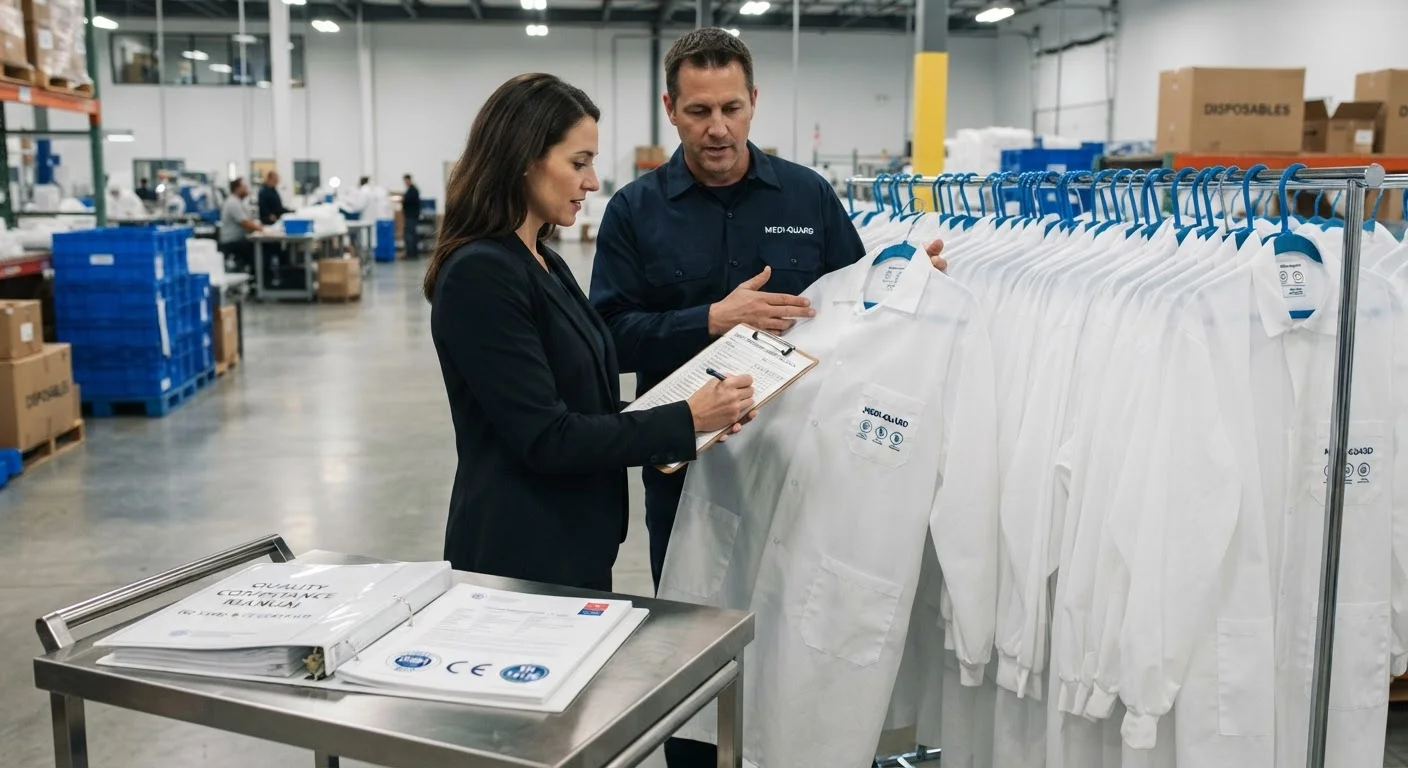
In 2026, buyers who look past price tags get the most from the disposable lab coat market. As this guide shows, the strongest partnerships come from matching your specific needs—regulatory compliance, order volume, turnaround speed—against a manufacturer’s actual production footprint, not their marketing claims. Global giants like DuPont and 3M lead on material innovation. Agile OEM players like Morntrip deliver the customization and cost efficiency that growing distributors and hospital procurement teams need, without sacrificing ISO or CE certification.
Your next move? Don’t settle for a single quote. Request samples from at least three shortlisted suppliers. Verify their certifications directly. Stress-test their MOQ flexibility against your actual demand forecasts. The right medical lab coat supplier won’t just fill an order—they’ll become a supply chain partner who scales with you through 2026 and beyond. Reach out to Morntrip today for a tailored quote and see how OEM manufacturing can strengthen your PPE sourcing strategy.





