
Too many brands claim “the best protection,” making it hard to know which gloves work. If you’ve typed “Ansell gloves” into a search bar hoping for a straight answer, you’re not alone. Whether you’re a procurement manager comparing suppliers, a mechanic tired of gloves that tear after one shift, or someone who wants hand protection that works, you need facts.
This review delivers exactly that. We tested Ansell gloves for cut resistance, grip, breathability, and durability. We also stack Ansell nitrile gloves and industrial lines against Showa and 3M, so you can see where Ansell shines and where it doesn’t. You get the answers you came here for.
Quick Answer: Are Ansell Gloves Good? A Complete Review (2026)
Ansell earns a solid yes, with a catch. It’s a mid-to-premium professional protection brand, priced above the cheapest option in the cart.
The numbers back this up. Knoji scores Ansell 3.6/5.0 across 11 reviews (July 2026). PickSmartly puts it at 6.1/10, drawing from over 20,000 review items across 104 products. Ansell also pulled in $2.0 billion in revenue in 2025, which makes it a serious manufacturer.
Ansell ranks globally in the top two for surgical gloves , cleanroom protection, and mechanical hand safety.
Best for: healthcare, labs, industrial safety teams who value compliance over rock-bottom pricing.
Skip it if: you’re chasing the lowest unit cost, period.
Ansell Gloves Performance: Key Testing Dimensions
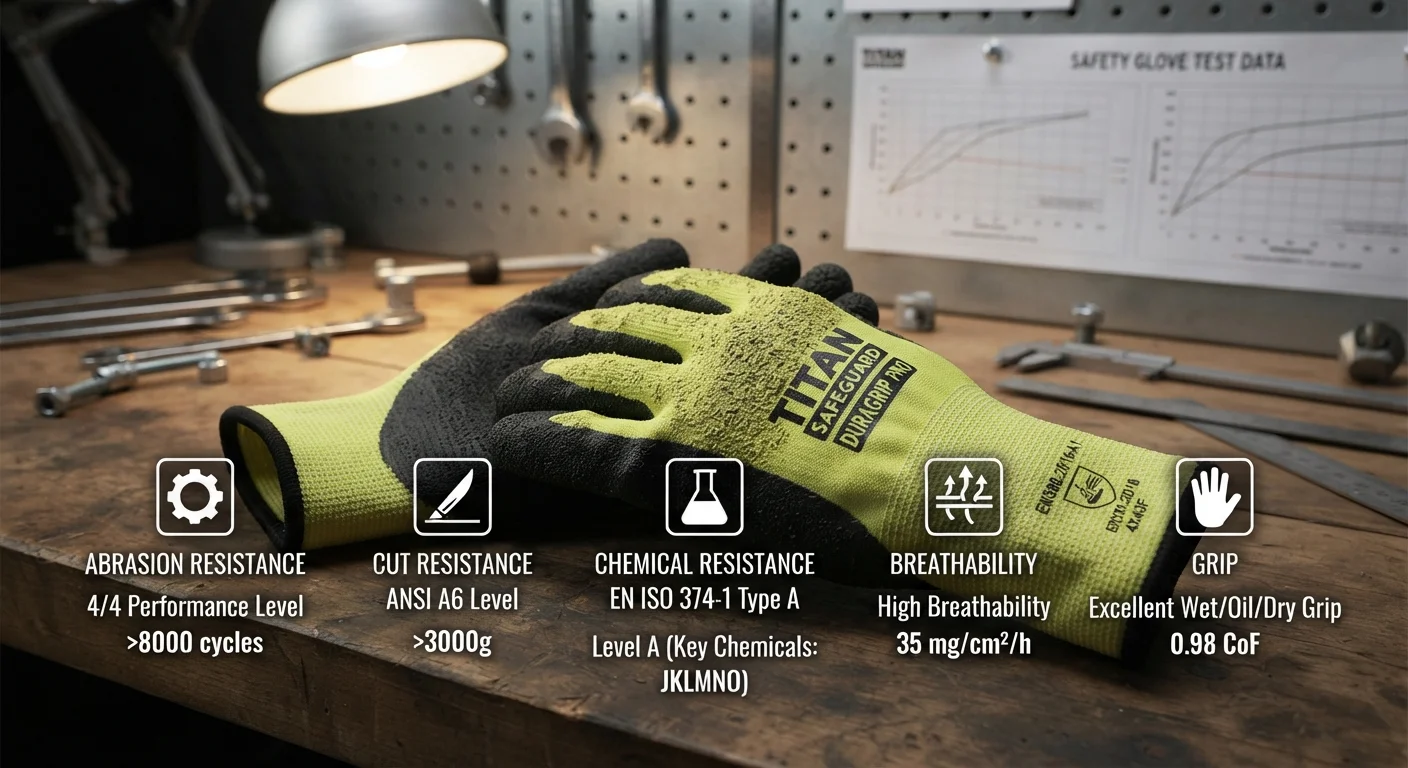
Numbers don’t lie, and Ansell publishes plenty of them. When you’re judging Ansell gloves quality, five dimensions matter most: abrasion resistance, cut resistance, chemical resistance, breathability/comfort, and grip. Here’s what the actual test data shows.
Chemical resistance relies on ASTM F739 permeation testing. A glove sample gets clamped as a barrier and submerged in the test chemical for 30 minutes. Testers then clock breakthrough time and permeation rate. Ansell’s own chemical resistance guide sets the bar at 30 minutes or more for a favorable rating, with permeation grades ranging from E (under 0.9 µg/cm²/min) down to NR (over 9000). One weak metric—poor degradation resistance, for example—can sink an otherwise decent glove. Both breakthrough time and degradation need to hold up together.
Grip and dexterity get concrete treatment too. Ansell’s Touch N’ Tuff Sterile Nitrile Glove (Style 93-700) carries a published Certificate of Conformance showing friction under 80 gmf on the donning side and above 90 gmf on the gripping side. Add in 14 MPa minimum tensile strength, 500% minimum elongation, and palm thickness between 0.12–0.15mm, and you’ve got real numbers for a disposable nitrile glove that’s supposed to grip well without tearing.
Cut Resistance: Where the Gap Shows Up
This is where Ansell cut resistant gloves reveal something important: quality varies by model. The HyFlex 11-644 hits ANSI Level 2 and EN 388:2016 Level B, paired with low palm weight for longer, comfortable wear on small, sharp parts. Compare that to an older catalogue listing using EN 388:2003 code 4332—a medium-duty glove that’s fine for general handling but nowhere near premium cut protection.
For Ansell hand protection shoppers, the takeaway is simple: don’t assume every Ansell glove performs identically. Match the model’s published rating to your actual job risk.
Strengths: Why Ansell Gloves Stand Out
Ansell doesn’t win on price. It wins on documentation—specs you can check, not just claims you have to trust.
Start with coverage. Ansell safety gloves span cut-resistant, chemical-resistant, surgical, and general work categories. That’s rare. Most competitors specialize in one or two lanes. Ansell plays in all of them, from factory floors to operating rooms.
Then there’s the cut protection number that actually matters: Ansell’s cut-resistant line claims a minimum of 3000 grams of cut protection, landing at ANSI cut level A6 or higher. That’s top-tier territory, tested against ASTM F2992-15.
The HyFlex 11-937 shows what happens when engineers solve two problems at once. It’s an 18-gauge ultra-lightweight glove built for both cut resistance and oil resistance, using RIPEL technology to keep oil off skin. It’s also silicone-free, which matters if you’re doing paint or finish work where contamination ruins the job.
Durability numbers back the design. FORTIX coating plus a reinforced thumb crotch delivers up to 12x more thumb-crotch durability and 40% better abrasion resistance compared to standard coatings. That’s the difference between replacing gloves weekly versus monthly.
Grip performance gets specific too. Ansell GRIP Technology delivers 13% better grip on wet or oily surfaces—a real edge in assembly and maintenance work. It also cuts hand fatigue: 80% less finger force needed for gripping, plus 45% less palm force on wet objects and 33% less on dry ones, versus gloves without the technology.
On the chemical side, TouchNTuff 92-600 offers 4x the puncture resistance of comparable Latex gloves and 3x versus similar nitrile options—while AlphaTec’s multilayer nitrile/neoprene/nitrile construction handles acids, bases, and solvents for lab environments needing daily chemical exposure protection.
Weaknesses: What to Watch Out For
Ansell’s own research found that 43% of workers aren’t sure their gloves protect their hands. Workers skip gloves or grab the wrong pair because of discomfort, weak grip, poor dexterity, and plain old habit.
Material Trade-Offs You Need to Know
No glove material is perfect, and Ansell’s training materials admit it:
-
Nitrile : Costs more than natural rubber latex, and grip gets worse in wet or oily conditions.
-
Polyurethane coatings : Weak cut resistance, plus liquids can seep through.
-
PVC : Cheap, but cuts and punctures easily—skip it around oil.
-
Kevlar® : Not built for abrasion. Bleach and UV degrade it fast.
-
HPPE : Struggles above 180°F.
-
Stainless steel mesh : Wire breakage happens.
Fit and Price Add Friction
Poor sizing makes every other complaint worse. When gloves don’t fit, workers ditch them—sometimes at the worst possible moment. And Ansell gloves aren’t the cheapest. Raw material swings (nitrile latex especially), tariffs, and distributor-based selling mean Ansell rarely wins a straight price war against 3M or MCR Safety on standardized gloves.
Check fit data, wet/oil grip performance, failure modes (cuts, punctures, wire breaks), material limits, and whether the price matches your risk level before buying.
Best Ansell Gloves by Use Case (2026 Recommendations)
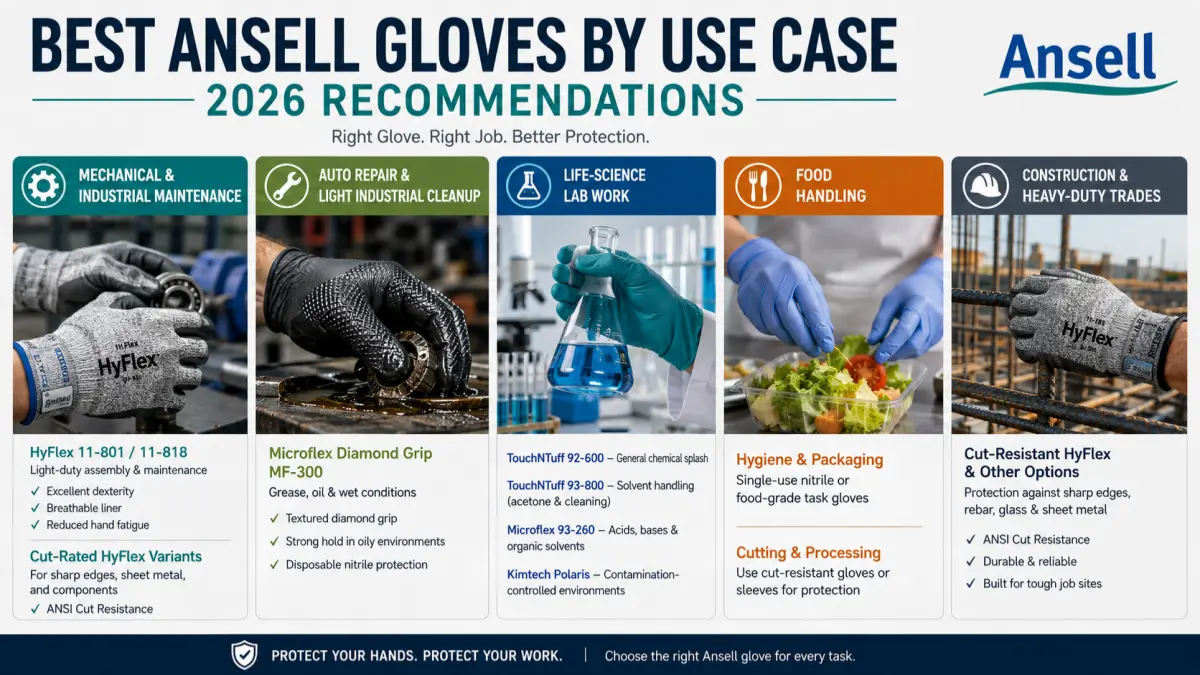
One glove can’t do every job. Ansell built its catalogue around that fact, splitting products by task instead of pushing one universal SKU. Here’s where each Ansell industrial gloves line earns its keep.
Mechanical and Industrial Maintenance
HyFlex is Ansell’s dexterity workhorse. For light-duty assembly and maintenance, the 11-801 gives you fingertip sensitivity and a breathable liner—you can feel what you’re doing. The 11-818 covers more ground for precision handling, dry parts assembly, and extended shifts without hand fatigue. It’s a widely stocked HyFlex model for good reason.
When the job involves sharp sheet metal, tool edges, or components, step up to a cut-rated HyFlex variant. Ansell’s cut-resistance guidance draws this line. For 2026, use 11-801 or 11-818 for fine work, and switch to cut-rated HyFlex when blades or metal edges show up.
Auto Repair and Light Industrial Cleanup
Grease changes everything. The Microflex Diamond Grip MF-300 is Ansell’s answer: a disposable nitrile glove with a textured diamond pattern built for wet, oily, greasy tasks. It’s the benchmark for parts cleaning and light industrial cleanup where a smooth disposable nitrile glove just slips. If tool control matters more than paper-thin tactile feel, this is the pick.
Life-Science Lab Work
Ansell splits lab protection by chemical exposure.
-
TouchNTuff 92-600 for general chemical splash, the simple default for routine lab work
-
TouchNTuff 93-800 for solvent handling, including acetone and equipment cleaning
-
Microflex 93-260 for mixed exposure to acids, bases, and organic solvents, without sacrificing dexterity
-
Kimtech Polaris for contamination-controlled research environments
Match the glove to the exposure.
Food Handling
There’s no single ” food glove .” Ansell segments this category by hygiene need versus cut risk. Raw handling and packaging call for single-use nitrile or food-grade task gloves. Once cutting enters the process, switch to cut-resistant Ansell gloves or sleeves. Standard food-grade disposables won’t protect you there.
Construction and Heavy-Duty Trades
Rebar, glass, and sharp sheet metal are Ansell cut-resistant gloves territory. Light handling can stay in HyFlex, but regular edge contact demands dedicated cut-rated products. If steel or glass is part of the daily grind, go with cut protection over general impact gloves every time.
Ansell Gloves vs Other Brands (Showa, MCR Safety, 3M)
Put four brands side by side, and the price tags tell a story before the specs even open their mouths.
Ansell Solvex 37-175 runs $35-$50 per dozen. SHOWA 730 sits at $30-$45 per dozen. Same 13-inch length, both nitrile—but Ansell’s glove is 17 mil thick versus SHOWA’s 15 mil. That extra 2 mil is Ansell betting on chemical barrier depth over anything else.
MCR Safety plays a different game. Its bread and butter is mechanical protection—cut resistance, abrasion, coated work gloves priced to move in bulk. 3M shows up as part of a broader safety-equipment purchase, not as a standalone glove comparison. You buy 3M when you’re outfitting a whole PPE system, not hunting for the single best nitrile glove on the shelf.
Where Each Brand Wins?
-
Ansell : chemical resistance, solvent handling, and prolonged exposure work. Check breakthrough time and permeation grade first.
-
SHOWA : grip and cold-wet performance. Temres 282 is described as more waterproof, warm, with better grip—and costs under $20 a pair. SHOWA 381 hits ANSI Cut Level A3-A4 at $25-$40 per dozen, decent for rough handling.
-
MCR Safety : mechanical protection at a lower cost, built for warehouses and assembly lines where budget matters as much as durability.
-
3M : bundled PPE purchasing, not glove-specific parameter wars.
The Buying Logic
If your job means hours of solvent contact, Ansell’s chemical resistance data justifies the premium. If you’re handling greasy parts in cold weather, SHOWA’s grip wins. If cost-per-glove drives the decision and cuts/abrasion are the real risk, MCR Safety competes hard. Ansell doesn’t chase the lowest price. It competes on documented protection depth for chemical and solvent tasks where breakthrough time matters.
How to Choose the Right Ansell Gloves: Buying Guide
Skip the brand name. Start with the hazard.
That’s the actual buying logic Ansell builds into its own selector tools: hazard first, then task, then fit, then standards. Not “Ansell makes good gloves, I’ll grab whatever’s on the shelf.”
The 4-Factor Filter
Run every purchase through this checklist before you buy Ansell safety gloves:
Hazard
: cut, chemical, puncture, heat, cold, vibration, electrical
Task
: the actual job decides the glove, not preference
User
: hand size, allergies, comfort tolerance
Conditions
: wet, dry, temperature swings, workplace layout
Skip any one of these, and you’ll end up with a glove that technically works, but nobody wants to wear.
Read the Label Correctly
EN 388 covers mechanical risks: cut, abrasion, tear, puncture. ANSI/ISEA ratings show up across Ansell’s cut-resistant catalog too. For chemical gloves , the material name alone tells you nothing. Cross-check the resistance chart for your exact chemical and exposure time.
Get Sizing Right
Ansell uses two sizing methods. Palm circumference: measure the widest point of your palm in millimeters, then match it to Ansell’s size chart. Hand-width template: lay your right hand flat, fingers together, index finger aligned to the blue line, and read your size off the matching colored line. Between sizes? Go tighter for dexterity work, roomier if you’re layering a liner.
Where to Buy?
Ansell’s official glove finder is the most reliable starting point. Authorized distributors work fine for bulk orders. Buying on Amazon? Verify the exact SKU and spec against Ansell’s official listing first. Seller variance is real.
Frequently Asked Questions About Ansell Gloves
Five questions come up again and again in Ansell’s own support channels. Here’s what the data actually says.
Are Ansell nitrile gloves safe for medical use?
Depends on the procedure. The material name alone isn’t enough. Ansell’s FAQ points to AQL (Acceptable Quality Level) as the key quality marker for medical settings, along with double-gloving and non-latex requirements. Nitrile alone doesn’t clear you for every clinical task—check the AQL rating first.
Do Ansell gloves resist chemicals?
Only against specific chemicals, for specific durations. Ansell’s own FAQ treats “Are nitrile gloves chemical resistant?” and “What is permeation?” as separate questions because they are different. Match your chemical list to the permeation and breakthrough data before you order. Nitrile isn’t a universal chemical shield.
Can you wash and reuse Ansell gloves?
Sometimes. The HyFlex 11-818, for example, holds up to washing at 40°C up to 3 times, without losing performance. Other Ansell models need their own spec sheet checked before you toss them in a wash cycle.
How do I get Ansell gloves sizing right?
Use Ansell’s online glove size finder. It matches hand measurements to SKU. Standard gloves run 240–300mm (about 12 inches). Long cleanroom or chemical-handling styles reach 400mm (16 inches) or more for forearm coverage.
Where can I find Ansell gloves near me?
First, lock in the model number (HyFlex, TouchNTuff, ActivArmr) before you search “near me.” Protection levels swing wildly between models under the same brand. Once you know the SKU and size, local PPE distributors or industrial suppliers can match stock fast. Searching the brand name alone wastes time.
Conclusion
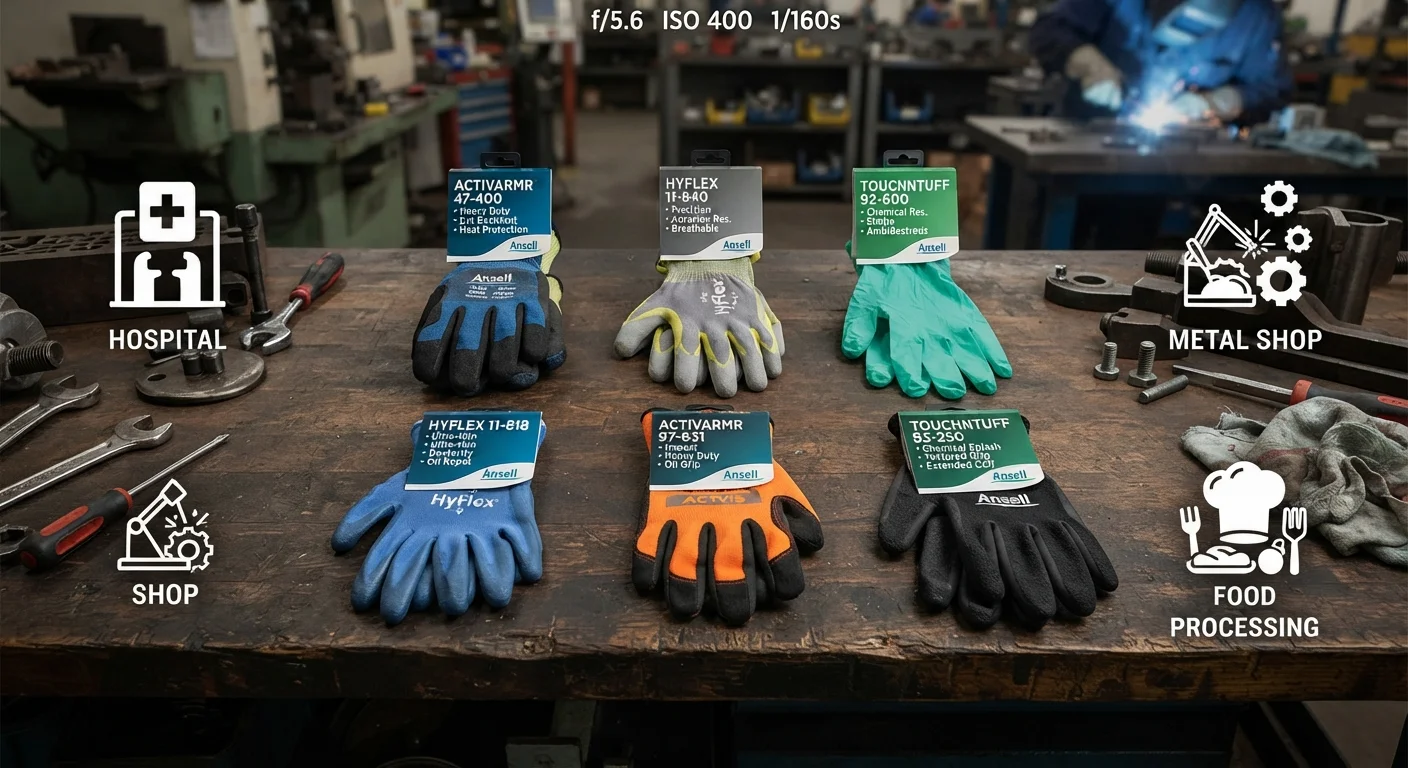
Ansell gloves earn their reputation. They pass rigorous EN388 and ANSI testing, stay comfortable through long shifts, and the lineup is deep enough to outfit a hospital, a metal shop, or a food processing line without missing a beat. The tradeoff is that you’ll pay a bit more than budget brands, and picking the wrong Ansell nitrile gloves for your specific hazard can undercut all that quality.
Performance only matters if it matches your task. Use the buying guide above, match the glove to the job, and you’ll get protection that holds up, not just marketing promises.
Browse Morntrip ’s Ansell glove selection to match your industry, hazard level, and budget in minutes, not hours.





