
If you’ve ever picked up a box of Ansell gloves and wondered where they come from, you’re not alone. The question seems simple until you start digging. Then you’re deep in supply chain research, trying to figure out if that “Made in Malaysia” tag actually means what you think it means. The origin of Ansell gloves isn’t a single answer. This global safety brand runs manufacturing operations across several countries, each with a distinct role in how their products reach your warehouse or store shelf. Whether you’re a procurement manager vetting suppliers, a buyer chasing compliance documentation, or someone who wants to know if their gloves were made ethically, knowing where Ansell makes its gloves changes how you evaluate quality, pricing, and lead times.
Ansell Products’ Global Manufacturing Footprint at a Glance
Here’s the number that matters: 14. That’s how many manufacturing facilities Ansell runs worldwide right now. Not one factory, not three—14 sites spread across a network built for redundancy and risk mitigation.
The heavy hitters are Malaysia, Sri Lanka, and Thailand. These three countries host Ansell’s largest production sites and handle the bulk of global output. Smaller facilities operate in Brazil, China, Lithuania, Portugal, Vietnam, and India, rounding out what Ansell calls a “flexible manufacturing network.”
Why does this matter for you? Scale. Ansell sells 10 billion gloves per year across 55+ countries, with sales activity reaching over 100 countries total. To support that volume, the company maintains:
-
20-24 warehouses globally (depending on the reporting period)
-
800-850+ sales force members
-
19-21 R&D facilities and Centers of Excellence
Ansell isn’t standing still, either. Capital expenditure has ranged from $40.7 million (FY19) up to $82.7 million (FY21), dropping to around $62.8 million by FY24—money poured into upgrading these facilities and refining production capabilities. That investment pattern tells you something: this is a company reshaping its manufacturing footprint, not coasting on legacy infrastructure.
Key Manufacturing Countries for Ansell Products
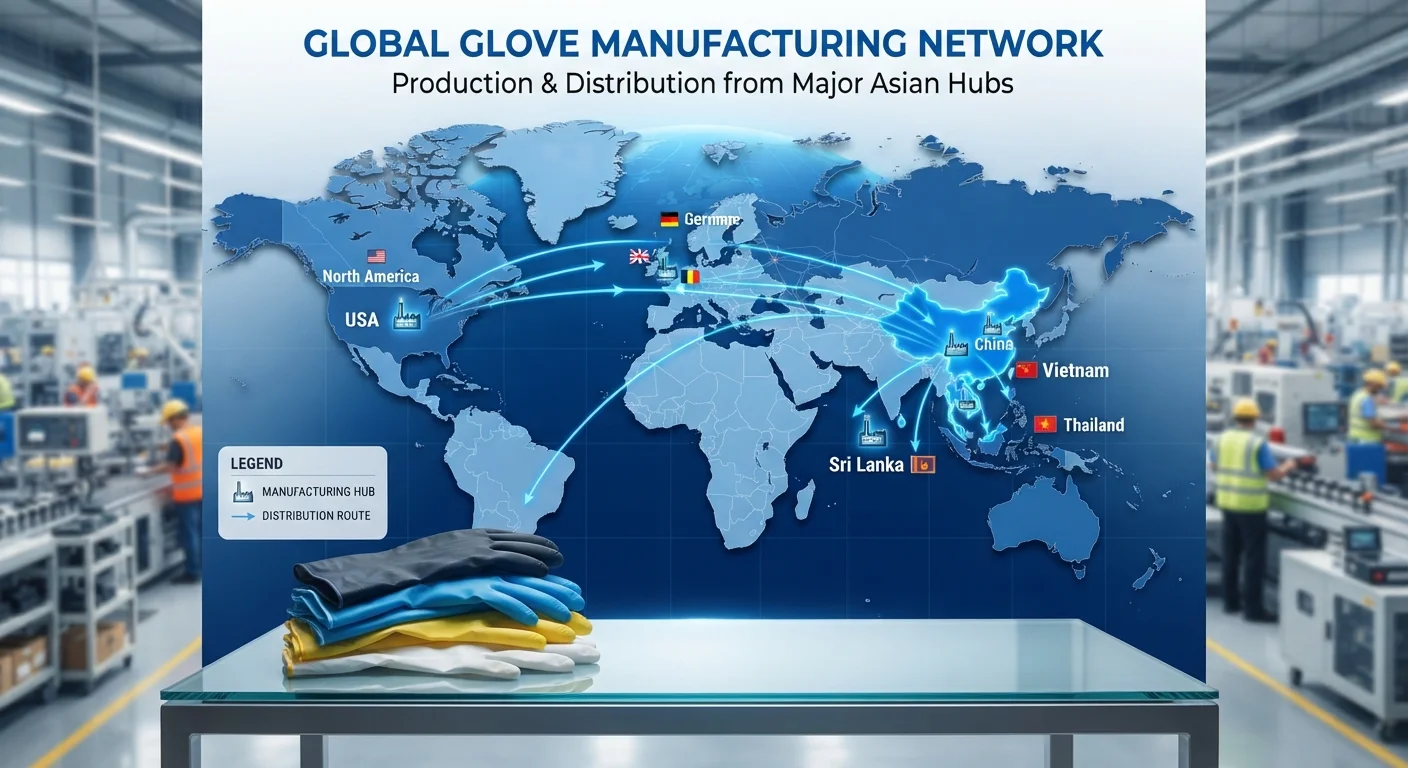
Asia handles most of Ansell’s glove production. The company makes its PPE and gloves in five countries: Malaysia, Sri Lanka, Thailand, Vietnam, and China. That spread isn’t random—it’s a sourcing strategy built around cost, capacity, and specialization.
Ansell’s healthcare PPE production sits in Malaysia and Sri Lanka. Those are the countries making the medical-grade gloves your hospital or clinic uses, the ones that need tighter quality control and regulatory compliance. If you’re sourcing healthcare gloves, that’s your answer.
For broader healthcare finished goods like disposable gloves , masks , and other PPE, Ansell adds more countries: Thailand, Vietnam, China, Indonesia, and Malaysia.
Ansell doesn’t put all its production in one factory or one country for any single product line. That’s smart risk management, and it’s why their supply chains kept moving when other manufacturers hit bottlenecks.
U.S. Import Data Confirms the Pattern
Ansell’s own U.S. import numbers back this up. The company says most products sold in the U.S. come from facilities or third-party suppliers in Malaysia, Sri Lanka, Thailand, Vietnam, and China. No single country supplies more than 30% of U.S. imports—Ansell built that ceiling on purpose. The largest exposures sit in Malaysia and Sri Lanka, the two countries that form the backbone of Ansell’s Asian production.
Tariff sensitivity adds another layer. Market reporting gives these figures for Ansell’s U.S.-linked manufacturing bases: Malaysia at 19%, Sri Lanka at 20%, and China at 30%.
If you’re a procurement manager tracking landed costs, those percentages matter more than brand loyalty.
Risk Profiling by Region
Ansell’s 2020 sustainability report flagged the highest inherent-risk manufacturing sites in South East Asia, China, and Brazil. Earlier regional mapping placed Ansell’s footprint across four zones: Asia Pacific (Malaysia, Thailand, Sri Lanka, China, Vietnam), Europe/Middle East/Africa (Lithuania, Portugal), Latin America (Brazil), and North America (Mexico).
Ansell’s plants aren’t scattered by accident. They’re clustered by risk, cost, and product type.
Does Ansell Manufacture in China or the US?
Short answer: yes to China, no to the US. Here’s the breakdown.
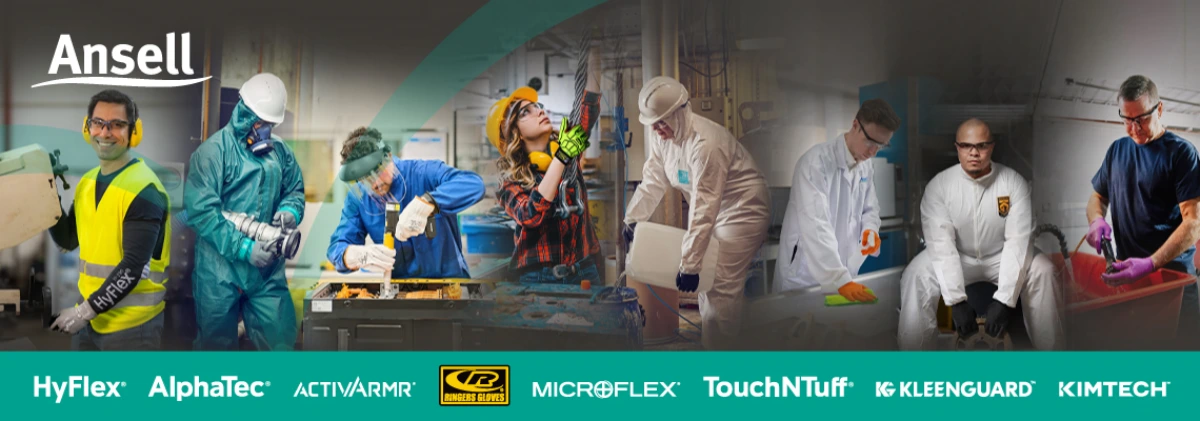
China sits on Ansell’s official facility list. It’s not a headquarters location or a rumor—it’s a confirmed production site. The US, on the other hand, tells a different story. Ansell keeps corporate offices in Iselin, NJ, and Chatsworth, CA, but neither location functions as a manufacturing plant. Those are sales, admin, and logistics hubs. Nothing in Ansell’s current facility disclosures points to a major US-based production plant.
That’s an important distinction if you’re trying to answer the “Ansell gloves origin” question with precision. The US matters enormously to Ansell’s business—just not as a factory floor.
Why the US Still Matters (Just Not for Production)
Roughly 43% of Ansell’s total revenue comes from the US market. That’s nearly half the company’s business tied to American buyers, hospitals, distributors, and industrial clients. But the products those buyers receive? They’re shipped in from Ansell’s Asian manufacturing base—Malaysia, Sri Lanka, Thailand, Vietnam, and China specifically supply most US-bound inventory.
So the US functions as Ansell’s biggest sales territory, not a manufacturing territory. Revenue generation and product origin are two separate stories here.
What’s Happening at Ansell’s China Facility?
One reported site in Xiamen, China offers a closer look at how Ansell runs its Chinese operations. That plant employed around 600 workers and historically exported about 90% of its output—meaning the vast majority of what it produced never stayed in the domestic Chinese market.
That changed briefly during COVID-era demand spikes, when the facility shifted more production toward local Chinese buyers to meet urgent PPE shortages. Once demand normalized, export volumes climbed back toward that historical 90% baseline.
For procurement teams tracking Ansell industrial gloves supplier data, this detail matters: China production feeds global distribution, not just domestic consumption.
Why Manufacturing Location Matters for Quality & Certification?
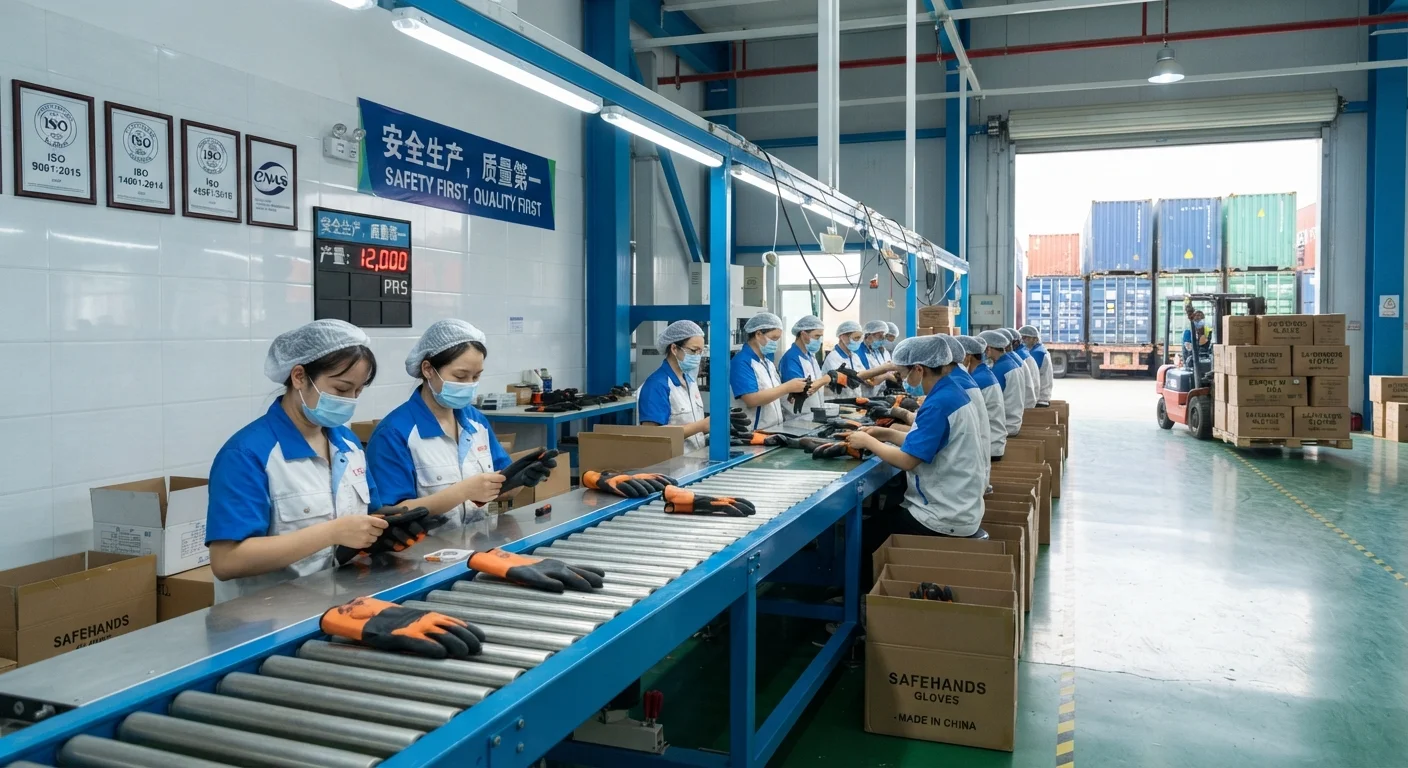
Certification isn’t a label you slap on once and forget. It’s tied to the physical location where the product gets made. Move production, add a new plant, or shift a supplier, and you can trigger a full reassessment—not a minor paperwork update.
ISO 9001 scope is site-bound. The certificate only covers locations explicitly listed in the scope statement. That means every one of Ansell’s manufacturing plants- Malaysia, Sri Lanka, Thailand, Vietnam, China, and the rest- has to be individually accounted for in Ansell’s quality documentation. If a site handling design, production, storage, or delivery isn’t in scope, conformity control weakens. Ansell’s global footprint creates a certification-management challenge with 14 moving parts.
Relocation carries real risk, too. Intertek and ASQ both flag that new production environments demand new audit scopes. Different equipment, different labor pools, and different raw-material sources can all invalidate existing certifications until reassessed. For Ansell safety gloves production specifically, that risk applies every time capacity shifts between facilities to manage tariffs or demand spikes.
Multi-site consistency matters more under newer rules. FDA QMSR, effective February 2, 2026, and ISO 13485:2016 require quality management at the organizational level, not the factory level. Fragmented document control or site-specific supplier qualification gaps are common failure points in networks as large as Ansell’s.
The Sourcing-Certification Connection
A study of 401 Spanish manufacturing plants found that companies sourcing more from low-cost countries were more likely to hold ISO 9000 or stricter certifications. Internal quality commitment was the real driver behind the pattern. Complex supply chains, like Ansell’s spread across Asia, Europe, and Latin America, lean harder on certification as a control mechanism precisely because more sites mean more variables to manage.
How Manufacturing Location Affects Pricing & Lead Time
Cheap isn’t always cheap. The lowest ex-factory price rarely equals the lowest landed cost once you factor in freight, duties, and the inventory you need to hold while waiting for a shipment to clear customs.
The actual math behind location decisions is straightforward:
-
Domestic/onshore production: 2-4 weeks, order to delivery
-
Nearshore/regional sourcing: 3-6 weeks
-
Overseas/offshore (think Malaysia, Sri Lanka, Thailand): 8-12 weeks
Price follows the same curve in reverse. A benchmark comparison using T-shirt manufacturing shows the pattern clearly. Onshore production runs around $11.00 per unit, nearshore drops to $7.50-$9.00, and overseas manufacturing lands at $5.90-$7.00. Labor costs explain most of that gap—U.S. wages sit at $12-$20/hour, while Bangladesh pays $0.50-$1.20/hour. That’s a 20-40x difference.
For Ansell industrial gloves supplier evaluations, this tradeoff isn’t theoretical. Ansell’s Asian manufacturing bases (Malaysia, Sri Lanka, Thailand, Vietnam, China) win on unit price. But buyers need to calculate total landed cost, which includes unit price, freight, insurance, duties, inspection, rework buffer, and delay cost.
Shorter lead times also mean less inventory. A 5-day replenishment loop lets you hold way less stock than a 5-week loop. Less stock means less capital tied up sitting in a warehouse.
Don’t compare unit price alone. Compare lead times, factor costs, and capacity flexibility together. Sometimes that few-dollar savings from offshore production gets eaten alive by six extra weeks of transit and the inventory buffer you need to cover it.
Ansell’s Sustainability & Ethical Manufacturing Practices
Numbers don’t lie, and Ansell’s sustainability data tells a story worth checking before you sign a supplier contract. Twelve out of Ansell’s 14 manufacturing plants already hold Zero Waste to Landfill certification. The remaining two are on the clock—Ansell wants full ISO 50001 certification across all plants by FY28.
Climate targets follow a similar structure. Ansell aims to cut Scope 1 and 2 emissions by 42% by FY2030, measured against a FY2020 baseline, with net zero on those same scopes locked in for FY2040. Zoom out further, and you get net-zero across the entire value chain by FY2045. That target requires 90% of suppliers (by spend) to adopt science-based emissions targets by 2030. Renewable energy already makes up 50% of Ansell’s manufacturing power mix in FY24, with 100% renewable electricity as the end goal.
Labor Standards Across the Supply Chain
Ansell runs its ethical oversight through a Supplier Management Framework (SMF), operational since 2021. The SMF checks supplier compliance against Ansell’s Code of Conduct. Higher-risk locations—the same regions handling bulk manufacturing—get priority attention under the company’s Labour Standards Management Framework.
The FY27 target is blunt. 100% of direct suppliers must meet Ansell’s labor, health, and safety standards. Workplace safety gets tracked too, with a goal to cut Total Recordable Injury Frequency Rate by 10% by 2030 from a 1.170 baseline.
Water usage matters as well. Ansell targets a 35% reduction in water withdrawals by FY27, using FY20 figures as the baseline.
FAQ – Common Questions About Ansell Products Manufacturing
Here are answers to a few more questions that didn’t fit above.
Is Ansell a manufacturer, or just a brand that outsources everything?
Ansell develops, manufactures, sources, distributes, and sells hand and body protection products in over 55 countries. They own and operate the whole process, from design through distribution.
Where is Ansell headquartered?
678 Victoria Street, Richmond, Victoria, Australia. Founded on August 16, 1920, Ansell trades publicly under ASX: ANN and now employs roughly 15,000 people, with 2025 revenue near $3.06 billion.
Does Ansell make cleanroom-grade products?
Yes. Their life-sciences production lines meet strict regulatory requirements and focus on lowest-particulating products to cut contamination risk in sensitive environments.
How do I reach Ansell’s U.S. team directly?
Call 800-800-0444 for general customer service, or +1 732 345 5400 for corporate inquiries. The U.S. office is at 111 Wood Avenue, Suite 900, Iselin, NJ 08830.
What core industries does Ansell serve?
Healthcare, industrial, and life sciences.
Conclusion
Ansell has multiple manufacturing plants across Malaysia, Sri Lanka, Thailand, and beyond—not a single factory cranking out gloves in one corner of the world. That geographic spread is what keeps quality consistent, certifications like international safety standards in place, and lead times realistic for buyers in different regions.
For a procurement manager, knowing the Ansell gloves origin for your specific product line means you can forecast compliance requirements and delivery timelines with confidence. If you’re a consumer, it means every pair you wear comes from a standardized, rigorously controlled production process.
Next step: check the product packaging or ask your supplier for the exact facility code tied to your order. Transparency starts with the right question.





