
Choosing the right chemical-resistant gloves is essential when working with hazardous substances. However, not all gloves provide the same level of protection, and simply choosing a glove labeled “chemical resistant” may not be enough.
EN 374 helps you understand glove performance against chemicals. This guide explains Type A, B, and C ratings, breakthrough time, and how to choose the right glove based on the chemicals and working conditions involved.
What Is EN 374 and Why It Matters for Chemical-Resistant Gloves
Not every glove labeled “chemical-resistant” has earned that claim through testing. EN 374 fixes that ambiguity. It’s the European standard governing protective gloves against chemicals and micro-organisms, and it exists because marketing language and lab-verified performance are two very different things.
The current framework is EN ISO 374:2016, which replaced the older EN 374:2003 system. That update expanded the tested chemical list from 12 to 18 chemicals, giving buyers a broader, more reliable benchmark for real-world exposure.
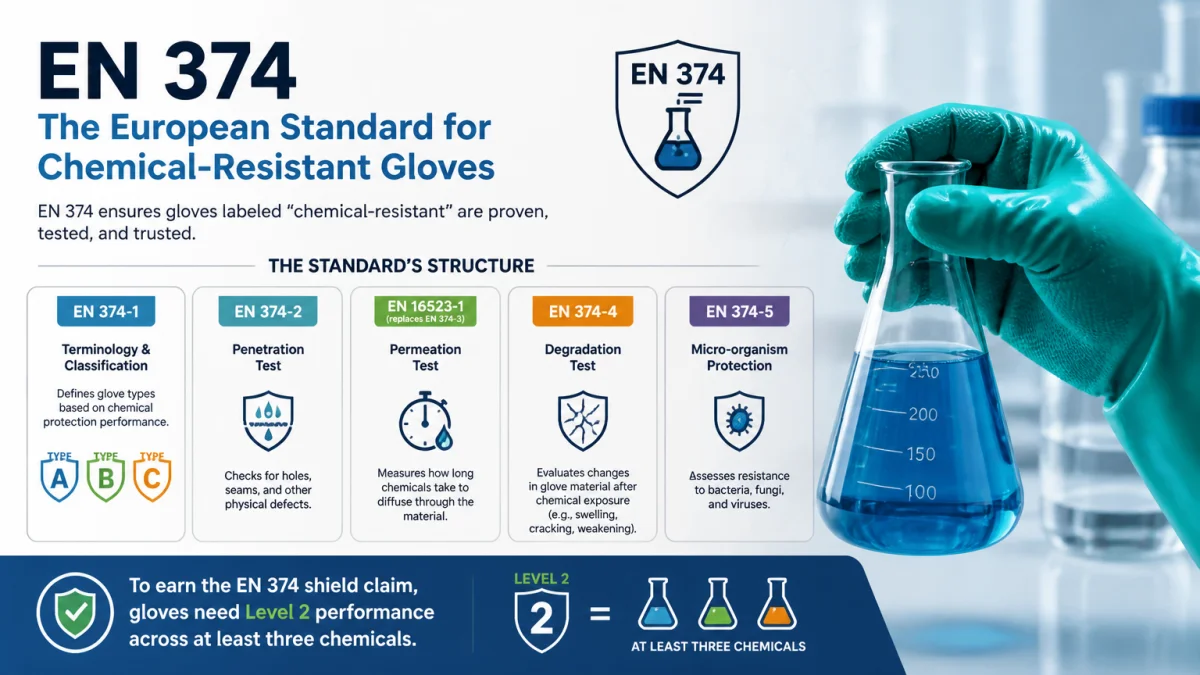
The Standard’s Structure
EN 374 isn’t one test — it’s a series:
-
EN 374-1: Defines terminology and classification (Type A/B/C)
-
EN 374-2: Tests penetration — checking holes, seams, and physical defects
-
EN 16523-1 (replacing old EN 374-3): Measures permeation — how long chemicals take to diffuse through the material
-
EN 374-4: Evaluates degradation — swelling, cracking, or weakening after exposure
-
EN 374-5: Covers micro-organism resistance
To earn the EN 374 shield claim at all, gloves need Level 2 performance across at least three chemicals. That’s the baseline, not the ceiling.
The Three Core Tests Behind EN 374 Certification
Three separate lab tests decide whether a glove earns its chemical protection claim. Skip any one of them and the certification doesn’t hold up.
Penetration Test
This test catches physical defects first. Labs use water leak or air leak testing to find holes, pinholes, weak seams, and closure gaps that let liquid or air slip through.
Three specimens are pulled from the palm area for every test batch. Gloves longer than 400 mm (or those claiming cuff protection) require three additional cuff specimens. Any seam in the hand area gets tested too.
No leakage is allowed. Fail this, and chemical protection claims are off the table before permeation even gets evaluated.
Permeation Test
This is where breakthrough time comes from. The glove material sits in a two-chamber test cell, exposed to a chemical on one side while sensors monitor the inside surface. Breakthrough happens once the permeation rate hits 1.0 μg/cm² per minute. That’s the trigger point, tested at 23°C for up to 480 minutes.
Six classification levels come out of this:
-
Level 1: >10 min
-
Level 2: >30 min
-
Level 3: >60 min
-
Level 4: >120 min
-
Level 5: >240 min
-
Level 6: >480 min
These levels feed the Type A, B, or C classification.
Degradation Test
A glove can look fine and still be compromised. Degradation testing measures swelling, brittleness, softening, and puncture-strength loss after chemical exposure, typically as a percentage change in puncture resistance after conditioning samples at 23°C and 50% relative humidity for 24 hours. Results go straight into the glove’s information leaflet. No shortcuts allowed.
Three letters separate a glove that handles industrial acid all day from one that is only good for a quick splash. Type A, B, and C translate breakthrough time data into a rating you can use when standing in a supply aisle deciding between products.
The classification runs off the 18-chemical test list built into EN ISO 374-1:2016. Here’s the breakdown:
-
Type A: Passes 30+ minutes against 6 or more of the 18 chemicals. This is the top tier, built for high-risk tasks involving multiple aggressive substances or extended contact.
-
Type B: Passes 30+ minutes against 3 or more chemicals. Solid mid-range protection for moderate-risk work where exposure is real but limited.
-
Type C: Passes just 10 minutes against 1 chemical . Fine for low-risk, short-duration handling or brief splash situations, not for sustained contact.
Reading the Chemical Code Behind the Type Letter
Every certified glove carries a flask-shaped pictogram, and beneath it sits a three-letter code. Those letters map directly to specific chemicals from the 18-item list: Methanol (A), Acetone (B), Sulphuric Acid 96% (L), Sodium Hydroxide 40% (K), and so on through T (Formaldehyde 37%).
So a glove marked “A K L” passed testing against the chemicals tied to those three letters specifically. The Type rating (A/B/C) then reflects how many total chemicals cleared the required time threshold. It’s the summary grade, while the letter code is the detail.
The Fast Selection Rule
If you need protection across 6+ chemicals at 30 minutes, go Type A. If you need 3+ chemicals at 30 minutes, Type B covers it. If you need just 1 chemical at 10 minutes, Type C is sufficient.
Match the rating to your actual chemical exposure list, not the highest number available. Over-buying Type A protection for a Type C job wastes budget without adding real safety value.
How to Choose the Right Chemical-Resistant Glove: A Step-by-Step Decision Framework
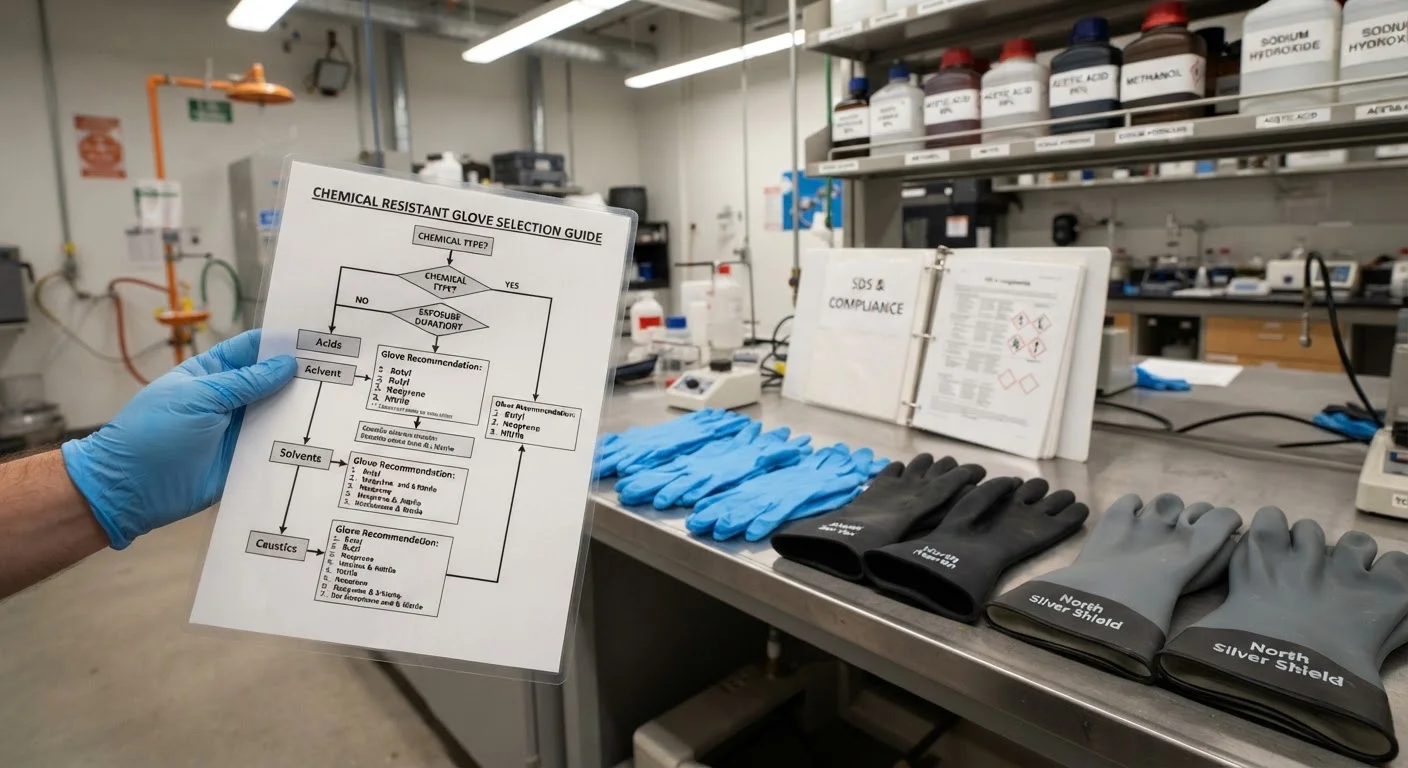
You need to make six decisions to get the right chemical-resistant gloves . Skip one, and you’re gambling with exposure limits you never verified.
Step 1: Pull the Exact Chemical From the SDS
Skip the industry category. Go straight to Section 8 of the Safety Data Sheet—it names the specific substance or mixture and often recommends a glove type. If the SDS is vague, cross-check the manufacturer’s glove chemical-resistance chart for that exact product and concentration. “Nitrile” or “latex” alone tells you nothing; the same material performs completely differently depending on the chemical.
Step 2: Match Breakthrough Time to Contact Duration
Breakthrough time is the clock between first contact and detection on the inner glove surface. Use this benchmark:
-
>8 hours — excellent, safe for all-day wear
-
2–8 hours — good for medium or intermittent exposure
-
15 minutes–2 hours — fair, splash protection only
-
<15 minutes — not recommended
Pick a glove whose breakthrough time exceeds your actual exposure window, not the one with the highest number on the box.
Step 3: Define Contact Type Before Picking Thickness
Splash exposure and full immersion aren’t the same risk. Thicker gloves extend breakthrough time (doubling thickness can quadruple it for some materials), but dexterity drops fast. If the task needs fine motor control, choose the thinnest glove that still clears your required breakthrough time.
Step 4: Check Mechanical Durability
Chemical resistance means nothing if the glove tears first. High-abrasion or puncture-risk tasks call for reinforced gloves, then re-check the dexterity tradeoff. Light sampling work flips the priority, putting dexterity first and chemical compatibility second.
Step 5: Verify Glove Length Against Exposure Zone
Match glove length to where the chemical lands. Gloves 40 cm or longer must have their cuff tested for permeation separately, not just the palm. A long cuff never tested can still fail at the wrist.
Step 6: Confirm the Test Standard Behind the Number
Not all breakthrough-time ratings mean the same thing. ASTM F739 flags breakthrough at 0.1 µg/cm²/min. EN 16523-1 (the EN 374 method) sets the bar higher, at 1.0 µg/cm²/min. Compare ratings only within the same standard—mixing them gives you a false sense of protection.
Glove Material Comparison: Nitrile vs Neoprene vs PVC vs Butyl Rubber
Four materials dominate the chemical-resistant glove market, and each one wins a different fight. Pick the wrong one, and you’re either overpaying for protection you don’t need or exposing skin to a chemical class the material was never built for.
Nitrile: The Industrial Workhorse
Nitrile gloves handle oils, greases, petroleum products, and some acids and caustics better than almost anything else on the shelf. That’s why they’ve largely replaced latex in industrial settings. You get chemical resistance plus abrasion and puncture resistance, without the allergy risk that comes with natural rubber latex. For fuel contact, maintenance work, and general shop chemicals, nitrile is the default choice. It scores 5/5 on oils and petroleum but only 3/5 on acids, bases, and organic solvents.
Neoprene: The Balanced Performer
Neoprene covers more ground than nitrile when the job involves harsh, mixed-chemical environments. It rates 4/5 on acids and alkalis, with excellent tensile strength and heat resistance, so it’s a fixture in petrochemical plants. Where nitrile struggles with aggressive caustics, neoprene holds up.
PVC: The Budget Option
PVC works for acids, fats, petroleum hydrocarbons, and wet or abrasive jobs, but it falls apart against harsh solvents (1–2/5). It’s the lower-cost, lighter-duty pick. Market pricing puts PVC and Neoprene gloves around the low tens of dollars per dozen, far below specialized alternatives.
Butyl Rubber: The Vapor Specialist
Butyl dominates against gases, water vapor, ketones, esters, and corrosive acids, hitting 5/5 across acids, alkalis, and ketones/esters. Some CBRN-grade butyl products claim over 24 hours of vapor-threat protection under NATO AEP-38. When permeation breakthrough—not abrasion—is the real threat, butyl is the benchmark.
Bottom line: validate any material choice against the specific chemical, concentration, and contact time before purchasing.
Reading EN 374 Markings and Verifying Product Claims
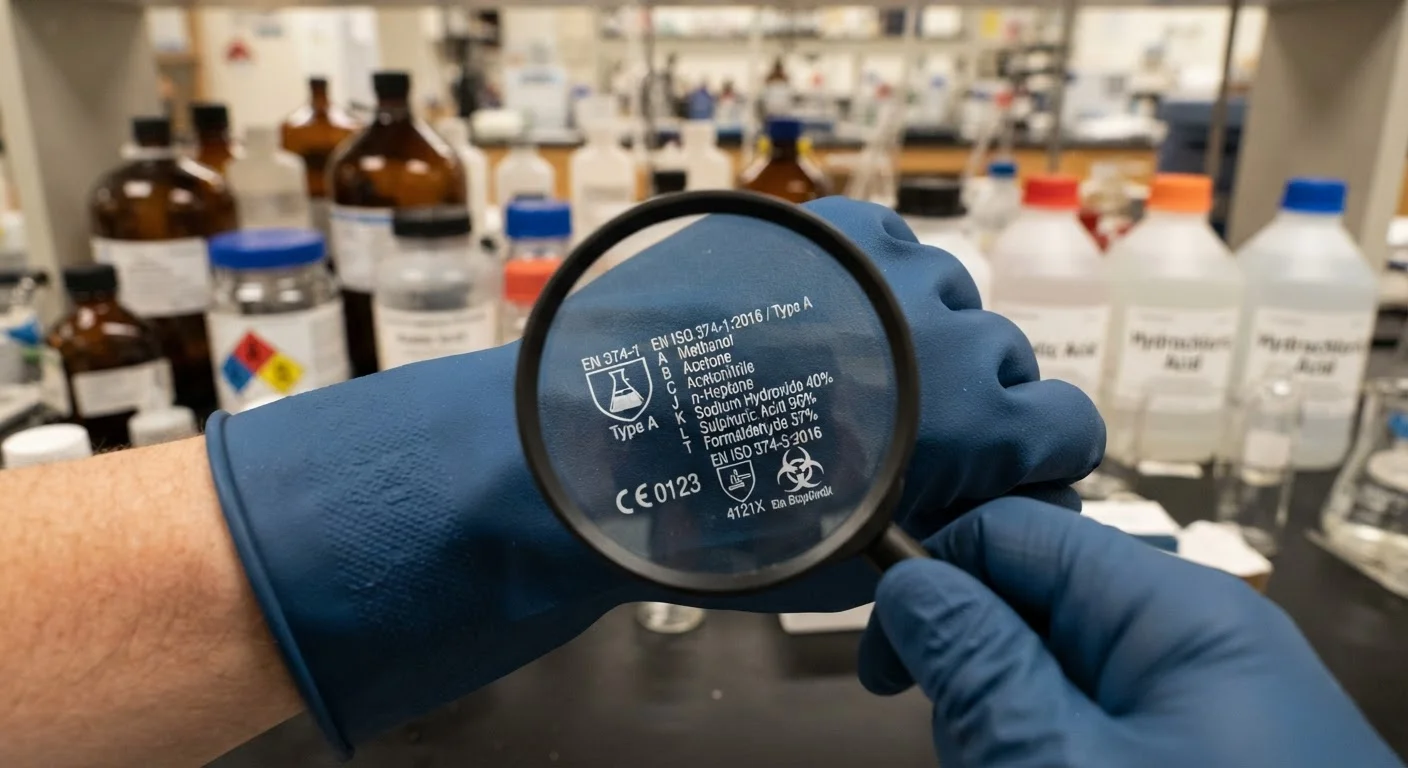
A flask icon on a glove by itself tells you almost nothing. The letters underneath tell you everything.
Decode the Letter Code First
Every EN 374-certified glove pairs its pictogram with letters from the full A–T chemical list. Here’s the complete map:
-
A = Methanol
-
B = Acetone
-
C = Acetonitrile
-
D = Dichloromethane
-
E = Carbon disulphide
-
F = Toluene
-
G = Diethylamine
-
H = Tetrahydrofuran
-
I = Ethyl acetate
-
J = n-Heptane
-
K = Sodium hydroxide 40%
-
L = Sulphuric acid 96%
-
M = Nitric acid 65%
-
N = Acetic acid 99%
-
O = Ammonia 25%
-
P = Hydrogen peroxide 30%
-
S = Hydrofluoric acid 40%
-
T = Formaldehyde 37%
A glove marked “B” only proves it passed against acetone. Nothing else. Don’t assume it handles toluene or dichloromethane just because both names start with the same material.
A “VIRUS” label confirms EN 374-5 pathogen testing only, not chemical protection. That’s a separate check.
Verify Claims in the Information Leaflet, Not the Packaging
The pictogram gives you a summary. The information leaflet gives you proof. Every chemical a manufacturer claims protection against needs matching permeation data and degradation results documented there. If the leaflet lists a material name but skips the letter-specific test data, treat that “chemical-resistant” claim as unverified.
Quick Verification Checklist
-
Flask icon and letter code present
-
Letters cross-checked against the A–T list
-
Type A/B/C threshold confirmed
-
Leaflet shows permeation and degradation data per claimed chemical
-
Material name never substituted for actual test results
Mistakes When Selecting Chemical-Resistant Gloves
Most glove failures trace back to the same handful of assumptions.
Treating nitrile as universal protection. No single material resists every chemical. Some substances permeate in seconds; others take days. For mixtures, select gloves based on the component with the shortest breakthrough time.
Confusing breakthrough time with safe wear time. A 480-minute rating isn’t 8 hours of guaranteed protection. Heat, movement, and fit reduce real-world performance, so build in a safety margin.
Skipping the mixture check. Solvents can carry active ingredients through glove material faster than expected. Base your choice on the fastest-permeating component.
Replacing gloves by habit instead of exposure. Inspect before and after every use. Swap gloves once contaminated, damaged, or past the task-specific exposure window—reuse without verification defeats the entire selection process.
FAQ: Frequently Asked Questions About EN 374 Chemical-Resistant Gloves
A lot of buyers stall out on the same handful of questions once they see the flask icon.
Can EN 374 pair with other glove standards?
Yes, and it usually does. EN 374 + EN 388 shows up constantly, since EN 388 covers abrasion, cut, tear, puncture, and impact while EN 374 handles chemicals and micro-organisms. EN 374 + EN 421 appears when radiation exposure is also on the table. Product listings often stack EN ISO 374-1 Type A, EN ISO 374-5, and EN 388 on one glove.
Are Disposable gloves EN 374-certified?
Often, yes. Thin nitrile, neoprene, or latex disposables pass the same chemical tests as heavy-duty reusables. They typically land at Type B or Type C, not Type A, given material thickness. Common uses: lab work, sample prep, food processing, short splash exposure.
What should a spec sheet actually list?
The standard edition (EN 374:2003 vs. EN ISO 374-1:2016), the glove Type, the chemical letter codes passed, minimum breakthrough times, and any EN 388/EN 421 add-ons. And if a field is missing, you’re guessing.
Conclusion
EN 374 certification tells you if a glove protects when it matters most. Match your Type A, B, or C classification to your actual chemical exposure. Verify breakthrough time against real-world contact duration. And never assume a “chemical-resistant” label means resistant to the chemicals you use.
Once you understand the testing behind EN 374 certification, choosing the right glove becomes a data-driven decision. You get fewer safety incidents, tighter compliance, and confidence in every purchase order you sign off on.
Don’t stop at reading the standard. Pull up your chemical inventory, cross-reference it against the resistance chart, and vet suppliers who can prove their claims with test data, not marketing copy.





