
Grab the yellow rubber gloves from under your kitchen sink and touch a live wire with them. You’ll learn the hard way that not all rubber is the same when electricity is involved. It’s a reasonable assumption that rubber doesn’t conduct, but that assumption has sent more than a few confident DIYers to the emergency room. The truth is messier and more interesting than “rubber = safe.” Some rubber gloves stop electrons cold. Others might as well be wet paper towels. The difference is chemistry, thickness, and a rigorous set of voltage ratings most people have never heard of. You’ll learn how real electrical insulation materials work, why your dish gloves aren’t one of them, and how to pick gloves that match the voltage you’re dealing with.
Do Rubber Gloves Prevent Electric Shock?
Yes, but only certified rubber insulating gloves are designed to protect workers from electric shock. Ordinary household, kitchen, or disposable gloves should not be used for electrical work.
Under ASTM D120, insulating gloves are divided into six voltage classes:
|
Class |
Maximum AC Use Voltage |
Maximum DC Use Voltage |
|---|---|---|
|
00 |
500 V |
750 V |
|
0 |
1,000 V |
1,500 V |
|
1 |
7,500 V |
11,250 V |
|
2 |
17,000 V |
25,500 V |
|
3 |
26,500 V |
39,750 V |
|
4 |
36,000 V |
54,000 V |
The glove class must match the actual electrical exposure.
Ordinary kitchen gloves may be made from rubber, but they are not tested for electrical insulation. Small holes, cuts, moisture, dirt, or wear can make them unsafe around electricity.
Certified electrician safety gloves are made and tested specifically for electrical work. They should also be checked before use and tested regularly according to the required safety standard.
For electrical work, check the glove’s voltage class, certification, condition, and test status . Never rely on rubber material alone.
ASTM D120 vs IEC/EN 60903: Which Standard Applies to You
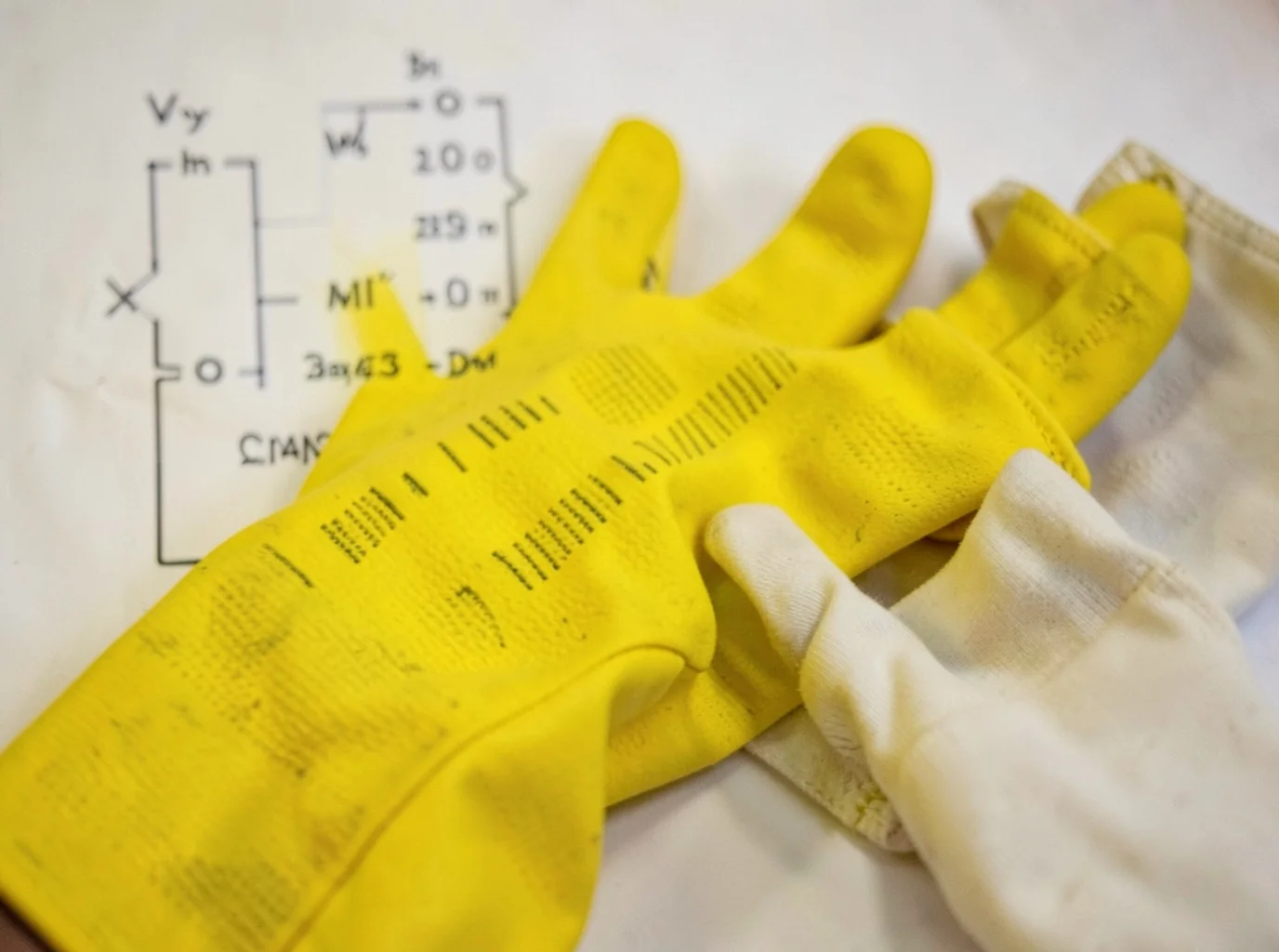
Two standards, same job, different passports. ASTM D120 is the American one. IEC 60903 is its international counterpart, and EN 60903 is the version Europe-stamped for regional use. If your job site is in the US or Canada, D120 is almost certainly what your supplier is testing against. If you’re in Europe, Asia, Africa, or Australia, IEC/EN 60903 is the version doing the heavy lifting.
Both cover the same six classes, 00 through 4; both cap out at 36,000V AC; and both require retesting every six months. So far, identical twins. The differences show up in the fine print.
ASTM D120 leans electrical. It’s built around insulation testing first, mechanical protection second. That’s why it typically requires leather protectors across every class, not just the high-voltage ones. IEC/EN 60903 leans toward comprehensive . It bundles mechanical performance grading and ozone resistance testing with the electrical requirements, and only mandates leather protectors at Class 3 and 4. Some public comparison charts even show slightly different AC thresholds at the same class number. EN/IEC Class 00 sits near 500V AC, while ASTM’s version of Class 00 is documented closer to 750V AC in certain references. Always check the spec sheet, not just the class letter.
Compliance paperwork diverges too. ASTM ties into OSHA and internal EHS retest schedules. IEC/EN ties into CE and PPE market-access requirements, with type tests, routine tests, and batch traceability documentation.
Quick rule of thumb:
– North American contractors, MRO teams, utility crews → ASTM D120
– European factories, export supply chains, international projects → IEC/EN 60903
– Multinational operations → look for suppliers offering both
Natural Rubber vs Synthetic Insulating Materials: Performance Comparison
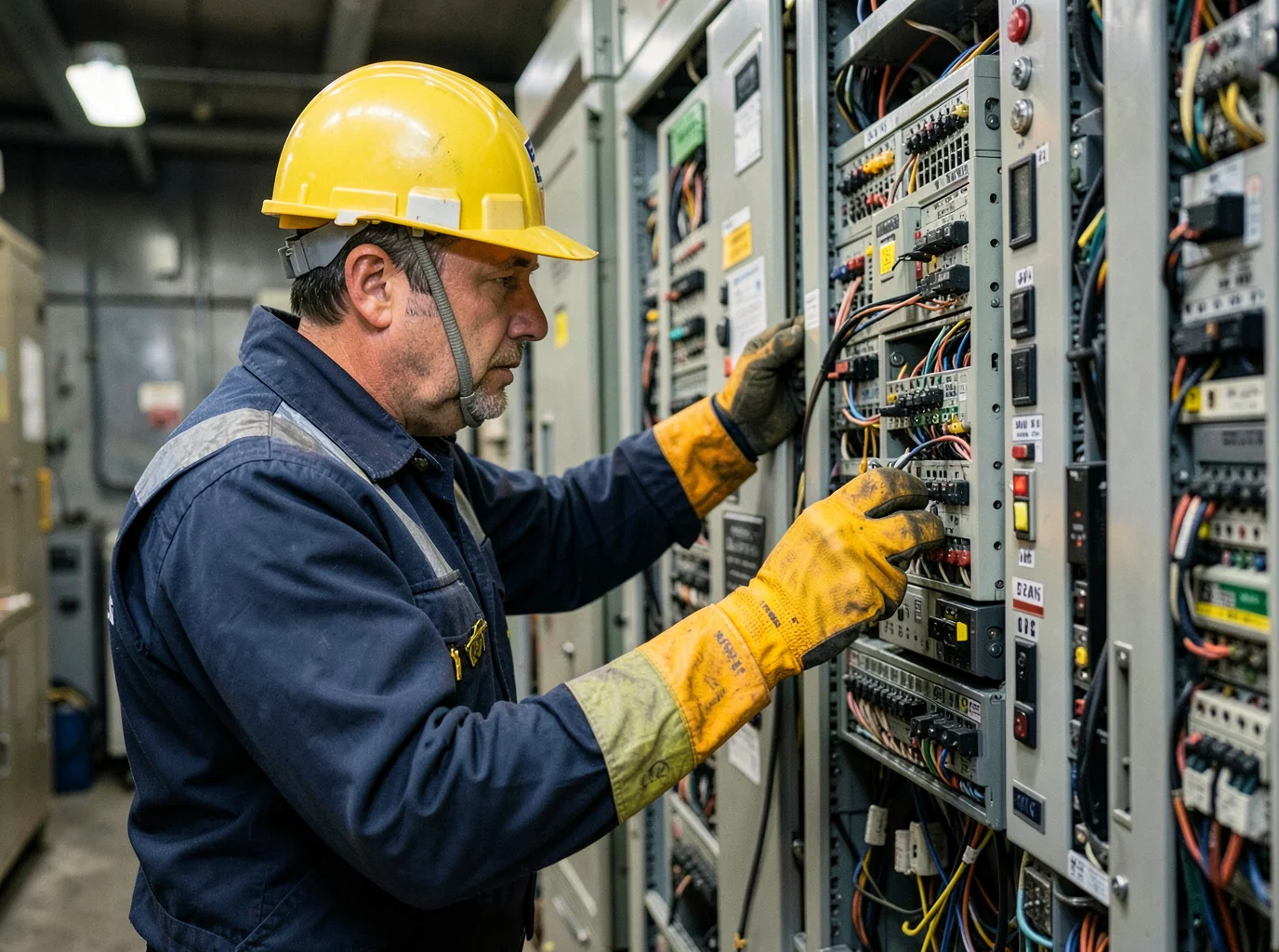
Not all insulating rubber is chasing the same goal. Manufacturers pick a polymer based on what’s going to kill the glove first, voltage or the environment, and the two main candidates split that job differently.
Natural rubber (NR) wins on raw electrical insulation. Dielectric strength runs around 15–30 kV/mm, volume resistivity sits at 10^13–10^15 Ω·m, and it recovers from bending and stretching better than almost anything else on the market. That’s why most dielectric rubber gloves start as NR. It also handles acids and bases fine, but mineral oil, grease, and solvents make it swell and degrade. Sunlight and heat age it faster too.
Neoprene (CR) trades some insulation for toughness. Dielectric strength drops to roughly 15–20 kV/mm and resistivity to 10^11–10^13 Ω·m, noticeably weaker than NR. What it gains is resistance to ozone, weather, oils, and chemicals, so it shows up more often as a protective outer layer or sheath than a primary insulator. The chlorine in its polymer also gives it better flame resistance.
Quick rule: NR for indoor, low-oil, high-flex electrician safety gloves . CR for outdoor, oily, or chemical-exposed work where insulation just needs to be “enough,” not maximum.
How to Inspect and Test Insulating Gloves Before Every Use?
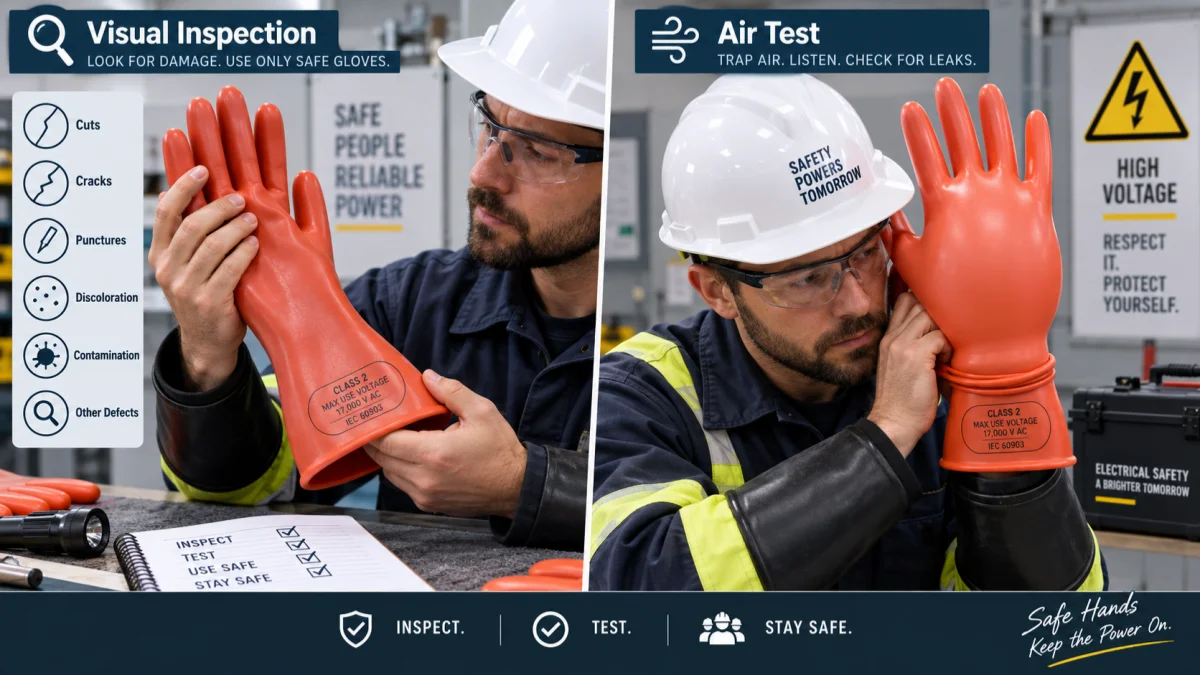
A glove that looks fine can still kill you. That’s the uncomfortable truth about electrical hazard PPE: the failure mode is invisible until it isn’t. Before every single use, run both gloves through a two-part ritual: visual inspection and an air test. “It looked okay yesterday” is not a safety protocol.
Step one: look at everything. Check both gloves for cuts, tears, cracks, punctures, pinholes, ozone cutting, UV checking, swelling, hardening, stickiness, discoloration, embedded objects, and chemical contamination. Check the fingers, palms, cuffs, and seams. Confirm the glove is still “in test” and the markings are legible. Any single defect means the glove goes out of service immediately. No exceptions, no “it’s probably fine.”
Step two: fill it with air. Roll the cuff toward the palm to trap air, or use a portable glove inflator. Expand the rubber—some guidance caps it at twice normal size—and watch the surface for cracking or abrasion. Hold it near your ear. Listen for escaping air, feel for pressure loss. Any leak means the glove is defective, full stop.
The retest clock never stops. Gloves need testing before first issue and every six months after that, plus after any repair, after use without leather protectors, or whenever you suspect the insulating value took a hit. Six months in storage without a retest still means retest before use. Damage doesn’t get monitored. It gets discarded.
Choosing the Right Insulated Rubber Gloves for Your Work (Buying Guide)
Buying insulating gloves is a lot like buying an umbrella rated for a specific storm. Bring the wrong one, and you’re still getting soaked, just with better paperwork. Brand and price matter less than matching the glove class to the actual work voltage, not the voltage you casually assume.
Match by application, not habit: – Residential panels and standard installs → Class 0 baseline – Utility distribution and industrial substations → Class 1–2 – Transmission and grid work → Class 3–4 – Automotive/HV battery work (400–800V DC systems) → Class 0 is common; OEM development environments may specify Class 1
Indoor switchgear work rewards dexterity, so Class 00–0 gloves (thinner, more finger feel) dominate. Outdoor line work is rougher on hands and gloves alike, which is where ASTM F696 leather protectors come in. They add zero electrical protection, none, but they stop abrasion and punctures from ending a $200 glove’s life in one bad grip.
Certification checkpoints before you buy:
– EN/IEC 60903 for classification and testing
– ASTM F696 for protector compatibility
– Explicit AC and DC voltage ratings printed on the glove, not vague “high voltage” marketing
Vet the supplier beyond the spec sheet. Ask if every lot gets dielectric-tested. Ask for test records. Ask about retesting support and batch traceability, because a glove without documentation is a guess with a price tag.
|
Buying factor |
What to check |
Benchmark |
|---|---|---|
|
Voltage class |
AC/DC max use |
Class 00–4 per ASTM D120/IEC 60903 |
|
Scene |
Indoor/outdoor |
Indoor = dexterity; outdoor = add protectors |
|
Protector |
ASTM F696 needed? |
Yes, for abrasion, line work, cable handling |
|
Supplier service |
Test records, retesting |
Batch traceability, replacement guidance |
Morntrip ‘s lineup covers Class 00 through 4, with F696 leather protectors and documented batch testing, so the selection logic above maps directly onto a real shortlist instead of a guessing game.
Common Questions About Rubber Gloves and Electrical Safety (FAQ)
People keep asking the same handful of questions. Here they are, answered straight.
Can regular rubber gloves protect from electricity?
No. Dish gloves are untested and unrated — they cannot handle live circuits. You need certified insulating gloves rated for the actual voltage instead.
Why is rubber an insulator in the first place?
Rubber’s electrons are tightly bound, with almost no free carriers to move current. It’s just chemistry.
Are latex or nitrile gloves electrically safe?
Only if you see a printed voltage rating and certification; without that, they’re just gloves that happen to be rubber-colored.
How often should insulating gloves be retested?
Every six months, no exceptions.
Conclusion
Those rubber gloves under your sink? About as electrically useful as a pair of socks. They’ll keep your dishwater warm, that’s it. Real protection means voltage-rated gloves built to ASTM D120 or IEC 60903, matched to the exact voltage you’re working with — not a vague comforting idea of “rubber.”
Before you grab any glove near a live wire, ask three things: What’s the voltage class? When was it last tested? Is it rated dielectric rubber, or just rubber-colored plastic? If you can’t answer all three, you’re gambling with amperage.
Morntrip’s certified glove lineup means you never have to guess. Browse the class ratings, check the voltage charts, and pick gear rated for reality.





