
You’re standing at the sink, gloves half-on, staring at your engagement ring or that fresh set of acrylics, wondering if you actually need to take them off. It’s a fair question—and the answer isn’t the same everywhere. Whether you’re prepping food, assisting in surgery, or handling machinery on a factory floor, the rules depend on what you’re doing and who’s regulating it.
You’ll get straight answers by industry, plus the real risks of torn gloves , trapped bacteria, and bad fit. If removing your jewelry or trimming your nails just isn’t happening today, there are practical fixes too. By the end, you’ll know exactly what glove hygiene rules apply to your situation, and how to stay compliant without sacrificing your personal style.
Quick Answer: Can You Wear Rings or Long Nails With Gloves?
Long fingernails and gloves generally don’t mix, especially in food-handling work. Rings are trickier—a plain wedding band sometimes passes, but only under specific policies.
Gloves aren’t a jewelry loophole. FDA guidance is blunt: skip hand and arm jewelry entirely, except for a plain ring. No stones, no etching, no chunky settings. Those trap bacteria and shred glove material fast.
Long or artificial nails are even riskier. They snag latex and nitrile during donning, puncture gloves mid-task, and harbor microbes gloves can’t fully seal against. Most GMP standards cap nail length around 1/4 inch—trimmed, unpolished, no exceptions in exposed-food environments.
Fast rule of thumb:
– Long nails + gloves = no
– Rings + gloves = sometimes , plain band only, site policy permitting
Wearing Rings or Nails With Gloves in Food Handling
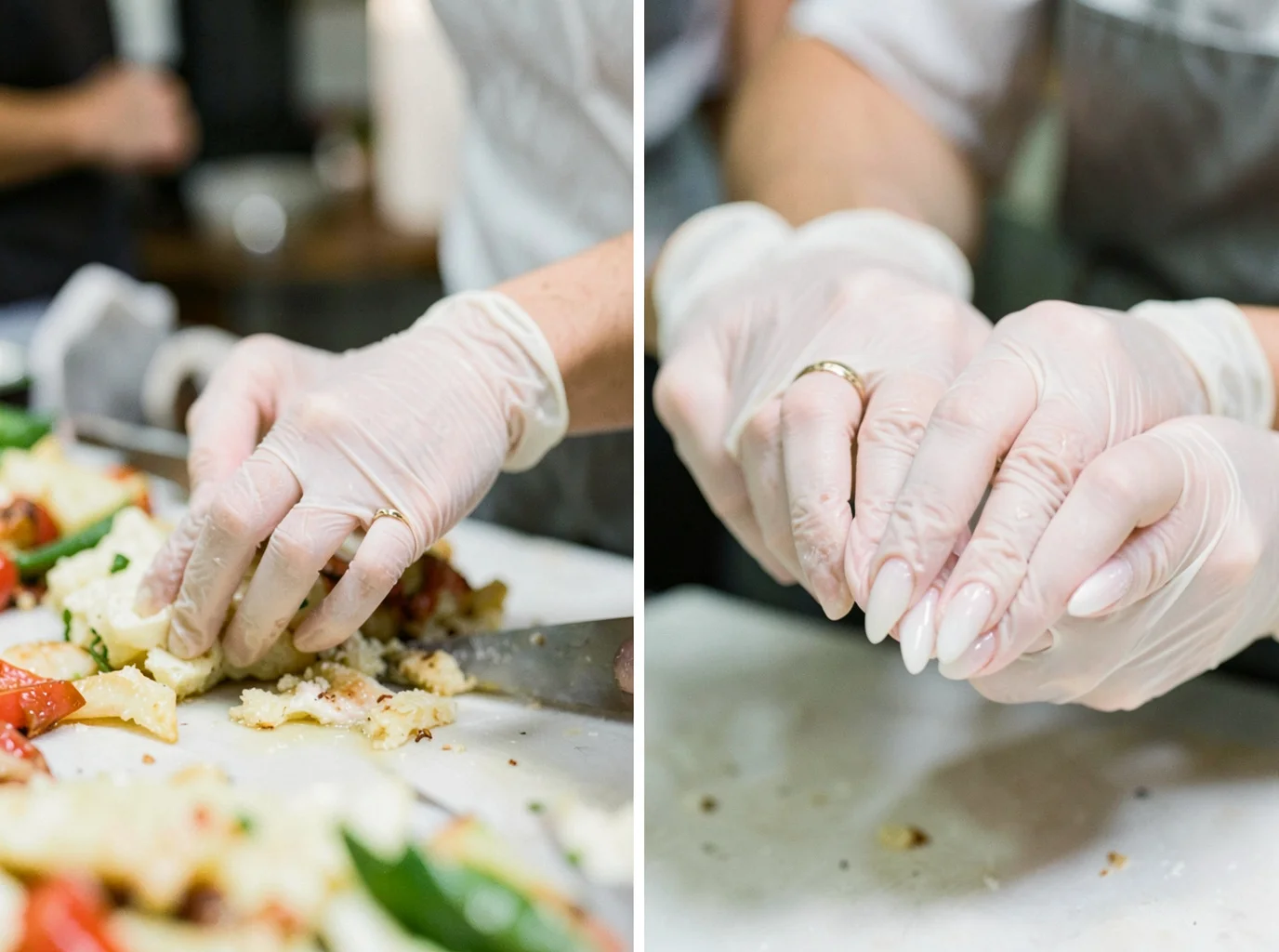
State and local codes don’t all agree, and that inconsistency trips up a lot of kitchen managers. California’s food law is specific: if an employee has artificial nails, nail polish, rings other than a plain wedding band, uncleanable orthopedic devices, or nails that aren’t clean and smooth, they must wear single-use nonlatex gloves when touching food. No exceptions, no workarounds.
Washington takes a softer stance. Its code allows a single ring or wedding ring set as long as it’s fully covered by a glove that’s in good repair. The moment that glove tears or gets soiled, the exception disappears. You’re back to bare-handed jewelry, which means you’re out of compliance.
Hong Kong’s Food Hygiene Code skips the nuance. Watches, rings, all jewelry come off before you touch food. Nails stay short and unpolished. It’s one of the stricter global benchmarks, and you should know it if you’re managing an operation with international standards in mind.
Why “Covered by a Glove” Isn’t a Safe Loophole?
Even when local code permits a glove-covered wedding band, that setup carries real risk. Rings with stones, grooves, or engraving snag glove material from the inside. You won’t see the damage until the glove tears mid-task, or worse, until you don’t notice at all and a glove fragment ends up in someone’s food.
Common violation scenarios show up the same way in kitchen after kitchen:
-
A ring with a stone setting creates micro-tears under the glove, and the glove fails without anyone noticing right away
-
Artificial nails or polish worn without the required gloves is an automatic noncompliance flag during inspection
-
Gloves reused after touching jewelry or after visible damage spike contamination risk
-
Jewelry slips off and lands in food, turning a hygiene issue into a foreign-object incident
The operational fallout is predictable: citations, corrective action orders, wasted food after a suspected puncture, and failed inspections when nail and jewelry rules aren’t enforced as a package deal.
Wearing Rings or Nails With Gloves in Healthcare & Surgical Settings

Hospitals don’t leave this up to interpretation. The CDC caps natural nail length at ¼ inch or less for anyone handling patient care, and artificial nails are off the table when you’re near high-risk patients, like in the ICU and OR. That’s the baseline for hand hygiene gloves to work.
Rings get the same treatment, and the reasoning is mechanical. Healthcare worksite guidance tells professionals to skip rings at work because the skin underneath collects more microorganisms than bare skin. Add a glove on top, and you’ve sealed that bacteria into a warm, humid pocket—the kind of environment that speeds up microbial growth.
Surgical Scrub: A Stricter Standard
Before a surgical scrub, the rule gets tighter. Scrubbed team members remove all jewelry—rings, bracelets, watches, no exceptions. None of it is sterile, and all of it can harbor microorganisms that a scrub can’t reach. Operating-room practice is the same: no rings, no bracelets, no watches, nails kept short, and no nail polish.
Nail polish sits in a gray zone in general-care settings. Fresh polish on short, natural nails is sometimes tolerated. But chipped polish, or polish worn longer than 4 days, is linked to microorganism retention even after proper handwashing. In surgical settings, that gray zone disappears. Polish is out, period.
The Glove Puncture Connection
Rings cause glove punctures. Crevices under a ring setting create friction points that tear gloves from the inside, and infection-control sources flag rings as a factor that increases tear risk. If a glove fails mid-procedure, surgical teams rely on hand antisepsis as backup. That’s how seriously punctures are treated.
What the Evidence Actually Shows?
A Cochrane review found no randomized trials proving nail polish or rings change postoperative infection rates. A 2020 review found rings correlated with lower hand-hygiene quality in general clinical units, but OR-specific studies were low quality and didn’t show a measured scrub-quality effect. The researchers concluded that safety hasn’t been proven, which is why policies stay strict on medical gloves and fingernails, and surgical gloves and nail polish, even without airtight data. Many health systems now prohibit artificial nails, wraps, extenders, and any jewelry for direct-care providers. No loopholes, no gray area.
Wearing Rings or Nails With Industrial/General Work Gloves
Factory floors run on different math than kitchens or ORs. The danger here is entanglement, not bacteria.
Oregon OSHA-adopted language spells it out: rings, watches, earrings, and bracelets that could contact power-driven machinery or electrical circuitry stay off. That’s not a suggestion. It’s a PPE jewelry restriction written into industrial safety standards nationwide.
Moving machinery flips the rulebook. California OSHA states that gloves themselves “shall not be worn where there is danger of entanglement in moving machinery or materials.” Even close-fitting gloves can get caught in rotating parts. So the usual glove hygiene rules don’t apply here—sometimes the safest move is no glove at all, task-dependent.
Rings make this worse. Internal industrial safety guidance is unambiguous: finger rings won’t be worn near moving machinery, rotating parts, climbing tasks, or energized electrical circuits. Taping over a ring or wearing a glove over it doesn’t count as removal. That workaround gets flagged every time.
Glove Fit and Material Matter More Than You’d Think
A ring creates a hard bump under the glove. That bump becomes a pressure point, kills dexterity, and increases glove tearing risk—especially with nitrile, which fits tight and shows every protrusion at the knuckle. Latex is even less forgiving; sharp edges create tension and tear points fast. Leather tolerates more, but pinch points and snag risk still climb.
The sourcing benchmark is simple: machinery-facing gloves get a “no jewelry, no long nails” spec, full stop. Chemical-handling gloves need a snug fit with zero internal protrusions, because anything that breaks contour adds fatigue and kills tactile control on the job.
Key Risks: Glove Tears, Contamination & Poor Fit
Every glove policy you’ll run into comes down to three problems: tears, contamination, and fit. They’re connected, and seeing how they work explains why the rules exist.
Glove tears start at the base. Rings create pressure points where the glove material stretches tightest—right at the finger base when you pull a glove on. Guidance links rings to multiple perforations forming in exactly that spot. This is mechanical and predictable, and it repeats every time a ring goes under a glove.
Contamination hides where you can’t see it. The skin under a ring isn’t clean skin. One widely cited summary found that 40% of nurses had Gram-negative bacteria living under their rings, and that bacteria can persist for months. Sealing that under a glove doesn’t neutralize it. It traps bacteria against the skin in warm, damp conditions that are ideal for growth.
Nail punctures compound the problem. The benchmark is nails at or under 1/4 inch (about 0.5 cm). Beyond that, nails can pierce glove material during donning, while adjusting a glove mid-task, or simply flexing your hand. The dangerous part is timing: a small puncture from a nail often goes unnoticed, so contaminated fluid can reach skin without anyone realizing it in real time.
What Happens After a Tear?
If a glove tears or punctures after contact with blood or body fluid, the protocol is strict: wash hands immediately with soap and water, and treat the incident as direct exposure. No gray area there.
High-Risk Items to Flag
Sourcing and QA teams should watch for:
-
Diamond or stone-set rings
-
Raised bezels or textured bands
-
Watches and bracelets
-
Long natural nails
-
Artificial nails or extenders
Standard policy language covers it cleanly: remove jewelry, keep nails short, change gloves after any tear or puncture, and perform hand hygiene immediately after glove removal. Poor fit isn’t a cosmetic issue. It’s the mechanism behind most of these failures.
Practical Solutions: How to Safely Wear Gloves With Rings or Nails
You don’t have to choose between your style and your safety. A few smart swaps solve most of the ring-and-nail problem without breaking any glove hygiene rules.
If you are keeping the ring, keep it simple. A plain, smooth band with no stones, grooves, or prongs is your safest bet. Food-safety guidance backs this up directly—it is the only style that does not hide contaminants or chew through glove material during a shift.
Better yet, swap metal for silicone. Safety-focused sources recommend removing metal rings and switching to a silicone safety ring for work hours instead. It flexes with your hand, snags less, and slides under a glove without creating that hard pressure point at the knuckle. If your job has an entanglement risk—moving machinery, tight equipment—this swap eliminates most of the avulsion risk that metal rings introduce.
Sizing Up for Rings and Long Nails
Fit is where most people get this wrong. If a glove takes force to pull over your ring, size up or switch to something stretchier. A too-tight glove does not accommodate a ring; it fights it, and that friction leads to tears mid-shift.
Long nails need a different fix: thickness, not just size. Standard exam gloves are too thin to survive nail pressure at the fingertips. Heavy-duty or extra-thick nitrile gloves —some rated at 1.5 AQL and available in S–XL—resist puncture far better. In beauty and salon settings, glove charts often go up to XXL, sized for hand widths in the 4.8 to 5.5 inch range, giving nails room without sacrificing dexterity.
Powder-free is the smarter default. It skips the residue mess and is the standard across most clinical and salon glove lines. One nail-supply reviewer found powder-free vinyl worked fine for long nails during waxing—proof that roomier, powder-free options handle nail-sensitive tasks without complications.
Quick Selection Checklist
-
Ring stays on: plain band, or switch to silicone
-
Glove fights the ring: go one size up, or pick a stretchier material
-
Nails feel tight at the fingertips: switch to thicker nitrile or an oversized salon glove
-
Task is lighter-duty: powder-free vinyl is often enough
If your glove still feels tight after sizing up, that means the current glove is not the right match—not that the rule does not apply to you.
Choosing the Right Gloves When You Can’t Remove Jewelry or Trim Nails
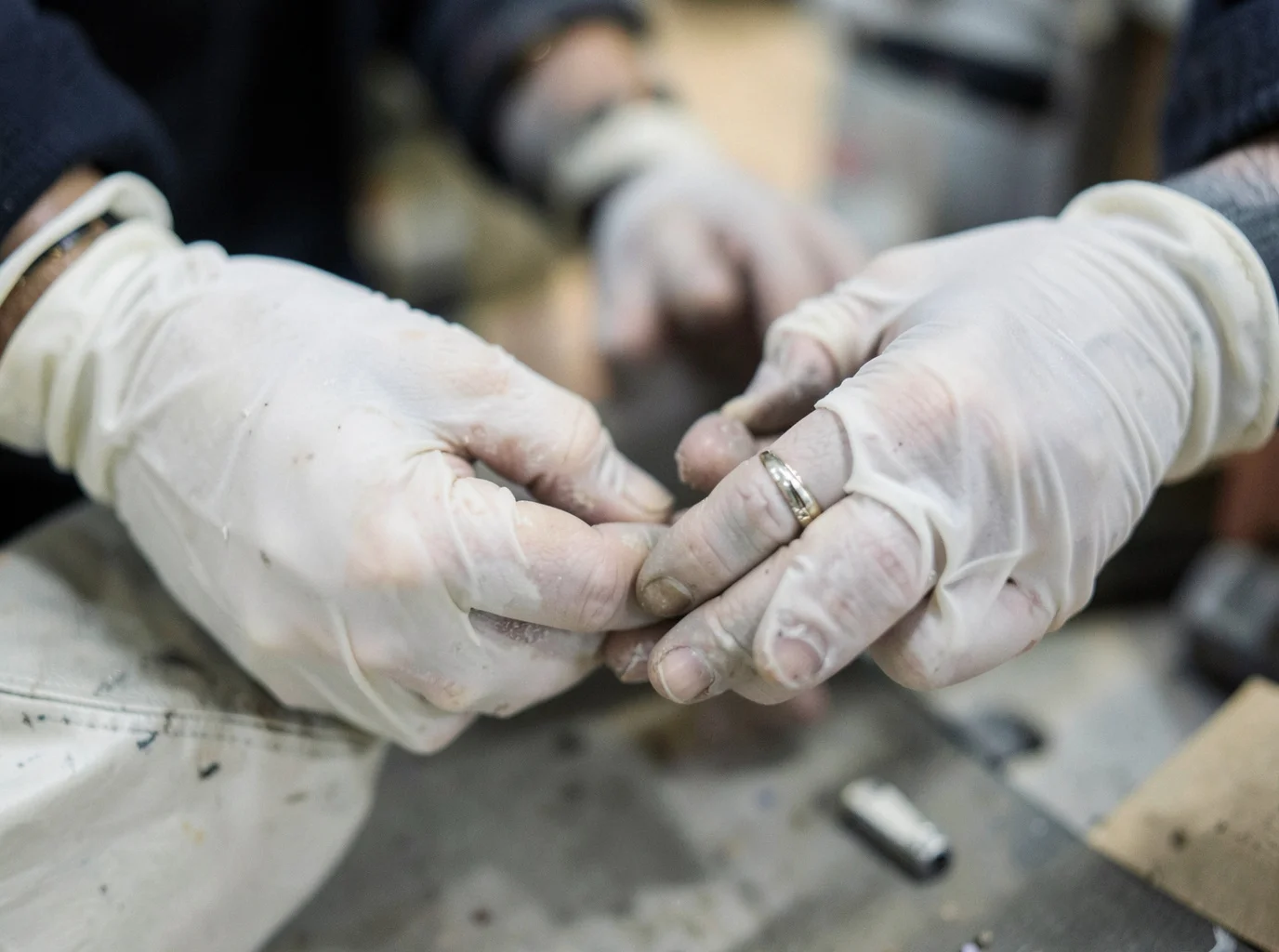
Some jobs won’t wait for a manicure appointment. When rings or nails aren’t coming off today, the glove itself has to do the compromising.
Look for extended fingertip designs. One nail-protection glove brand says its extended finger section fits 99% of nail consumers and folds back if it runs long. Spandex/nylon blends add stretch, easing pressure at the nail bed and knuckle.
For hardware or precision tasks , fingerless gloves with textured palms and hook-and-loop wrist straps skip the fingertip problem.
Tear resistance: Latex (0.08mm+) outperforms nitrile (0.05mm, 14 MPa tensile) and PVC (11 MPa) against snags.
Last resort: Cut the fingertip. It’s a workaround that beats a torn glove mid-task.
Conclusion
Can you wear rings or long fingernails with gloves? It depends on what you’re doing, but the risks are rarely worth ignoring. In food service and healthcare, rings and long nails puncture gloves, harbor bacteria, and defeat the purpose of wearing PPE. Industrial work gives you a bit more wiggle room, but more room still carries risk.
The smart fix is better gear. Sized-up gloves, textured nitrile, and puncture-resistant materials let you keep your rings and long nails without turning your hands into a hygiene hazard.
Browse Morntrip ‘s glove collection built for real hands, real jobs, and real jewelry.





