A single cuff detail can make or break a disposable lab coat order. Get it wrong, and you’re stuck with sleeves that gap under gloves, let contaminants sneak in, or irritate your team enough that they start cutting corners on PPE compliance. Get it right, and cuff design disappears as a problem.
Knit cuffs and elastic cuffs both keep sleeves sealed, but they do it in different ways. The right choice depends on your industry, your budget, and how your team moves on the job. Here is how each option compares on protection, comfort, and cost, along with the exact specs to confirm before you commit to a bulk Disposable lab coat order.
Knit Cuffs Vs. Elastic Cuffs: What Is the Difference in Disposable Lab Coats?
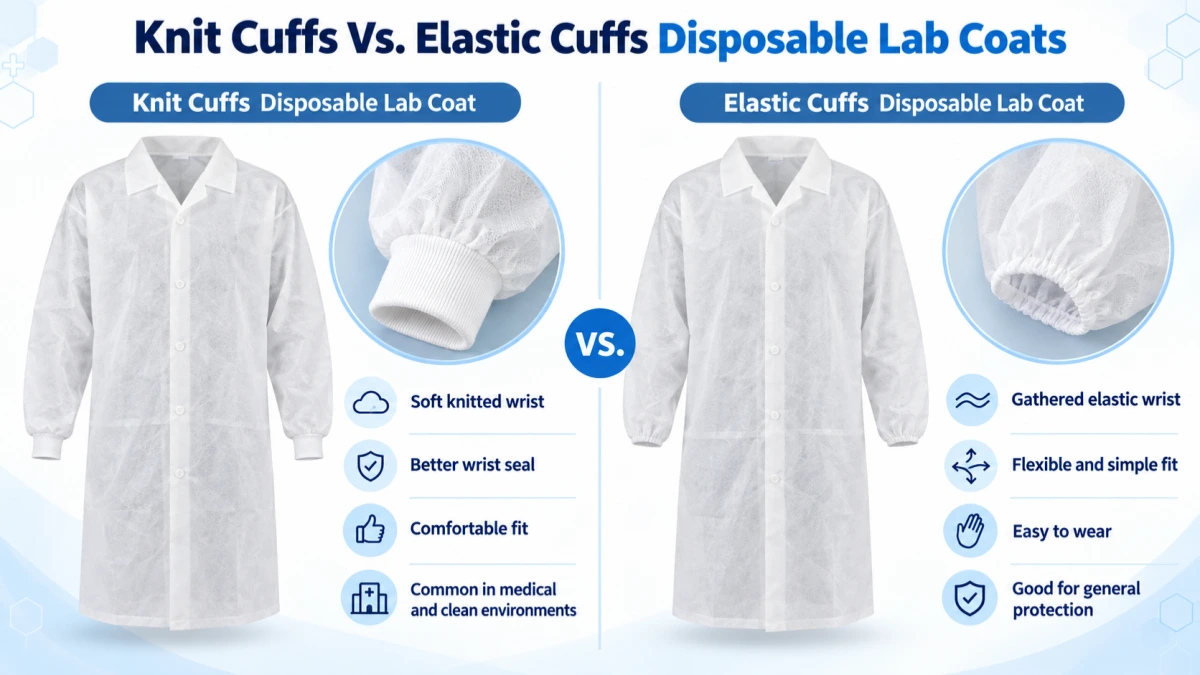
Strip away the marketing language, and the two cuff styles come down to a simple engineering choice between fabric and elastic. That choice shapes fit, feel, and how well the sleeve works with your gloves.
Knit cuffs use a ribbed knit fabric sewn as a circular band at the end of the sleeve. You can see the distinct knit texture and the seam where it joins the nonwoven coat material. By contrast, elastic cuffs use a rubber band, covered elastic thread, or elastic tape sewn straight into the sleeve hem, gathering the nonwoven fabric to cinch the opening.
How Does Each Cuff Fit the Wrist?
The contact feel is where workers notice the difference first.
-
Knit cuffs provide a soft, wide band of contact like a fabric wristlet, giving you low friction and even pressure.
-
Elastic cuffs concentrate pressure into a narrow line, creating an immediate and noticeable gathered feel against the skin.
Glove overlap also varies between the two. Knit cuffs tuck partway into a glove cuff, forming a continuous layer with a stable outer diameter. Elastic cuffs cinch closer to bare skin, often leaving less bulk under the glove cuff depending on the elastic width and stitching method.
Recoil and Comfort Over a Shift
Knit cuffs depend on the fabric weave to spring back. Frequent glove changes or repeated stretching can loosen that hold across an eight-hour shift. Elastic cuffs depend on internal rubber or synthetic thread to snap shut, giving a firmer initial grip. However, heat, storage age, and chemical splashes can degrade raw elastic faster than knit fabric.
For comfort during long wear, knit cuffs hold the edge because they distribute pressure over more skin. That explains why Fisherbrand pairs a knit cuff with a three-pocket layout on its 40 g/m² SMS extended-wear coat. Elastic cuffs suit jobs where a snug barrier matters more than all-day comfort; Fisher Scientific uses an elastic cuff alongside a hook-and-loop front closure on its 50 gsm Polypropylene model.
Price Differences Worth Knowing
|
Cuff Type |
Example Product |
Price Per Unit |
|---|---|---|
|
Knit Cuff |
Enviroguard PP lab coat, 3-pocket, 30/case |
~$1.97/unit |
|
Elastic Cuff |
WWM disposable lab coat, 30/case |
~$2.30–$2.97/unit |
|
Knit Cuff (premium) |
Fisherbrand 40 g/m² SMS, 100/case |
~$4.38/unit |
Cuff design alone rarely dictates the price. Base fabric, brand tier, order packaging, and protective ratings drive the larger cost swings.
Which Disposable Lab Coat Cuff Design Should You Choose?
Your buying decision comes down to five questions: How long will someone wear the coat? How much reaching and lifting happens on shift? How does the cuff meet the glove? How often does staff change coats? And what might splash, spill, or float around the wrist?
Answer those, and the right cuff design becomes clear.
For Long Shifts, Pick Knit Cuffs First
Anyone wearing a disposable lab coat for several continuous hours needs a cuff that stays comfortable. Knit cuffs work best because they hug the wrist without pinching. Fisherbrand pairs knit cuffs with a knit collar on its disposable SMS lab coat for this reason.
Elastic cuffs come in second. DuPont’s Tyvek ® 400 disposable lab coat uses an elastic cuff with a no-pocket design, snap front, and bound seams. It stays in place and resists slipping, but it can feel stiff against bare skin by hour six of a shift.
For Constant Reaching, Avoid Open Cuffs
Jobs that involve repeated arm extension, elbow bending, or lifting need a cuff that stays put. Elastic and knit cuffs both hold their position better than open cuffs when arms move all day.
Open cuffs trade coverage for mobility and airflow. Condor’s polypropylene lab coat uses an open cuff built for light-duty, non-hazardous work where ease of movement matters more than a wrist seal. If your team reaches into equipment, workstations, or passes containers all day, skip open cuffs unless the room carries low risk.
Matching Cuffs to Glove Overlap
How the cuff meets the glove changes the recommendation.
-
Glove over cuff : Choose elastic or knit cuffs. This overlap gives continuous wrist coverage against splashes.
-
Cuff tucked inside glove : Choose a thinner, flatter elastic cuff. A bulky knit cuff bunches under the glove and creates gaps at the wrist seal.
VWR’s disposable SPP coat line offers both styles, so you can match the cuff to how your team wears their gloves. Before placing a bulk order, test both configurations with the gloves your team wears on shift. Raise your arms, bend your wrists, and check for slippage or exposed skin. A spec sheet will not catch what a five-minute fit test reveals.
For High-Turnover, Low-Risk Tasks, Go Simple
Short tasks with low contamination risk do not require heavy-duty cuffs. Open cuffs work well here because staff can pull them on and off quickly. VWR’s lightweight 20 gsm SPP coats, along with their 30 gsm and 48 gsm elastic-cuff versions, give buyers a clear cost ladder to match durability needs without overspending.
The One Thing Cuff Style Can’t Tell You
Cuff design alone does not determine overall PPE protection. When handling splashes or infectious materials, check the fabric weight, barrier rating, seam construction, front closure, and documented test standards alongside the cuff. Certain Tyvek® IsoClean garments list ASTM D6978, ASTM F1383, ASTM F739, EN 374-3, and ISO 6529 compliance for specific hazards. Base buying decisions on those certified ratings rather than assumptions about elastic or knit wristbands.
|
Need |
Recommended Cuff |
Buyer’s Checklist |
|---|---|---|
|
Long wear time |
Knit cuff, then elastic |
Comfort, slippage, wrist pressure |
|
Frequent reaching |
Elastic or knit |
Test arm raises and elbow bends |
|
Glove pairing |
Elastic cuff or thin knit cuff |
Confirm overlap direction, test motion |
|
High turnover, low risk |
Open cuff or lightweight elastic |
Prioritize speed and per-unit cost |
|
Splash or infectious risk |
Snug cuff, but verify full spec sheet |
Check fabric, seams, and test certifications |
How to Check Disposable Lab Coat Cuff Fit Before a Bulk Order?
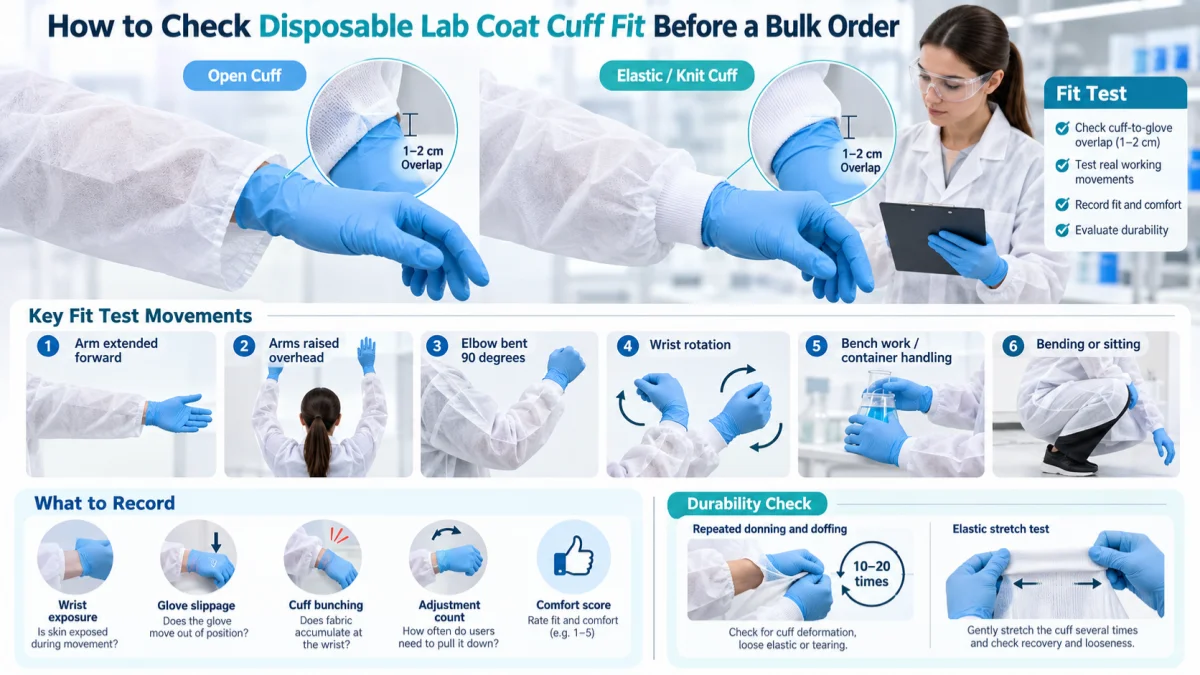
A spec sheet outlines what a cuff should do. A fit test shows how it performs on a real wrist, with a real glove, through a normal shift. Before you sign off on a bulk disposable lab coat order, run both cuff styles through a side-by-side comparison. Here is how to set it up.
Build a Fair Sample Comparison
Pull two samples that differ only in cuff design. Keep the fabric, size, sleeve length, shoulder width, front closure, and packaging identical. Sample A might be an open cuff; Sample B, a knit or elastic cuff. Sleeves must reach the wrist and overlap the glove during regular work posture. Many disposable gloves extend 5–7 cm up the forearm, so use that baseline and set your minimum acceptance line at 1–2 cm of cuff-to-glove overlap. Test with the exact glove brand, size, and material your team wears on the job.
Test with Real Bodies and Real Movements
Recruit testers across three wrist sizes—small, average, and large—with two people per size. Have each person wear both cuff styles with the same glove and base layer. Run them through:
-
Arm extended forward, held for 10 seconds
-
Arms raised overhead, held for 10 seconds
-
Elbow bent at 90 degrees
-
Ten consecutive wrist rotations
-
Simulated bench work, container handling, and glove changes
-
Bending, sitting, and standing
Record What Happens at the Wrist
Track five things for each action set:
-
Wrist exposure : any visible skin or base-layer fabric counts as a fail
-
Glove slippage : measure in millimeters if the cuff pushes the glove back or slides underneath it
-
Cuff bunching : note bulk or restricted wrist rotation
-
Adjustment count : flag any sample needing more than one re-tuck across six actions
-
Comfort score : rate 1–5 for pressure, heat, and flexibility; anything averaging below 3 does not move to a bulk order
Check Structural Durability After Repeated Wear
Put each sample through five donning and doffing cycles, then inspect the seams, elastic coverage, and knit integrity. For elastic cuffs, stretch and release 10 times, then measure the opening before and after. Reject anything with exposed elastic, open seams, or more than 10% permanent stretch in the cuff opening.
Fit testing confirms sizing and durability. It does not replace barrier, particulate, or seam-strength testing, so request those test certificates for any protective-use order.
What to Specify When Ordering Disposable Lab Coats With Different Cuffs
Most cuff-related disputes trace back to vague purchase orders. Writing “elastic cuff” or “knit cuff” on a spec sheet tells a supplier almost nothing about dimensions, material, or latex content. Catalogs frequently mix up these terms, so the label alone will not tell you the fiber content or how the cuff is built. Lock down these details before signing off on a bulk disposable lab coat order.
Name the Cuff Type Precisely
State whether you want a knit cuff, elastic cuff, or elastic knit cuff. Supplier catalogs often treat these three descriptions as identical. Put the exact construction into your PO instead of relying on a broad category name.
Knit Cuff Specifications to Request
-
Fiber composition : exact blend percentages for polyester, nylon, or spandex
-
Latex content : confirmation of whether natural rubber latex is present
-
Flat length : target dimension (such as 70 mm) with a tolerance of ±5 mm
-
Opening size : relaxed opening (such as 80 mm) and maximum stretched opening (such as 120 mm), along with the measurement method
-
Structure : single-layer or double-layer, rib knit pattern, sleeve attachment method, and whether edges are bound
A common SMS lab coat configuration pairs a knit collar and knit cuffs with a snap-front closure in non-sterile packaging.
Elastic Cuff Specifications to Request
-
Elastic material : rubber, natural latex, synthetic rubber, or spandex. The word “elastic” by itself does not confirm latex-free status.
-
Casing method : sewn into a channel, exposed stitching, or covered by knit fabric, along with casing width and stitch count
-
Opening sizes : unstretched, worn, and maximum stretched openings (such as 70–90 mm natural, 110–130 mm maximum), with a ±5 mm tolerance
-
Comfort data : stretch-force measurements or standardized wear-test results for long shifts
Require Latex and Restricted-Substance Declarations
Put “natural rubber latex: none” straight into your PO, and request a material statement, BOM, or substance declaration covering the cuff fabric, elastic, thread, and casing. Ask about DEHP content on its own, because “latex-free” and “DEHP-free” are entirely different claims. For cleanroom coats, specify particulate limits, anti-static compliance under EN 1149-5:2008 , and the required ISO class.
Fix Variables Before Comparing Prices
Hold fabric type, gsm, closure, pockets, seams, packaging, and order volume constant across quotes. That way, any price differences reflect cuff design instead of mismatched garment specs.
Lock Sample Approval Into the Order
Reference an approved sample number, version date, and close-up photo of the cuff. Attach the detailed specs for cuff type, material, length, openings, casing, and tolerances as a separate document, complete with an incoming inspection checklist covering opening size, exposed elastic, stitch quality, and left-to-right consistency.
FAQs About Disposable Lab Coat Cuffs
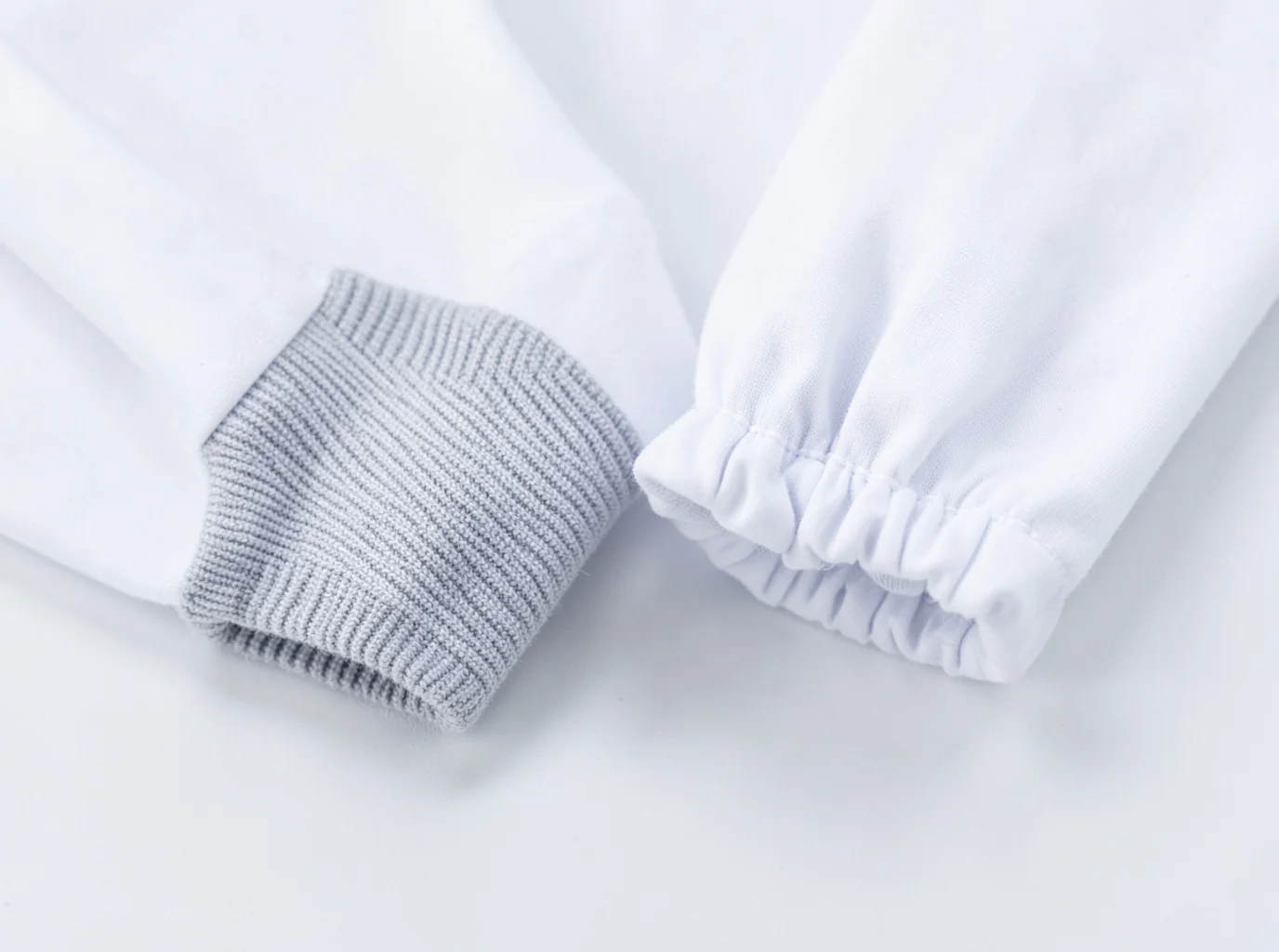
Supplier catalogs don’t use consistent terms, leaving buyers to guess what they are ordering. These four questions come up most often once teams start comparing disposable lab coat cuff options.
Are Knit Cuffs and Ribbed Cuffs the Same Thing?
Not quite. “Knit cuff” describes the broad manufacturing category for any cuff made from knitted textile. A ribbed cuff is a specific structure within that category, built with raised alternating ribs that give the fabric stretch and recovery. Suppliers frequently mix terms like “knitted cuff,” “rib-knit cuff,” and “elastic knit cuff” for products that differ in fiber content, stretch, and dimensions. Don’t rely on the product name alone. Confirm the construction details before ordering. A workable spec line reads: “rib-knit wrist cuff, latex-free, compatible with glove overlap, cuff length ___ cm, opening circumference ___ cm.” Elastic cuffs and knit cuffs are not interchangeable either. VWR, for example, lists elasticated and knitted cuff versions as separate product lines.
Can Disposable Lab Coat Cuffs Be Customized?
Yes. OEM suppliers can adjust cuff length, opening size, material, and construction style, including rib-knit, plain knit, elasticated, or thumb-loop designs. Request a pre-production sample with measurement tolerances spelled out, and ask for quotes across three tiers: sample, pilot order, and production run. Custom cuffs often carry a higher MOQ than stock styles. Confirm relevant certifications as well, such as ISO 13485, EN 1149-5 for antistatic claims, or AAMI PB70 for liquid-barrier performance.
Should You Roll Up Disposable Lab Coat Sleeves?
No. Rolling sleeves exposes skin and breaks the glove-to-cuff seal. If sleeves run long, resize the garment instead of rolling them.
Conclusion
Your cuff choice shapes contamination control, wearer comfort, and your cost-per-unit math. Knit cuffs deliver a snug seal suited for cleanrooms and extended lab work, while elastic cuffs offer quick on/off convenience in high-turnover environments where speed matters more than an airtight closure. The best option depends on your specific protocol, budget, and compliance requirements.
Getting this right brings fewer returns, fewer complaints from staff, and PPE that performs when it counts.
Before your next bulk order, pull your usage data. How often are gloves overlapping cuffs? What is your contamination tolerance? Then talk to a manufacturer who can customize cuff designs around your answers.
Morntrip builds disposable lab coats to spec. Reach out, and let’s engineer the right fit for your floor.