
Every day in labs and warehouses, someone reaches for rubber gloves, sees “chemical resistant” on the box, and assumes they’re covered—literally and figuratively. Then a solvent splashes, and thirty seconds later, that assumption starts to burn. Quite literally.
The truth is messier than any packaging label admits. Nitrile gloves that shrug off oils will fail fast against acetone. Latex handles some acids well but dissolves under others. Even the toughest Neoprene has a breaking point measured in minutes. If you choose gloves based on marketing copy instead of actual chemical resistance rates, you’re gambling with your skin.
This guide breaks down what “chemical-resistant” actually means, which glove materials hold up against which substances, and how to tell—before you ever open that chemical container—whether your gloves will protect you or quietly betray you.
The Short Answer: No Rubber Glove Is 100% Chemical-Resistant
OSHA’s guidance says plainly that no glove material resists permeation by all chemicals. CCOHS goes further and calls “impervious gloves” technically inaccurate. No glove material stays impervious to a specific chemical forever, and no single material blocks every chemical.
Protection is chemical-specific and material-specific, period. ” rubber gloves ” is a catch-all label hiding real differences between latex, nitrile, neoprene, butyl, and PVC. Rubber gloves resist many chemicals but not all—protection depends on material, chemical type, thickness, and how long you’re exposed.
The exposure risk is real. High-risk chemicals like nitric acid, sulfuric acid, hydrofluoric acid, peroxide, and rocket fuels can cause chemical burns, dermatitis, or systemic absorption once breakthrough happens. That’s why matching the exact chemical and concentration to manufacturer breakthrough-time data matters more than trusting a material name alone.
What Is “Breakthrough Time” and Why It Determines Real Protection
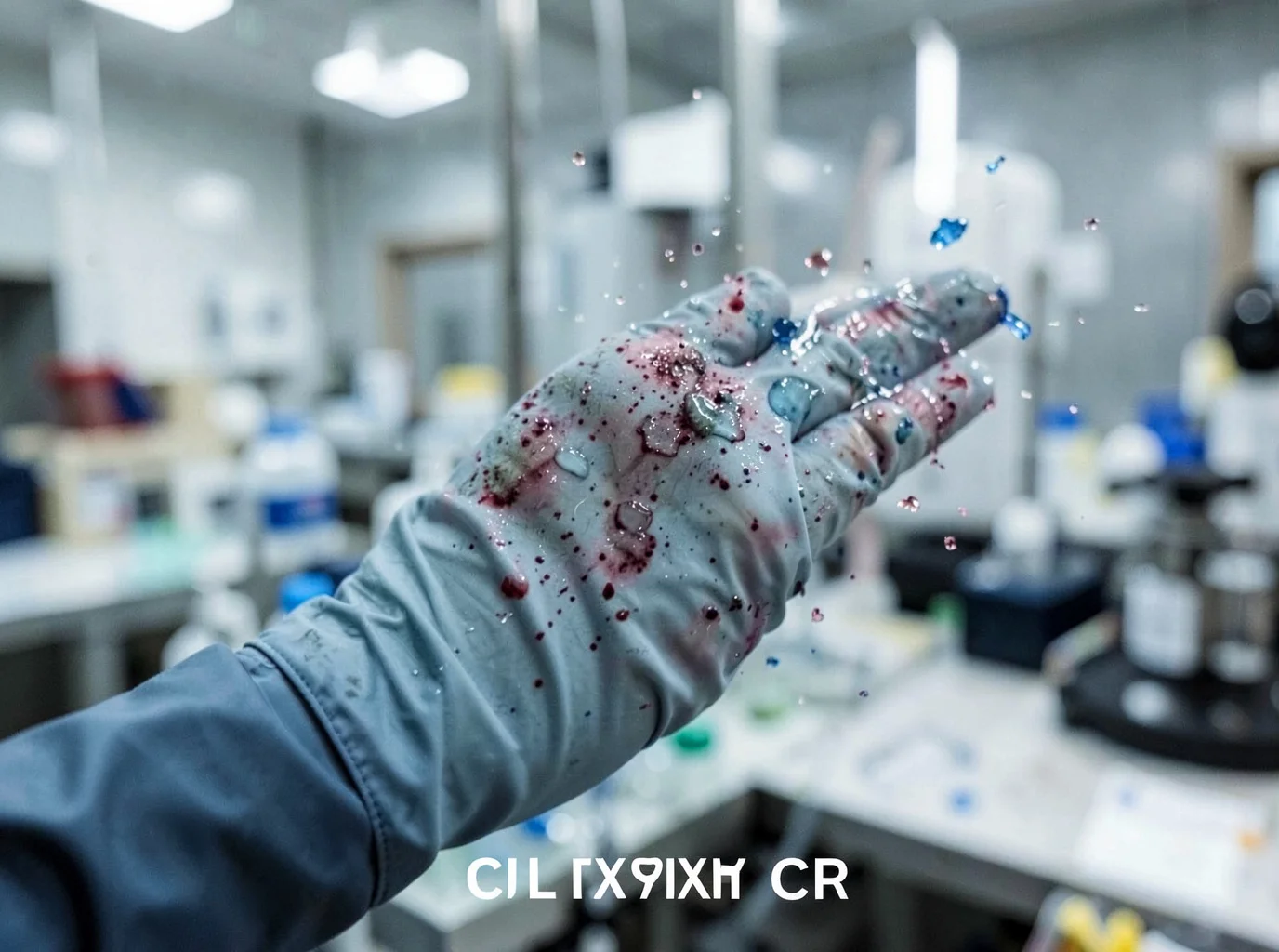
Breakthrough time is the number that matters. Most boxes print “chemical resistant” but don’t mention it. This is the measured interval between the moment a chemical touches the outside of a glove and the moment it permeates through to the inside at a rate of 0.1 mg/m²/s—the standard threshold used in permeation testing. Cross that line, and the chemical is already on your skin, whether you feel it yet or not.
Manufacturers translate this raw time into a Level 1 through Level 6 rating system:
-
Level 1 : >10 minutes
-
Level 2 : >30 minutes
-
Level 3 : >60 minutes
-
Level 4 : >120 minutes
-
Level 5 : >240 minutes
-
Level 6 : >480 minutes
A higher number means longer protection. Simple enough. But under EN ISO 374, you’ll also see Type A, B, or C stamped on the packaging. Type A means the glove hit at least 30 minutes (Level 2) against six or more tested chemicals. Type B drops that to three chemicals. Type C only requires one chemical to clear 10 minutes. Skip the marketing language and look for the actual chemical name paired with its breakthrough time and level.
Lab Data Isn’t Field Data
Breakthrough time comes from controlled lab testing, not your actual workday. Heat, friction, repeated stretching, higher chemical concentrations, and larger contact areas all shrink that number in real conditions.
Matching Gloves to Exposure Time
The rule is straightforward: your exposure time should sit well below the glove’s breakthrough time, not equal to it.
-
Brief splashes → Level 1–2 minimum
-
~1 hour of contact → Level 3
-
2+ hours → Level 4–5
-
Near full-shift exposure → Level 6, plus glove rotation or double-layering
A 45-minute task calls for Level 3 at minimum, Level 4 for safety margin. A 3-hour job needs Level 5, ideally Level 6.
Material-by-Material Chemical Resistance Comparison (Nitrile vs Latex vs Neoprene vs Butyl vs PVC)
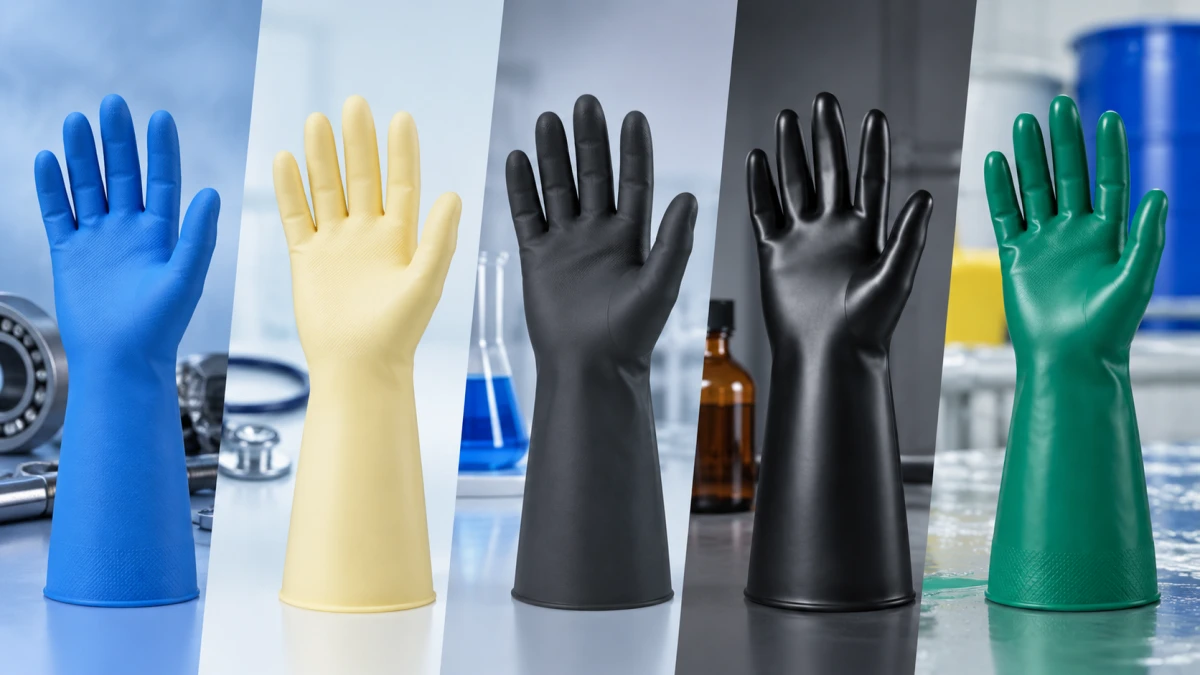
Five materials dominate the rubber gloves market, and each one plays a different game. Pick the wrong one, and it doesn’t matter how thick the glove is—the chemical wins anyway.
Latex: Fine for Water, Fails on Solvents
Natural rubber latex handles general cleaning, water-based solutions, and dilute inorganic chemicals well. Alcohols and bases are also fine. But organic chemicals destroy latex fast, particularly ketones and chlorinated solvents. If your job is short, light-duty aqueous work, latex earns its spot. Anything involving acetone or degreasers, and it’s the wrong pick.
Nitrile: The Everyday Workhorse, With Caveats
Nitrile gloves chemical resistance covers the widest everyday range—oils, greases, aliphatic chemicals, some acids and bases, plus most disinfectants. That’s why nitrile dominates labs and cleaning carts.
Thickness and formulation change everything. A 4-mil exam glove and an 8-mil industrial nitrile glove aren’t the same product, even with identical labeling.
The benchmark numbers show the gap:
-
Ethanol → Excellent
-
Isopropyl alcohol → Excellent
-
Ammonia → Excellent
-
Acetone → Fair to moderate
-
MEK → Moderate
-
Toluene → Moderate
Nitrile is your best all-around choice for cleaners, dilute acids, dilute bases, and alcohols. Push it into aggressive solvents, and performance gets shaky fast.
Neoprene: The Broad-Spectrum Middle Ground
Neoprene gloves chemical resistance spans acids, bases, alcohols, fuels, peroxides, hydrocarbons, phenols, and oils. Few materials cover that much ground.
Neoprene weakens against ketones, esters, chlorinated solvents, and aromatics. If your day involves acids, bases, alcohols, peroxides, fuels, and phenols in rotation, neoprene is the broadest single option available, and you don’t need a different glove for every task.
Butyl: Built for the Worst-Case Chemicals
Butyl rubber gloves exist for one reason: permeation resistance when nothing else holds up. For strong acids, strong bases, ketones, esters, and aldehydes, butyl is best-in-class. For rocket fuels and peroxide handling, butyl is the standard answer.
If your chemical list includes ketones or esters, start with butyl. Test nitrile or neoprene only if you have verified permeation data backing that choice—don’t guess.
PVC: Cheap, But Chemically Limited
PVC gloves chemical protection covers some acids, bases, salts, and select alcohols. That’s about it. PVC isn’t rubber. It’s a thermoplastic barrier, not an elastomer, and that distinction matters. That’s why PVC performs poorly against acetone and most organic solvents.
PVC works when cost matters more than coverage. It’s not a substitute for rubber gloves once aggressive solvents enter the picture.
Glove Material Compatibility Chart
|
Material |
Acids |
Bases |
Alcohols |
Ketones |
Esters |
Chlorinated Solvents |
Oils/Greases |
|---|---|---|---|---|---|---|---|
|
Latex |
Good (dilute) |
Good |
Good |
Poor |
Poor |
Poor |
Poor |
|
Nitrile |
Good |
Good |
Excellent |
Fair |
Variable |
Limited |
Excellent |
|
Neoprene |
Good |
Good |
Good |
Weak |
Weak |
Weak |
Good |
|
Excellent |
Excellent |
Good–Very Good |
Best-in-class |
Best-in-class |
Strong |
Good |
|
|
PVC |
Fair–Good |
Fair–Good |
Mixed |
Poor |
Poor |
Poor |
Fair |
Matching Material to Task
-
Ketones or esters on the list → butyl first, then verify nitrile/neoprene data before switching
-
Mostly cleaners, dilute acids/bases, alcohols → nitrile, best cost-to-protection ratio
-
Mixed exposure (acids, bases, fuels, phenols) → neoprene, broadest coverage
-
Short-duration, water-based cleaning → latex works, skip ketones and chlorinated solvents
-
Budget is the priority → PVC, but not for solvent-heavy work
None of these materials is universal. The chemical you’re handling decides the material.
How to Choose the Right Chemical-Resistant Rubber Gloves for Your Specific Task?
Skip the material label. Start with the chemical’s actual name, its concentration, and how long your skin will be near it. That’s the entire method in one sentence—everything else is just filling in the blanks.
Step 1: Look Up the Chemical, Not the Material
Pull the manufacturer’s chemical compatibility chart and search by chemical name, not by “nitrile” or “PVC.” A glove material compatibility chart lists breakthrough time and rating for each specific chemical—that’s the number that means anything. Some vendors simplify this into four practical tiers: >8 hours = highly recommended, >4 hours = recommended, 1–4 hours = use caution, <1 hour = not recommended. Use that shortcut when you need a fast answer.
Step 2: Match the Rating to Your Actual Contact Time
-
Quick lab transfers or pipetting → Class 3 (≥60 min) minimum; Class 2 (≥30 min) only if you’re swapping gloves immediately after
-
Continuous industrial handling, assembly, or repeated cleaning → Class 5 or 6 (≥240–480 min)
-
Degreasing or mixed-chemical cleanup → Class 3–5, and shorten your change interval based on real exposure
-
Medical disinfectant work → often fine at >60 min for brief contact, but repeated exposure to alcohols, aldehydes, or oxidizers needs its own chemical-specific check—don’t assume ” medical glove ” covers it
NIOSH data on acetic acid makes the point well: butyl, Teflon, Viton, and PE/EVAL hold up to 8 hours, while neoprene and Barricade top out around 4 hours. Same acid, wildly different protection windows depending on material.
Step 3: Balance Thickness Against Dexterity
Thicker gloves generally resist chemicals longer, but every added mil costs you feel and speed. A 17-mil glove markets itself on flexibility; a 15-mil glove leans on comfort. Studies tracking task completion time show a near-linear slowdown as thickness increases—more protection, slower hands.
-
Precision work (sampling, cap removal) → thinner glove, sufficient breakthrough time
-
Immersion or heavy chemical splash protection → thicker glove, even if dexterity drops
Quick Reference by Chemical Type
-
Acids (acetic, chromic) → acid-resistant gloves in butyl, Teflon, Viton, PE/EVAL; neoprene works for some, verify concentration first
-
Bases → neoprene, nitrile, PVC; recheck strong bases individually
-
Solvents (aliphatic, aromatic) → solvent-resistant gloves lean toward butyl or Viton
-
Ketones (acetone, MEK) → butyl or a manufacturer-rated specialty glove
The Decision Template
Lock in the chemical name, concentration, temperature, exposure time, and whether it’s mixed. Choose a glove where breakthrough time is 2–4x your actual contact time—that margin covers delays you didn’t plan for. Then pick the thinnest option that still clears that bar. That’s how you get real chemical splash protection without sacrificing every bit of hand control.
Warning Signs: When to Replace Your Chemical-Resistant Rubber Gloves
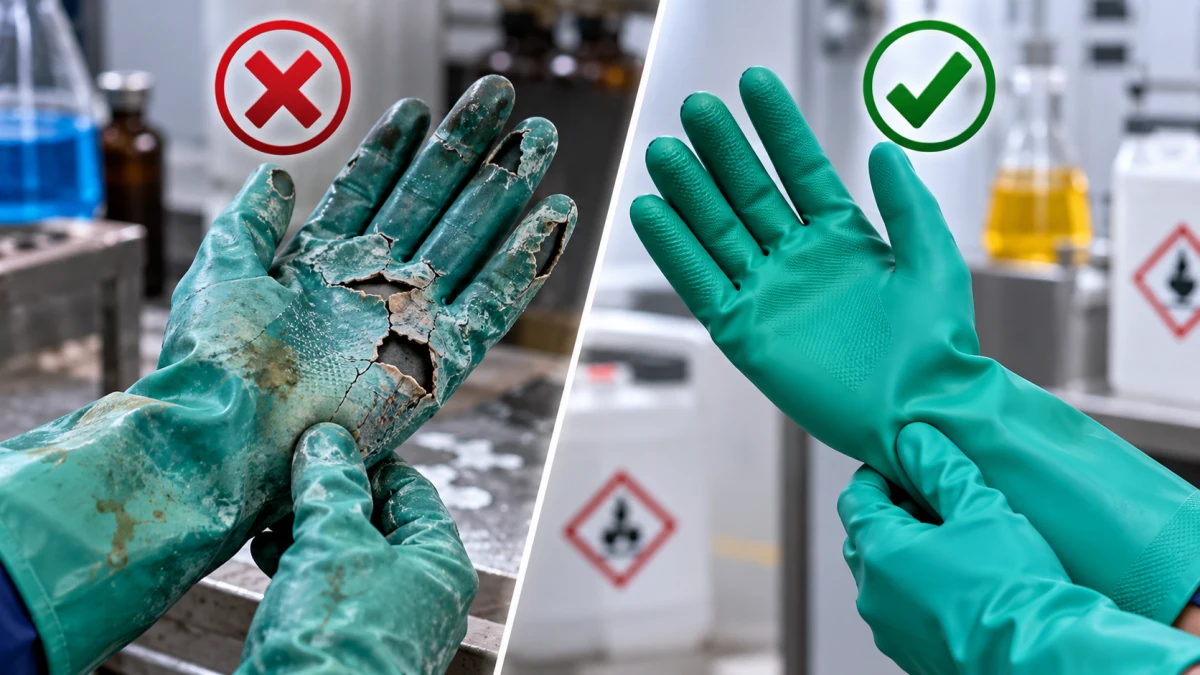
A glove doesn’t need a hole to be done for. That’s the part most people miss.
Stop and replace the moment you spot any of these:
– Holes, cuts, or abrasion spots
– Cracked or separated seams
– Surface flaking or peeling
– Discoloration, swelling, or shrinking
– A sticky, tacky, or hardened surface
– Brittleness where the material used to flex
Any one of these means the chemical is already breaking down the glove’s structure. Don’t wait for a second sign.
The Invisible Failure
Here’s the uncomfortable truth: a glove can look perfectly fine and still have failed. Breakthrough time—the point when a chemical first shows up on the inside surface—doesn’t announce itself. OSHA defines it exactly this way, and it’s why appearance alone can’t be your safety check. Once you’re past that time, the glove is compromised, holes or not.
Set Your Replacement Schedule Before You Start
Use ANSI/ISEA 105 ratings to build a preventive replacement cycle, not a reactive one:
-
Level 0: <10 min
-
Level 1: ≥10 min
-
Level 2: ≥30 min
-
Level 3: ≥60 min
-
Level 4: ≥120 min
-
Level 5: ≥240 min
-
Level 6: ≥480 min (8 hours)
Pick your task’s expected exposure time, then swap gloves before you hit that number—not after.
Build This Into Your SOP
-
Check gloves before, during, and after every task
-
Replace immediately after contamination, wetting, or any physical degradation
-
Keep a chemical-to-glove compatibility chart on hand for quick reference
-
Treat “looks fine but past breakthrough time” as a failure, not a judgment call
FAQ: Common Questions About Rubber Glove Chemical Resistance
Readers keep asking the same five questions. Here they are, answered straight.
Is nitrile better than latex for chemicals?
Yes. Nitrile gloves have well-documented chemical resistance data under EN ISO 374 and ASTM F739 testing, covering oils, fuels, dilute acids, and most cleaning products. Latex gets picked for stretch and feel, not chemical coverage. Neither one handles acetone or MEK well. Don’t assume otherwise without checking a chemical-specific chart first.
What does “chemical resistance” mean?
It’s not a single pass/fail grade. Three things get measured: permeation (chemical migrating through the material), penetration (leaks through pinholes or seams), and degradation (swelling, cracking, softening). A glove can look flawless and still be leaking chemical through permeation. That’s why the material name alone tells you nothing.
Which chemicals do nitrile gloves handle well or poorly?
One nitrile glove chart shows these levels: methanol at Level 2 (77.7 min), n‑heptane at Level 6 (11.7 min), 40% sodium hydroxide at Level 6, 96% sulfuric acid at Level 3 (62.1 min), 30% hydrogen peroxide at Level 6 (2.5 min), 25% ammonium hydroxide at Level 5 (9.4 min), and 37% formaldehyde at Level 6. Concentration changes everything. Dilute and concentrated versions of the same chemical behave like different substances.
What standards matter on the label?
Look for EN ISO 374‑1 (Type A means 30+ minutes across six test chemicals) and ASTM F739‑based permeation data. Medical‑grade certification alone doesn’t qualify a glove for chemical protection claims.
Morntrip ’s HC‑30 line, for example, is EN388/EN374‑tested for ketones, cleaners, alcohols, and alkalis. It’s built around actual permeation data, not marketing language.
Conclusion
Rubber gloves are a barrier, not a force field. Every material—nitrile, latex, neoprene, PVC—has a breakthrough point, and pretending otherwise is how chemical burns happen. A safe workday versus a trip to urgent care comes down to whether you matched the material to the actual chemical you’re handling, respected the breakthrough time, and swapped gloves the moment you saw swelling, discoloration, or stiffness.
Pull up a glove material compatibility chart before your next task. Cross-reference it against the Safety Data Sheet for whatever you’re working with. Treat “chemical-resistant” as a spectrum, not a guarantee. If you’re still unsure which nitrile gloves chemical resistance level fits your specific use case, get a straight answer before you open that bottle, not after.





