
That $0.02 per unit savings on your wholesale latex gloves quote might be costing you more than you think. Once customs delays, MOQ overcommitments, and quality inconsistencies enter the picture, the “cheaper” factory-direct option quietly erases your margins.
Most B2B buyers compare latex gloves wholesale price sheets side-by-side and ignore the hidden costs baked into each sourcing model. Should you fly straight to a Chinese manufacturer, or is your local distributor the smarter play for your order volume?
We’re breaking down the real total cost of ownership—shipping, certifications, lead times, and everything in between—so you can stop guessing and start sourcing with actual numbers backing your decision.
Factory Direct Sourcing for Wholesale Latex Gloves: Pricing Structure and Operating Model

Chinese manufacturers don’t post one price. They post a range, and that range tells you everything about how factory pricing works.
Public quotes for wholesale latex gloves from Chinese factories fall between $0.026 and $0.22 per unit. That’s an 8x spread. Pricing is tiered, and volume moves it.
The Volume-Price Relationship
Pull up Made-in-China listings, and you’ll see this pattern repeat:
-
$0.13/pair at MOQ 2,400 pairs
-
$0.19/pair at MOQ 12,000 pairs
-
$0.135–$0.18/pair across MOQ ranges from 5,000 to 60,000 pairs
Lower unit prices don’t always correlate with higher MOQs in a straight line. They correlate with standardization. The more customized your order, the less volume helps on price.
Some suppliers price by carton instead of piece. Expect $15.5–$20/carton with a 400-carton MOQ. That’s useful if you’re calculating landed cost by container rather than per glove.
What Drives the Price You Get?
Order quantity is the primary driver, but three other factors reshape your quote.
-
Packaging format – Carton-based pricing suits buyers who think in container loads.
-
Customization level – OEM/ODM orders (custom logo, private label, specific packaging) come with longer lead times and higher MOQs than standard SKUs.
-
Trade terms – Most factory-direct quotes are FOB or EXW . Shipping and customs clearance sit entirely on your side. If you can’t self-manage logistics, your cheap factory price gets expensive fast.
Lead Time Benchmarks
-
7–15 working days for standard, in-stock or semi-finished styles
-
15–30 working days for OEM/ODM orders with custom logos or packaging
-
20–35 days for larger production runs, especially medical-grade orders requiring stricter QC
-
45 days for first orders, 30–50 days for reorders – the conservative benchmark for established suppliers
MOQ Thresholds That Matter
Typical entry points: 400–500 cartons, 1,000 dozens (roughly 12,000 pairs), or piece-based tiers at 2,400 / 5,000 / 6,000 / 12,000 / 60,000 pairs. The higher you climb, the closer you get to that low-price band.
This model works best for buyers placing repeat, high-volume orders who handle their own QC and freight. If that’s not you yet, the math changes.
Local Distributor Pricing for Bulk Latex Gloves: Convenience vs. Risk Premium
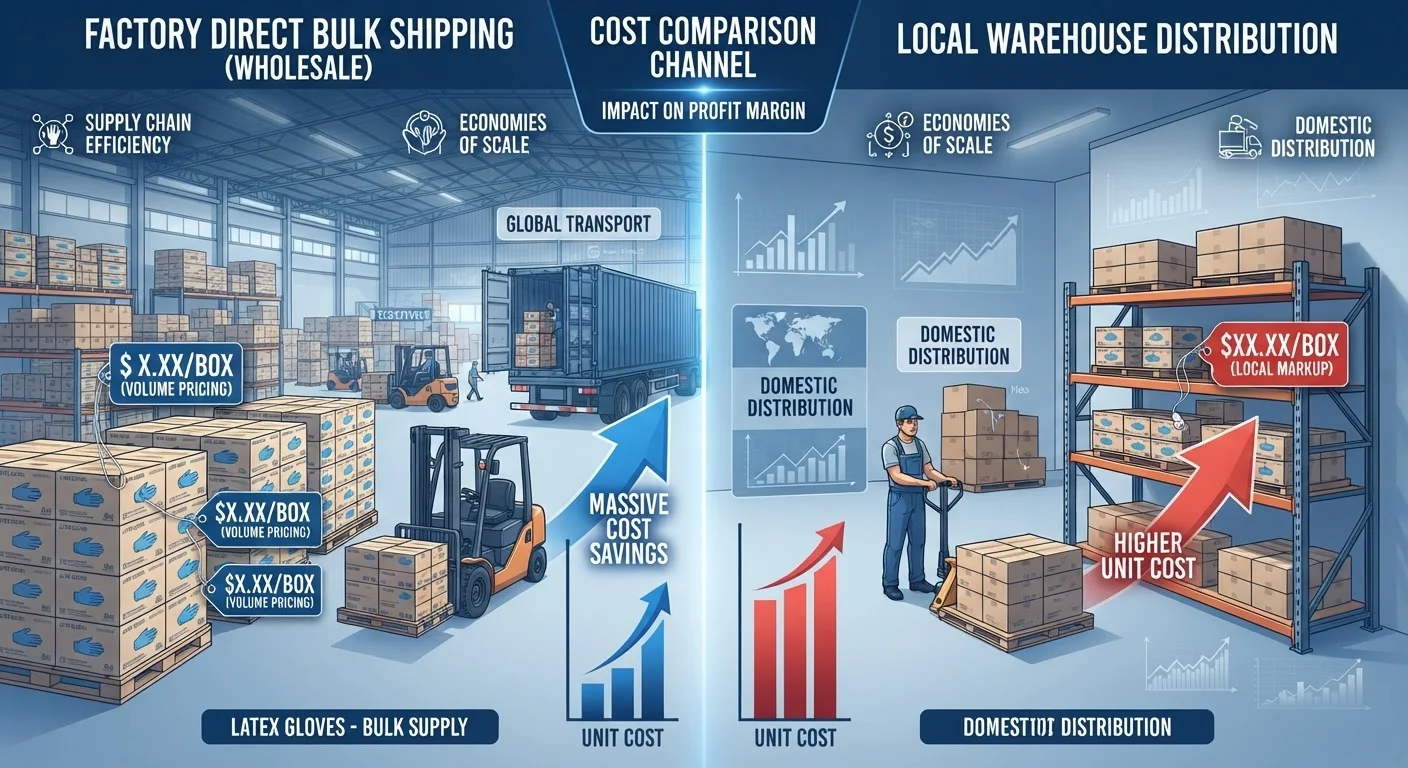
Local distributors charge 37 to 50 times more per unit than factory-direct sourcing. Not 2x or 5x—up to 50x.
Check the math yourself. One U.S. wholesale listing prices latex gloves at $44.99+ “as low as” for certain SKUs. Another quotes $64.99 across 100/200/1000-count options. Compare that to factory FOB benchmarks: $1.00–$1.20 per box at a 3,000-box MOQ, or $1.30–$1.50 per box at the same volume tier.
$44.99 versus $1.00–$1.20 gives you 37–45x higher before freight or duties. $64.99 versus $1.30–$1.50 pushes that gap to 43–50x.
Where the Premium Comes From?
Distributors price in real operational costs:
-
Warehouse holding costs for inventory on U.S. soil
-
Split-case fulfillment so you order 10 cases instead of 10,000
-
Local delivery and LTL shipping, often same-day
-
Financing and credit risk on smaller, faster-turnaround orders
Factory MOQs sit at 3,000–10,000 boxes. Distributors let you in at 10 cases minimum, or sometimes a single 96-case pallet at $84.99. One medical supply distributor offers custom pricing starting at 10 cases—flexibility factories rarely extend.
When the Premium Is Worth Paying
Search ” latex gloves supplier near me ” and you’ll find sellers advertising in-stock inventory and same-day shipping. For emergency replenishment or smaller recurring orders, that speed has real value.
As a working benchmark: paying a 10x to 40x premium over factory FOB pricing can still make financial sense if it eliminates weeks of lead time, customs paperwork, and MOQ overcommitment. Match your order size and urgency to the right channel.
Core Comparison Dimension: Latex Gloves Wholesale Price Full Cost Breakdown (TCO Analysis)
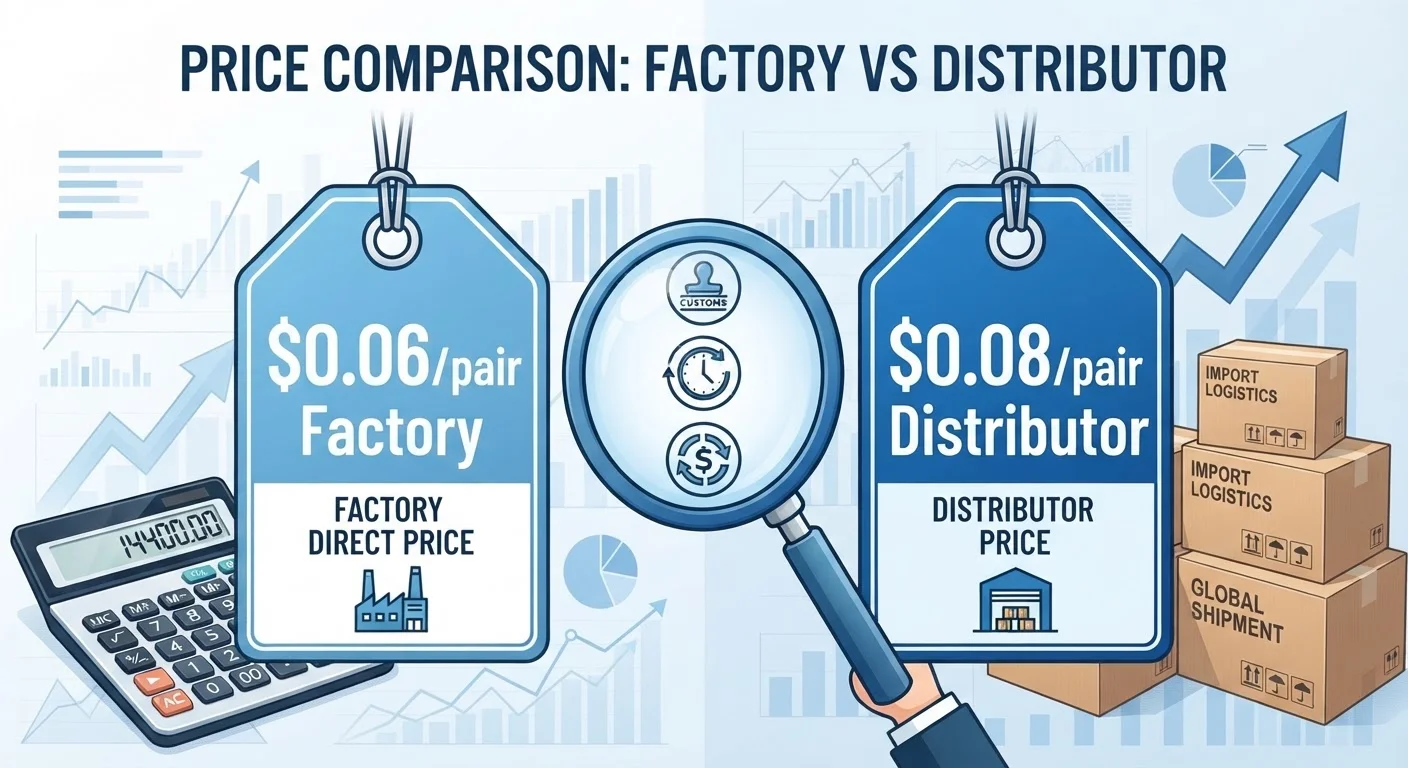
Sticker price lies. A $0.06/pair factory quote and a $0.08/pair distributor quote look like a $0.02 gap—until you run the full landed cost formula and watch that gap shrink to almost nothing.
The Five-Dimension Comparison
|
Dimension |
Factory Direct |
Local Distributor |
|---|---|---|
|
Unit Price |
$0.05–$0.10/pair (basic), $0.08–$0.14/pair (medical-grade) |
$0.10–$0.22/pair, up to $0.12–$0.19/pair for high-spec |
|
MOQ |
10,000–50,000 pairs |
1,000–12,000 pairs |
|
Lead Time |
15–35 days |
Faster, but inconsistent on restock cycles |
|
Certifications |
Direct-issue CE, EN 455, ISO 13485, PPE docs |
Depends on upstream factory |
|
After-Sales |
Built for OEM/ODM, long-term contracts |
Built for rush orders and small test buys |
That’s the real disposable latex gloves supplier tradeoff. Lower unit price, higher operational lift. Higher unit price, lower friction.
The Landed Cost Formula
The landed cost formula is:
Landed cost per pair = ex-factory price + freight-in per pair + duty per pair + inspection/compliance per pair + other landing costs
Freight and duty alone can add $0.015–$0.025 per pair once you factor in ocean shipping, customs clearance, and third-party inspection fees. Add currency fluctuation between deposit and balance payment, plus internal QC labor for sampling and pre-shipment checks, and that “cheap” factory price stops looking cheap.
The 100,000-Pair Reality Check
-
Factory-direct price: $0.06/pair
-
Distributor price: $0.08/pair
-
Surface-level savings on a latex gloves bulk order of 100,000 pairs: $2,000
Now run the landed cost math:
-
Ex-factory: $0.06/pair
-
Freight + duty + inspection: $0.015–$0.025/pair
-
Actual landed cost: $0.075–$0.085/pair
Against a distributor’s flat $0.08/pair, your factory-direct advantage compresses to $0.00–$0.005/pair. Layer in exchange rate loss and internal communication costs for sample confirmation, and the “savings” can disappear.
Quality Compliance and Certification: How ISO, CE, and EN 455 Differ Across Sourcing Channels
Paperwork wins or loses deals in this industry. A supplier can quote the best price on the market, but if their EN 455 documentation doesn’t match the product on the pallet, you’ve bought a liability, not a glove.
What Certifications Show Up in Medical-Grade Sourcing?
Legitimate factory-direct medical glove suppliers stack a specific set of documents:
-
ISO 9001 / ISO 13485 — quality management certs, supervised by TÜV NORD or TÜV SÜD
-
CE + EN 455 — the core combo for medical exam gloves , split across four parts covering freedom from holes, physical properties, biocompatibility, and shelf life
-
EN 374 — layered on for chemical or lab-use gloves
-
ASTM D3578 / D5250 — the U.S. equivalent standards, often listed alongside EN 455
Inside EN 455, three numbers matter most: AQL ≤ 1.5 (EN 455-1), tensile strength 7N minimum with 650% elongation (EN 455-2), and extractable protein monitoring for natural latex (EN 455-3). Skip verifying these, and you’re trusting a label.
Factory Direct: Deeper Access, Higher Verification Burden
Buying direct means you can request the full compliance chain — spec sheets, DoC, test reports, batch records, raw material origin. That gives you real leverage for medical or food-contact orders.
The catch: CE and EN 455 certificates often cover one specific model or one factory line, not your entire order. Always cross-check certificate numbers against the exact SKU you’re purchasing.
Local Distributors: Faster Physical Inspection, Weaker Traceability
Distributors let you inspect physical stock before payment — useful for catching labeling or sizing issues fast. But most are forwarding upstream paperwork. Confirm the original manufacturer name, certificate holder, and batch number match what’s shipped, not just what’s on the resale invoice.
Decision Matrix: How to Choose Between a Latex Gloves Manufacturer China or a Local Distributor Based on Purchase Volume
Order volume decides everything here. Match your quantity to the wrong channel, and you either overpay or overcommit.
The Volume-Based Decision Matrix
-
Under 1,000 pairs : Go local. Factory MOQs typically start at 5,000–12,000 pairs, so distributors are your only realistic option for small, urgent orders.
-
1,000–5,000 pairs : Test both. Distributors win on speed and low management overhead. Some factories offer sample runs at 500 cartons MOQ, but standard batches usually require 6,000+ pairs.
-
5,000–20,000 pairs : Factory direct starts winning. Expect $0.05–$0.24/pair depending on specs, with lead times of 10–35 days.
-
Over 20,000 pairs : Factory sourcing is almost non-negotiable. Bulk pricing drops to $0.12–$0.15/pair at 50,000–100,000 pair tiers.
When Factory Direct Makes Sense
Choose a latex gloves OEM manufacturer when you have repeat orders, price sensitivity, private-label needs (expect 30% deposit, 2–4 extra weeks for customization), and the internal capacity to manage ocean freight and customs. Verify EN 455-1/2/3, EN 374, and CE documentation before committing.
When Local Distributors Make Sense
Pick distributors for emergency restocks, fluctuating demand, or when you need split-case flexibility and local after-sales support without the international payment and customs hassle.
The Hybrid Strategy (Recommended)
Run 80% of planned volume through factory direct sourcing—size it against 8–12 weeks of sales as safety stock. Keep 20% for local distributors to cover 1–2 weeks of emergency buffer. This split works especially well for medical, cleaning, and food-service buyers with steady, predictable consumption patterns.
The Real-World Procurement Checklist: From RFQ to Delivery
Skip the checklist, and you’ll pay for it later—usually in the form of a shipment that doesn’t match your sample. This is what goes into an RFQ that gets you a real, comparable quote.
Lock Specs Before You Send the RFQ
Nail down these fields first:
-
Type : exam, surgical, or industrial—each carries different standards
-
Material/powder : latex or nitrile, powder-free or powdered
-
Thickness : fingertip, palm, cuff (in mil or mm)
-
Length, size range, sterility, certification (ASTM D3578, EN 455, ISO 21420)
Vague specs get vague quotes.
The Must-Ask Negotiation List
Push every latex gloves distributor or manufacturer on:
-
MOQ : standard tiers sit around 50,000–200,000 pcs
-
Lead time : 3–10 days for samples, 15–30 for production, up to 45 for first orders
-
Incoterms : EXW, FOB, CFR, CIF, or DDP
-
Payment : typically 30% deposit + 70% before shipment
-
Quality terms : AQL 1.5, COA/COC, third-party inspection, claims window
Landed Cost, Fast
Formula: (Product cost + Freight + Insurance + Duty + VAT) ÷ total pairs. A $0.045/pair factory price with $0.015 freight and 10% duty lands near $0.0735/pair after tax.
Conclusion
The lowest unit price rarely equals the lowest total cost. Factor in MOQ flexibility, customs duties, lead times, and certification reliability, and factory-direct medical gloves often win for high-volume buyers. Local distributors still make sense if you need smaller batches, faster turnaround, or hands-on quality checks before payment clears.
The real skill is matching your order volume, risk tolerance, and timeline to the right sourcing model, then negotiating from knowledge instead of guesswork.
Before you send another RFQ, run your numbers through the TCO framework we covered. Compare at least two factory quotes and one distributor quote side-by-side.
Need a second opinion on your wholesale latex gloves sourcing strategy? Morntrip’s team can give you a free landed-cost comparison. Guessing costs more than asking.





