
A single glove tear during aseptic filling can trigger a batch investigation costing tens of thousands of dollars—and the culprit is often something as small as a stray particle of cornstarch. Since the FDA’s 2016 ban reshaped the market, most pharmaceutical facilities default to powder-free gloves. But audits require quality teams to back that choice with hard data.
This comparison breaks down what separates powder-free from powdered gloves across particulate residue, protein allergen exposure, and cross-contamination risk—the variables that matter most in GMP-regulated environments. You’ll also find a practical risk matrix mapping glove types to specific production stages, so procurement decisions hold up under both regulatory scrutiny and real-world manufacturing conditions.
Powder-Free Disposable Gloves: Composition, Manufacturing & Core Advantages

Strip away the cornstarch, and what you have left defines the quality of the glove. Powder-free construction is a different manufacturing approach built on material science and surface treatment.
Material Composition That Drives Performance
Three materials dominate powder-free production:
Nitrile (acrylonitrile-butadiene copolymer) — the go-to for pharmaceutical applications. Synthetic, low-allergen, and tested against ASTM D6319 for physical properties and ASTM D6124 for residual powder.
Latex blends — natural rubber combined with neoprene and nitrile in tri-polymer formulas, often finished with a chlorinated interior surface so they slip on easier.
Neoprene (polychloroprene) — used where chemical resistance and cleanroom compatibility both matter.
Polymer-coated versions get explicit FDA recognition alongside standard powder-free gloves , held to the same particulate ceiling.
The Numbers That Matter for GMP Compliance
FDA says powder-free means residual powder under ASTM D6124 must stay below 2 mg per glove. Powdered gloves commonly test around 120 mg per glove—a 60x difference.
Real product data backs this up:
– One nitrile exam glove submission logged 0.21–0.22 mg/glove
– Another hit 1.2 mg/glove, still well under threshold
– Multiple glove manufacturers now report 0.42–0.54 mg/glove, pushing residuals into sub-1mg territory
That gap is the difference between passing an audit and triggering one.
Why Cleanrooms Demand This Standard?
Cleanroom gloves built for pharmaceutical environments typically combine:
Anti-static properties (standard in nitrile and composite formulations)
Deionized washing to strip surface particulates and ionic residues
Particle counts under 1,200 counts/cm² at ≥0.5 μm
ISO Class 5 compatibility , with some products claiming 100 particles/cm² or less
Add chlorinated interiors for donning ease, anti-slip fingertip finishes for grip, and accelerator-free formulations that cut Type IV chemical sensitivity risk alongside latex allergy concerns. You get gloves engineered for cross-contamination prevention, not just powder removal.
Powdered Disposable Gloves: Why They Pose Contamination & Allergy Risks

Cornstarch binds to natural rubber latex (NRL) proteins during manufacturing, then releases them as airborne particles the moment someone dons or removes the glove. Those particles get inhaled, land in eyes, contact mucous membranes. That is why latex allergy gloves and powder combinations create the highest-risk scenario in any facility.
The Two Allergy Pathways
Powder drives two distinct immune responses. In Type I (IgE-mediated), powder-coated latex proteins aerosolize, and sensitized workers react within minutes—respiratory distress, skin reactions, sometimes anaphylaxis. Type IV (delayed contact allergy) is slower. FDA guidance links glove powder directly to irritant dermatitis and delayed hypersensitivity, with symptoms appearing hours or days after exposure.
NIOSH confirms that latex proteins fasten to powder particles, so more protein reaches the skin, and more becomes airborne during every glove change.
Beyond Allergies: The Contamination Vector
Powder is a growth medium. FDA filings describe glove powder as capable of harboring bacteria and endotoxin, reducing tissue resistance to infection. In surgical settings, that means wound inflammation, granulomas, and post-operative adhesions.
Why FDA Pulled the Plug
On December 19, 2016, FDA finalized a ban covering powdered surgeon’s gloves, powdered examination gloves, and absorbable glove lubricant powder. The stated reason was that the risk could not be corrected by labeling. Even with adoption already declining industry-wide, FDA determined residual risk remained too high for sterile disposable gloves and medical-grade gloves used in patient-facing or aseptic environments.
FDA 2016 Ban on Powdered Gloves: What Pharmaceutical Manufacturers Must Know
January 18, 2017, is the date that matters most. That’s when the ban became enforceable. It covered inventory already in warehouses and distribution channels, plus new products. Facilities holding powdered stock couldn’t sell through existing supply after that date. The rule covered three specific product categories: powdered surgeon’s gloves, powdered patient examination gloves, and absorbable powder used to lubricate surgeon’s gloves.
FDA’s reasoning left no room for compromise. The agency classified powder exposure as an unreasonable and substantial risk of illness or injury. They decided that warning labels wouldn’t solve airborne protein exposure, so they banned it outright.
Compliance Actions That Hold Up Under Audit
Quality teams need to document SOP language that explicitly marks powdered medical gloves as prohibited across procurement, PPE issuance, and cleanroom access protocols; vendor qualification forms that require written confirmation that products contain no absorbable dusting powder and meet medical grade gloves criteria; and inventory disposition records showing that pre-2017 stock was isolated, returned, or destroyed—not quietly used until depleted.
Auditors will ask for this paper trail. Facilities without it face findings.
Risk Comparison: Powder-Free vs. Powdered Gloves
Numbers settle arguments that opinions can’t. This comparison puts powdered and powder-free gloves side by side across contamination risk, allergy exposure, regulatory standing, and cost.
Dimension | Powdered Gloves | Powder-Free Gloves |
|---|---|---|
Contamination risk | The FDA links powder to direct wound and tissue contact, and particle shedding turns them into bacteria carriers. | ≤2 mg residual powder per glove; nitrile options come with non-staining, non-smudging finishes. |
Protein exposure | Users face up to 50x higher airborne latex protein than powder-free versions (HSE-cited data). | Low-protein formulations target <50 μg/g extractable protein. |
Annual sensitization rate | About 1% of regular users develop sensitivity each year. | 0% reported among low-protein, powder-free users. |
Regulatory stance | The UK HSE classifies NRL protein as a COSHH hazardous substance and flags powdered latex as unsuitable for workplace use. | Powder-free gloves align with GMP logic, which favors low-shed, low-protein, low-particulate materials. |
Cleanroom compatibility | Poor – particle and protein aerosolization messes with controlled environments. | Strong – Class 10-rated nitrile options with latex-free, low-shed specs. |
Unit cost | Lower upfront price, faster to don. | Higher range ($550.72–$18,317.97 for high-spec cleanroom nitrile), but lower total cost of ownership once contamination and rework are factored in. |
Powdered gloves win on sticker price and speed. Powder-free gloves win on everything a GMP audit actually checks.
Matching Risk Tier to Production Stage
For high-risk aseptic operations like filling lines, isolators, and Grade A/B zones, use powder-free nitrile only with a low-shed spec. For moderate-risk controlled operations like weighing, primary packaging prep, and general cleanroom transfer, use low-protein powder-free gloves and eliminate latex entirely if allergy-sensitive personnel are present. For low-risk general packaging, powder-free industrial gloves are acceptable, though powdered options still add unnecessary sensitization exposure.
Procurement teams building spec sheets can simplify the shortlist. Require powder-free, latex-free, low-particulate, cleanroom-grade labeling. Demand extractable protein test data under 50 μg/g for any latex product still in use. Exclude powdered latex outright wherever airborne exposure or sensitive populations are a factor.
Application Scenarios: Matching Glove Type to Pharmaceutical Processing Stages
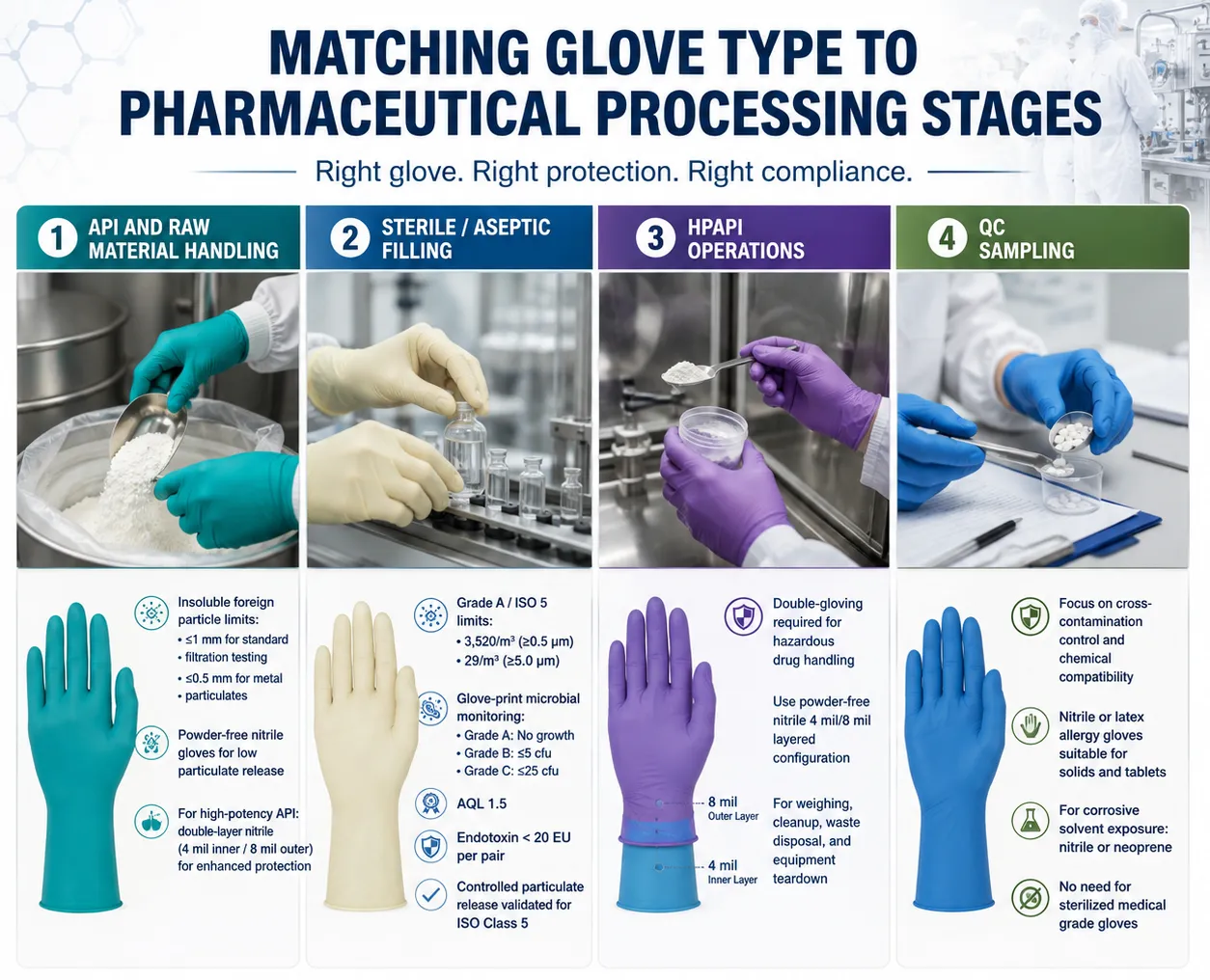
Not every production stage carries the same contamination stakes. API handling, aseptic filling, HPAPI operations, and QC sampling each demand different glove specs—matching the wrong one to the wrong stage is where audits go sideways.
API and Raw Material Handling
Insoluble foreign particle limits sit at ≤1 mm for standard filtration testing, tightening to ≤0.5 mm for metal particulates. For dispensing, charging, and transfer, powder-free nitrile gloves designed for low particulate release are the baseline. High-potency API justifies stepping up to double-layer nitrile—a 4 mil inner layer paired with an 8 mil outer layer—balancing dexterity against puncture resistance during unpacking and screening.
Sterile/Aseptic Filling
Grade A / ISO 5 zones cap airborne particles at 3,520/m³ (≥0.5 μm) and 29/m³ (≥5.0 μm). Glove-print microbial monitoring demands no growth in Grade A, ≤5 cfu in Grade B, and ≤25 cfu in Grade C. Sterile cleanroom gloves here should hit AQL 1.5, endotoxin under 20 EU per pair, and controlled particulate release validated for ISO Class 5.
HPAPI Operations
Occupational safety guidance for hazardous drug handling requires double-gloving. Powder-free nitrile in a 4 mil/8 mil layered configuration covers weighing, cleanup, waste disposal, and equipment teardown.
QC Sampling
Cross-contamination and chemical compatibility matter more than sterile-grade particle counts. Nitrile or latex allergy gloves work for solids and tablets; corrosive solvent exposure calls for nitrile or neoprene, without escalating to sterilized medical-grade gloves.
How to Select GMP-Compliant Powder-Free Gloves: A Buyer’s Checklist
Certificates tell you whether a glove batch will hold up on a filling line. Before signing a purchase order, check these items.
Core Specs to Nail Down First
AQL rating : 1.5 is standard for medical and exam gloves; sterile or high-cleanroom applications often need 1.0, sometimes 0.65. Weigh pinhole tolerance against operational risk and cost. Residual powder: confirm ≤2 mg per glove, validated via ASTM D6124 or an equivalent method. “Powder-free” on a label means nothing without that number. Material fit: nitrile gloves for pharmaceutical use outperform latex on chemical resistance and batch-to-batch consistency, which is critical for GMP compliance. Thickness: fingertip 0.07–0.16 mm, palm 0.06–0.13 mm, cuff 0.04–0.11 mm. Thicker isn’t better because it kills tactile sensitivity during weighing and aseptic handling. Test samples for grip and fatigue, not just spec sheets.
Supplier Documentation to Demand
Require FDA registration status, ASTM D6319 (nitrile) or D3578 (latex) compliance, CE documentation against EN 455, and ISO 10993 biocompatibility data (cytotoxicity, irritation, sensitization) if the glove touches skin or product. Ask for batch COAs covering AQL, dimensions, tensile strength, and residual powder. Compare three separate batches before committing because low bids often hide thickness drift and AQL slippage that only shows up at volume.
Final Verification Step
Run hands-on testing at the actual workstation for grip, dexterity, tear rate, don/doff speed, and static behavior.
Morntrip’s Powder-Free Nitrile Gloves for Pharmaceutical Compliance
Sourcing decisions depend on paper trails. Morntrip builds its nitrile-glove line through custom OEM solutions that cover material selection, product detail, branding, packaging, and sample runs before committing to bulk production. That structure matters to distributors, wholesalers, and pharmaceutical buyers who need documented specs.
What to Verify Before Ordering
Quality control uses 100% visual inspection paired with AQL Level II sampling under ISO 2859-1. That’s the batch-level evidence auditors expect. For pharma-facing SKUs, check confirmation against this list:
ASTM D6319 nitrile material compliance
Powder-free confirmation ≤2 mg/glove per ASTM D6124
AQL ≤2.5 acceptance target for medical-grade use
ISO 13485 quality-system certification
CE marking for EU distribution
Batch COAs tied to individual lots
Morntrip’s current industrial rubber glove specs list 0.035–0.04 mm thickness with CE and ISO 13485 certification. If exact pharma-nitrile documentation isn’t published for your target SKU, that baseline — powder-free, ASTM D6319, AQL ≤2.5, lot-level test reports — is the defensible standard to ask for directly.
Conclusion
Powdered gloves are a regulatory and contamination liability your pharmaceutical operation can’t afford. Powder-free disposable gloves give you the particulate control, allergy risk reduction, and GMP compliance that modern production demands. Since the FDA’s 2016 ban reshaped the industry, the choice is about which powder-free option balances barrier protection, tactile precision, and cost efficiency for your specific processing stage.
Whether you’re outfitting a sterile filling line or a high-volume packaging area, matching glove specifications to actual risk exposure protects both product integrity and your bottom line.
Explore Morntrip’s nitrile gloves pharmaceutical line, engineered for GMP audits and built for the realities of pharmaceutical manufacturing. Request a technical sample kit today.





