
You’ve probably stood in the cleaning aisle staring at a wall of gloves, or scrolled through Amazon listings at 2 AM, and realized that buying rubber gloves should be simpler. Latex or nitrile? Retail or wholesale? A trusted local store or straight from a manufacturer? For home users, the wrong pair means constant tears and re-buys. For business owners buying in bulk, it means wasted budget, shipping delays, or gloves that fail on the first harsh chemical. This guide covers where to buy rubber gloves for your needs, how to match material and thickness to your use case, and what smart buyers—especially wholesale purchasers—check before ordering. Just the practical answers you came here for.
Our Quick Recommendations
Not sure where to buy rubber gloves ? Here’s the short answer:
|
Buying Need |
Best Place To Buy |
Why |
|---|---|---|
|
Home cleaning |
Amazon or Walmart |
Convenient and low quantity |
|
Restaurants |
Local distributors |
Easy repeat orders |
|
Small businesses |
Disposable glove suppliers |
Better bulk pricing |
|
Wholesalers & importers |
Manufacturers |
Lowest cost and customization |
If you’re buying more than a few hundred pairs regularly, retail channels usually stop being the most cost-effective option.
Where To Buy Rubber Gloves: Best Places To Buy
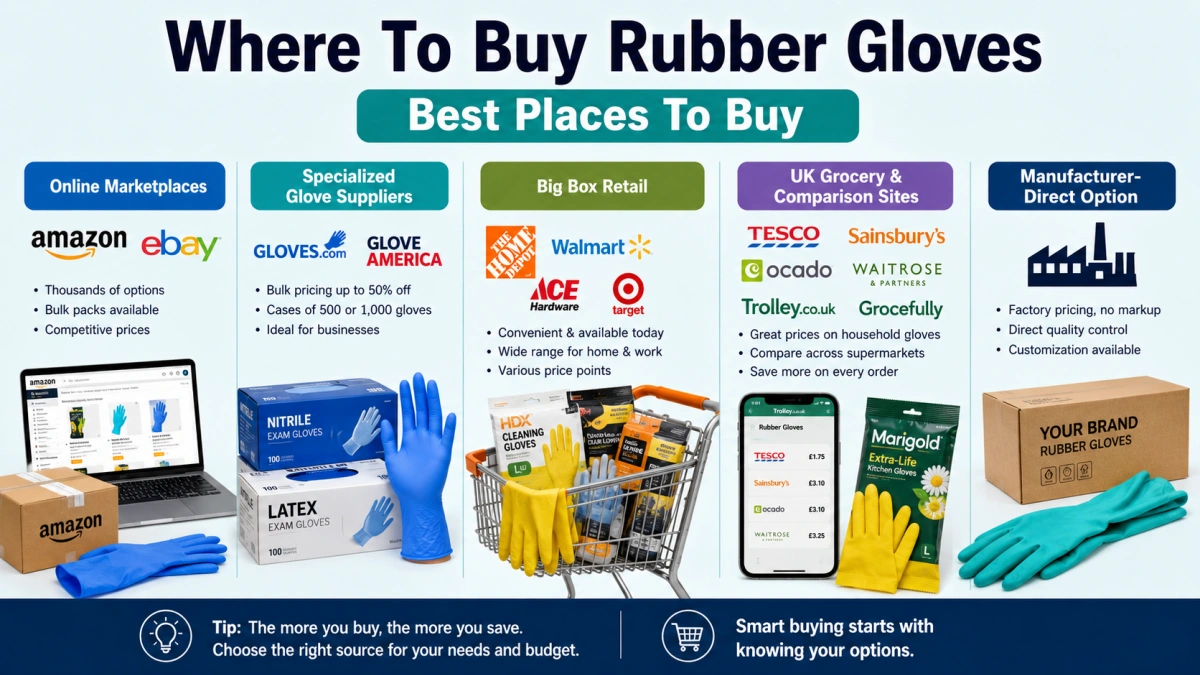
Every glove retailer thinks they’ve got the best deal. They don’t all have your best deal. Here’s where the money goes further, broken down by what you’re buying.
Online Marketplaces: Amazon and eBay
Amazon alone pulls up 3,000+ results for “rubber safety gloves”–household and industrial types mixed together. Most listings run in bulk packs, think 100 to 1,000 pieces per pack for disposable latex or nitrile gloves . Medical exam glove best-sellers typically ship as 10 boxes of 100 gloves, so 1,000 gloves per case. On pricing, branded household pairs land around $3-$8 per pair, and multipacks of 3-10 pairs run $10-$25.
eBay works differently. Both the US and UK sites have dedicated rubber gloves categories. The UK version breaks out “Rubber Household Cleaning Gloves” for dishwashing tasks. You’ll find household multipacks of 10-50 pairs, and industrial lots of 12-72 pairs. Sellers here often negotiate on quantity, so don’t be shy about making an offer.
Specialized Disposable Glove Suppliers
If you’re buying nitrile, latex, or vinyl gloves in serious volume, skip the general marketplaces. Gloves.com and GloveAmerica exist for this. Gloves.com offers up to 50% off bulk orders, with standard cases at 1,000 gloves (10 boxes of 100). GloveAmerica sells by the case too–either 1,000 or 500 gloves–and it’s the go-to for labs, food service, and manufacturing operations that need repeat ordering without reinventing the wheel every month.
Big Box Retail: Home Depot, Walmart, Ace, Target
For household or work gloves you can grab today, big box still wins on convenience. Home Depot stocks HDX-branded cleaning gloves at $2-$5 per pair, plus rubber-coated work gloves in multipacks ($9-$20 for 3-10 pairs). Walmart’s Industrial Gloves section prices similarly–$2-$8 per pair, or $12-$20 for a 12-pair pack. Ace Hardware runs $3-$6 for household gloves and $8-$15 for chemical-resistant heavy-duty pairs. Target focuses on disposable latex, usually $5-$12 per box of 100.
UK Grocery and Comparison Sites
UK shoppers have it easier for household gloves . Tesco prices standard cleaning gloves at £1.50-£3.50 per pair. Marigold’s Extra-Life Kitchen Gloves show up at £3.10 on Ocado and Sainsbury’s, £3.25 on Waitrose. Small differences, but they add up across a case. Sites like Trolley.co.uk and Grocefully compare prices across 15 supermarkets, so you can spot the cheapest SKU in seconds instead of tab-hopping.
The Manufacturer-Direct Option
Every channel above has one thing in common: markup. Retailers, marketplace sellers, and even bulk suppliers add their cut before the gloves reach you. If you’re a wholesaler, distributor, or business buying beyond a few cases, going straight to a rubber gloves manufacturer cuts out that layer. You get factory pricing, direct quality control, and the ability to customize thickness, sizing, or branding. Amazon and Home Depot can’t offer any of that.
Should You Buy From A Retailer Or A Manufacturer?
|
Factor |
Retail Stores |
Manufacturer |
|---|---|---|
|
MOQ |
Very low |
Higher |
|
Delivery speed |
Fast |
Production required |
|
Custom logo |
No |
Yes |
|
Private label |
No |
Yes |
|
Unit cost |
Higher |
Lower |
|
Best for |
Consumers |
Businesses |
A simple rule:
-
Under 50 pairs → Retail
-
500+ pairs → Distributor
-
10,000+ pairs → Manufacturer
How To Choose The Right Rubber Gloves?
Most glove failures happen because people buy by feel instead of by spec. A pair that’s perfect for dishwashing will tear apart the moment it touches solvent. Get the material, thickness, and size right first, and everything else (price, brand, channel) becomes a minor detail.
Match The Material To The Hazard
Start by naming the exact threat. Be specific: “5% sodium hypochlorite bleach” or “70% isopropyl alcohol” or “motor oil.” Vague categories lead to vague protection.
-
Latex : Great dexterity, flexes like a second skin, handles light chemicals and biological fluids well. Skip it if you or your team have latex allergies.
-
Nitrile : Tougher against punctures and chemicals than latex. The default choice for solvents, oils, and most lab or industrial work.
-
Neoprene/Norfoil : Reserve for aggressive chemicals or high-toxicity substances. Norfoil covers the broadest chemical range.
-
Vinyl : Fine for dry, low-risk dusting. Everywhere else, it tears and lets chemicals through.
Also factor in contact type. A quick splash (under 10 minutes) needs less protection than extended immersion or repeated dips over a shift.
Pick The Right Thickness
Disposable gloves run 3-8 mil (0.076-0.203mm). Thickness dictates what you can safely handle:
-
3-4 mil : Light work, food handling, quick wipe-downs.
-
5-6 mil : Dishwashing, bathroom scrubbing, general household cleaning.
-
7-8 mil : Chemical handling, industrial cleaning, rough surfaces.
-
8+ mil : Harsh solvents, extended chemical exposure.
Rule of thumb: household degreasers need at least 0.10mm (~4 mil). Industrial solvents or long immersion need 0.15mm (~6 mil) minimum. Check the fingers, palms, and cuffs first, because those spots wear out before anywhere else.
Get The Sizing Right
Wrap a tape measure around the widest part of your palm, skip the thumb, and record it in inches. Then measure from the base of your palm to your middle fingertip. Whichever measurement lands you a bigger size, go with that one.
Rough mapping: S runs 6- 7 in circumference, M hits 7- 8 in, L covers 8- 9 in, XL spans 9- 10 in, and XXL starts at 10in+. If you don’t have a tape measure, lay your hand over a dollar bill and eyeball the border. When unsure, size up.
Check For Certifications
Packaging tells you more than marketing copy does. Look for EN 374-2 (wet work protection) and EN 374-3 (chemical resistance) on European-market gloves. For cut and abrasion resistance, ANSI/ISEA 105 or EN 388 ratings matter. Medical use requires ASTM D6319 for nitrile or ASTM D3578 for latex, plus FDA compliance.
Before ordering in bulk, request sample packs. Test grip when wet, check for heat build-up over a full shift, and flex the fingertips hard. That five-minute test saves a much bigger headache later.
Buying Rubber Gloves Wholesale: What Businesses Should Know
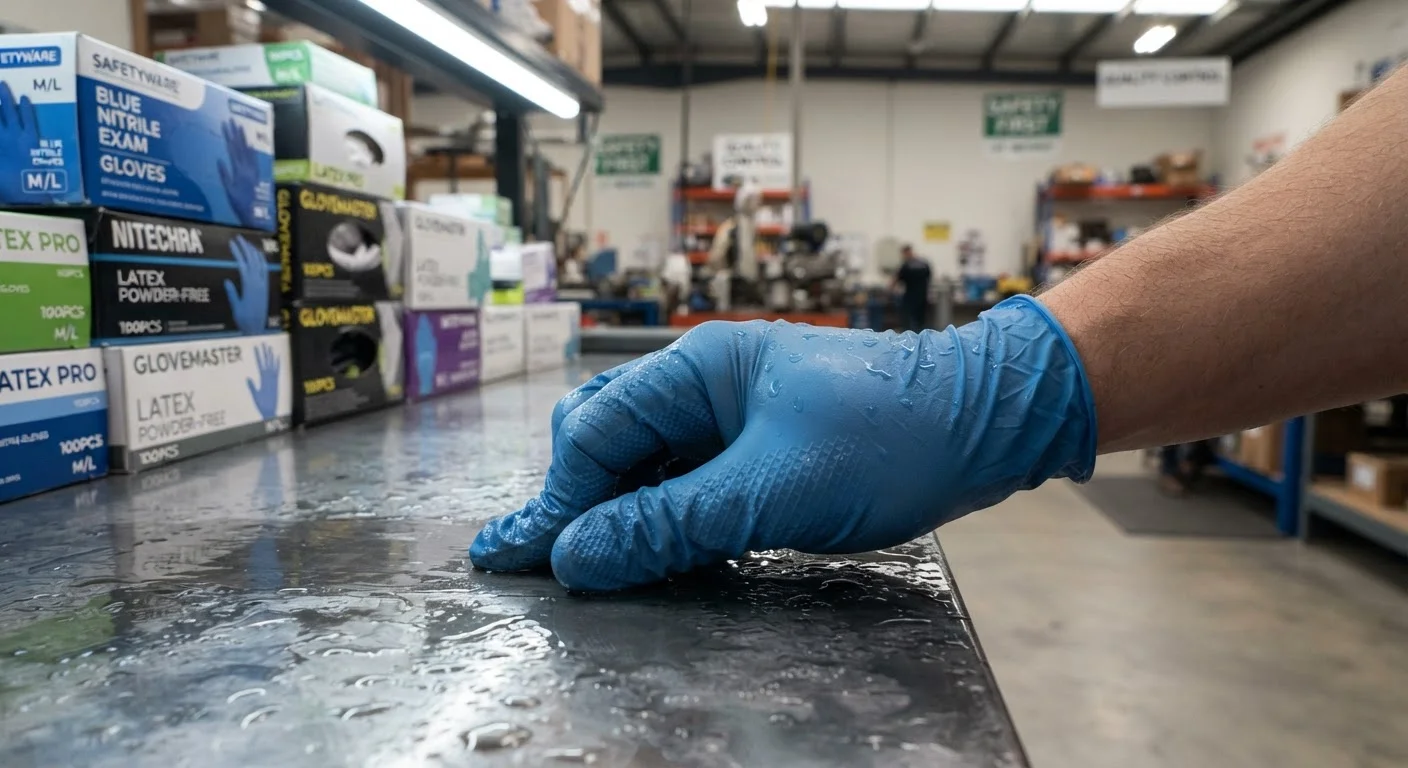
Understanding MOQ
Local distributors often require relatively low minimum order quantities, while factories may require larger production volumes, especially for customized products.
The more customization you need, the higher the MOQ usually becomes.
One Mistake Buyers Often Make
One mistake we frequently see is choosing gloves solely based on price.
Lower-cost gloves may use thinner rubber, weaker cuffs, or lower-quality materials. While the purchase price looks attractive, the replacement frequency can significantly increase the real cost.
Total cost of ownership matters more than the invoice price.
Lock In Supply When Possible
For businesses with stable annual demand, long-term contracts often provide better pricing stability and protect against raw material fluctuations.
Frequently Asked Questions About Buying Rubber Gloves
Bad habits cause most glove failures. Here’s what buyers ask most once they’ve picked the right pair.
How Often Should You Replace Rubber Gloves?
Reusable household or industrial rubber gloves last 3-6 months or about 50 uses, whichever comes first, assuming no punctures or heavy chemical exposure. Disposable nitrile or latex gloves are different. Swap them every 2 hours of continuous work, or the moment they’re contaminated, torn, or you switch tasks. If splashed with chemicals, toss them immediately. Never rinse and reuse a disposable glove. Unopened boxes of nitrile gloves hold up for 3-5 years if stored properly.
Can You Reuse Rubber Gloves, And How Do You Maintain Them?
Reusable rubber gloves need rinsing after every use, then air-drying away from sunlight and ozone sources like motors. Store them somewhere cool, dry, and dark. That alone extends their working life. Disposable gloves get one job, one use, then the trash.
How Do You Know If Gloves Are Still Safe?
Check for swelling, cracking, discoloration, or stiffness before every use. Any of those signs means retirement. Doubling glove thickness roughly quadruples chemical breakthrough time, which is useful math for anyone handling aggressive solvents.
Are Thicker Gloves Always Safer?
No. Anything over 0.15mm starts killing dexterity, which raises accident risk for precision work. Match thickness to the hazard instead of defaulting to “thicker is better.”
Conclusion
Finding the right rubber gloves comes down to three things: knowing your use case (kitchen cleanup vs. chemical handling vs. medical-grade protection), matching the material to that need — latex, nitrile, or PVC — and choosing a purchasing channel that fits your volume. A homeowner grabbing a pack from Amazon has different priorities than a procurement manager sourcing 50,000 units for a hospital network.
You’re avoiding costly mistakes. Flimsy household gloves fail in an industrial setting. Overpaying retail markup on a bulk order that should have gone straight to the source.
If you’re buying in quantity, skip the middlemen. Working directly with a rubber gloves manufacturer like Morntrip means better pricing, custom specs, and quality control you can actually verify.
Ready to move forward? Reach out for a quote. Your hands — and your bottom line — will thank you.





