
A single pinhole. A tensile strength result 2% below spec. A packaging seal that fails under transit pressure. Any one of these can turn a shipment of disposable gloves into a compliance nightmare, or worse, a liability claim from a hospital that trusted the barrier protection was there.
Serious buyers don’t ask suppliers, “Are your gloves AQL certified?” and take the answer at face value. They want to know how that AQL acceptable quality level gets applied on the production floor, what a real pinhole test looks like in practice, and whether tensile strength is verified before and after artificial aging, not just on a spec sheet.
Here’s a transparent walkthrough of the four inspection stages we run on every batch, and why each one matters to your procurement decision.
AQL Sampling Inspection: The First Line of Quality Control
Most buyers hear “AQL” and nod along without knowing what it means.
AQL stands for Acceptable Quality Limit (sometimes written as Acceptance Quality Limit). Under ISO 2859-1, it’s defined as the worst tolerable process average across consecutive batches, or put more plainly: the maximum percentage of defective units we’re willing to accept in a given production run. It’s a statistically grounded sampling framework used across manufacturing industries, and disposable hand gloves are no exception.
The decision logic works through these steps:
-
Step 1 : We confirm the batch size and select an inspection level (Level I, II, or III, depending on risk tolerance).
-
Step 2 : We cross-reference standard tables to find a code letter, then use the AQL value to determine sample size, along with the acceptance number (Ac) and rejection number (Re).
-
Step 3 : A random sample is pulled from the full batch and checked for attribute defects such as holes, surface flaws, dimensional inconsistencies, and packaging issues.
-
Step 4 : We count the defects. If the number is ≤ Ac, the entire batch passes. If it hits Re, the whole batch is rejected.
That last point matters. AQL is a batch-level judgment mechanism built on sampling risk math, designed to separate acceptable manufacturing variance from genuine quality failure.
Why the AQL Grade You Choose Says a Lot?
Not all gloves are held to the same bar. The industry generally applies a tiered AQL structure:
-
Examination gloves have an AQL of 1.5 , balancing cost with baseline protective consistency for general use.
-
Surgical gloves have an AQL of 1.0 , offering tighter tolerance because pinhole and micro-defect sensitivity is higher in surgical settings.
-
Laboratory gloves have an AQL of 0.65 , the strictest tier, reserved for high-risk exposure or higher liquid-barrier demands.
Lower AQL number means lower defect tolerance and higher protection requirement.
A batch of 10,000 gloves tested at AQL 0.65 under Inspection Level I requires a sample of 80 gloves to be pulled and tested. That sample density is a statistically meaningful slice of the batch, expected for laboratory-grade or high-risk glove shipments.
If a batch fails to meet Ac thresholds, it does not get ignored. The standard practice is isolation and rework. The flagged batch gets quarantined, re-inspected, and reprocessed before it re-enters the sampling verification cycle. ISO 2859-1 itself only defines the accept/reject framework—the rework loop is something a serious quality system builds around it.
Leakage & Pinhole Testing: Ensuring Barrier Integrity
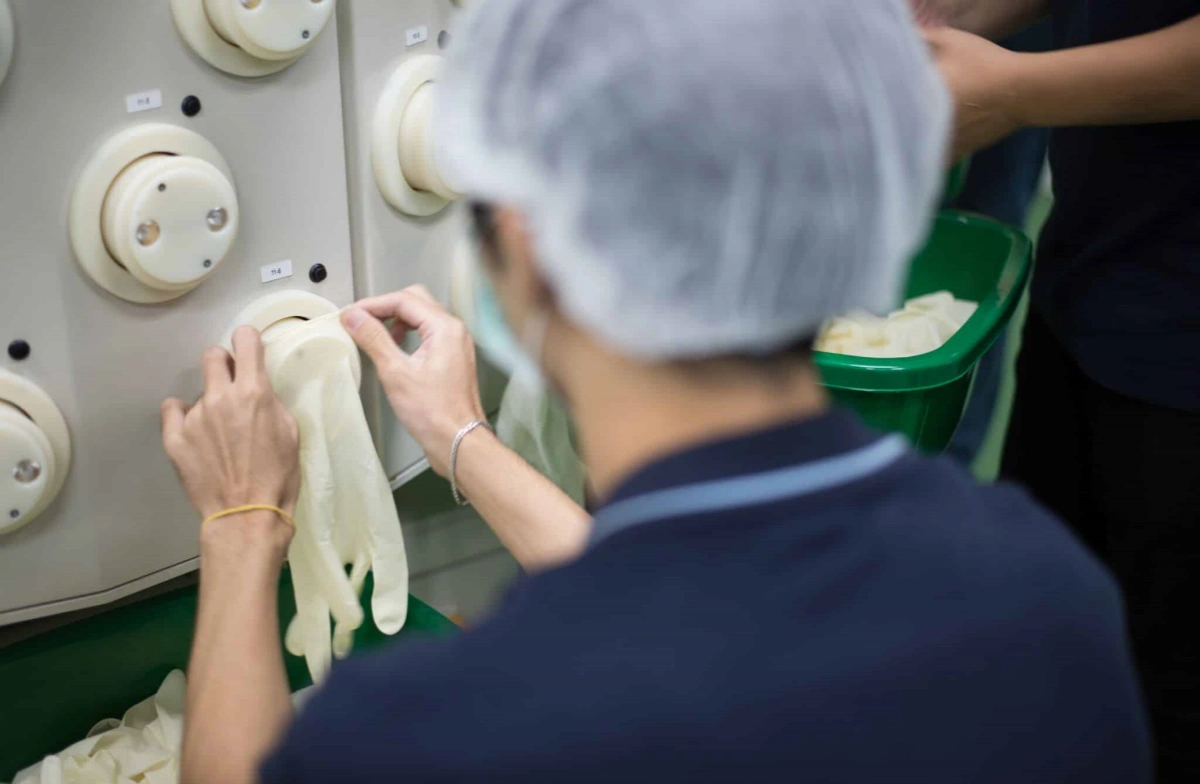
Water doesn’t lie. That’s the whole idea behind the pinhole test every glove goes through before it leaves our facility. The water leak test that disposable gloves rely on is one of the most physically direct ways to verify barrier integrity.
The procedure follows EN 455-1, and it’s more precise than most buyers expect:
-
We fix each glove vertically on a filling pipe, with the overlap at the cuff kept to no more than 40 mm.
-
We fill it with 1,000 ± 50 mL of water at 15–35°C, letting it flow freely into every finger.
-
The first visual check happens immediately.
-
A second check follows 2–3 minutes later.
-
If the glove has stretched and the water hasn’t reached within 40 mm of the cuff, we lift the glove and observe the untested zone for another 2–3 minutes.
What Counts as a Failure?
Any visible water leakage fails the glove. The standard is blunt. There’s no partial credit, no “minor seepage is fine.” The one exception is leakage within 40 mm of the cuff edge, which isn’t counted, because that zone sits outside the functional barrier area a wearer actually depends on.
How This Feeds Into AQL?
Leak testing doesn’t operate in isolation. It’s typically the key functional check inside the broader AQL sampling inspection. The workflow runs like this: sample the batch per ISO 2859-1, water-test each unit in that sample individually, tally the defects, then compare that failure count against the AQL threshold. If a batch is being held to AQL 1.5 and more than roughly 1.5% of the sampled gloves leak, the entire batch gets rejected, no exceptions, no partial shipments.
A single failed glove in a sample of 80 doesn’t sink the batch. A pattern of leaks does.
Tensile Strength Test: Verifying Durability Before and After Aging

Pinholes aren’t the only way a glove fails. A glove can pass every leak test and still tear the moment a nurse stretches it over wet hands, if the material itself hasn’t been checked for durability under stress. That’s what tensile strength testing catches, and it’s the step most buyers never see documented.
The nitrile glove tensile strength standard we test against comes from ASTM D6319, which sets a minimum of 14 MPa, and that threshold applies both before and after accelerated aging. EN 455-2 uses a different metric: force at break, with a minimum of 6.0 N, also required both before and after aging. Most export-grade medical gloves get benchmarked against both standards simultaneously, since ASTM dominates the U.S. market and EN 455 governs the EU.
The Aging-and-Testing Sequence
Here’s how we actually run it:
-
Two sample groups are pulled from the same batch: one tested as-is, one artificially aged first.
-
Aging condition: gloves sit in a heat chamber at 70°C for roughly 166 hours (the equivalent of a 7-day accelerated aging cycle).
-
Testing method: both groups go through a tensile testing machine, referencing ASTM D412 methodology, then evaluated against D6319 thresholds.
-
Breakpoint recording: we capture the maximum load at the moment of rupture and convert that into MPa (or median force at break, for EN 455 evaluation).
Where Our Results Land
Our test numbers handily beat the minimum. Before aging, tensile strength runs 18.2–19.8 MPa. After aging, it holds at 15.2–16.5 MPa. Both sit comfortably above the 14 MPa floor.
The elongation test tells a similar story. ASTM D6319 requires 500% minimum elongation before aging and 400% after. Our gloves test between 580–680% before aging and 465–536% after. Higher elongation means the material stretches without tearing, which translates directly into fit, comfort, and tear resistance during real-world wear, not just in the lab.
Packaging Inspection: The Final Checkpoint Before Shipment
Gloves that pass leak testing and tensile strength standards can still cause a shipment to fail at customs, or worse, get flagged during a hospital audit, over something as basic as a mislabeled carton. Packaging inspection catches the paperwork problems physical testing never touches.
What Gets Checked Against What?
Every carton gets cross-referenced before it’s cleared for loading. Product name, model number, and dimensions on the outer box must match all three: the purchase order, the bill of materials, and the inner packaging label. We pull the actual net weight, gross weight, and unit count per carton, then compare them against what’s printed on the label. We check material specs (plastic film, inner liner, label stock) against the approved sample used during order confirmation.
Quantity verification runs three layers deep: units per box, boxes per shipment, and pallets per order. Batch numbers and expiry dates must trace directly back to the production and release records – no gaps, no illegible print, no smudged ink that makes a lot code unreadable six months from now.
Physical Integrity and Contamination Risk
We inspect seal continuity, tape adhesion, and heat-seal lines for any sign of tampering or accidental reopening. Contamination risk gets flagged if there’s exposed film, dust, moisture, oil residue, or odor inside the carton. We check cushioning, corner protectors, and pallet wrapping to confirm the box can survive transit pressure and drops without compromising what’s inside.
Labels go through a version check too. Old label versions, wrong language variants, or mixed batches inside one shipment get rejected before dispatch, every time.
How Do These Four Checks Work Together in Our Quality System?
None of these four checks operates as a standalone gate. They’re stitched together into a single chain, and that chain is what determines whether a batch ships.
Here’s the structure: 100% visual inspection comes first, catching visible defects — surface flaws, discoloration, obvious tears — before any statistical sampling even starts. Then AQL Level II sampling under ISO 2859-1 takes over as the second gate, verifying the performance metrics that visual inspection can’t catch on its own: pinhole leaks, tensile strength, elongation. Think of it as two control doors. The first door removes what’s obviously wrong. The second door confirms what’s structurally sound.
One Batch, One Traceable File
Every glove batch gets tied to a lot number, and that lot number is the connecting field across the entire production record. Raw material batch, production run, and finished goods batch all link back to the same lot number. When a batch record gets reviewed, we’re cross-checking raw material ID, quantity, Certificate of Analysis, production and packaging logs, inspection results, and yield deviation — all under one file. If a customer ever asks, “Can you trace this specific carton back to its raw material source,” the answer is yes, and it’s documented, not reconstructed after the fact.
Standards Alignment, Not Just Standalone Testing
This is what separates a standards-aligned quality system from a single-point spot check. Our AQL sampling framework aligns directly with ISO 2859-1. Barrier and strength verification map to EN 455 and ASTM D6319. Packaging and documentation checks confirm CE and compliance paperwork match the physical product, not just the label.
For a medical glove quality assurance program, that alignment matters more than any single test result. A supplier who can trace one carton back through four checkpoints to raw material intake isn’t guessing at quality. They’re proving it, batch by batch.
What This Means for Your Procurement Decision?

None of this matters if you can’t verify it after the fact. Before you sign with any glove supplier , ask for raw numbers on five things: the AQL grade declared per defect class. Critical items should sit at 100% inspection or AQL 0.65, Major at 1.0, Minor at 2.5. Ask for the actual sampling plan — which cartons and layers got pulled. Ask for raw leak-test data with pass/fail counts. Ask for tensile and elongation numbers before and after aging. And ask for a packaging inspection log tied to batch and date codes.
At Morntrip, that evidence exists. We run internal QC on ear-loop pull strength and fabric thickness at raw material intake, cutting, and sewing stages. We also accept third-party inspection and remote video verification before shipment. Ask us for a report sample tied to a PO number.
Conclusion
Quality control isn’t one checkpoint—it’s a system. AQL sampling catches structural defects early. Leakage and tensile testing confirm the gloves actually hold up under pressure. A final packaging inspection ensures what ships matches what was tested. Together, these four checks form a closed loop that leaves little room for surprises once disposable gloves reach your warehouse or clinic.
For procurement teams, that’s the real takeaway: reliable suppliers don’t just claim compliance with standards like ASTM D6319 or EN 455—they show you the process behind it. If you’re evaluating a glove manufacturer , ask to see their AQL data, test reports, and packaging protocols before you commit to an order.
Want to see how Morntrip’s inspection records stack up? Request a sample batch report and judge the quality control for yourself, not just the marketing claims.





