
Walk into any cleanroom, hospital supply closet, or commercial kitchen. Chances are, you’ll find bouffant caps and mob caps sitting in the same box — sometimes even labeled the same way. It’s an easy mix-up.
But grab the wrong one for your work environment. You could fall out of compliance, face contamination risks, or leave your staff stuck with a cover that fits poorly and fails to protect.
Stocking an operating room? Running a food processing line? Sourcing disposable bouffant caps in bulk for the first time? The difference between these two disposable caps matters more than most people expect.
This guide breaks it all down — straight, no fluff.
What Is a Bouffant Cap? (Definition + Core Features)

The name says it all. “Bouffant” comes from the French word for puffed — and that’s a perfect description. It’s a dome-shaped, voluminous cap that billows outward from your head instead of hugging it tight.
A bouffant cap is a disposable, dome-shaped hair cover. It’s made from gathered or pleated nonwoven fabric with a continuous elastic band around the opening. That elastic creates a 360° seal along your hairline. Pull it on, and the pleated body expands into its signature puffy shape. It fits long hair, ponytails, and thick braids with ease — hairstyles a flat hairnet can’t hold in place.
The materials come in two main types:
-
Spunbond polypropylene (PP) — lightweight, breathable, and low-cost. This is the go-to material for food processing lines and general healthcare. Typical basis weight: 10–25 g/m².
-
SMS composite (Spunbond–Meltblown–Spunbond) — this adds a fluid-resistant barrier layer. You’ll see it in operating rooms and pharmaceutical cleanrooms, where liquid splashes are a real hazard.
Both types are single-use . Toss it after each shift or procedure. That’s the whole point — no cross-contamination moves from one task to the next.
What Is a Mob Cap? (Definition + Core Features)

Mob cap. The name sounds vintage — and it is. The original mobcap was an 18th-century women’s bonnet, the kind you’d see in period dramas. On a procurement order form today, the term means something else.
In modern PPE and food safety, a mob cap is a disposable, pleated hair cover. It’s lightweight, expandable, and built to keep every stray hair in place. The material is nonwoven Polypropylene. Elastic runs around the edge. It’s made for single-use environments. Sound familiar? It should. The structure matches a bouffant cap almost exactly.
That’s where the confusion starts.
Here’s what defines a mob cap in practical use:
-
Pleated construction — the pleats let the cap expand and cover high-volume hair, including thick or loose styles
-
Single or double elastic — double elastic gives a more secure fit for longer shifts
-
Lightweight, breathable material — nonwoven PP is the standard choice for all-day wear comfort
-
One-handed dispenser-friendly — pleated mob caps pull out one by one from a box dispenser with ease. That matters on a fast-moving food line or a busy ward
Where you’ll see mob caps most:
Food processing facilities, catering kitchens, healthcare settings, cleanrooms, and beauty salons. The term skews the UK and EU. British and European hygiene supply catalogs default to “mob cap” where North American suppliers would write “bouffant cap.”
For procurement teams: a spec sheet that says mob cap needs three checks before you order at volume — pleated or flat construction, single or double elastic, and the material weight. Most disposable versions use nonwoven polypropylene. Most. Not all.
Bouffant Cap vs Mob Cap: Are They the Same Thing?

Sort of. But “sort of” is the kind of answer that gets procurement orders wrong.
Here’s the clear relationship: the bouffant cap is the parent category. Mob cap is a subtype within it. Bouffant caps come in two structural forms — flat (non-pleated) and pleated. The pleated version? That’s your mob cap. Also called a clip cap . Same product, same nonwoven PP fabric, same single-use purpose. Just a different build.
The flat bouffant comes pre-opened, dome-shaped, ready to put on. The mob cap comes folded into a tight accordion strip. You pull it open before wearing it. That one physical difference — pleated vs. flat — is what separates them. Not the material. Not the regulatory category. Not the intended use.
How to tell them apart on the spot:
-
Run your fingers around the rim. Continuous accordion folds = mob cap. Smooth hemmed edge = flat bouffant.
-
Check the elastic. A double elastic band is almost always a mob/pleated spec.
-
Read the datasheet keywords. “Pleated,” “accordion,” “clip cap” all point to the same thing: bouffant cap – pleated (mob).
Catalog confusion runs deep. One supplier lists it as a “disposable mob cap.” Another labels the exact same SKU a “pleated bouffant cap.” A third writes “clip cap” — then hides the accordion-pleat detail three lines into the product description. All three are the same item.
For procurement: clean up your line items. Group everything with pleat or accordion terminology into one internal category. This cuts reordering errors and keeps your compliance documentation tidy.
Side-by-Side Comparison: Bouffant Cap vs Mob Cap
The differences between these two caps are real — but they’re narrower than most catalogs suggest. Here’s what separates them, feature by feature.
|
Feature |
Bouffant Cap (Flat/Non-Pleated) |
Mob Cap (Pleated Bouffant) |
|---|---|---|
|
Structure |
Smooth dome, no pleats, continuous fabric |
Accordion-pleated edge, folds flat for storage |
|
Elastic design |
Single elastic band |
Single or double elastic; double is common |
|
Size range |
18″–28″ diameter (45–71 cm) |
Same size range; pleats aid edge conformity |
|
Material |
PP nonwoven, 10–20 gsm ; SMS for high-protection |
Same — PP or SMS depending on spec |
|
Packaging |
Individual pull or stacked |
Continuous pull, dispenser-ready |
|
Price (PP, bulk) |
~$0.01–$0.04 per piece |
~5–15% higher than the equivalent flat bouffant |
|
Best fit |
OR, pharma cleanroom, ISO 7–8 environments |
Food lines, catering kitchens, beauty salons |
|
Compliance |
CE, ISO 9001 /13485, FDA-applicable |
Same certifications |
Where the Numbers Matter?
Elastic design is the variable most buyers underestimate.
A single-band bouffant exerts 0.8–1.2 N of tension around a 52–62 cm head circumference. That’s comfortable for short shifts and adequate for clinic use. Double elastic spreads contact area by 30–50% more. This pushes slip resistance up by 1.3–1.5x.
On a six-hour food processing shift, that gap shows up fast. Single-band caps need more frequent readjustment. Double-elastic mob caps hold position and cut repositioning actions by an estimated 30–40%.
On coverage: Both cap types use continuous nonwoven fabric — no mesh apertures. Use either cap correctly, and hair contamination drops to 20–40% of the hairnet baseline. The pleated mob cap conforms better to irregular head shapes. So you get 5–10% less side and rear hair escape compared to a flat bouffant.
On cost: SMS construction runs 1.5–2.5x the price of standard PP. Double elastic adds 20–40% to per-unit cost over single-band. Neither gap feels significant per piece — but it compounds at volume.
One clear procurement rule: your environment needs fluid resistance or ISO cleanroom certification? Specify SMS and confirm GSM. Is your priority dispenser speed and all-day fit on a food line? Go with a pleated double-elastic mob cap. That’s the practical call.
How to Choose the Right Cap: A Real Decision Guide
Forget the industry names for a second. To pick the right cap, you just need to look at what your workers actually do. Ask yourself these four simple questions to find the perfect fit.
Step 1: Check the shift length and movement.
Think about how long your team wears the cap without a break.
-
For long shifts (6+ hours): You need double elastic bands. They grip the head gently but firmly. Workers will not need to adjust their caps with dirty hands.
-
For short tasks or quick visits: A single elastic band works perfectly. It costs less and holds well for a quick job.
Step 2: Look at the hair volume.
A cap only works safely if it holds all the hair inside.
-
Long hair, thick braids, or underscarves: Always buy a larger diameter cap. The cover needs enough room to hide the hairline and sit flat over both ears without sliding up.
-
Short or thin hair: A standard size does the job well. There won’t be annoying extra fabric puffing up on top.
Step 3: Think about dispensing speed.
How you hand out the caps matters a lot on a busy day.
-
Fast-moving teams: Get the pleated mob cap . Because it is folded tightly, a worker can pull just one out of a wall box using only one hand.
-
Slower, controlled setups: The flat bouffant cap is perfectly fine here. They usually sit flat in a stack, which means people take more time to pick one up and open it.
Step 4: Check the splash risk.
This is a simple rule about safety and comfort.
-
High liquid risk: You must buy a fluid-resistant flat cap. It stops dirty water or chemicals from reaching the personal hair.
-
Dry work areas: Stick to standard breathable caps. They let heat escape, which keeps your team comfortable from morning to evening.
Quick Summary:
-
Need quick access and a strong grip all day? Pick a pleated mob cap with double elastic.
-
Need liquid protection and a round fit? Pick a flat bouffant cap with fluid resistance.
Frequently Asked Questions About Bouffant Caps and Mob Caps
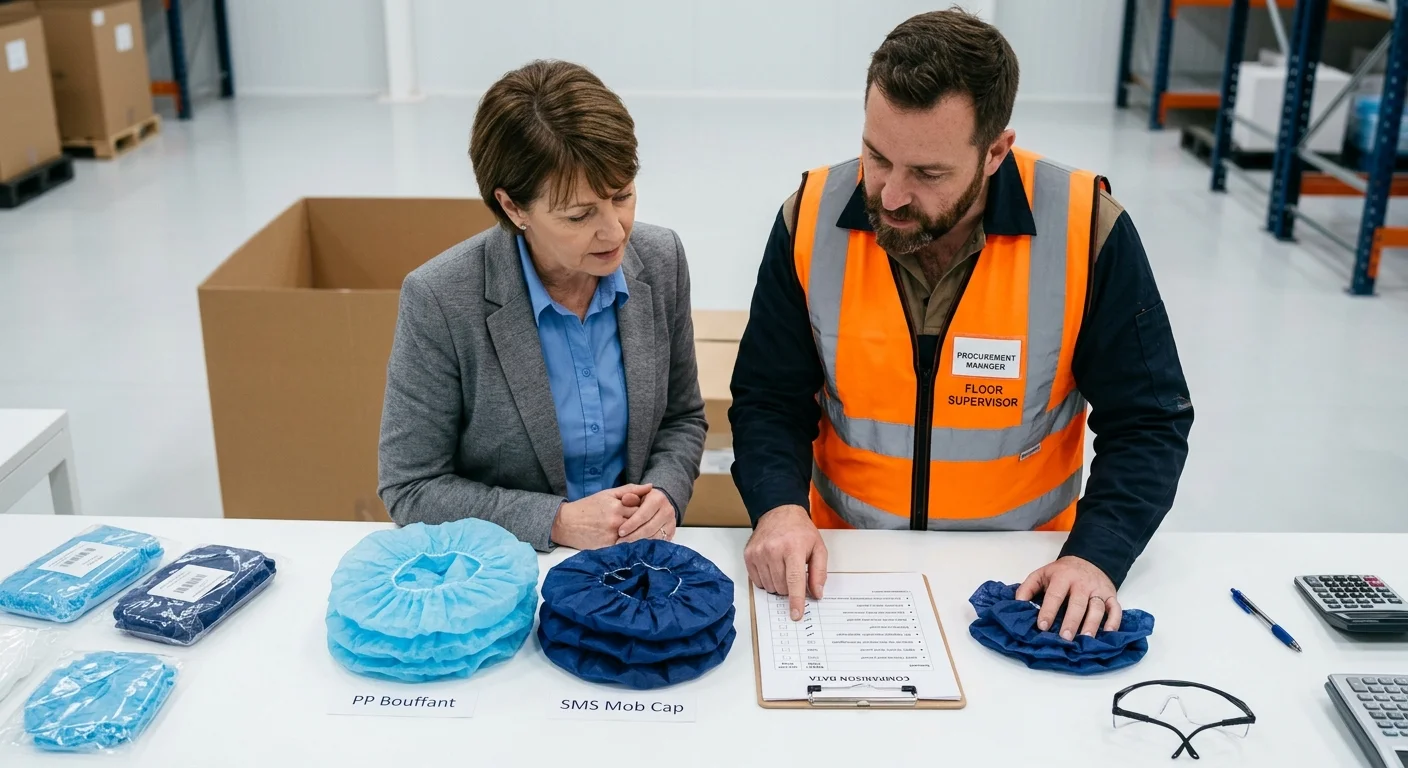
Procurement managers, floor supervisors, and compliance officers ask these questions all the time. Here are straight answers.
Q: Are mob caps metal-detectable for HACCP lines?
Standard PP mob caps are not. Does your production line run metal-detection audits? You need caps made with an embedded metal strip or detectable additive. Check that the spec sheet lists them as “metal-detectable” — that label confirms the right construction.
Q: Does SMS justify the extra cost over PP?
Fluid splashes, wet processing, or biohazard exposure — yes, SMS is worth it. Standard PP handles dry food packing and general clinical use well. SMS earns its price premium in operating rooms, pharmaceutical cleanrooms, and heavy-duty processing environments. In those settings, barrier performance is non-negotiable.
Q: Which cap holds up best during a long shift in a hot facility?
Lightweight PP — bouffant or pleated mob cap, both hold up well. PP nonwoven breathes better than SMS under sustained heat. Check that the elastic is latex-free. After five or six hours, that detail shifts from a nice-to-have to a must-have.
Conclusion
Choosing between a bouffant cap and a mob cap basically comes down to three simple questions:
-
Does your workplace require fluid resistance?
-
How long will your team wear the cap each day?
-
Do you need fast, one-handed dispensing?
That is really it. Answer those, and you have found your match.
You don’t need to overthink the tricky catalog terms we talked about earlier. Just look closely at your actual work floor. Getting the right cover on the first order saves your budget and stops compliance headaches before they even start.
Ready to sort out your supply? Browse Morntrip’s full range of disposable caps . Pick the exact specs your team needs, and let’s keep your operation running smoothly.





