
Every procurement manager eventually asks: should you buy straight from Ansell, or go through an Ansell PPE distributor ?
On paper, buying direct looks like the obvious win—cut the middleman, cut the cost. But once you factor in MOQs, lead times, and the hidden fees that never show up in the initial quote, it’s not always that simple.
We’ve broken down the real numbers behind both routes: Ansell’s direct pricing structure, distributor markups, total landed costs, and where each option actually saves you money based on your order volume. Whether you’re stocking gloves for a 50-person warehouse or sourcing PPE for a multi-site operation, you’ll know exactly which channel fits your budget and your risk tolerance. No guesswork required.
Quick Answer: Which Option Saves More Money on Ansell Products
Here’s the number that matters: direct sales run 40-50% cheaper per case than Ansell distributor pricing. Take the Ansell Microflex Diamond Grip MF-300—direct pricing lands around $109.99/case, while the same glove through distributor channels runs $160-$180/case. That’s real money on a recurring order.
But here’s the catch. That “cheaper” price only wins if you’re buying in volume with stable, repeat demand. Once you factor in freight, customs clearance, warehousing, and tied-up capital, small or irregular orders often flip the math in the distributor’s favor.
The 30-second rule:
|
Your Situation |
Cheaper Option |
Why |
|---|---|---|
|
High volume, stable monthly demand |
Direct/manufacturer |
Lower unit price, tiered discounts available |
|
Few SKUs, standardized products |
Direct |
Easy to lock in bulk pricing |
|
Small batch, urgent restock |
Skips MOQs and shipping delays |
|
|
Multi-category orders |
Authorized Ansell dealer |
One-stop sourcing cuts management overhead |
|
Cross-border sourcing |
Calculate landed cost first |
Logistics can erase the unit-price advantage |
A quick threshold: if direct pricing beats distributor pricing by less than 10%, the savings get eaten by logistics and inventory carrying costs. At 30% or more, direct sourcing starts making real sense. At 40%+, it’s the clear winner—assuming you can handle the MOQ and lead time.
Buying Direct from Ansell: Cost Structure & Requirements
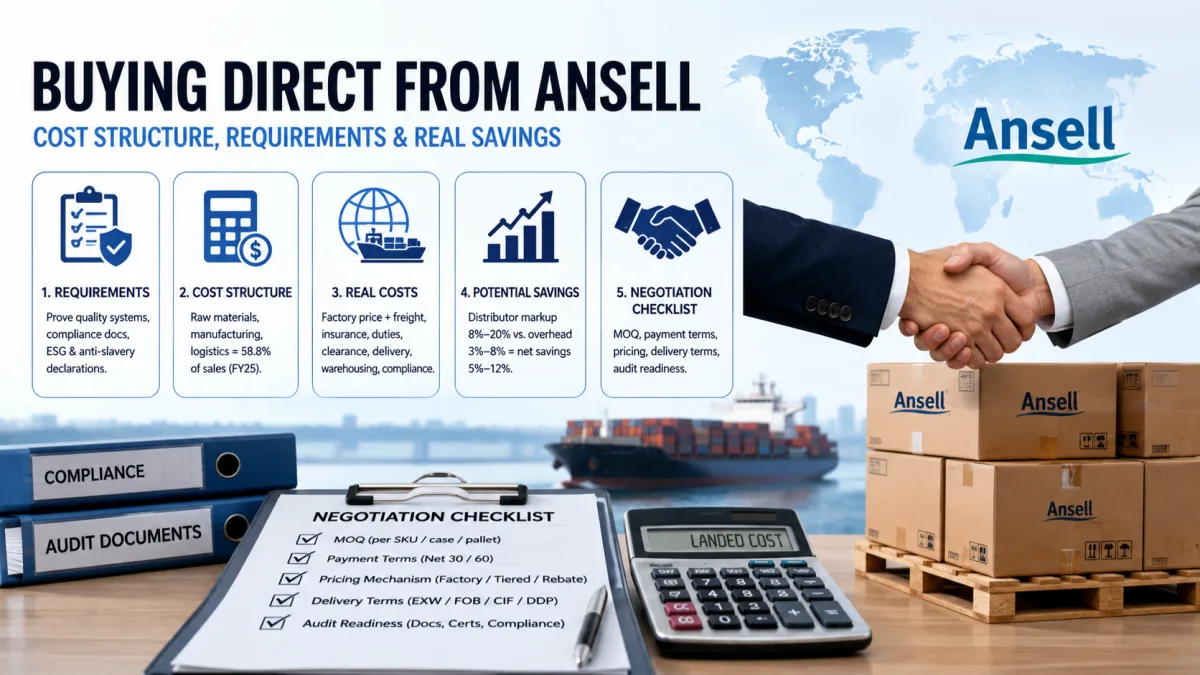
There is no public MOQ list, no published payment terms, and no standard onboarding checklist for buying direct from Ansell. What you negotiate is a custom B2B supply agreement, and the terms depend almost entirely on your leverage.
What Ansell requires from direct buyers
Ansell audits its global suppliers and partners on a two-year cycle minimum, more often if issues surface. If you want direct access, expect to prove your quality systems, compliance documentation, and possibly ESG or anti-slavery declarations before pricing conversations start. It’s a vetting process.
The financial reality behind the pricing
Ansell’s FY25 numbers show why margins move the way they do. Revenue hit $2,003. 3M (up 23.7%), while COGS climbed to $1,178.3M, roughly 58.8% of sales. That cost structure is tight; raw materials, manufacturing, and logistics eat most of the margin before Ansell even prices the product for you.
Calculating your real direct-purchase cost
Factory price, international freight, insurance, customs duties, clearance and agent fees, inland delivery, warehousing, compliance and testing costs. Add these up, and the discount you expected from skipping an Ansell distributor often shrinks fast.
A working formula: if distributor markups typically sit between 8% and 20%, and you can keep import and compliance overhead under 3% to 8%, net savings usually land in the 5% to 12% range. Below that, you’re breaking even at best.
Negotiation checklist before you commit
-
MOQ, confirmed per SKU, per case or pallet
-
Payment terms, Net 30 or 60, credit insurance, or prepayment
-
Pricing mechanism, factory price versus tiered versus rebate-based
-
Delivery terms, EXW, FOB, CIF, or DDP ; this alone changes your landed cost dramatically
-
Audit readiness, quality docs, certifications, compliance records
Skip any of these, and your direct savings can vanish before the first shipment clears customs.
Buying Through an Ansell Distributor: Cost Structure & Requirements
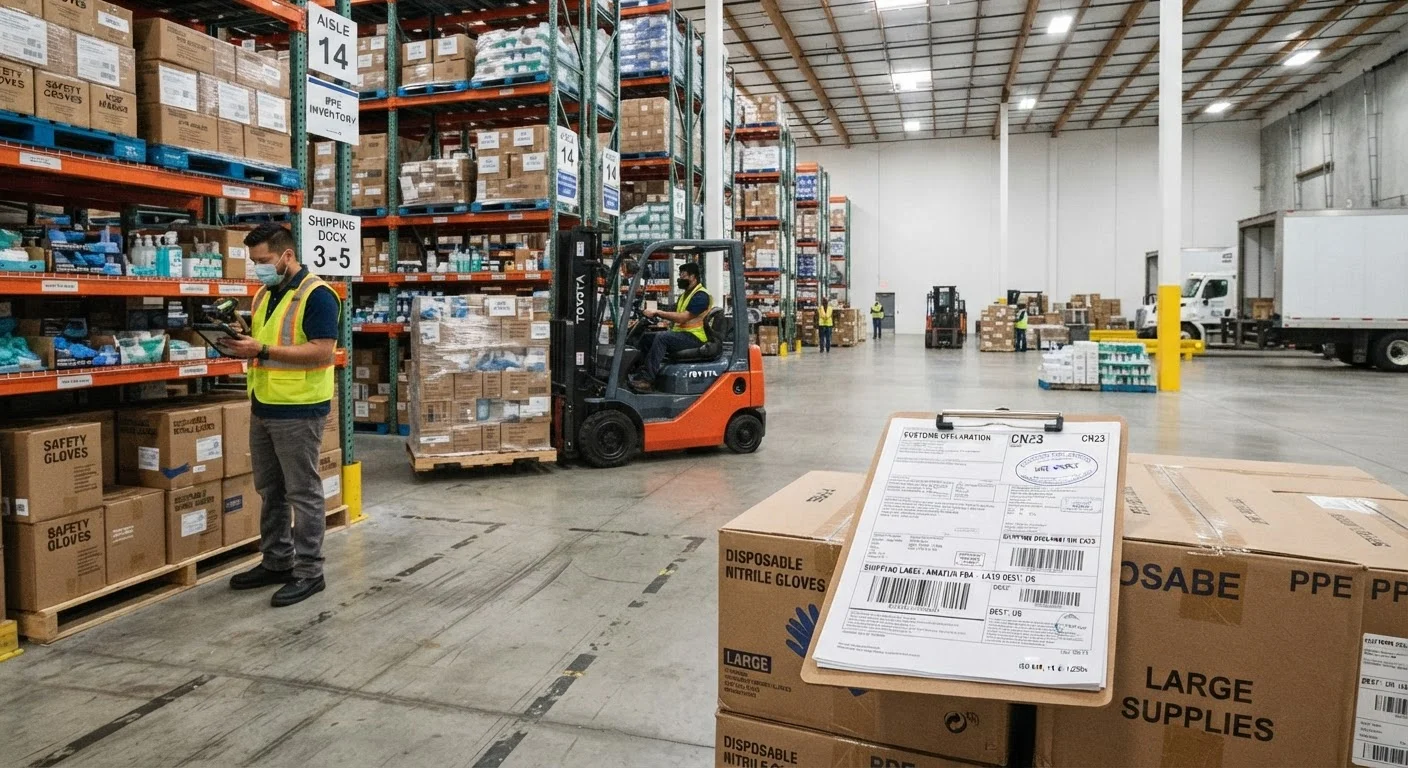
Markup pays for speed, stock, and service.
Most Ansell distributors add a 5-25% markup over base list price for standard PPE lines. Specialty or urgent-supply categories can push that to 15-40%. That sounds steep until you see what it covers.
What’s included in the distributor price
-
Base product price set by Ansell-authorized distributors
-
Domestic freight and handling (already cleared, already in-country)
-
Split-case and mixed-SKU order flexibility
-
Inventory carrying cost the distributor absorbs, not you
-
Rush replenishment premiums when you need stock fast
The last point matters more than most buyers realize. If a distributor already has Ansell gloves in a domestic warehouse, you skip customs paperwork, import compliance, and the wait. Ansell’s FY25 numbers show why this margin structure exists: $2.0033bn in sales against $1.1783bn in COGS. That’s a manufacturing-heavy cost base. The remaining margin covers channel costs, logistics, and the service layer distributors provide.
Requirements to buy through an Ansell distributor
Working with an authorized Ansell dealer is straightforward but formal:
-
Verify authorized status. Ansell maintains a public “where to buy” list. Unverified resellers carry counterfeit risk.
-
Complete standard account onboarding: business details, tax documentation, billing and shipping setup.
-
Confirm channel access terms. Ansell’s distributor policy dictates who can legally resell and under what pricing structure.
Real-world channel examples
Airgas, MSC, Northern Safety, Wesco, Medline, Henry Schein, McKesson , Cardinal Health, Owens & Minor. These are established Ansell B2B suppliers handling broad PPE and medical consumable baskets, which improves order-mix efficiency when you’re bundling gloves with other supplies.
The benchmark that matters. If the distributor premium stays under 10-15% and inventory is local, the channel usually pays for itself through eliminated freight risk and lower carrying costs. Above 25%, negotiate volume breaks or shop alternate authorized dealers.
Total Landed Cost Comparison: Direct vs Distributor
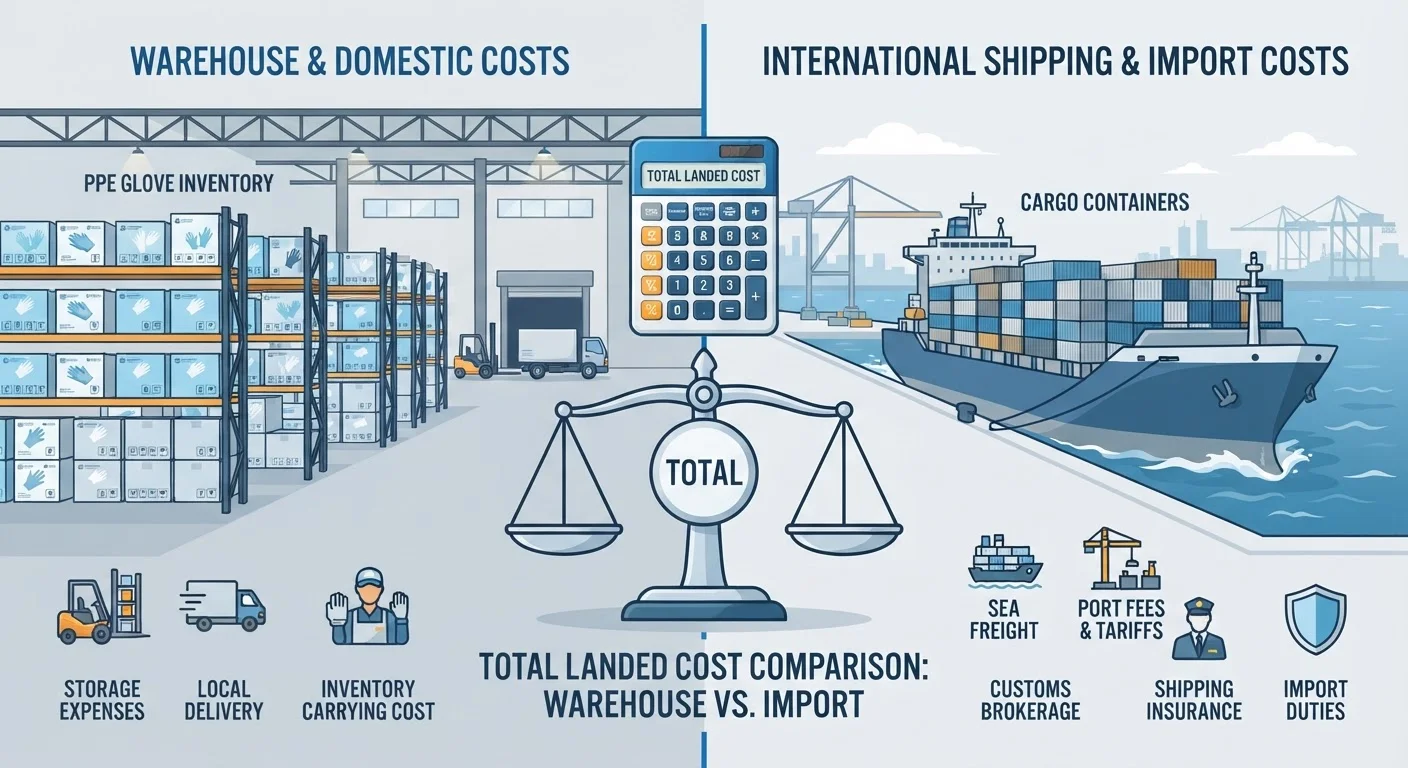
Invoice price lies. It’s the number everyone fixates on, and it’s also the number that tricks procurement teams into bad decisions. The real metric is Total Landed Cost (TLC) — the full price tag once freight, duties, insurance, warehousing, and risk get added in.
The TLC formula:
TLC = Unit Price + Freight + Duties/Taxes + Insurance + Customs Clearance + Port/Handling Fees + Warehousing + Inspection + Capital Tied Up + Stockout Risk Cost
Skip any of these variables, and your “cheaper” Ansell manufacturer direct sales quote can end up costing more than an authorized Ansell dealer’s price.
A Real Numbers Breakdown
Here’s a worked example based on a 1,000-unit order.
Direct purchase:
– Factory price: $50/unit
– Freight + customs clearance: $10/unit
– Warehousing + capital tied up + coordination overhead: $4/unit
– Total: $64/unit → $64,000
Distributor purchase:
– Distributor price: $68/unit (36% above factory price)
– Local delivery: $3/unit
– Total: $71/unit → $71,000
Net result: direct sourcing saves $7,000, roughly 9.9%. Not dramatic. But push freight and customs costs down further, which happens naturally at higher volumes, and that gap widens fast, often into the 20-40% range.
This is the number every Ansell bulk order decision should be built on.
Where the Crossover Point Sits by Order Volume?
Small batches (under 500 units): Distributors usually win. When you go direct, fixed costs like international freight, clearance, inspection, and capital lockup get spread across too few units. The math punishes small orders every time.
Mid-size batches (500-2,000 units): This is the gray zone. If your direct landed cost comes in 10-20% below distributor pricing, direct sourcing starts pulling ahead. Bulky products or complex customs categories can flip that back toward the distributor.
Large batches (over 2,000 units): Direct sourcing typically wins outright. Fixed logistics and clearance costs get diluted across enough units that the distributor’s typical 15-35% markup gets fully absorbed and then some.
The Rule That Actually Matters
|
Order Size |
Better Option |
Reasoning |
|---|---|---|
|
Small (<500 units) |
Ansell distributors |
Lower operational drag, faster restock, minimal stockout exposure |
|
Medium (500-2,000) |
Depends on TLC gap |
Calculate before committing. The 10-20% threshold decides it |
|
Large (2,000+) |
Direct/manufacturer |
Fixed costs dilute, price gap widens to 20-40% |
Compare Total Landed Cost, not invoice price. It’s the only number that tells you whether an Ansell PPE distributor or a direct manufacturer deal protects your margin. A lower unit price on paper means nothing if freight delays, customs holds, or idle warehouse capital quietly eat the savings before the product ever reaches your dock.
Which Option Fits Your Business? Recommendations by Buyer Type
Not every business fits the same box. The right sourcing channel depends less on company size and more on how predictable your demand is, how much internal bandwidth you have, and how much a supply delay actually costs you.
Here’s how to match your buyer profile to the smarter procurement path.
Small and Mid-Sized Businesses: Go With a Distributor
If you’re running a single facility, buying for the first time, or don’t have a dedicated supply chain team, an Ansell distributor is almost always the better fit. The reason isn’t just price. It’s operational load.
An authorized Ansell dealer absorbs the work you’d otherwise have to build internally:
-
Lower upfront investment — no need to prepay for container-sized orders
-
Reduced inventory pressure — the distributor holds the stock, not you
-
Less procurement headcount required — sourcing, vendor vetting, and shipment tracking are handled for you
When you evaluate any B2B supply relationship, the factors that matter most are financial capacity, integration complexity, and how well the partnership fits your existing operations. For smaller buyers, direct sourcing usually fails on all three. The internal cost of managing customs, quality audits, and freight coordination quietly outweighs the unit-price savings.
Factories, Chains, and Multi-Site Operations: Evaluate Direct Sourcing
Once your annual volume is large enough to justify dedicated supply chain staff, and your SKU list is stable and standardized, direct sourcing becomes worth investigating. This is where an Ansell manufacturer direct sales agreement starts pulling ahead. You can lock in annual pricing, negotiate rebate tiers, and reduce per-unit cost through committed volume.
There’s no universal industry threshold for when direct buying pays off. The operating rule is simple: once your purchase volume already covers the fixed cost of quality control, logistics coordination, and compliance tracking, and your demand is steady enough to support a framework agreement, direct sourcing deserves a real cost comparison.
Urgent or Project-Based Orders: Stick With Distributors
If a delay means a stalled production line, a paused construction site, or contractual penalties, price stops being the priority. Time and certainty take over.
This is where Ansell distributors earn their markup. Local stock, fast replenishment, and the flexibility to substitute equivalent specs can compress a weeks-long direct lead time into a same-week fix. For any project where downtime cost exceeds the per-unit savings, choose the channel with confirmed stock and delivery commitment, not the lowest quote.
Match Your Demand Pattern to the Right Channel
|
Your Profile |
Best Fit |
Why |
|---|---|---|
|
Stable, predictable, high-volume demand |
Direct/manufacturer |
Annual pricing locks in lower per-unit cost |
|
Irregular, project-based, or seasonal demand |
Ansell distributors |
Absorbs demand swings without your capital risk |
|
Multiple specs, small batch sizes |
Ansell distributors |
One order covers mixed SKUs without MOQ friction |
|
Single SKU, large recurring order |
Direct/manufacturer |
Standardization makes volume discounts easy to negotiate |
The more volatile and project-driven your demand, the more a distributor protects you. The more predictable, standardized, and high-volume your demand, the more direct sourcing saves real money. Growth trajectory matters too. If your volume is scaling toward a threshold where fixed management costs get diluted, revisit this comparison every 6-12 months rather than treating it as a one-time decision.
How to Choose an Authorized Ansell Distributor?
Not every seller calling itself an “Ansell distributor” actually is one. Always verify first.
Start with Ansell’s official “Where to Buy” tool. It tells you whether a vendor is part of Ansell’s real sales network. Then ask for the authorization certificate. A legitimate one shows the authorization level, expiration date, product categories, and service region. Anything vaguer is a red flag.
Four metrics separate a solid Ansell PPE distributor from a risky one:
-
Local inventory — regional stock means shorter lead times, not customs delays
-
MOQ flexibility — can they handle sample orders or mixed SKUs, not just full pallets
-
Quote turnaround — request specs, taxes, freight, and delivery date in one response, same business day
-
Track record — batch traceability, formal contracts, and after-sales support matter more than a rock-bottom price
Before you commit, ask six direct questions: Are you Ansell-authorized? Can you send the certificate? What’s the coverage region and expiration date? What’s current local stock? What’s your MOQ? Does the quote include tax, freight, and traceability terms?
Distributors like Morntrip that pass all six checks tend to deliver on both pricing and reliability. That’s exactly what a B2B PPE order needs.
FAQs
Procurement teams ask the same few questions before signing off on a sourcing decision. Here are the answers they need.
Is buying direct from Ansell always cheaper?
No. Unit price looks better, but once freight, customs, and financing costs are factored in, total landed cost often wipes out that advantage. Compare total landed cost, not invoice price.
What margin do Ansell distributors typically add?
Most Ansell distributors work on roughly 10–30% gross margin, depending on product category, order volume, and service level required. Commoditized high-volume gloves sit at the low end. Regulated or specialty PPE runs higher.
How do I find an Ansell distributor near me?
Pick the nearest authorized dealer with confirmed local stock and documented lead times. Proximity matters when delivery speed and traceability outweigh a better headline price.
What’s Ansell’s minimum order quantity?
MOQ varies by SKU, packaging format, and whether you’re ordering by case or pallet. Always request price breaks at the case, carton, and pallet level before comparing offers.
Conclusion
Unless you’re ordering pallet-loads of Ansell gloves on a recurring basis, buying direct rarely pays off once you factor in MOQs, freight, and the hidden cost of tied-up capital. For most businesses—small teams, mid-sized operations, even larger companies that need flexibility—working with an authorized Ansell dealer consistently gives you a better total landed cost, faster turnaround, and far less procurement headache.
The real comparison is about risk, speed, and long-term supply stability. A trusted Ansell PPE distributor absorbs the volume risk so you don’t have to, while still passing along competitive bulk pricing.
Audit your current order volume and lead-time pain points, then request a quote from a vetted distributor like Morntrip. You’ll likely find the “savings” from going direct are costing you more than you realized.





