
When your warehouse crew burns through gloves faster than you can restock, the question of Ansell Vs Showa stops being casual and becomes a line item on your budget. Ansell and Showa both dominate industrial hand protection for good reason, but they’re not interchangeable. Picking the wrong one for your job costs you in reglove frequency, injury risk, or money spent on protection you don’t need.
This comparison cuts through the marketing to show what matters: how their nitrile-coated gloves handle real cut and puncture stress, where each brand leads on chemical resistance, and which delivers more durability per dollar in high-volume environments. Whether you’re outfitting a chemical plant, a food processing line, or a machine shop, you’ll know which brand and model fits your risk profile and budget.
In-Depth Analysis of the Ansell Glove Brand
Numbers tell the Ansell story better than marketing copy does. The company ships 9 billion glove pairs a year, serves 25+ industries, and has 14,000+ employees across 55+ countries. In several niche segments, Ansell holds the #1 or #2 global market position. That’s infrastructure.
Behind the brand sits Ansell Limited (ASX: ANN), a publicly traded company backed by 18 R&D centers, 15 manufacturing sites, and 24 warehouses spanning China, Malaysia, Thailand, Vietnam, Portugal, Mexico, and Brazil. For B2B buyers, that footprint means consistent supply and localized production.
Product Lines That Matter for Buyers
-
HyFlex series : general-purpose industrial gloves for handling, assembly, and warehouse work. The HyFlex 11-840 is Ansell’s official best seller in general handling. It uses a 15-gauge knitted shell with foam nitrile palm coating. It’s latex-free and Oeko-Tex certified.
-
Solvex / AlphaTec Solvex 37-175 : built for chemical resistance. An 18-mil nitrile compound that is EN 374 Type A certified and FDA-approved for food contact. A strong pick if chemical-resistant work gloves are your priority.
-
HyFlex 11-561 : marketed as one of the thinnest, lightest ISO Cut C gloves available, with claimed 2x durability versus the nearest competitor.
The Technology Behind the Claims
Ansell’s FORTIX™ Abrasion Resistance tech (used in the 11-840) promises 2x more grip and up to 20% greater abrasion protection, which lowers reglove frequency. Pair that with ERGOFORM™ ergonomic shaping and ZONZ™ comfort-fit design, and you get gloves built for full-shift wear without hand fatigue.
What You’ll Actually Pay?
Pricing scales with protection level:
– HyFlex 11-840 : roughly $1–$4+ per pair wholesale
– Solvex 37-175 : about $1.50–$5+ per pair
– HyFlex 11-561 : around $2–$6+ per pair
Expect 20%–50%+ price swings across regions and distributors, driven by certification requirements, sizing mix, and packaging (12/pack, 100/case are common).
An In-Depth Look at the Showa Glove Brand
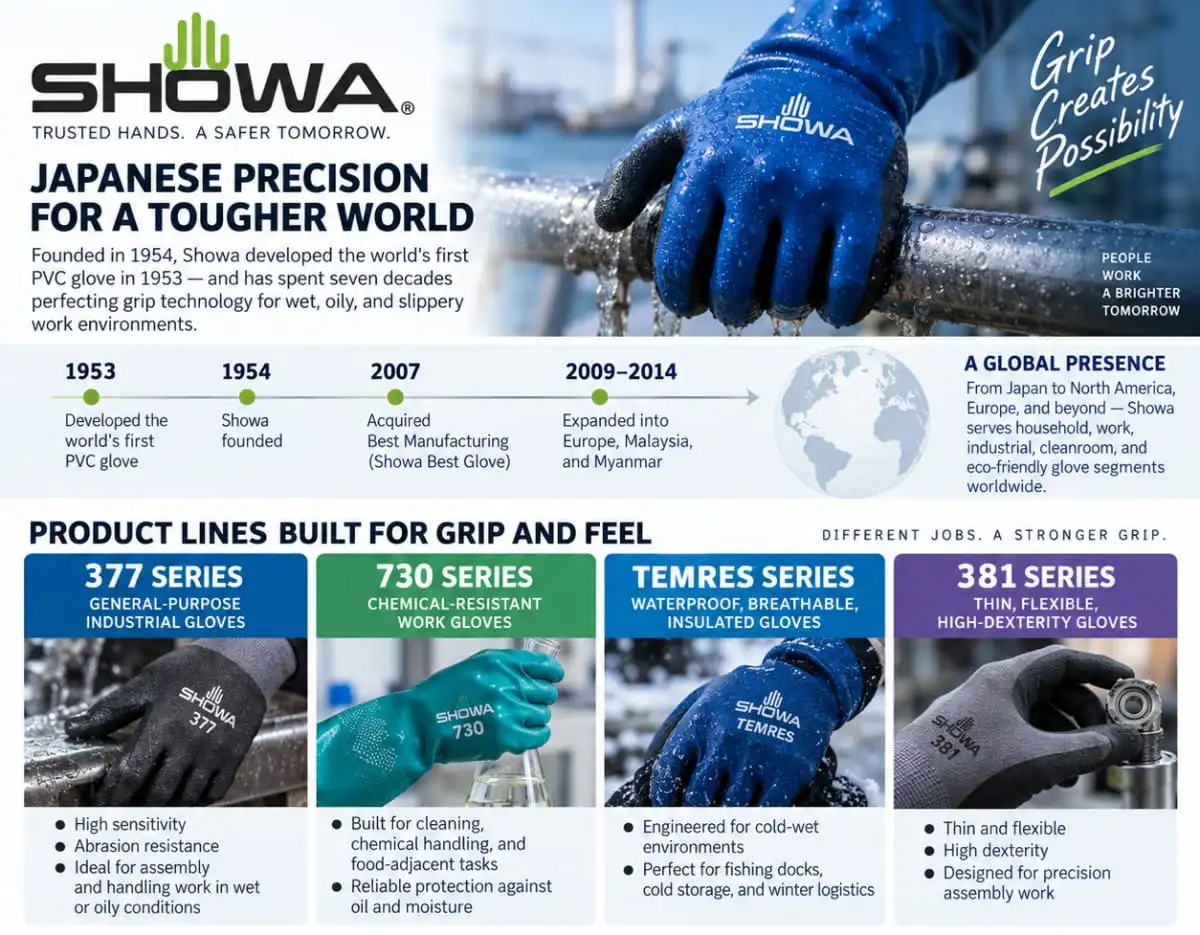
Japan’s manufacturing obsession with precision shows up in every Showa Glove you’ll test. Founded in 1954, Showa built its reputation on a technical milestone few competitors can claim: developing the world’s first PVC glove back in 1953. That’s the foundation of a brand that’s spent seven decades refining grip technology for wet, oily, and slippery work environments.
The 2007 acquisition of Best Manufacturing (creating Showa Best Glove) expanded its reach into North America, followed by strategic moves into Europe, Malaysia, and Myanmar between 2009 and 2014. Today, Showa covers household, work, industrial, cleanroom, and eco-friendly glove segments.
Product Lines Built for Grip and Feel
-
377 series : general-purpose industrial gloves known for high sensitivity and abrasion resistance. This is your go-to for assembly and handling work in wet or oily conditions.
-
730 series : the chemical-resistant work gloves line—built for cleaning, chemical handling, and food-adjacent tasks where oil and moisture are constant threats.
-
TEMRES series : waterproof, breathable, insulated gloves engineered for cold-wet environments. Fishing docks, cold storage, winter logistics—this is where TEMRES earns its reputation.
-
381 series : thin, flexible, high-dexterity gloves for precision assembly work.
The Technology That Sets Showa Apart
Foam-coated rubber gives Showa’s grip-focused gloves serious traction on slick surfaces without sacrificing tactile feel. Their seamless knit construction, pioneered in the 1980s, eliminates seam friction and improves fit—a small detail that matters after eight hours on the line.
Pricing Reality
Expect $3–$10 per pair for 377/381 series gloves, while TEMRES commands $15–$35 per pair given its functional premium. Bulk orders of 1,000+ pairs typically drop to 50%–75% of catalog price.
Material and Technical Specifications Comparison (Ansell vs Showa Nitrile Gloves)
Thickness alone tells you more about a glove’s job than any marketing headline. The Ansell AlphaTec 58-735 runs at 39 mil (1.0 mm), putting it firmly in heavy-duty chemical resistant work gloves territory with an EN388 rating of 3432 / 4X32C. Compare that to the Ansell 58-535B at just 12 mil, EN388 3122A / 4121. Same brand, completely different job. You’re choosing between thick chemical armor and thin, dexterous handling.
Showa’s flagship 737 sits at 22 mil, EN388 3001X, with ANSI Abrasion Level 4 but Cut Level 0 and Puncture Level 1. It gives solid abrasion resistance but minimal cut protection. As a cut resistant gloves comparison data point, Ansell’s 58-735 outranks the 737 on mechanical protection ceiling. If your line involves sharp edges or metal handling, that gap matters.
Where Showa Pulls Ahead: Wet and Oily Grip
Numbers back up Showa’s grip reputation. Testing on the 377 series shows foamed nitrile coating scoring 1.08 dry / 0.18 oil, versus film nitrile at 1.84 dry / 0.07 oil. The foam construction disperses oil films better in wet, dry, or oily conditions—exactly what Showa’s product pages claim. Ansell didn’t publish comparable grip-friction data for its chemical-focused lines. This tells you that Ansell optimizes for barrier protection and Showa for control.
Chemical Breakthrough Times: Ansell’s Strong Suit
Ansell’s 0.425 mm nitrile gloves post breakthrough times of >480 minutes against sodium hydroxide, hydrogen peroxide, and formaldehyde, so you get all-shift protection. Sulphuric acid breaks through in 105 minutes, methanol in 61. Showa doesn’t publish equivalent breakthrough tables. Their 15–22 mil chemical nitrile performs well against oils and fuels, but without Ansell’s documented extreme-exposure data.
Pick Ansell’s thicker AlphaTec line for hardcore chemical exposure and Showa’s 377 for wet or oily grip-dependent tasks.
Protective Performance and Certification Standards Comparison (Industrial Safety Gloves Comparison)
A glove passes or fails your safety audit based on its certification paperwork. Showa builds compliance around three standards: ANSI/ISEA 105-2016, EN 388:2016+A1:2018, and EN ISO 374-1:2016. Their food-contact products also meet EU 1935/2004 and EU 2023/2006, which matters if you’re sourcing for food processing lines.
Cut Resistance: Full-Spectrum Coverage
Showa’s product catalog covers the full cut protection range. You’ll find EN 388 Cut ISO A–F and ANSI/ISEA Cut A1–A9 across different lines. Some examples: EN 388:2016 4111X on chemical-focused gloves, 2242X on standard coated models, and 3X43E on chemical-plus-cut hybrids like the SHOWA 3416, which pairs ANSI A5 with protection against acids, caustics, solvents, grease, and oil. Showa spreads A2, A4, and A5 ratings across multiple product families, so buyers comparing puncture resistant gloves and cut resistance side-by-side have real options at each tier.
Chemical Protection: Type A/B/C Breakdown
Showa’s EN ISO 374 gloves fall into Type A, B, or C categories based on breakdown resistance. The chemical resistance charts cover sodium hydroxide 40% (K), sulphuric acid 96% (L), nitric acid 65% (M), formaldehyde 37% (T), plus solvents like methanol (A), acetone (B), and n-Heptane (J). That covers the four chemical categories most industrial buyers care about: acids, caustics, solvents, and oils.
Procurement Checklist for Compliance-Driven Buyers
-
EN 388 : confirm 2016+A1:2018 version, TDM Cut value, A–F rating
-
ANSI/ISEA 105 : verify A3–A5 coverage with matching puncture level
-
EN ISO 374 : check Type A/B/C plus chemical letter codes (AJKLMT, JKL, BJKL)
-
Food contact : look for EU 1935/2004, EU 2023/2006, or FDA compliance. Several Showa models even carry FDA Class I Medical Device status.
Industry & Use-Case Matching (Which Brand Suits Your Industry Best)
Your industry decides which glove wins. Match the glove to the hazard, not the other way around.
Ansell Wins in Chemical, Maintenance, and Precision Work
Ansell’s product documentation covers industrial maintenance tasks like chemical handling, refining, tank filling, degassing, and working with acids, caustics, and solvents. If your crew works around plant equipment or heavy machinery, this is your lane.
The HyFlex 11-931 is built for automotive and equipment repair environments: chassis assembly, body trimming, engine and transmission repair, oil and filter changes, press shop operations. Automotive manufacturing and mechanical maintenance jobs skew toward Ansell because the application data is built around those exact tasks.
There’s also a real cost argument. Ansell’s AnsellGUARDIAN program cites an EthosEnergy case study showing fewer injuries and thousands of dollars saved from better glove-to-task matching. For plant managers tracking injury reports against PPE brands, that’s a procurement argument, not marketing fluff.
Showa Wins in Food, Cold Storage, and Wet/Oily Conditions
Showa designed its gloves around food processing and cold-chain work. The Showa 708 handles fatty and oily food with liquid-proof, food-safe construction for wet processing lines. The Showa 460 covers building, food processing, and cooling storage applications, backed by EN 511:2006 cold protection certification. Some Showa chemical-resistant models stay flexible down to -20°C – useful when your team moves between cold storage and loading docks all shift.
Quick Industry Match
|
Industry |
Recommended Brand |
|---|---|
|
Chemical processing / refining |
Ansell |
|
Plant maintenance / equipment repair |
Ansell |
|
Automotive assembly |
Ansell |
|
Food processing / packing |
Showa |
|
Cold storage / cold chain logistics |
Showa |
|
Construction (wet/cold conditions) |
Showa |
Price & Value-for-Money Comparison (Ansell Gloves Price vs Showa Gloves Price)
Bulk pricing is where these two brands really diverge. Ansell’s box-packed SKUs run from $21.54 per 144-pair case (HyFlex 11-581) up to $846.72 per 144 pairs for premium 11-814s. Their chemical-resistant specialty lines jump to $124–$1,074 per 12-pair box. Showa’s public pricing skews retail: £1.87–£8.08 per pair on UK channels, C$84.84–C$136.02 in Canada, and $22.07 ($1.84/count) on Amazon.
|
Tier |
Ansell |
Showa |
|---|---|---|
|
Entry retail |
$1.50–$6+/pair |
£1.87–£8.08/pair |
|
Mid-tier industrial |
$1.92–$10.36/pair |
£17.24–£20.29/pair |
|
High-end chemical/specialty |
$45–$89/pair |
£19.67–£23.14/pair |
Ansell wins on volume. Their case-packed SKUs (144/box, 250/pack) bring unit cost down to $0.15–$1.00/pair. That’s a swing of tens of times depending on protection level and packaging, not just brand.
Showa’s pricing is quote-driven. Fewer public bulk discounts mean you negotiate tiered pricing (12, 60, or 120-pair boxes) directly with suppliers, and you typically land 5%–15% off catalog for project volume.
If you need low first-purchase cost and general handling, Showa wins. If you need standardized bulk procurement and high-protection ROI, Ansell does.
Durability and Real-World Lifespan Comparison
Durability specs on a spec sheet mean nothing once a glove is on a warehouse floor for eight hours a day. What matters is how many shifts a glove survives before it tears, deglazes, or loses grip — and what that costs you per wear.
Cost-Per-Wear Is the Real Durability Metric
Reusable protective gear only pays off once it clears a break-even threshold. Industry data on reusable-vs-disposable packaging shows the crossover point lands around 50 uses. Below that, disposables win on cost. Above it, reusables pull ahead fast.
Run the math on a real example: a $50 box of reusable gear used 100 times works out to $0.50 per use, versus $1.00 per use for single-use equivalents. A similar case using a $20 reusable unit with $0.10 per-use maintenance cost, amortized over 100 uses, lands near $0.37 per use — still beating disposable gear at roughly $0.40 per use.
Apply that same logic to nitrile-coated gloves . A pair that survives 100 shifts before failure beats a cheaper glove that needs replacing every 20–30 shifts, even if the upfront price looks higher.
What to Track Instead of Marketing Claims?
Skip the abrasion-resistance percentages on the box. Ask suppliers for:
-
Shift-to-failure count under your specific task load
-
Reglove frequency across a 3-month trial batch
-
Cost-per-wear , not cost-per-pair
Those three numbers separate real durability of work gloves from marketing copy — and they’ll tell you faster than any spec sheet whether Ansell or Showa lasts longer in your specific environment.
User Feedback & Market Reviews Roundup (Ansell Gloves Review & Showa Gloves Review)
Review scores rarely tell the full story, but they do reveal patterns worth trusting. Ansell’s HyFlex 11-801 pulls strong Amazon praise for fit, comfort, and grip — buyers call it “tough and light” and say it “lasts longer than any other gloves.” A 2026 aggregate review summary backs that up with mixed-but-solid marks. Knoji rates Ansell 3.6/5.0, and PickSmartly scores it 6.1/10 across 20,000+ review items. The HyFlex 11-561 scores 8.4/10 for cut protection and grip, though reviewers dock it to 7/10 on long-term reliability. The coating tends to fail before the liner does. Some batches also draw fit complaints, including one German reviewer flagging “Keine Passgenauigkeit” (no proper sizing match).
Showa’s feedback skews cleaner. The 300XL-10 Atlas Fit earns praise for durability and grip, with reviewers calling it “long-lasting” and comfortable on skin. The 282-02 carries 1,140 reviews at a 4-star average on Amazon Canada — a volume signal that Ansell’s individual SKUs rarely match. ScubaBoard users single out the 720 series for cold/wet protection unmatched by competitors.
The Bottom Line on Reputation
Ansell wins praise for dexterity and fine handling; Showa wins loyalty in wet, greasy, budget-conscious environments.
Buying Decision Chart (Best Work Gloves Brand by Scenario)
Stop guessing. Match your task to the correct glove.
For chemical exposure, the Ansell AlphaTec Solvex 37-185 or 37-695 meets EN 374-1 Type A, is rated for food contact, and uses 0.425mm nitrile for heavy exposure.
For dry assembly, the Ansell HyFlex 11-725 is thin and flexible, with EN 388 4131A-level dexterity.
If you need a wet or oily grip, Showa’s 377 or 730 series uses foam nitrile that disperses oil, carrying an EN 374 Type B rating.
For cold storage, the Showa TEMRES or 460 are waterproof and EN 511 rated down to -20°C.
In food processing, you have two options. The Ansell AlphaTec 87-356 is FDA 21 CFR 177.2600 compliant. The Showa 7502PFS carries EN ISO 374-5 with a food-contact declaration.
For bulk procurement, combine the SKUs above from both brands. Lock in two primary models plus one backup, giving you dual-supplier security.
Quick rule: chemical and precision work leans Ansell. Wet, cold, or oily tasks lean Showa.
Frequently Asked Questions (FAQ)
Buyers ask the same four questions before they commit to a bulk order.
Which brand is more durable? Dry, precision work favors Ansell HyFlex 11-840, rated EN 388 abrasion level 4. Oily, wet jobs favor Showa 377’s dual-layer foam nitrile palm. For heavy solvent exposure, Ansell Solvex 37-175 (17 mil) outlasts Showa 730 (15 mil).
Which offers better value? Bulk, box-consumed orders lean Showa — cheaper per case, positioned as budget-friendly. Single-use precision tasks favor Ansell. You pay more per unit but get fewer rework errors.
What’s the core difference? Ansell is performance-first. Showa is cost-and-scenario-first.
Which is better for distributors? High-spec chemical/PPE contracts favor Ansell. High-turnover, price-sensitive restocking favors Showa.
Procurement Consultation & Wholesale Partnership Guide
Spec sheets only get you so far. At some point, you need a sample in hand and a quote on paper.
If your operation runs chemical-heavy work, ask for Ansell options first. The Microflex 93-260 gives you a 30-minute protection window against certain chemicals. Showa 8005 has no data on those same chemicals. For daily consumable orders, Showa wins on cost — the 730 runs $30–$45/dozen, while the Ansell Solvex 37-175 runs $35–$50/dozen for food-safe solvent work.
Ready to move from research to procurement? Morntrip handles both paths. Submit your requirement, get product matching, receive a quote, test free samples, adjust, and place bulk orders.
-
Free samples : standard ships in 1–3 days; custom OEM samples take 5–7 business days (buyer covers courier cost)
-
MOQ : typically starts at 100,000 units, adjusted for custom logo or material specs
-
Contact : +86 27 87816890 | [email protected]
Contact Morntrip for a wholesale quote, a free sample request, or a custom OEM procurement plan.





