
If you’ve ever pulled on a pair of Ansell gloves at work and wondered who profits when you buy them, the short answer is yes. Ansell is a public company, trading on the Australian Securities Exchange under the ticker ASX: ANN. Behind that stock ticker sits a global glove and safety equipment manufacturer with a market cap worth understanding, a shareholder base that might surprise you, and a corporate structure that matters more than you’d think, whether you’re eyeing an investment, vetting a business partner, or just satisfying your curiosity about the brand on your box of gloves. Let’s break down what “publicly traded” means for Ansell and why it matters to you.
Is Ansell a Public Company? (Quick Answer)
Ansell Limited is the registered legal name behind the brand, and it’s the entity you’ll find listed on the ASX. Depending on which trading platform you’re using, you might see it as ANN or ANN.AX—same company, different formatting.
A few numbers to ground this:
Incorporated: August 16, 1920
Headquarters: 678 Victoria Street, Richmond, Victoria, Australia
Shares outstanding: roughly 144.31 million
Market cap: around A$4.84B–A$4.88B in recent snapshots
FY2025 revenue: approximately A$3.06B–A$3.08B
Employees: somewhere between 15,000 and 15,724 worldwide
Ansell Limited Company Profile & Stock Listing

Numbers only tell part of the story. Ansell is a genuine public company with a business model, a global footprint, and a paper trail that stretches back further than most modern corporations even exist.
Ansell carries the ISIN AU000000ANN9, the unique code that identifies its shares on international financial systems. You’ll also see it referenced as ANN.AX in market data feeds—another way of saying “Ansell’s stock,” formatted for algorithms rather than humans. And while the ASX remains its primary listing, some market databases reference secondary or over-the-counter trading activity tied to international investors. ASX: ANN is the listing that matters.
Who Owns Ansell?
No single billionaire founder sits behind Ansell , pulling the strings from a corner office. Ansell is what analysts call “widely held.” Nobody owns enough of it to call the shots alone.
Depending on which data source you check, institutional ownership sits somewhere between 55% and 68%. Simply Wall St pegs it at 63.8%, while another snapshot puts it closer to 68.4%. The breakdown: “Other Institutional Investors” hold 49.27%, Mutual Funds & ETFs hold 25.86%, and Public Companies & Individual Investors hold 24.87%. The exact numbers shift depending on the day and the methodology, but the pattern holds.
The Names Behind the Numbers
A few institutional shareholders appear consistently across ownership reports:
Allan Gray Australia — roughly 16.9%–19.62% , the largest single stake by most counts
State Street Global Advisors — about 8.17%
Host-Plus Pty Ltd. — 5.06%–6.30%
Australian Retirement Trust — 4.94%–5.24%
Pinnacle Investment Management — 4.99%–5.23%
The Vanguard Group — 2.20%–4.60% , depending on the fund
Not one of these Ansell shareholders crosses 10%. No controlling blockholder means no single entity can override the board or force a strategic pivot alone.
What This Means for You?
Insiders barely register. Executives and board members collectively hold around 0.417%–0.421% of shares, a rounding error. Compare that to founder-led companies in the safety equipment space, where insiders often hold blocking stakes or outright majorities. Ansell doesn’t work that way.
The top 20 shareholders control 50%–60% of the company, and free float exceeds 90%. That means a lot of shares are moving in the market, available to any investor with a brokerage account.
Superannuation funds. Index funds. Fund managers making bets on your behalf. Control is exercised through board votes, institutional pressure, and the collective weight of thousands of shareholders.
Ansell Stock (ASX: ANN) — What Investors Should Know
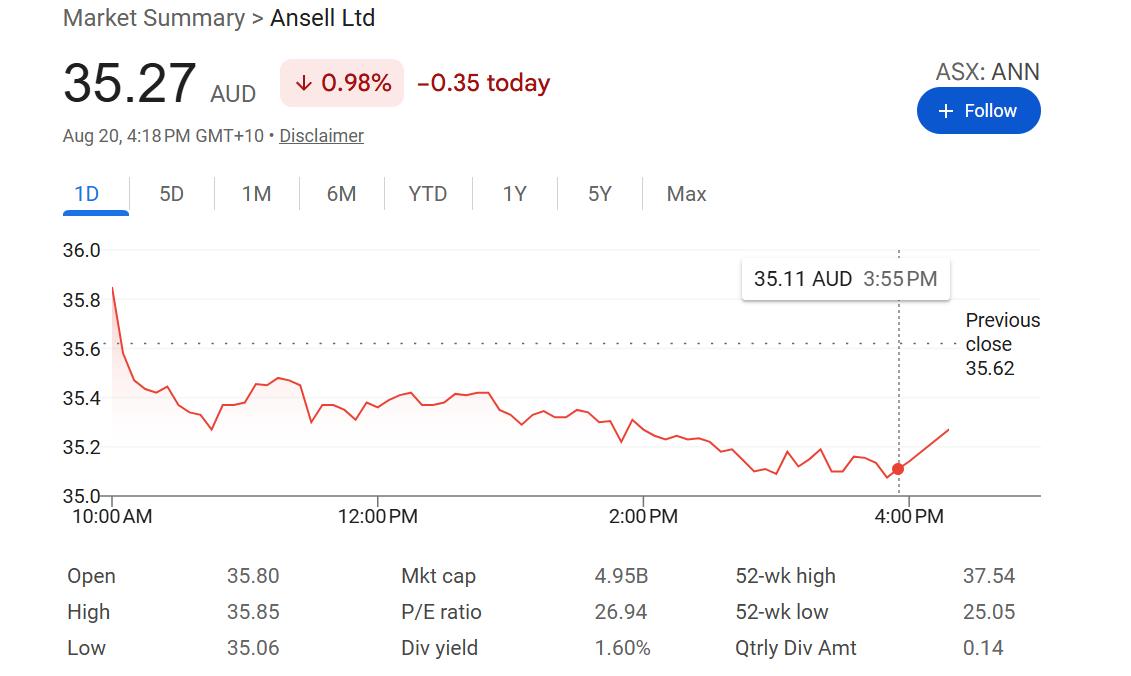
Punch ANN into the ASX website or Ansell’s investor portal, and that’s what shows up. Switch to Yahoo Finance, and it becomes ANN.AX. Same company, same shares. The labeling just depends on which platform’s convention you’re using. Good to know before you search for “ANN.AX” on the ASX site and draw a blank.
Valuation Snapshot
The stock trades at a P/E ratio of 31.88, with a forward P/E of 16.17. That gap means the market is pricing in earnings growth, not just current earnings. Ansell pays A$0.84 per share in dividends, for a trailing yield around 2.30%–2.49%. Not a high-yield stock, but consistent.
Beta sits at 0.36 on at least one data point. That tells you Ansell’s stock moves less than the broader market. If you’re building a portfolio around volatility tolerance rather than chasing returns, that matters.
Price Action and Trading Range
Recent prices for ANN have traded between roughly A$29.78 and A$35.30, depending on the snapshot. The 52-week range runs from A$28.19 to A$37.85. Average daily volume is about 480,543 shares, though some days it drops to 167,694. Liquidity varies, and the timing of your snapshot matters more than most people think.
Where the Business Makes Money
Ansell operates in two segments: Industrial and Healthcare. Both sell gloves and personal protective equipment, just to different customers. One segment outfits factory floors and warehouses. The other supplies hospitals and clinics. Watch both, because changes in either segment affect revenue.
Talking to the Company
Investor Relations contact: Michael Evans (+61 481 008 490, [email protected]). Media inquiries go to Nicholas Owens at Sefiani (+61 421 977 062). Share registry is handled by Computershare Investor Services, reachable at 1300 850 505 within Australia or +61 3 9415 4000 internationally.
Investor’s Quick Checklist
Before trading ANN:
Check which ticker your platform uses — ANN or ANN.AX
Get official numbers from Ansell’s Investor Centre, not just third-party sites
Compare market cap and shares outstanding across sources, since snapshots vary by date
Watch for ASX announcements on capital management, such as share purchase plan completions
Track top institutional holders for signs of accumulation or exit
None of this replaces professional financial advice. But it’s the groundwork any serious Ansell investor should cover first.
Public vs Private Company: Why This Matters for Ansell
Public companies operate under a spotlight. Private companies do not.
A private company answers mostly to its founders or a small circle of investors. Disclosure is optional in most cases. Financials stay behind closed doors. A public company like Ansell plays by different rules. Shares trade openly on the ASX. Ownership spreads across thousands of hands. And the company must publish regular, audited financial disclosures whether it wants to or not.
That distinction changes everything about how a company operates.
What Public Status Buys You?
Ansell posted A$3,056,263,000 in 2025 revenue and employs roughly 15,000 people across its Australia-based operations. Numbers that size do not stay private for long. Public reporting means suppliers, partners, and job candidates can see exactly how the business performs, not just what a press release claims.
Leadership sits in public view too. Nathalie Ahlstrom runs the company as Managing Director and CEO. Nigel Garrard chairs the board as Non-Executive Chair. That separation between CEO and chair is a governance signal, and institutional investors watch it closely.
Who Benefits From This Transparency
Suppliers get a clearer read on financial stability before signing multi-year contracts. No guessing games about whether a company can pay its bills.
Partners can evaluate ownership structure, filings, and leadership before committing. Misconduct or quality failures show up in the share price, which keeps everyone accountable.
Job seekers can assess company size, growth trajectory, and board structure before ever submitting a resume.
Public listing does not guarantee perfection. It guarantees visibility. And for a company processing billions in revenue and employing thousands worldwide, that visibility makes Ansell easier to trust than a private competitor hiding behind closed books.
Frequently Asked Questions About Ansell’s Corporate Status

People searching “Is Ansell a public company” usually have one follow-up question, then five more.
Can I buy Ansell stock right now?
Yes. Ansell trades on the ASX, so you’ll need a licensed stockbroker or an online trading platform, the same process as buying any other listed stock. No special access required.
What’s Ansell’s ABN?
89 004 085 330. That’s the Australian Business Number tied to the legal entity, useful if you’re doing due diligence or verifying corporate filings.
How many countries does Ansell operate in?
Over 55. That’s not a rounding-up number, either. Ansell describes itself as a “Leader in Industrial Safety Solutions,” and that footprint backs up the claim.
Who handles my shares if I own Ansell stock?
Computershare Investor Services. Call 1300 850 505 in Australia, +61 3 9415 4000 from outside, or email [email protected] for dividend payments, address updates, or transaction questions. Skip general customer service; they’ll just redirect you here anyway.
Who are Ansell’s biggest competitors?
In gloves and PPE specifically: MCR Safety, 3M , Honeywell, Kimberly-Clark Professional, and Superior Glove . For broader protective workwear comparisons, Lakeland Industries and Uvex show up too. If you’re benchmarking Ansell against peers, stick with the glove-and-PPE specialists. That’s the apples-to-apples comparison.
Where can I check Ansell’s stock price history?
Search ASX ticker ANN directly on the exchange site or any financial platform. Filter by 1M, 6M, 1Y, 5Y, or max range. Cross-reference with dividend and split data, then pair that chart with Ansell’s annual reports and results announcements for the full picture.
Conclusion
Ansell has been a public company since 2001, trading on the ASX under the ticker ANN. That’s the short answer.
What that status buys you is transparency. Quarterly earnings, named leadership, a governance structure you can actually read through before you buy shares, evaluate a business partnership, or just check who makes the gloves in your supply closet.
If you are an investor, ANN is where you start, not where you stop. Go read the financials, watch the market cap, study the shareholder reports. If you are a job seeker or potential partner, treat the public listing as a green light. Companies that answer to shareholders and regulators tend to spring fewer surprises.





